Ethereum On Exchanges Crashes To Historic Low Amid Market Volatility, A Bullish Signal For Price?

bitcoinistPublished on 2025-12-08Last updated on 2025-12-08

Abstract

Ethereum has rebounded above $3,000 amid growing bullish sentiment, while the supply of ETH on centralized exchanges has dropped to a historic low of just 8.7%—the lowest level since its launch in 2015. This decline suggests a shift toward long-term holding, staking, and self-custody, potentially reducing selling pressure and setting the stage for a strong price rally when demand increases. However, mid-size whale wallets (holding 1,000–10,000 ETH) continue to sell, adding bearish pressure near recent highs, while larger whales remain neutral. ETH is currently trading at $3,135, up over 3% in 24 hours, with trading volume surging 142%.

Ethereum saw a bounce back above the $3,000 price market, with bullish sentiment gaining momentum among investors, especially those on centralized exchanges. Even with the market experiencing sideways movements, the overall supply of ETH on crypto exchanges has fallen sharply, hitting unprecedented levels.

Lowest Supply Of Ethereum On Exchanges

Recent signals from on-chain metrics indicate that the Ethereum market environment is undergoing a quiet yet significant transformation. This unfolding trend is due to the sharp drop in the supply of ETH available on cryptocurrency exchanges.

Related Reading: Ethereum Network Fatigue? Monthly On-Chain Transactions Drops As Activity Slows Down

As reported by Coin Bureau on the social media platform X, ETH supply on centralized exchanges has hit levels not seen in years. With more holders choosing long-term storage, staking, and self-custody over keeping their assets available for trade, this significant supply drain indicates a change in investor behavior.

Data from the ETH Percent Balance on Exchanges metric shows a total of 8.7% of Ethereum supply available on exchanges, marking the lowest level since ETH’s launch in 2015.
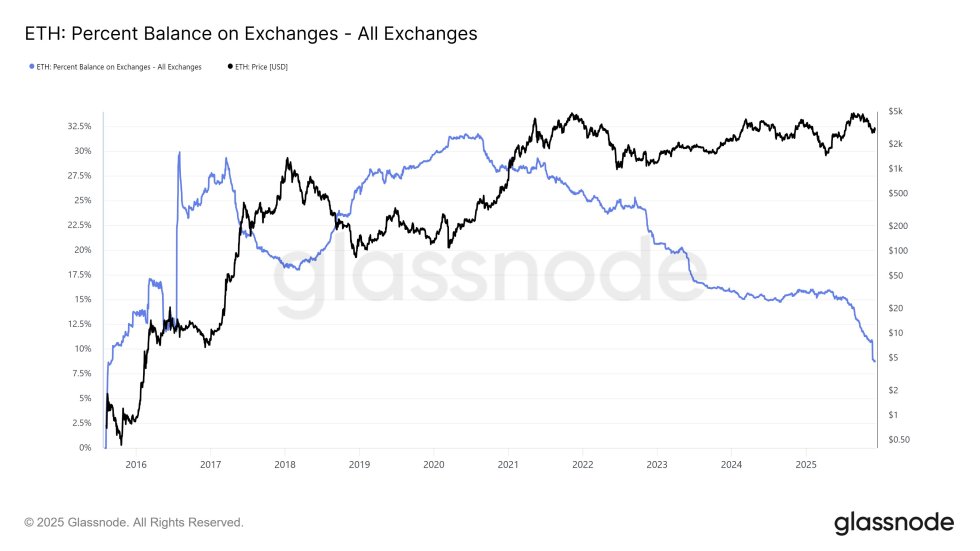
ETH on exchanges falls to the lowest level ever | Source: Chart from Coin Bureau on X

As exchange reserves decrease, the structural pressure on ETH’s circulating supply is increasing, which could create a scenario for a more explosive price environment. Coin Bureau stated that several crypto analysts are currently warning that tightening liquidity might trigger a robust rally when demand recovers.

Mid-Size Whale Holders Are Still Existing In The Market

Despite a sharp withdrawal of ETH from exchanges, selling pressure still remains in the market as indicated by the Ethereum Accumulation Heatmap. After examining the metric, Alphractal, an advanced investment and on-chain data analytics platform, uncovered that wallet addresses holding 1,000 ETH to 10,000 ETH, or mid-size whales, are offloading their holdings, signaling weakening sentiment among the group due to ongoing market fluctuations.

According to the metric, these investors carried out heavy distribution just near the price top. The cohort was the one who took advantage of the euphoria to secure profits while others were celebrating at the all-time high.

What’s interesting is that these investors are still selling, mounting heavy bearish pressure on the market, which is likely fueling the current bearish wave. Meanwhile, wallet addresses holding at least 10,000 ETH or mega whale holders continue to be considerably more neutral, with relatively light distribution, demonstrating no panic, no aggressive buying, at least not yet.

Such a trend suggests that supply behavior is not completely aligned with the euphoria of retail investors. These accumulation and distribution patterns are vital to gauge those who are actually driving ETH’s price moves. It also determines those who are quietly heading for the exit, while others are still entering.

At the time of writing, the price of ETH was trading at $3,135, demonstrating a more than 3% rise in the last 24 hours. Bullish sentiment seems to be returning strongly, as evidenced by an over 142% increase in trading volume over the past day.


ETH trading at $3,132 on the 1D chart | Source: ETHUSDT on Tradingview.com

Related Reads

Retail Investors Are Leaving, What Will Drive the Next Bull Market?

A significant market correction has seen Bitcoin drop 28.57% from $126,000 to $90,000, causing panic, liquidity drying up, and widespread deleveraging. However, structural positives are emerging: the U.S. SEC plans an "Innovation Exemption" in January 2026 to ease compliance, and the Federal Reserve is expected to end quantitative tightening and begin rate cuts, potentially boosting risk assets. The previous retail and leverage-driven bull cycle is unlikely to repeat. While over 200 companies hold $115 billion in crypto via Digital Asset Treasury (DAT) strategies, this represents less than 5% of the crypto market and is insufficient to fuel the next bull run. Instead, three key institutional pipelines are being established: 1. **Institutional Entry via ETFs and Infrastructure**: Global Bitcoin and Ethereum ETFs provide a standardized investment channel. Improved custody and settlement solutions (e.g., from BNY Mellon, Anchorage Digital) enable efficient capital deployment. Pension funds and sovereign wealth funds may soon allocate 1-3% to crypto, potentially moving trillions of dollars. 2. **Real World Assets (RWA) Tokenization**: Tokenizing traditional assets (bonds, real estate) onto blockchains could grow the RWA market from $309 billion today to $4-30 trillion by 2030. Protocols like MakerDAO using U.S. Treasuries as collateral bridge DeFi with traditional finance, offering stable yields and reducing volatility. 3. **Infrastructure Upgrades**: Layer 2 solutions reduce transaction costs and times, crucial for institutional scale. Stablecoins, with a $1.66 trillion market cap and $4 trillion in on-chain volume, have become pillars for cross-border payments and liquidity, especially as regulators mandate full reserve backing. Short-term, Fed policy and SEC rules may drive a speculative rebound in early 2026. Medium-term, gradual institutional capital will provide stability. Long-term, RWA integration could structurally anchor crypto to global finance, enabling sustainable, trillion-dollar growth. The market's evolution from speculation to infrastructure marks its path to maturity.

marsbitHace 32 min(s)

Retail Investors Are Leaving, What Will Drive the Next Bull Market?

marsbitHace 32 min(s)

Trading

Spot
Futures
活动图片