Ethereum Nearing A Turning Point? Supply-Demand Structure Suggest A Shift Is Coming In 2026

bitcoinistPublicado a 2025-12-31Actualizado a 2025-12-31

Resumen

Ethereum is struggling to reclaim the $3,000 level amid persistent selling pressure and weak market sentiment. According to a CryptoQuant report, ETH is in a late-stage bearish phase, transitioning toward range-bound trading with slower, more methodical distribution rather than panic selling. Despite price weakness, on-chain data shows improvement: ETH is leaving exchanges at the fastest pace this cycle, likely due to increased staking and long-term holding. The validator queue now has more ETH waiting to enter staking than to exit, indicating tightening medium-to-long-term supply. While ETF flows remain negative, network activity is resilient, with record smart contract deployments and growing real-world asset value on-chain. The data suggests ongoing price pressure but gradual structural improvement, with a potential shift expected by 2026.

Ethereum is once again struggling to regain the $3,000 level, highlighting the fragile state of the market as selling pressure continues to weigh on price action. After multiple failed attempts to push higher, ETH remains locked below key resistance, reflecting broad uncertainty and a lack of conviction among both traders and long-term investors.

Market sentiment has deteriorated sharply, with apathy and fear dominating positioning as participants remain hesitant to deploy fresh capital. Rather than aggressive capitulation, the current environment points to exhaustion and indecision, a common feature of late-cycle corrective phases.

According to a recent report by XWIN Research Japan on CryptoQuant, Ethereum is now in a late-stage bearish phase that appears to be transitioning into a more range-bound structure. While bearish pressure still dominates the broader trend, the nature of selling activity is changing.

Instead of sharp, panic-driven sell-offs, the market is experiencing slower, more methodical distribution, suggesting that many weak hands may have already exited. This shift often marks a critical inflection point, where volatility compresses, and price stabilizes within a defined range.

Ethereum’s On-Chain Structure Improves As Price Weakness Persists

While Ethereum continues to struggle below key resistance levels, on-chain indicators suggest that the underlying market structure may be gradually improving. Data shows ETH leaving exchanges at the fastest pace of this cycle, a move increasingly associated with self-custody, staking, and long-term holding rather than short-term trading activity.

This shift is reinforced by validator queue dynamics: for the first time in six months, the entry queue has surpassed the exit queue, with roughly 745,000 ETH waiting to be staked versus around 360,000 ETH queued for withdrawal. The imbalance points to renewed staking participation and a tightening medium- to long-term supply profile.

Additional context comes from the 90-day Spot Taker CVD, which indicates a transition away from strongly sell-dominant conditions toward neutral to mildly positive pressure. Although this does not imply an immediate price rebound, it suggests that aggressive selling is beginning to lose intensity.
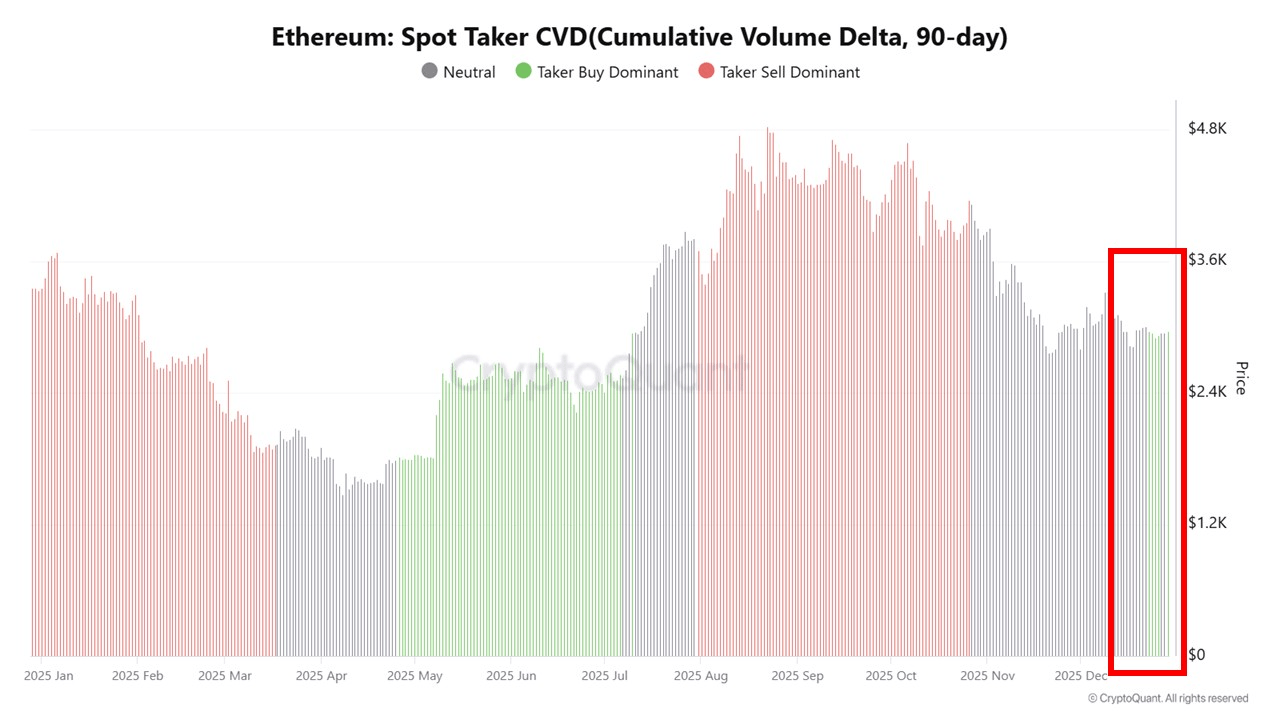
Ethereum Spot Taker CVD | Source: CryptoQuant

That said, Ethereum ETF flows remain negative on both daily and weekly timeframes, signaling that institutional demand via financial products continues to weigh on price action.

Beyond market flows, Ethereum’s network activity remains resilient. Deployed smart contracts reached a record 8.7 million in Q4 2025, while on-chain real-world asset value expanded to approximately $19 billion, led by Ethereum. These trends indicate that usage-driven demand remains intact despite weak sentiment.

The data support a scenario of ongoing price pressure alongside gradual structural improvement. This assessment would weaken if exchange balances rise again or sell-side flows regain dominance.


Criptos en tendencia

Preguntas relacionadas

QWhat is the current market sentiment for Ethereum according to the article?

AMarket sentiment has deteriorated sharply, with apathy and fear dominating positioning as participants remain hesitant to deploy fresh capital.

QWhich research firm's report is cited in the article, and what phase does it say Ethereum is in?

AThe report is by XWIN Research Japan on CryptoQuant, and it states that Ethereum is in a late-stage bearish phase that appears to be transitioning into a more range-bound structure.

QWhat on-chain data suggests an improvement in Ethereum's underlying market structure despite price weakness?

AData shows ETH leaving exchanges at the fastest pace of this cycle, and the validator entry queue has surpassed the exit queue for the first time in six months, indicating a shift toward self-custody, staking, and long-term holding.

QWhat does the 90-day Spot Taker CVD indicate about the current selling pressure?

AThe 90-day Spot Taker CVD indicates a transition away from strongly sell-dominant conditions toward neutral to mildly positive pressure, suggesting that aggressive selling is beginning to lose intensity.

QWhat two metrics are provided as evidence that Ethereum's network activity remains resilient?

ADeployed smart contracts reached a record 8.7 million in Q4 2025, and on-chain real-world asset value expanded to approximately $19 billion, led by Ethereum.

Lecturas Relacionadas

Ripple MiCA Authorization Opens A Wider European Payments Lane

Ripple has obtained full MiCA (Markets in Crypto-Assets) authorization in Europe. This regulatory approval provides a clearer path for Ripple's corporate payment entity to offer crypto-enabled payment services across the European Union and European Economic Area. It is important to note that this authorization specifically applies to Ripple's business operations under MiCA, not a blanket endorsement of XRP trading itself. The authorization is significant for Ripple's strategy, as the unified MiCA framework simplifies scaling across Europe for compliant firms. This regulatory clarity can facilitate partnerships with banks, payment providers, and institutional clients by addressing compliance concerns. While the development supports the broader XRP narrative by reducing regulatory uncertainty for Ripple's core payments business, it does not directly translate to regulatory approval for XRP as an investment product. The true impact on XRP will depend on whether this regulatory milestone leads to increased adoption, new client partnerships, and greater payment volume in European corridors. The approval reflects a broader trend where crypto firms are seeking regulatory footing in Europe due to MiCA's comprehensive rulebook, contrasting with the uncertain regulatory landscape in the United States. Ultimately, the license is a permission to operate; its success hinges on Ripple's ability to convert this regulatory advantage into tangible business growth and adoption.

bitcoinistHace 3 min(s)

Ripple MiCA Authorization Opens A Wider European Payments Lane

bitcoinistHace 3 min(s)

Trading

Spot

Artículos destacados

Cómo comprar O

¡Bienvenido a HTX.com! Hemos hecho que comprar O1 exchange (O) sea simple y conveniente. Sigue nuestra guía paso a paso para iniciar tu viaje de criptos.Paso 1: crea tu cuenta HTXUtiliza tu correo electrónico o número de teléfono para registrarte y obtener una cuenta gratuita en HTX. Experimenta un proceso de registro sin complicaciones y desbloquea todas las funciones.Obtener mi cuentaPaso 2: ve a Comprar cripto y elige tu método de pagoTarjeta de crédito/débito: usa tu Visa o Mastercard para comprar O1 exchange (O) al instante.Saldo: utiliza fondos del saldo de tu cuenta HTX para tradear sin problemas.Terceros: hemos agregado métodos de pago populares como Google Pay y Apple Pay para mejorar la comodidad.P2P: tradear directamente con otros usuarios en HTX.Over-the-Counter (OTC): ofrecemos servicios personalizados y tipos de cambio competitivos para los traders.Paso 3: guarda tu O1 exchange (O)Después de comprar tu O1 exchange (O), guárdalo en tu cuenta HTX. Alternativamente, puedes enviarlo a otro lugar mediante transferencia blockchain o utilizarlo para tradear otras criptomonedas.Paso 4: tradear O1 exchange (O)Tradear fácilmente con O1 exchange (O) en HTX's mercado spot. Simplemente accede a tu cuenta, selecciona tu par de trading, ejecuta tus trades y monitorea en tiempo real. Ofrecemos una experiencia fácil de usar tanto para principiantes como para traders experimentados.

126 Vistas totalesPublicado en 2026.06.19Actualizado en 2026.06.29

Cómo comprar O

Cómo comprar PROS

¡Bienvenido a HTX.com! Hemos hecho que comprar Pharos (PROS) sea simple y conveniente. Sigue nuestra guía paso a paso para iniciar tu viaje de criptos.Paso 1: crea tu cuenta HTXUtiliza tu correo electrónico o número de teléfono para registrarte y obtener una cuenta gratuita en HTX. Experimenta un proceso de registro sin complicaciones y desbloquea todas las funciones.Obtener mi cuentaPaso 2: ve a Comprar cripto y elige tu método de pagoTarjeta de crédito/débito: usa tu Visa o Mastercard para comprar Pharos (PROS) al instante.Saldo: utiliza fondos del saldo de tu cuenta HTX para tradear sin problemas.Terceros: hemos agregado métodos de pago populares como Google Pay y Apple Pay para mejorar la comodidad.P2P: tradear directamente con otros usuarios en HTX.Over-the-Counter (OTC): ofrecemos servicios personalizados y tipos de cambio competitivos para los traders.Paso 3: guarda tu Pharos (PROS)Después de comprar tu Pharos (PROS), guárdalo en tu cuenta HTX. Alternativamente, puedes enviarlo a otro lugar mediante transferencia blockchain o utilizarlo para tradear otras criptomonedas.Paso 4: tradear Pharos (PROS)Tradear fácilmente con Pharos (PROS) en HTX's mercado spot. Simplemente accede a tu cuenta, selecciona tu par de trading, ejecuta tus trades y monitorea en tiempo real. Ofrecemos una experiencia fácil de usar tanto para principiantes como para traders experimentados.

146 Vistas totalesPublicado en 2026.06.22Actualizado en 2026.06.29

Cómo comprar PROS

Qué es VERONA

I. Introducción al Proyecto VERONA es una blockchain construida para todos, en todas partes a través de la abstracción de cadenas. Utilizando su capa de Abstracción Generalizada, VERONA se distingue por integrar funcionalidades complejas de blockchain, como cuentas, firmas e interoperabilidad, directamente a nivel de protocolo. Este enfoque permite interactuar con aplicaciones de blockchain sin necesidad de entender las tecnologías subyacentes.1) Información Básica Nombre: VERONA (VERONA)III. Enlaces Relacionados Enlace al sitio web oficial: https://xion.burnt.com/ Libro Blanco: https://xion.burnt.com/whitepaper.pdf Exploradores: https://explorer.burnt.com/ Redes Sociales: https://x.com/burnt_xion Nota: La introducción del proyecto proviene de los materiales publicados o proporcionados por el equipo oficial del proyecto, que es solo para referencia y no constituye asesoramiento de inversión. HTX no se hace responsable de ninguna pérdida directa o indirecta resultante.

171 Vistas totalesPublicado en 2026.06.22Actualizado en 2026.06.22

Qué es VERONA

Discusiones

Bienvenido a la comunidad de HTX. Aquí puedes mantenerte informado sobre los últimos desarrollos de la plataforma y acceder a análisis profesionales del mercado. A continuación se presentan las opiniones de los usuarios sobre el precio de A (A).

活动图片