Ethereum falls to $1.7K – Will a $153 mln whale push help ETH bounce back?

ambcryptoPublicado a 2026-07-14Actualizado a 2026-07-14

Resumen

Ethereum (ETH) price has declined to around $1,748 after failing to hold the $1.8k level. Despite this market weakness, on-chain data reveals significant accumulation by large investors, or "whales." Four whale entities have collectively purchased approximately 87,083 ETH, worth about $153.8 million, withdrawing assets from major exchanges like Coinbase Prime and Gemini. One whale staked a large portion of its holdings. This activity has contributed to a decline in the Exchange Supply Ratio to a multi-year low of 0.129, indicating assets are moving off exchanges, which can reduce available supply and potentially increase scarcity. However, this substantial whale demand has not yet translated into stronger price momentum for ETH. Technical indicators, such as the Stochastic Momentum Index (SMI), show a bearish crossover, suggesting the current trend remains weak. If this persists, ETH could test support levels near $1,710 or $1,681. For a sustained price recovery, Ethereum would need to reclaim and hold above the $1,847 resistance level to shift momentum positively.

After failing to hold $1.8k, Ethereum [ETH] has continued to hover around $1.7k. As of this writing, ETH traded at $1748, after rising slightly by 0.68% on the daily charts.

Interestingly, this market pullback has created a perfect buying opportunity, especially for high-net-worth investors.

Ethereum whales are aggressively accumulating

Amid extended sideways movement, whales have continued to accumulate. According to Onchain Lens, a whale withdrew 30.01K ETH, worth $52.84M, from Coinbase Prime to a new wallet.

Lookonchain reported two more accumulating whales. According to the monitor, a newly created wallet withdrew 8,239 ETH, worth $14.5 million, from multiple exchanges.

The other whale purchased 11,843 ETH worth $20.8 million. These two whales accumulated 20,082 ETH worth $35.3 million.
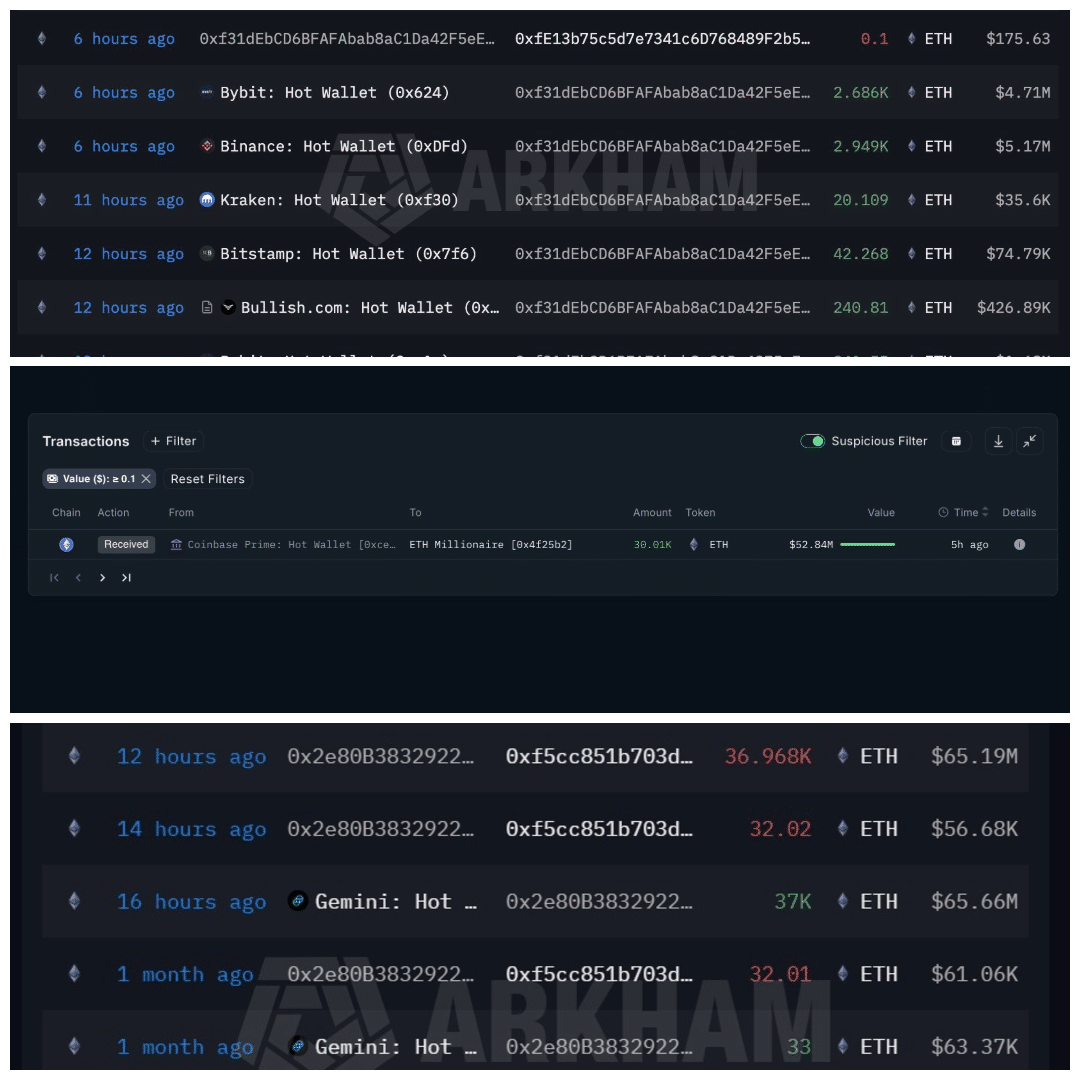
Source: Arkham

Finally, a wallet withdrew 37,000 ETH, worth $65.66 million, from Gemini and then staked it in batches to the Eth2 Beacon Chain.

In total, these four whales purchased 87,083 ETH worth $153.8 million. Whales aggressively piling in during this period of market weakness signals confidence in market prospects.

Furthermore, exchange activity has echoed this whale accumulation spree. In fact, whales have significantly absorbed the available supply on CEXs.

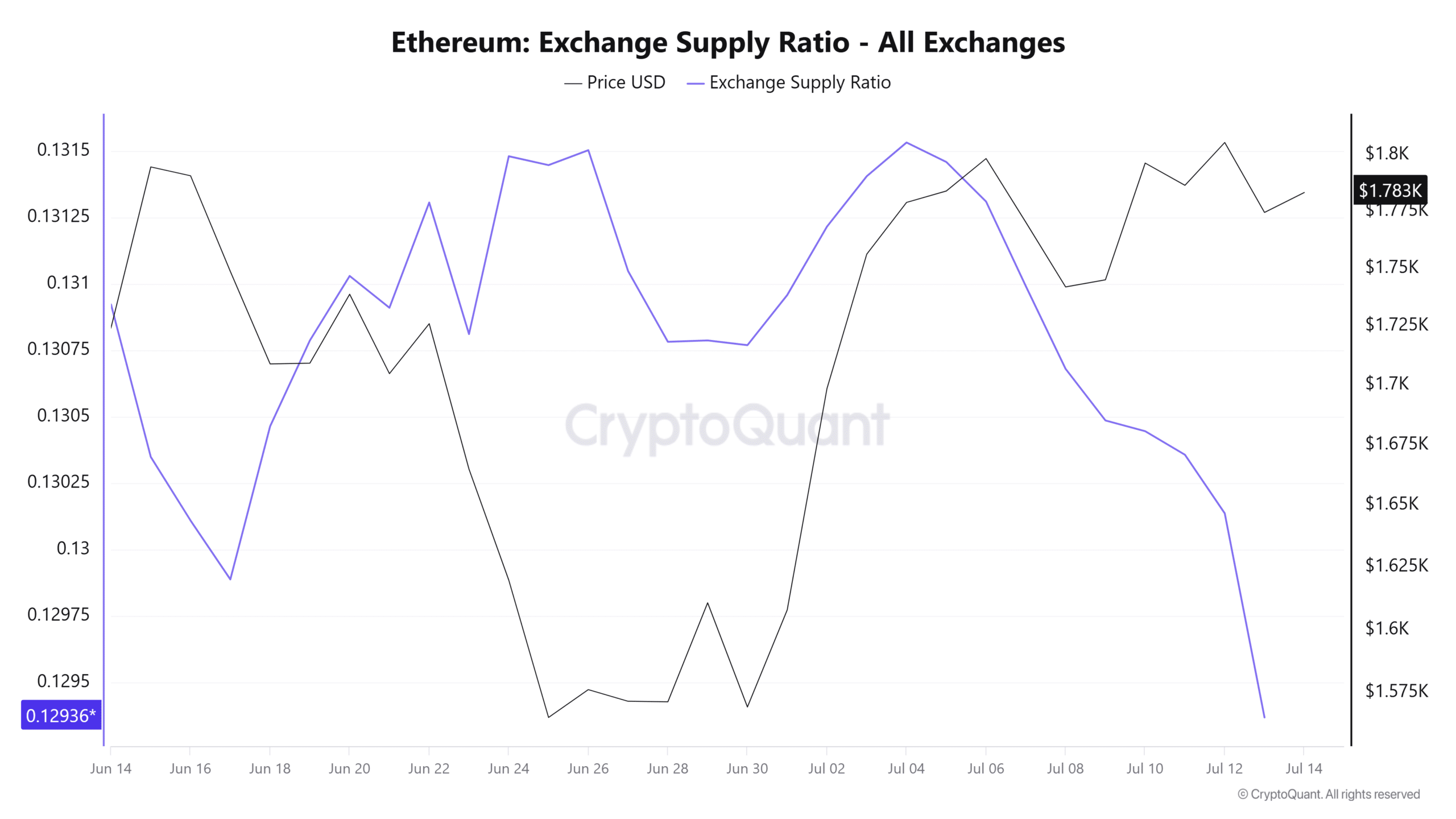
Meanwhile, the Exchange Supply Ratio dropped back to the 2016 level of 0.129 at press time.
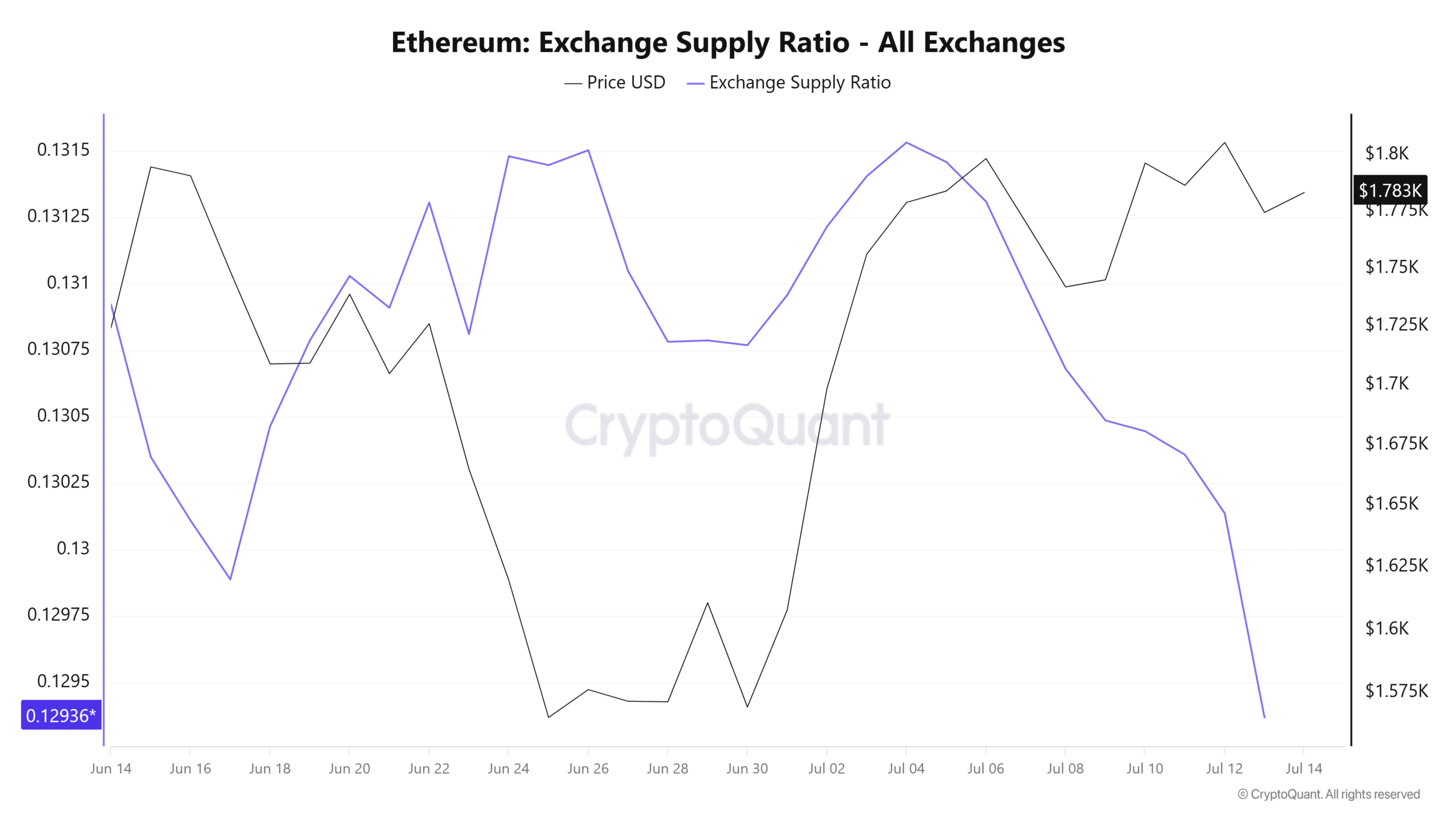
Source: CryptoQuant

When the ESR drops to such low levels, it implies that more assets have flowed out of exchanges than into them.

Often, such market activity reduces supply while increasing scarcity. Rising scarcity has historically preceded stronger upside price movement.

Is the demand adequate to boost ETH price action?

Interestingly, although demand has recovered significantly, largely driven by whales, ETH has not yet reflected this on its price charts.

As such, the altcoin’s momentum has remained relatively weak. For instance, when we look at the Stochastic Momentum Index (SMI), it formed a bearish crossover and fell to 37.
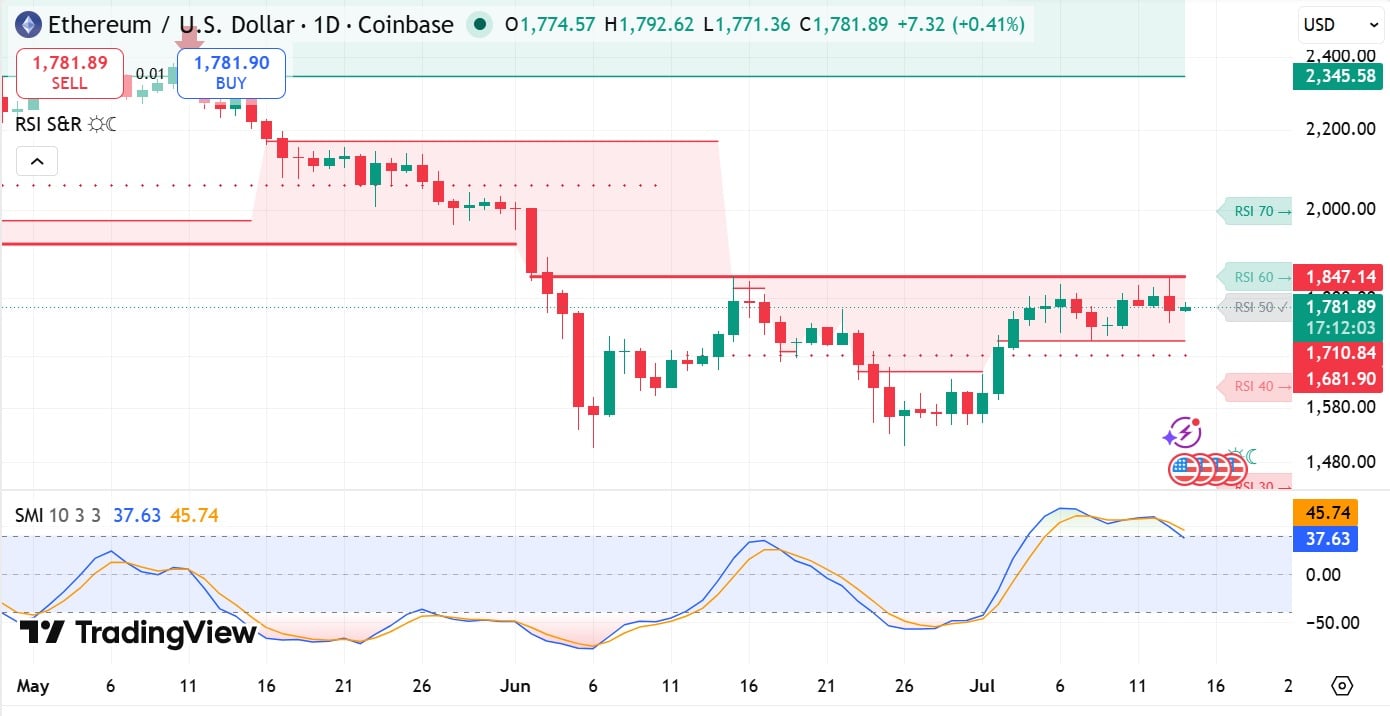
Source: TradingView

A bearish move here suggested the trend has weakened significantly. Thus, current whale demand has proved insufficient to inspire a move higher.

With the trend holding in this manner, it points to extended market weakness for Ethereum. Thus, if the prevailing trend continues, ETH could drop to the bearish threshold at $1710, with RSI rebounding at $1681 as critical support.

However, if the whale accumulation finally materializes and the market starts to feel the impact, we could see a major upswing. For an upside move, Ethereum must reclaim the RSI breakdown at $1847, which will strengthen the altcoin’s upward momentum.


Final Summary

  • Ethereum whales are aggressively accumulating, adding 87,083 ETH worth $153.8 million.
  • Despite the recovering whale demand, ETH remains structurally weak and risks another slip.

Criptos en tendencia

Lecturas Relacionadas

Dialogue with Jia Hang | Looking Back at Two Decades of Chinese Payment Going Global

**Summary: A Conversation with Jia Hang on Two Decades of China's Payment Globalization** Jia Hang, a veteran with over twenty years in payments, reflects on China's attempts to build a global payment network through three key phases: UnionPay (card networks), Alipay+ (digital wallets), and now, stablecoins. His journey began at UnionPay International, aiming to establish China's card network abroad. While successful in following Chinese tourists ("where Chinese go, UnionPay goes"), it struggled to achieve true global scale. The core lesson: card networks like Visa/Mastercard's unassailable advantage isn't just technical standards, but their deeply entrenched **governance and profit-sharing models** that create powerful network effects. Competing as the "same species" is nearly impossible. At Ant Group, he led Alipay+, a strategy to bypass card networks by interconnecting local e-wallets worldwide. While innovative, it faced a similar ceiling. Mobile QR payments and card swipes were essentially **the same species competing for the same pie**, lacking a disruptive value proposition for users or a sustainable new incentive model to replace the card networks' established flywheel. Today, at Singapore's DCS, Jia focuses on stablecoin-based payments. He argues stablecoins represent a fundamental shift. They are not competing with Visa for consumer payments but challenging the **traditional banking and account system for value movement**. Products like "U Cards" (stablecoin-linked payment cards) are transitional, leveraging existing card networks for acceptance while building new rails. The real potential lies in stablecoins enabling seamless, low-cost global value transfer, potentially reorganizing the financial infrastructure around **accounts rather than cards**. Jia believes stablecoin adoption for local retail payments, cross-border transactions, and as high-yield savings vehicles is becoming irreversible. This could gradually reduce reliance on traditional fiat channels, especially in regions with weak currencies or capital controls. The quest for the "next global payment network" continues, now centered on whether stablecoins can successfully bridge Web2 and Web3, establish new governance, and create compelling user value beyond mere cost reduction.

marsbitHace 18 min(s)

Dialogue with Jia Hang | Looking Back at Two Decades of Chinese Payment Going Global

marsbitHace 18 min(s)

Circle's Stock Price Plunges 76%, Hong Kong Dollar Stablecoin Set to Launch Within Two Weeks

Circle's stock price has plunged approximately 76% from its 2023 peak, reflecting a major market revaluation. Despite this, Circle President Heath Tarbert emphasized the company's focus on long-term execution and its dominant position with USDC's $73 billion circulation across 34 blockchains. The competitive landscape is intensifying. A new consortium-backed stablecoin, Open USD, is attempting to challenge incumbents by sharing reserve yields with partners. More significantly, Visa's new stablecoin platform, initially supporting Open USD while also being compatible with USDC, could erode Circle's network effects. In response, Circle is expanding into real-world payments through partnerships like the one with Japan's JCB. Separately, Tether (USDT) faces a two-year compliance window under new U.S. regulations, requiring it to adjust its reserve composition away from assets like Bitcoin and loans towards cash and U.S. Treasuries. Meanwhile, in Hong Kong, Standard Chartered-backed fintech firm Dian Dian is poised to launch a licensed HKD-pegged stablecoin (HKDAP), moving the industry into a phase where the real test is integrating licensed stablecoins into actual payment flows and corporate treasury systems. The sharp decline in Circle's stock underscores a broader shift: the stablecoin market is moving from a winner-takes-all dynamic to a multi-player competitive arena where execution, compliance, and real-world utility are becoming paramount.

marsbitHace 19 min(s)

Circle's Stock Price Plunges 76%, Hong Kong Dollar Stablecoin Set to Launch Within Two Weeks

marsbitHace 19 min(s)

Amidst Capital's Encirclement, Decentralization is the Sole Defense for Public Blockchains

In a landscape dominated by power and profit motives, the author argues that decentralization is not merely one desirable feature among many in blockchain design—it is the singular, non-negotiable defense against corporate and capital capture. The article adopts a Machiavellian, realist perspective on human institutions, positing that businesses will inevitably attempt to co-opt any valuable network to protect their profits and dominance. While external attacks like 51% forks are often discussed, the greater existential risk is internal capture—the gradual erosion of a protocol’s neutrality by vested interests, as seen historically with platforms like Visa and Google. The piece critiques permissioned chains, highly centralized “permissionless” layer-1s, and layer-2s without sufficient decentralization (e.g., single sequencers) as inherently vulnerable. These compromised systems, promoted by established financial players, are framed as delaying tactics to stifle truly open networks that threaten existing high-fee, inefficient business models. Real-world examples, such as closed enterprise consortiums that exclude competitors, illustrate how such systems cement oligopolies rather than foster innovation. The author concludes that while decentralized protocols like Ethereum are imperfect and costly to operate, they represent the only viable long-term equilibrium. In a market where value naturally flows to the most secure and neutral settlement layer, only maximally decentralized public blockchains can resist being subsumed by capital and powerful incumbents.

Foresight NewsHace 29 min(s)

Amidst Capital's Encirclement, Decentralization is the Sole Defense for Public Blockchains

Foresight NewsHace 29 min(s)

Trading

Spot

Artículos destacados

Cómo comprar PUSH

¡Bienvenido a HTX.com! Hemos hecho que comprar Push Protocol (PUSH) sea simple y conveniente. Sigue nuestra guía paso a paso para iniciar tu viaje de criptos.Paso 1: crea tu cuenta HTXUtiliza tu correo electrónico o número de teléfono para registrarte y obtener una cuenta gratuita en HTX. Experimenta un proceso de registro sin complicaciones y desbloquea todas las funciones.Obtener mi cuentaPaso 2: ve a Comprar cripto y elige tu método de pagoTarjeta de crédito/débito: usa tu Visa o Mastercard para comprar Push Protocol (PUSH) al instante.Saldo: utiliza fondos del saldo de tu cuenta HTX para tradear sin problemas.Terceros: hemos agregado métodos de pago populares como Google Pay y Apple Pay para mejorar la comodidad.P2P: tradear directamente con otros usuarios en HTX.Over-the-Counter (OTC): ofrecemos servicios personalizados y tipos de cambio competitivos para los traders.Paso 3: guarda tu Push Protocol (PUSH)Después de comprar tu Push Protocol (PUSH), guárdalo en tu cuenta HTX. Alternativamente, puedes enviarlo a otro lugar mediante transferencia blockchain o utilizarlo para tradear otras criptomonedas.Paso 4: tradear Push Protocol (PUSH)Tradear fácilmente con Push Protocol (PUSH) en HTX's mercado spot. Simplemente accede a tu cuenta, selecciona tu par de trading, ejecuta tus trades y monitorea en tiempo real. Ofrecemos una experiencia fácil de usar tanto para principiantes como para traders experimentados.

238 Vistas totalesPublicado en 2024.12.13Actualizado en 2026.06.02

Cómo comprar PUSH

Discusiones

Bienvenido a la comunidad de HTX. Aquí puedes mantenerte informado sobre los últimos desarrollos de la plataforma y acceder a análisis profesionales del mercado. A continuación se presentan las opiniones de los usuarios sobre el precio de PUSH (PUSH).

活动图片