Ethereum Completes Another Key Technical Advancement, Can It Achieve a Leap Forward by 2026?

marsbitPublicado a 2025-12-22Actualizado a 2025-12-22

Resumen

The Ethereum Foundation (EF) has announced a major technical breakthrough in zkEVM development, achieving a dramatic reduction in block proof generation time—from 16 minutes to just 16 seconds—with a 45-fold decrease in cost. Certain zkVMs can now prove 99% of mainnet blocks in under 10 seconds on target hardware. However, EF emphasizes that raw speed is meaningless without proven security. Several mathematical conjectures underlying popular STARK-based zkEVMs have recently been disproven, reducing their security guarantees. The core focus has now shifted from throughput to provable safety, with L1 zkEVMs required to meet a 128-bit security standard to prevent risks like token forgery or state corruption. EF released a three-phase roadmap aiming for full compliance by December 2026: 1. By end-February 2026, all zkEVM teams must integrate with EF’s soundcalc security tool. 2. By end-May, achieve intermediate goals like 100-bit provable security. 3. By end-December, reach 128-bit provable security with formal verification of recursive proof systems. Key technologies like WHIR and JaggedPCS are being deployed to improve efficiency. Challenges remain, including on-chain implementation, dynamic security parameter adjustments, and uneven progress among teams. Once achieved, secure zkEVMs could allow Ethereum to increase gas limits safely, enhance L1 capacity, and blur the lines between L1 and L2 execution. The race for reliability is now the central theme for Ethereum in 2026.

The zkEVM ecosystem has achieved a performance leap after a year of intensive efforts, reducing Ethereum block proof time from 16 minutes to 16 seconds, with a cost reduction of 45 times. Participating zkVMs can now complete proofs for 99% of mainnet blocks within 10 seconds on target hardware.

On December 18, the Ethereum Foundation (EF) announced the implementation of a real-time proof mechanism and the elimination of performance bottlenecks. However, it emphasized that the real challenge lies in reliability, as speed without security support becomes a burden. Additionally, several zkEVMs based on STARK algorithms have had their underlying mathematical conjectures disproven in recent months, leading to a reduction in security levels.

Previously, in July, EF set comprehensive real-time proof goals covering multiple dimensions such as latency, hardware, and security. These have now been met through the EthProofs benchmark tests.

The core shift is from pursuing throughput to prioritizing provable security, clearly stating that L1-level zkEVMs must achieve a 128-bit security standard, aligning with mainstream cryptographic norms. This is because forged proofs could lead to critical risks such as token counterfeiting and L1 state tampering, making security margins non-negotiable.

EF simultaneously unveiled a three-phase security roadmap:

  1. By the end of February 2026, all zkEVM teams must integrate their proof systems with EF's soundcalc security assessment tool to standardize security calculations;
  2. Achieve the Glamsterdam standard by the end of May, meeting interim goals like 100-bit provable security;
  3. Complete the H-star final goal by the end of December, achieving 128-bit provable security and providing formal security arguments for recursive topological structures.

To meet these goals, EF mentioned key technical tools like WHIR and JaggedPCS, which can improve efficiency by optimizing proof generation and avoiding computational waste, while techniques like recursive topologies help reduce proof size.

However, multiple challenges remain: real-time proofs have not yet been implemented on-chain, leaving actual validator performance in question; security parameters need dynamic adjustment as mathematical conjectures are disproven; it is uncertain if all teams can meet deadlines; and formal verification projects for recursive architectures are still in early stages, with uneven ecosystem development.

Notably, compliant zkEVMs could enable Ethereum to increase the Gas limit, enhancing block capacity while ensuring staking feasibility, promoting L1 as a trusted settlement layer, and blurring the boundaries between L2 and L1 execution.

With the performance sprint concluded, the core focus of the zkEVM ecosystem has shifted to achieving sufficiently reliable security proofs without relying on easily disprovable conjectures, to support trillion-dollar asset scales. The security competition has now officially begun, and it will be the main theme for Ethereum in 2026.

Criptos en tendencia

Preguntas relacionadas

QWhat major technical achievement did the Ethereum Foundation announce on December 18th regarding zkEVM?

AThe Ethereum Foundation announced the implementation of a real-time proof mechanism and the elimination of performance bottlenecks, reducing block proof time from 16 minutes to 16 seconds and cutting costs by 45 times.

QWhat is the core shift in focus for zkEVM development according to the Ethereum Foundation?

AThe core shift is from pursuing throughput to prioritizing provable security, requiring L1-level zkEVMs to achieve a 128-bit security standard to prevent risks like token forgery and L1 state tampering.

QWhat are the three phases of the security roadmap set by the Ethereum Foundation for zkEVM teams?

A1. By February 2026, all zkEVM teams must integrate their proof systems with EF's soundcalc security assessment tool. 2. By May 2026, achieve the Glamsterdam standard with 100-bit provable security. 3. By December 2026, complete the H-star goal with 128-bit provable security and formal security arguments for recursive topology structures.

QWhat challenges remain for zkEVM despite the performance improvements?

AChallenges include real-time proofs not yet being on-chain, security parameters needing dynamic adjustments due to disproven mathematical conjectures, uncertainty about teams meeting deadlines, and early-stage formal verification for recursive architectures.

QHow could achieving the security goals for zkEVM benefit Ethereum's future?

AIt could enable Ethereum to increase Gas limits, enhance block capacity while ensuring staking feasibility, solidify L1 as a trusted settlement layer, and blur the boundaries between L2 and L1 execution.

Lecturas Relacionadas

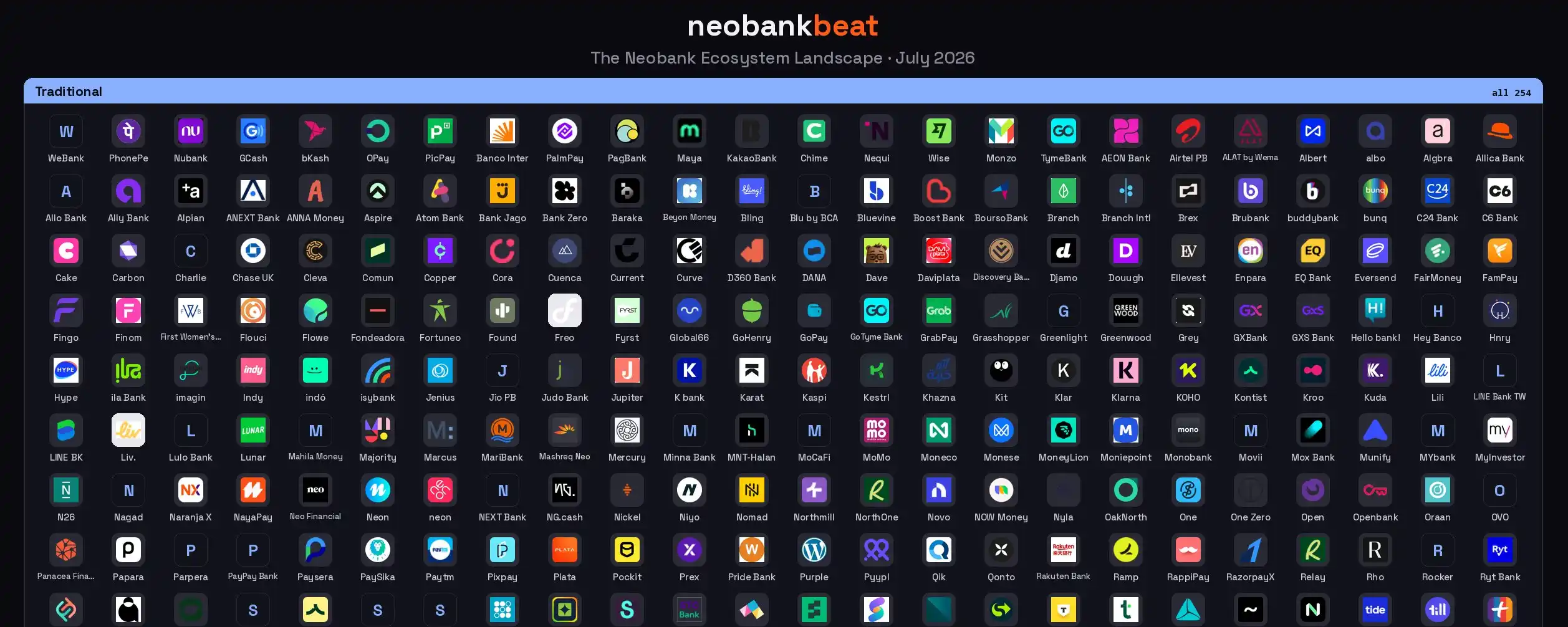
The Truth Behind Digital Banking: The Fragile Ecosystem Supporting 1.46 Billion Users

The article "The Truth About Digital Banks: The Fragile Ecosystem Behind 1.46 Billion Users" provides a data-driven analysis of the digital banking sector based on a verified list of 368 active neobanks as of July 2026. While these platforms collectively serve 1.46 billion users, with Asia (817 million users) and institutions like WeBank and Nubank dominating the landscape, the sector faces significant structural vulnerabilities. A key finding is that only 127 of the 368 neobanks hold full banking licenses. The majority operate atop third-party infrastructure providers like Banking-as-a-Service (BaaS) platforms, creating systemic risk where the failure of a single provider, as seen in past cases like Wirecard and Synapse, can jeopardize multiple consumer brands. Furthermore, the industry experiences a steady, quiet stream of failures, mergers, and shutdowns that often go unreported. The analysis also examines the adoption of artificial intelligence (AI), finding only 67 platforms (18%) have deployed AI at scale, with many innovators based in emerging markets like Nigeria and the Philippines. The infrastructure layer is highly concentrated, with 106 providers supporting the entire ecosystem of 368 consumer-facing brands. The article concludes with three predictions: the unlicensed gap will close through acquisitions or exits; an AI credit model is likely to fail in the next economic downturn; and a nascent but significant trend is the emergence of financial services designed for AI agents rather than humans.

marsbitHace 14 min(s)

The Truth Behind Digital Banking: The Fragile Ecosystem Supporting 1.46 Billion Users

marsbitHace 14 min(s)

Digital Asset Trading Platform Uphold Cuts 17% of Global Workforce Amid 'Crypto Winter'

Cryptocurrency trading platform Uphold has laid off approximately 17% of its global workforce, affecting 85 full-time employees and contractors. The cuts are part of a strategic shift to reallocate resources towards its rapidly growing corporate services business, as retail cryptocurrency trading activity has declined amid the ongoing market downturn. CEO Simon McLaughlin stated the company is restructuring after years of significant growth and remains confident in the long-term prospects of digital assets and blockchain technology. Founded in 2015, Uphold offers trading and custody services for cryptocurrencies, fiat, stocks, and precious metals. It has recently expanded to provide infrastructure for banks, fintech firms, and broker-dealers to integrate crypto services. The layoffs occur against a backdrop of a prolonged crypto market slump, with total market capitalization falling to around $2.1 trillion by Q2 2024. Factors include weakened trading volumes, reduced retail participation, interest rate hikes, geopolitical uncertainty, and net outflows from U.S. spot Bitcoin ETFs. Uphold clarified it is not shutting down its UK operations or any international offices. The company highlighted strong growth in its corporate platform and announced plans to evolve its consumer app into a broader blockchain-based financial assistant by 2026, offering U.S. stocks, tokenized securities, lending, credit cards, and DeFi yield opportunities.

cryptonews.ruHace 14 min(s)

Digital Asset Trading Platform Uphold Cuts 17% of Global Workforce Amid 'Crypto Winter'

cryptonews.ruHace 14 min(s)

Has the Crypto Utopia Collapsed? The Industry Reaches an Inflection Point After the Frenzy Subsides

Has the crypto utopia collapsed? The industry is at an inflection point as the hype fades. The prevailing view is that crypto has become an outlet for excess liquidity, with many participants leaving as financial returns have fallen short of past-decade expectations. The 2021 boom has been revealed as an illusion, placing the industry in the "trough of disillusionment" on Gartner's Hype Cycle. This forces a return to first principles: re-evaluating token value, securing DeFi protocols, and finding real-world applications. The core failure is a repetitive cycle of reflexive speculation, driven by the premature liquidity of tokens. The industry's incentives prioritized short-term gains over genuine innovation. While curiosity drives invention, recent DeFi hacks signal a need for engineering and iteration, including token models. The culture is shifting; the industry is no longer in its early stages. Positioned at a turning point on the technology adoption curve, crypto faces the immense challenge of rebuilding finance from scratch, a process of inevitable iteration and failure. Regarding crypto VC, claims of its death are overstated. The exceptional returns of 2016-2021 were an anomaly. The initial crypto-anarchist ethos has largely been co-opted by Wall Street and regulators. The utopian vision is over; the industry is being assimilated into the existing system, becoming a business. Current viable project categories include stablecoins, prediction markets, tokenized assets/RWA, perpetual contracts, and AI/agent integration. Crypto is converging with fintech, far from the envisioned DeFi revolution, and must find killer apps within regulatory boundaries. A reconciliation is possible: cryptocurrency may change value storage and transfer in subtle, imperceptible ways that integrate into existing systems, rather than through revolutionary fanfare. True creativity often emerges from adversity. There remains much to build for those driven by genuine curiosity.

marsbitHace 29 min(s)

Has the Crypto Utopia Collapsed? The Industry Reaches an Inflection Point After the Frenzy Subsides

marsbitHace 29 min(s)

Trading

Spot

Artículos destacados

Cómo comprar O

¡Bienvenido a HTX.com! Hemos hecho que comprar O1 exchange (O) sea simple y conveniente. Sigue nuestra guía paso a paso para iniciar tu viaje de criptos.Paso 1: crea tu cuenta HTXUtiliza tu correo electrónico o número de teléfono para registrarte y obtener una cuenta gratuita en HTX. Experimenta un proceso de registro sin complicaciones y desbloquea todas las funciones.Obtener mi cuentaPaso 2: ve a Comprar cripto y elige tu método de pagoTarjeta de crédito/débito: usa tu Visa o Mastercard para comprar O1 exchange (O) al instante.Saldo: utiliza fondos del saldo de tu cuenta HTX para tradear sin problemas.Terceros: hemos agregado métodos de pago populares como Google Pay y Apple Pay para mejorar la comodidad.P2P: tradear directamente con otros usuarios en HTX.Over-the-Counter (OTC): ofrecemos servicios personalizados y tipos de cambio competitivos para los traders.Paso 3: guarda tu O1 exchange (O)Después de comprar tu O1 exchange (O), guárdalo en tu cuenta HTX. Alternativamente, puedes enviarlo a otro lugar mediante transferencia blockchain o utilizarlo para tradear otras criptomonedas.Paso 4: tradear O1 exchange (O)Tradear fácilmente con O1 exchange (O) en HTX's mercado spot. Simplemente accede a tu cuenta, selecciona tu par de trading, ejecuta tus trades y monitorea en tiempo real. Ofrecemos una experiencia fácil de usar tanto para principiantes como para traders experimentados.

248 Vistas totalesPublicado en 2026.06.19Actualizado en 2026.06.29

Cómo comprar O

Cómo comprar PROS

¡Bienvenido a HTX.com! Hemos hecho que comprar Pharos (PROS) sea simple y conveniente. Sigue nuestra guía paso a paso para iniciar tu viaje de criptos.Paso 1: crea tu cuenta HTXUtiliza tu correo electrónico o número de teléfono para registrarte y obtener una cuenta gratuita en HTX. Experimenta un proceso de registro sin complicaciones y desbloquea todas las funciones.Obtener mi cuentaPaso 2: ve a Comprar cripto y elige tu método de pagoTarjeta de crédito/débito: usa tu Visa o Mastercard para comprar Pharos (PROS) al instante.Saldo: utiliza fondos del saldo de tu cuenta HTX para tradear sin problemas.Terceros: hemos agregado métodos de pago populares como Google Pay y Apple Pay para mejorar la comodidad.P2P: tradear directamente con otros usuarios en HTX.Over-the-Counter (OTC): ofrecemos servicios personalizados y tipos de cambio competitivos para los traders.Paso 3: guarda tu Pharos (PROS)Después de comprar tu Pharos (PROS), guárdalo en tu cuenta HTX. Alternativamente, puedes enviarlo a otro lugar mediante transferencia blockchain o utilizarlo para tradear otras criptomonedas.Paso 4: tradear Pharos (PROS)Tradear fácilmente con Pharos (PROS) en HTX's mercado spot. Simplemente accede a tu cuenta, selecciona tu par de trading, ejecuta tus trades y monitorea en tiempo real. Ofrecemos una experiencia fácil de usar tanto para principiantes como para traders experimentados.

264 Vistas totalesPublicado en 2026.06.22Actualizado en 2026.06.29

Cómo comprar PROS

Qué es VERONA

I. Introducción al Proyecto VERONA es una blockchain construida para todos, en todas partes a través de la abstracción de cadenas. Utilizando su capa de Abstracción Generalizada, VERONA se distingue por integrar funcionalidades complejas de blockchain, como cuentas, firmas e interoperabilidad, directamente a nivel de protocolo. Este enfoque permite interactuar con aplicaciones de blockchain sin necesidad de entender las tecnologías subyacentes.1) Información Básica Nombre: VERONA (VERONA)III. Enlaces Relacionados Enlace al sitio web oficial: https://xion.burnt.com/ Libro Blanco: https://xion.burnt.com/whitepaper.pdf Exploradores: https://explorer.burnt.com/ Redes Sociales: https://x.com/burnt_xion Nota: La introducción del proyecto proviene de los materiales publicados o proporcionados por el equipo oficial del proyecto, que es solo para referencia y no constituye asesoramiento de inversión. HTX no se hace responsable de ninguna pérdida directa o indirecta resultante.

304 Vistas totalesPublicado en 2026.06.22Actualizado en 2026.06.22

Qué es VERONA

Discusiones

Bienvenido a la comunidad de HTX. Aquí puedes mantenerte informado sobre los últimos desarrollos de la plataforma y acceder a análisis profesionales del mercado. A continuación se presentan las opiniones de los usuarios sobre el precio de A (A).

活动图片