Ethereum: Buterin Revives ‘Milady’ For A World Computer Push

bitcoinistPublicado a 2026-01-02Actualizado a 2026-01-02

Resumen

Ethereum co-founder Vitalik Buterin marked the start of 2026 by switching his profile picture to a Milady-style avatar and publishing a post refocusing Ethereum’s mission on its original ambition: becoming a "world computer" for an open internet. He highlighted 2025 progress such as higher gas limits, improved node software, and zkEVM advancements, but emphasized that Ethereum ecosystem must prioritize its core mission over short-term trends like memecoins or transaction fee-driven incentives. Buterin defined the "world computer" as a platform for decentralized applications resistant to censorship, fraud, and third-party interference—capable of operating even if developers abandon them or centralized services fail. He stressed that scalability, usability, and genuine decentralization are non-negotiable requirements for both base and application layers. The post served as a call to action, urging the community to aggressively improve infrastructure, client diversity, and dapp resilience to fulfill Ethereum’s foundational vision.

Ethereum co-founder Vitalik Buterin rang in 2026 by switching his X profile image back to a Milady-style avatar and pairing it with a manifesto-like post that re-centers Ethereum’s identity around a single, old-school ambition: becoming “the world computer” for an open internet.

“Welcome to 2026! Milady is back,” Buterin wrote, before ticking through what he framed as Ethereum’s 2025 progress: higher gas limits, a larger blob count, better node software quality, and zkEVMs hitting major performance milestones. He also argued that “with zkEVMs and PeerDAS ethereum made its largest step toward being a fundamentally new and more powerful kind of blockchain.”

Ethereum Must Deliver The World Computer

But the post’s center of gravity wasn’t a victory lap. It was a warning that the network is still falling short of its own stated goals and that chasing whatever narrative is currently printing attention is not the point.

Buterin drew a bright line between Ethereum’s long-term mission and trend-driven incentives that often dominate crypto cycles. “Ethereum needs to do more to meet its own stated goals,” he wrote. “Not the quest of ‘winning the next meta’ regardless of whether it’s tokenized dollars or political memecoins, not arbitrarily convincing people to help us fill up blockspace to make ETH ultrasound again, but the mission: To build the world computer that serves as a central infrastructure piece of a more free and open internet.”

From there, he offered a description of what “world computer” should mean in practice: decentralized applications that can’t be quietly altered or shut off, and that remain usable even when the companies and infrastructure most users take for granted fail.

“We’re building decentralized applications. Applications that run without fraud, censorship or third-party interference,” he wrote. “Applications that pass the walkaway test: they keep running even if the original developers disappear. Applications where if you’re a user, you don’t even notice if Cloudflare goes down — or even if all of Cloudflare gets hacked by North Korea.”

Buterin extended that same set of expectations beyond finance, explicitly name-checking identity, governance, and “whatever other civilizational infrastructure people want to build,” and he emphasized privacy as a core property rather than a nice-to-have.

A notable thread in the post is that Buterin refuses to treat usability-at-scale and decentralization as a trade-off Ethereum can punt on. “To achieve this, it needs to be (i) usable, and usable at scale, and (ii) actually decentralized,” he wrote, arguing those requirements apply both to the base layer—“including the software we use to run and talk to the blockchain” and to the application layer.

That framing implicitly puts pressure on multiple constituencies at once: core protocol work, client diversity and quality, infrastructure that doesn’t centralize around a few providers, and dapp architectures that can survive developer abandonment while still meeting user expectations.

Buterin closed on a note of resolve rather than specifics, saying Ethereum has “powerful tools” but needs to apply them more aggressively. “All of these pieces must be improved — they are already being improved, but they must be improved more,” he wrote. “Fortunately, we have powerful tools on our side — but we need to apply them, and we will.”

At press time, ETH traded at $3,030.
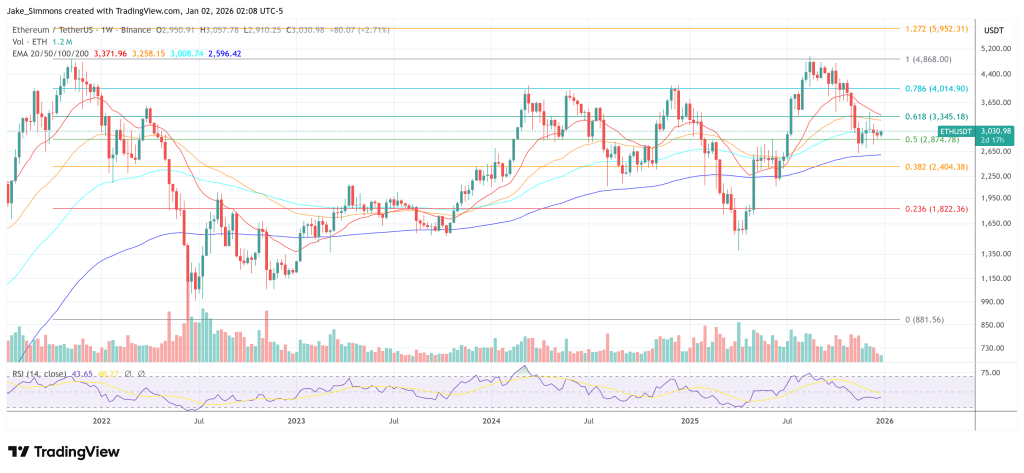
ETH holds above the 0.5 Fib, 1-week chart | Source: ETHUSDT on TradingView.com

Preguntas relacionadas

QWhat is the main ambition that Vitalik Buterin re-centers Ethereum's identity around in his 2026 post?

ABecoming 'the world computer' for an open internet.

QAccording to Buterin, what are the two key requirements Ethereum needs to meet to achieve its 'world computer' goal?

AIt needs to be (i) usable, and usable at scale, and (ii) actually decentralized.

QWhat does Buterin mean by applications that 'pass the walkaway test'?

AApplications that keep running even if the original developers disappear.

QBeyond finance, what other areas does Buterin suggest the 'world computer' infrastructure should serve?

AIdentity, governance, and 'whatever other civilizational infrastructure people want to build'.

QWhat does Buterin warn against, emphasizing it is not Ethereum's true mission?

AChasing whatever narrative is currently printing attention, such as 'winning the next meta' regardless of whether it's tokenized dollars or political memecoins, or arbitrarily convincing people to fill up blockspace to make ETH 'ultrasound' again.

Lecturas Relacionadas

How to Do Research Well: Deliberately Practice the Real Skills That Matter

No one truly teaches you how to do research. You're often given a desk, a pre-selected problem, and vague instructions to "create something new." Consequently, many people reverse-engineer the job based on visible outputs—papers, posts, announcements—learning only how to *appear* like a researcher rather than how to *become* one. True research capability is built from stacking small, trainable skills, nearly all of which can be developed through deliberate practice. **Pick Your Own Problem:** Most researchers absorb problems from advisors or trends, lacking the underlying reasoning. Choosing a problem you genuinely care about, as John Schulman advises, leads to original work. Develop "taste" like a muscle: predict experiment outcomes, guess paper results from methods, and track which findings remain important over time. **Upgrade Your Inputs:** Relying on shared reading lists (arXiv hot lists, filtered group chats) leads to unoriginal conclusions. Undervalued old literature often holds crucial insights (e.g., MoE, LSTM, backpropagation). Richard Sutton's "The Bitter Lesson" or Claude Shannon's 1952 talk on creative thinking are more predictive than lengthy modern surveys. Breadth matters as much as depth: draw from neuroscience, mechanism design, hardware knowledge, and honest statistics. Read papers directly, especially appendices and limitations sections. **Write Everything Down:** As Paul Graham noted, writing exposes flaws in seemingly mature ideas. Writing is the cheapest defense against self-deception. Following Feynman's principle, Darwin programmatically wrote down facts contradicting his theory to combat memory bias. Maintain a detailed log of hypotheses, setups, predictions, results, and updated understandings. Reviewing past logs fosters essential humility.

marsbitHace 1 hora(s)

How to Do Research Well: Deliberately Practice the Real Skills That Matter

marsbitHace 1 hora(s)

Following US Ban on Fable 5, Zhipu AI's Stock Soars 47%

On June 15th, shares of Zhipu AI surged dramatically on the Hong Kong stock market, peaking at a 47.6% gain before closing 32.82% higher. This sharp increase was directly triggered by two recent industry events. On June 12th, Anthropic announced it was suspending global access to its latest flagship models, Claude Fable 5 and Claude Mythos 5, to comply with a U.S. government export control order. The next day, Zhipu AI announced it would open access to its latest open-source flagship model, GLM-5.2, under the permissive MIT license. The Anthropic incident highlighted a critical issue beyond raw model capability: the risk of sudden, unpredictable loss of access to advanced AI models, especially for developers and enterprises deeply integrated with them. This has shifted industry and market focus toward factors like stability, sustainable access, and controllability. Zhipu's move, promoting "frontier intelligence for all," positions its openly available model as a reliable and accessible alternative. The GLM-5.2 model emphasizes "Long Horizon Task" capabilities with a 1M context window, targeting complex, multi-step coding and engineering workflows where maintaining context is crucial. Analysts note this event exposes the risk of dependency on closed-source models subject to single jurisdictional controls, potentially accelerating a shift toward domestic base models and localized deployments. The market's reaction signals a new valuation dimension in AI: providers who can offer stable, long-term, and sustainably accessible AI capabilities are gaining strategic importance.

marsbitHace 1 hora(s)

Following US Ban on Fable 5, Zhipu AI's Stock Soars 47%

marsbitHace 1 hora(s)

Fully Entering the AI Era: Alipay Bets on Conversation, WeChat Holds Fast to Social

In May 2026, Alipay announced over 300 million AI payment transactions. Shortly after, WeChat opened its mini-programs for AI integration, sparking controversy by requiring developer source code access. This highlights their diverging approaches to AI integration. Alipay is testing "Project Treasure," an optional AI-native interface replacing traditional app grids with a conversational window. Users can command complex tasks (e.g., "book a ride and order coffee") handled end-to-end by AI. This shift follows an abandoned standalone AI app, focusing instead on enhancing its existing user base. For unmodified mini-programs, Alipay's AI uses "screen-reading" to simulate user interactions, bypassing the need for developer overhaul. It also introduced "Token Pay" for micro-transactions and "AI Wallets" for autonomous agent spending. WeChat, prioritizing its core social function, is taking an embedded approach. Its AI agent will operate within existing contexts like group chats and official accounts, assisting without a separate interface. To enable this, WeChat offers developers two paths: granting source code access for direct AI control ("Automatic Mode") or manually encapsulating services into standardized "Skills." Both place significant burden on developers. Key differences emerge in handling legacy services: WeChat demands developer cooperation (code or labor), while Alipay's screen-reading offers immediate, if potentially less stable, compatibility. Alipay's 3 billion AI transactions demonstrate user acceptance of AI-driven commercial actions. The divergent strategies may reshape mini-program ecosystems—Alipay passively "AI-fying" services, WeChat potentially favoring resource-rich developers—and set competing technical standards. Ultimately, the competition centers on where users entrust the command to "help me get things done."

marsbitHace 1 hora(s)

Fully Entering the AI Era: Alipay Bets on Conversation, WeChat Holds Fast to Social

marsbitHace 1 hora(s)

Trading

Spot
Futuros

Artículos destacados

Qué es ATWO

I. Introducción al ProyectoArena Two es una plataforma interactiva descentralizada que permite a los fanáticos jugar un papel activo y tokenizado en los resultados de eventos en tiempo real. A diferencia de los modelos de transmisión tradicionales que reducen a los fanáticos a espectadores pasivos, Arena Two aprovecha la tecnología blockchain para permitir que los fanáticos voten directamente en tiempo real e influyan en los resultados en el campo.II. Información del TokenNombre del token: ATWO (Arena Two)III. Enlaces RelacionadosSitio web: https://arenatwo.com/Exploradores: https://basescan.org/token/0x499D35eBE6cEe9B2Ac35Fd003fcBbeeB9CFc7B32Twitter: https://x.com/arenatwoXNota: La introducción del proyecto proviene de los materiales publicados o proporcionados por el equipo oficial del proyecto, que es solo para referencia y no constituye asesoramiento de inversión. HTX no se hace responsable de ninguna pérdida directa o indirecta resultante.

179 Vistas totalesPublicado en 2026.05.18Actualizado en 2026.06.02

Qué es ATWO

Cómo comprar ATWO

¡Bienvenido a HTX.com! Hemos hecho que comprar Arena Two (ATWO) sea simple y conveniente. Sigue nuestra guía paso a paso para iniciar tu viaje de criptos.Paso 1: crea tu cuenta HTXUtiliza tu correo electrónico o número de teléfono para registrarte y obtener una cuenta gratuita en HTX. Experimenta un proceso de registro sin complicaciones y desbloquea todas las funciones.Obtener mi cuentaPaso 2: ve a Comprar cripto y elige tu método de pagoTarjeta de crédito/débito: usa tu Visa o Mastercard para comprar Arena Two (ATWO) al instante.Saldo: utiliza fondos del saldo de tu cuenta HTX para tradear sin problemas.Terceros: hemos agregado métodos de pago populares como Google Pay y Apple Pay para mejorar la comodidad.P2P: tradear directamente con otros usuarios en HTX.Over-the-Counter (OTC): ofrecemos servicios personalizados y tipos de cambio competitivos para los traders.Paso 3: guarda tu Arena Two (ATWO)Después de comprar tu Arena Two (ATWO), guárdalo en tu cuenta HTX. Alternativamente, puedes enviarlo a otro lugar mediante transferencia blockchain o utilizarlo para tradear otras criptomonedas.Paso 4: tradear Arena Two (ATWO)Tradear fácilmente con Arena Two (ATWO) en HTX's mercado spot. Simplemente accede a tu cuenta, selecciona tu par de trading, ejecuta tus trades y monitorea en tiempo real. Ofrecemos una experiencia fácil de usar tanto para principiantes como para traders experimentados.

196 Vistas totalesPublicado en 2026.05.18Actualizado en 2026.06.02

Cómo comprar ATWO

Qué es ZEST

I. Introducción al ProyectoEl Protocolo Zest es un protocolo de préstamos en Bitcoin que permite a los proveedores de liquidez de Bitcoin ganar rendimiento en Bitcoin a través de fondos de préstamos gestionados profesionalmente.II. Información del TokenNombre del token: ZEST (Protocolo Zest)III. Enlaces RelacionadosSitio web: https://www.zestprotocol.com/Exploradores: https://bscscan.com/token/0x5506599c722389a60580b5213ea1da60d64754a1Twitter: https://twitter.com/ZestProtocolNota: La introducción al proyecto proviene de los materiales publicados o proporcionados por el equipo oficial del proyecto, que es solo para referencia y no constituye asesoramiento de inversión. HTX no se hace responsable de ninguna pérdida directa o indirecta resultante.

218 Vistas totalesPublicado en 2026.05.19Actualizado en 2026.06.02

Qué es ZEST

Discusiones

Bienvenido a la comunidad de HTX. Aquí puedes mantenerte informado sobre los últimos desarrollos de la plataforma y acceder a análisis profesionales del mercado. A continuación se presentan las opiniones de los usuarios sobre el precio de A (A).

活动图片