Ethereum Block Space Futures Market ETHGas Aims to Become a Real-Time Execution Layer?

marsbitPublicado a 2026-01-03Actualizado a 2026-01-03

Resumen

Ethereum block space futures market ETHGas has raised $12 million in a funding round led by Polychain Capital, with participation from several other investors. The platform aims to address Ethereum's gas fee volatility by allowing users to lock in future gas costs through futures contracts, making expenses predictable for DApps and L2 solutions. A key feature is its Blockspace auction market, where validators and block builders can auction space in upcoming blocks, ensuring transaction inclusion and execution efficiency. ETHGas ultimately envisions a "Real-Time Ethereum" by guaranteeing transaction execution in subsequent blocks. However, challenges include potential increased costs for retail users due to institutional dominance in auctions, and risks of market manipulation through futures trading. The platform plans to mitigate these issues to avoid undermining its core goals.

Author: Eric, Foresight News

On December 17, the block space futures market ETHGas announced the completion of a $12 million funding round, led by Polychain Capital, with participation from Stake Capital, BlueYard Capital, Lafayette Macro Advisors, SIG DT, and Amber Group. Founder Kevin Lepsoe revealed that ETHGas had completed an undisclosed Pre-Seed funding round of approximately $5 million in mid-2024.

Lepsoe also stated that Ethereum validators, block builders, and relay nodes have committed around $800 million to support market and product development, not in cash investments but by providing liquidity to the ETHGas market in the form of Ethereum block space.

Although the project is defined as a block space futures market, its true vision is to achieve "Real-Time Ethereum."

The Order of Blocks

Ethereum co-founder Vitalik Buterin proposed the concept of a Gas futures market earlier this month, aiming to address the issue of Ethereum Gas volatility. Similar to the logic of commodity futures in traditional markets, locking in future Gas costs through futures would make Gas expenses predictable and controllable.

This would allow DApps to lock in Gas costs before events such as users claiming token airdrops and design activities to subsidize users. L2s could also purchase futures when Gas fees are lower to stabilize the cost of bundling and submitting data to L1, making transaction costs on L2s stable and predictable. This would serve businesses that require pre-calculated costs, such as tokenized U.S. stocks.

According to the documentation, ETHGas will also launch a no-code tool called Open Gas specifically for DApps to help them provide Gas subsidy programs. This tool will allow users to claim the Gas fees they consumed on the ETHGas platform after using a DApp.

Developing a Gas futures market is not particularly challenging, as it essentially requires building a sufficiently liquid on-chain futures trading market. ETHGas's "killer feature" is its block space auction market.
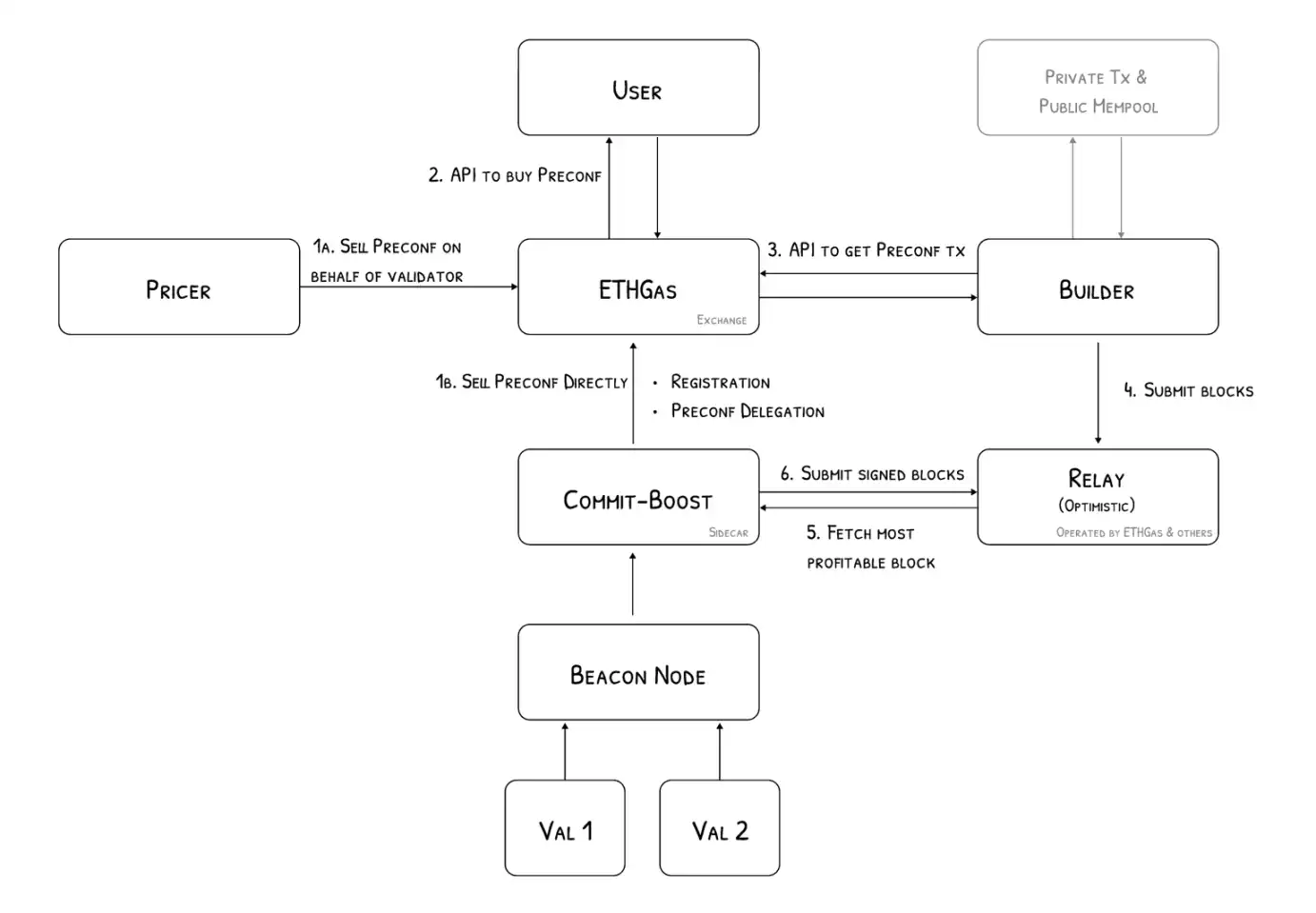
This auction market, named Blockspace, allows Ethereum validators, block builders, and relay nodes to auction space in subsequent blocks, ensuring that bidders' transactions are included in the next block and guaranteeing the execution efficiency of those transactions. Additionally, bidders can even purchase an entire block to include only their own transactions or transactions they provide for others.

Comparing transactions to packages, guaranteeing block inclusion is like ensuring a package is loaded onto a transport plane, while guaranteeing transaction execution is like ensuring the package is delivered to the intended recipient on time. Purchasing an entire block is akin to chartering an entire plane to transport one's packages, but with the option to sublet the extra space to other packages.

ETHGas's ultimate goal is to achieve "real-time transactions" on Ethereum through Blockspace. This "real-time transaction" can only be in quotes because the completion of transactions on the Ethereum mainnet must wait for the block to be finalized. However, if a transaction can be guaranteed to be included in the next block, it can, in a way, be considered "already completed." ETHGas can be understood as an execution layer on top of Ethereum, but how real-time transactions will be reflected on the front end remains to be seen as ETHGas provides answers.

ETHGas aims to create an orderly block space, as opposed to the current system of chaotic bidding for block space with numerous uncontrollable MEV transactions. By offering predictable returns to attract infrastructure operators to join Blockspace and create sufficient liquidity for real-time transactions, the resulting efficiency improvements will attract various DApps. DApps, in turn, will attract users through Open Gas, and users will bring more transaction volume into the ETHGas network, thereby increasing the returns for infrastructure operators and forming a positive cycle.

Challenges Beneath the Ideal Vision

For a DApp about to conduct a token airdrop, it could estimate the number of transactions for claiming the airdrop, pre-book n blocks after a specific time, and provide a Gas subsidy program, thereby achieving a budget-controlled and network-congestion-free token claim event.

Although such visions are ideal, allowing block space to be auctioned may lead to many foreseeable issues.

First, if institutional users can auction block space without restrictions, they might purchase entire blocks in large quantities and resell them to retail users. While this would ensure stable and predictable returns for validators, it could increase transaction costs for retail users. In this scenario, retail users lack the technical capability to compete with institutional users, and even if they could participate in auctions or use futures markets to hedge against rising Gas fees, it would essentially raise their transaction costs.

Additionally, the futures market could become a tool for market manipulation. For example, large players could deliberately create a high volume of on-chain transactions to drive up Gas fees and profit from the futures market, but this could increase transaction costs for other users on the Ethereum mainnet. Moreover, as DApp operators are aware of the specific timing of events that could cause a surge in transactions, they could profit from operations in the futures market in advance, turning the futures market into an arbitrage playground for those with informational advantages and causing unpredictable losses for ordinary users who simply use the market for hedging.

The birth of a new trading market inevitably creates arbitrage opportunities due to information asymmetry, potentially undermining the very problems the market aims to solve. For ETHGas, balancing this issue and preventing a "positive cycle" from turning into a "death spiral" may require some necessary restrictions.


Criptos en tendencia

Preguntas relacionadas

QWhat is the main vision of ETHGas, despite being defined as a block space futures market?

AThe main vision of ETHGas is to achieve 'Real-Time Ethereum' by creating an orderly block space and acting as an execution layer on top of Ethereum.

QWho led the $12 million funding round for ETHGas announced on December 17th?

AThe $12 million funding round was led by Polychain Capital.

QWhat is the purpose of the Blockspace auction market introduced by ETHGas?

AThe Blockspace auction market allows validators, block builders, and relay nodes to auction space in future blocks, guaranteeing that a bidder's transaction will be included in the next block and ensuring its efficiency. It can also be used to auction an entire block.

QWhat potential problem does the article identify with allowing unlimited block space auctions?

AUnlimited auctions could allow institutional users to outbid散户 (retail users) and potentially resell block space to them, ultimately increasing transaction costs for ordinary users and creating an unlevel playing field.

QWhat tool is ETHGas developing specifically for DApps, and what is its function?

AETHGas is developing a zero-code tool called Open Gas, which is designed to help DApps provide gas subsidy programs, allowing users to claim the gas fees they spent after using the DApp on the ETHGas platform.

Lecturas Relacionadas

Why Bitcoin Holds Above $64,000 After Fed's Hard Pause

**Bitcoin Stabilizes Near $64,000 Following Hawkish Fed Pause** The cryptocurrency market, led by Bitcoin, remained stable around $64,000 despite a volatile reaction to the latest U.S. Federal Reserve meeting. The Fed paused interest rates but signaled a hawkish stance, with three committee members voting for an increase—the highest dissent since 2016. This limits risk appetite but hasn't triggered panic selling. Key market highlights include Bitcoin ETFs seeing a net inflow of $32.1 million, breaking a streak of outflows, while Ethereum ETFs experienced outflows of $18.65 million. Liquidations affected about 90,000 traders. Technically, Bitcoin finds support around $63,000-$63,500, with major resistance near $66,000. While its price is about 49% below its all-time high, institutional demand via ETFs and the absence of mass capitulation support a potential recovery scenario in the second half of the year. Major altcoins showed mixed movements, with Solana attracting capital while Ethereum faced selling pressure despite strong on-chain metrics like a growing staking queue. Regulatory news took a pause as the U.S. Senate delayed the CLARITY Act vote until at least autumn. For the final trading day of July, U.S. inflation and consumer spending data will be crucial. Bitcoin's key levels to watch are $63,000 support and $66,000 resistance. Sustained ETF inflows and Bitcoin holding above $63,000 are seen as positive signs for a potential market recovery later in the year.

cryptonews.ruHace 1 hora(s)

Why Bitcoin Holds Above $64,000 After Fed's Hard Pause

cryptonews.ruHace 1 hora(s)

Participants in XRP Fraud Scheme That Stole $9 Million from 71 Investors Arrested

South Korean police have arrested three individuals accused of operating a fraudulent investment platform that stole approximately 3.4 million XRP (worth about $9 million) from 71 investors between October 16 and 23. The suspects promoted the site Fxrpntwork.com through blogs, online articles, and YouTube videos, promising guaranteed principal and monthly returns of 1.5% to 1.8%. Investors were instructed to transfer XRP from Korean exchanges to overseas platforms and then to wallets controlled by the group before the site was shut down. The scammers copied the branding of legitimate projects Flare Network and FXRP to appear credible. Authorities warn that such impersonation frauds, which use familiar branding and urgent promises of guaranteed profits, are a common red flag. Legitimate companies do not solicit cryptocurrency transfers through unsolicited promotions. Seoul police have issued an Interpol Red Notice for a fourth suspect abroad and are investigating others involved in creating and promoting the fraudulent website. While investigators froze 17.3 billion won in assets, approximately 10 billion won was moved during the probe, with wallet analysis revealing transfers totaling 27.3 billion won, suggesting there may be additional unidentified victims and accomplices. The case underscores the organized, cross-border nature of crypto investment fraud.

cryptonews.ruHace 1 hora(s)

Participants in XRP Fraud Scheme That Stole $9 Million from 71 Investors Arrested

cryptonews.ruHace 1 hora(s)

Trading

Spot

Artículos destacados

Cómo comprar O

¡Bienvenido a HTX.com! Hemos hecho que comprar O1 exchange (O) sea simple y conveniente. Sigue nuestra guía paso a paso para iniciar tu viaje de criptos.Paso 1: crea tu cuenta HTXUtiliza tu correo electrónico o número de teléfono para registrarte y obtener una cuenta gratuita en HTX. Experimenta un proceso de registro sin complicaciones y desbloquea todas las funciones.Obtener mi cuentaPaso 2: ve a Comprar cripto y elige tu método de pagoTarjeta de crédito/débito: usa tu Visa o Mastercard para comprar O1 exchange (O) al instante.Saldo: utiliza fondos del saldo de tu cuenta HTX para tradear sin problemas.Terceros: hemos agregado métodos de pago populares como Google Pay y Apple Pay para mejorar la comodidad.P2P: tradear directamente con otros usuarios en HTX.Over-the-Counter (OTC): ofrecemos servicios personalizados y tipos de cambio competitivos para los traders.Paso 3: guarda tu O1 exchange (O)Después de comprar tu O1 exchange (O), guárdalo en tu cuenta HTX. Alternativamente, puedes enviarlo a otro lugar mediante transferencia blockchain o utilizarlo para tradear otras criptomonedas.Paso 4: tradear O1 exchange (O)Tradear fácilmente con O1 exchange (O) en HTX's mercado spot. Simplemente accede a tu cuenta, selecciona tu par de trading, ejecuta tus trades y monitorea en tiempo real. Ofrecemos una experiencia fácil de usar tanto para principiantes como para traders experimentados.

460 Vistas totalesPublicado en 2026.06.19Actualizado en 2026.06.29

Cómo comprar O

Cómo comprar PROS

¡Bienvenido a HTX.com! Hemos hecho que comprar Pharos (PROS) sea simple y conveniente. Sigue nuestra guía paso a paso para iniciar tu viaje de criptos.Paso 1: crea tu cuenta HTXUtiliza tu correo electrónico o número de teléfono para registrarte y obtener una cuenta gratuita en HTX. Experimenta un proceso de registro sin complicaciones y desbloquea todas las funciones.Obtener mi cuentaPaso 2: ve a Comprar cripto y elige tu método de pagoTarjeta de crédito/débito: usa tu Visa o Mastercard para comprar Pharos (PROS) al instante.Saldo: utiliza fondos del saldo de tu cuenta HTX para tradear sin problemas.Terceros: hemos agregado métodos de pago populares como Google Pay y Apple Pay para mejorar la comodidad.P2P: tradear directamente con otros usuarios en HTX.Over-the-Counter (OTC): ofrecemos servicios personalizados y tipos de cambio competitivos para los traders.Paso 3: guarda tu Pharos (PROS)Después de comprar tu Pharos (PROS), guárdalo en tu cuenta HTX. Alternativamente, puedes enviarlo a otro lugar mediante transferencia blockchain o utilizarlo para tradear otras criptomonedas.Paso 4: tradear Pharos (PROS)Tradear fácilmente con Pharos (PROS) en HTX's mercado spot. Simplemente accede a tu cuenta, selecciona tu par de trading, ejecuta tus trades y monitorea en tiempo real. Ofrecemos una experiencia fácil de usar tanto para principiantes como para traders experimentados.

474 Vistas totalesPublicado en 2026.06.22Actualizado en 2026.06.29

Cómo comprar PROS

Qué es VERONA

I. Introducción al Proyecto VERONA es una blockchain construida para todos, en todas partes a través de la abstracción de cadenas. Utilizando su capa de Abstracción Generalizada, VERONA se distingue por integrar funcionalidades complejas de blockchain, como cuentas, firmas e interoperabilidad, directamente a nivel de protocolo. Este enfoque permite interactuar con aplicaciones de blockchain sin necesidad de entender las tecnologías subyacentes.1) Información Básica Nombre: VERONA (VERONA)III. Enlaces Relacionados Enlace al sitio web oficial: https://xion.burnt.com/ Libro Blanco: https://xion.burnt.com/whitepaper.pdf Exploradores: https://explorer.burnt.com/ Redes Sociales: https://x.com/burnt_xion Nota: La introducción del proyecto proviene de los materiales publicados o proporcionados por el equipo oficial del proyecto, que es solo para referencia y no constituye asesoramiento de inversión. HTX no se hace responsable de ninguna pérdida directa o indirecta resultante.

554 Vistas totalesPublicado en 2026.06.22Actualizado en 2026.06.22

Qué es VERONA

Discusiones

Bienvenido a la comunidad de HTX. Aquí puedes mantenerte informado sobre los últimos desarrollos de la plataforma y acceder a análisis profesionales del mercado. A continuación se presentan las opiniones de los usuarios sobre el precio de A (A).

活动图片













