ETFs See Net Inflows for Two Consecutive Weeks, On-Chain Gold Surpasses $6.1 Billion, Crypto Outperforms US Stocks This Week

marsbitPublicado a 2026-03-15Actualizado a 2026-03-15

Resumen

Cryptocurrency markets outperformed traditional equities this week, with assets like HYPE (+18.8%), Ethereum (+5.2%), and Bitcoin (+4.7%) posting gains. Crypto ETFs recorded net inflows for the second consecutive week, totaling $609.9 million, signaling renewed institutional interest amid macroeconomic uncertainty. HIP-3 open interest reached a record $1.3 billion, largely driven by oil futures, which now account for 31% of total open interest—a significant shift indicating growing demand for real-world asset exposure on-chain. Tokenized gold supply also surged, surpassing 1.2 million ounces (worth ~$6.1 billion), reflecting increased demand for blockchain-based hard assets. Other notable developments include Mastercard’s expanded crypto partnership program, Coinbase’s potential collaboration with Bybit, and Kraken’s progress toward direct Fed payment access. These trends suggest a broader shift of capital into crypto and tokenized real-world assets as macro conditions favor alternative stores of value.

Author: Artemis Analytics

Compiled by: Deep Tide TechFlow

Deep Tide Insight: This weekly report illustrates one thing with data—the crypto market is shifting from defense to offense. ETFs recording net inflows for two consecutive weeks, on-chain gold tripling in scale, and HIP-3 open interest hitting a record high—the simultaneous strength of these three trends reflects macro uncertainties driving capital to reprice hard assets.

Market Overview: Weekly Review

Welcome back to Artemis' "Digital Finance Fundamentals" weekly report!

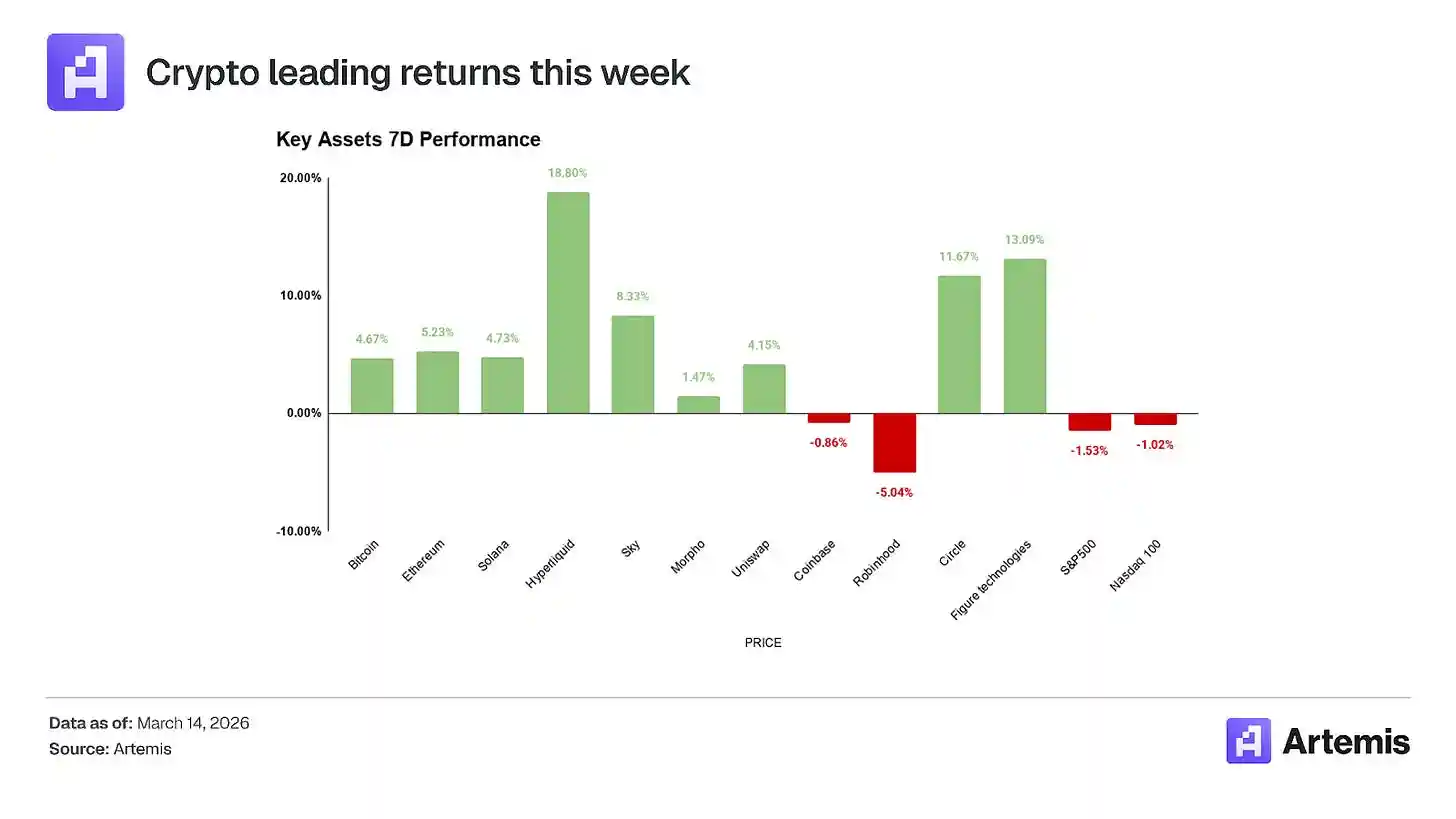
This week, crypto asset returns significantly outperformed. HYPE was the standout performer, surging +18.8% over the past 7 days; Figure Technologies (+13.1%) and Circle (+11.7%) also posted substantial gains. Among mainstream assets, Ethereum (+5.2%), Solana (+4.7%), and Bitcoin (+4.7%) all advanced, with Uniswap (+4.2%) and SKY (+8.3%) further boosting the overall rally in digital assets.

Notably, crypto clearly outperformed traditional stocks this week. Although digital assets and crypto-related stocks were mostly in the green, Coinbase (-0.9%) and Robinhood (-5.0%) underperformed the broader market, showing more divergence at the equity level. Among traditional benchmarks, the S&P 500 fell -1.5% weekly, and the Nasdaq 100 declined -1.0%. Overall, risk appetite clearly flowed back into crypto assets, with tokens and some crypto-linked instruments significantly outperforming the market.
Highlights of the Week

HIP-3 open interest and trading volume hit record highs, driven by oil futures

Crypto ETFs see net inflows for two consecutive weeks

On-chain tokenized gold supply exceeds 1.2 million ounces

1. HIP-3 Open Interest and Volume Hit Record Highs, Oil Futures Become Key Driver
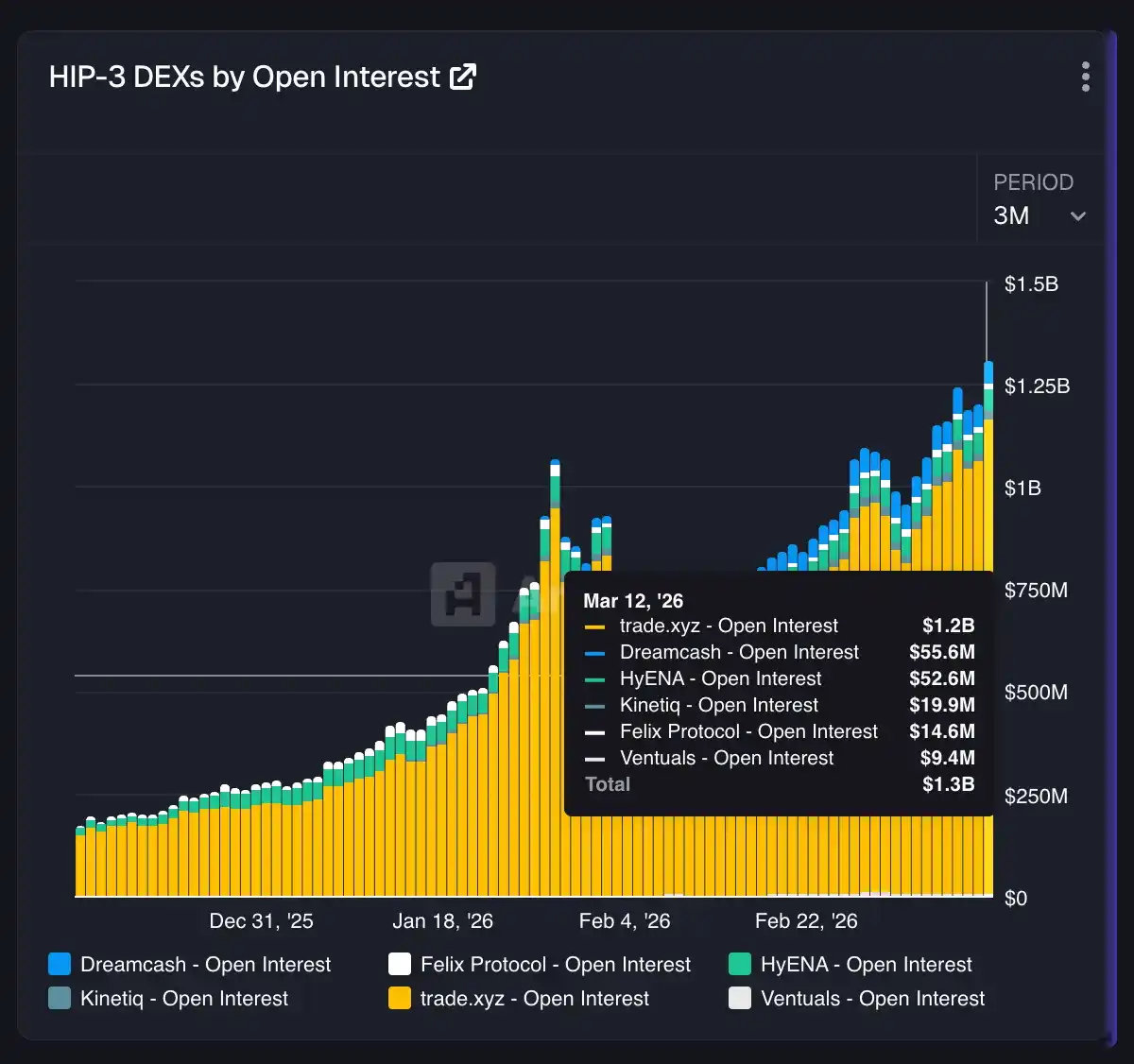
HIP-3 market open interest (OI) reached another record high this week: on March 12, total OI hit approximately $1.3 billion. The platform trade.xyz contributed about $1.2 billion of this, with smaller platforms like Dreamcash and HyENA providing additional depth.
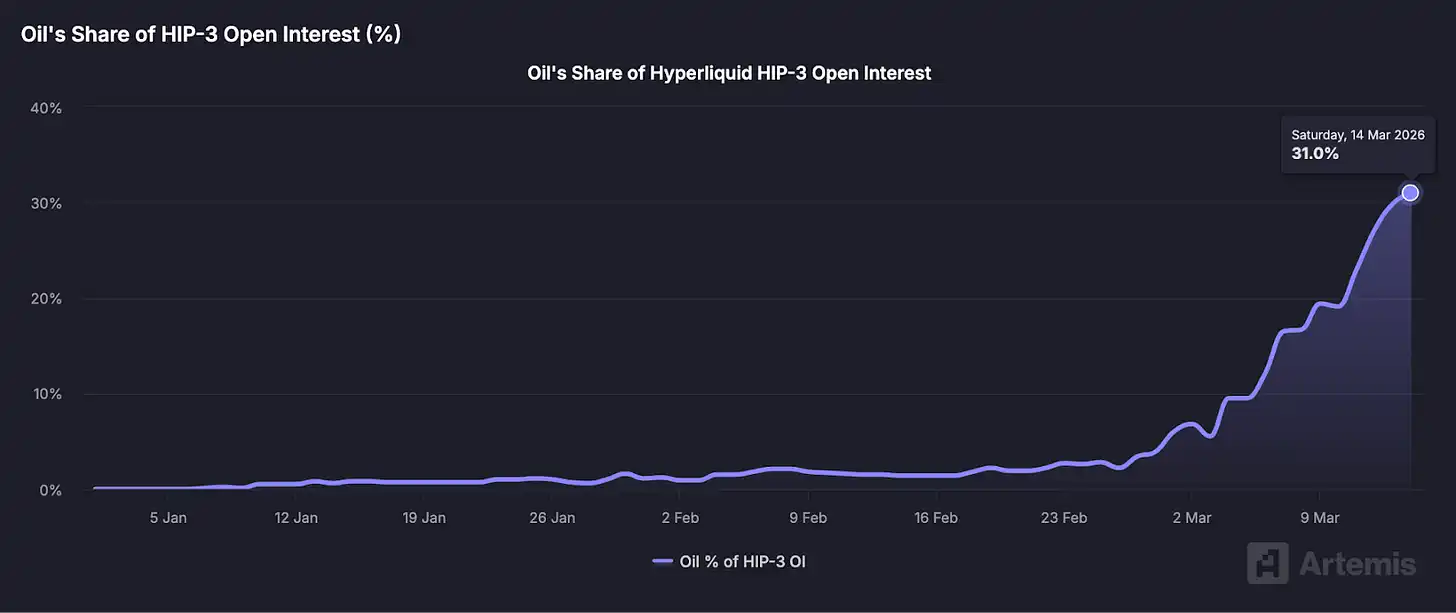
More important than the absolute numbers is the shift in drivers. Oil's share of HIP-3 total open interest rose to 31% by March 14—up from nearly negligible levels for most of January and February. In less than two weeks, oil went from a marginal role to one of the most in-demand sources in the entire ecosystem.

This shift signals that HIP-3 is evolving beyond crypto-native long-tail experiments into a truly permissionless venue for macro expression. When offshore traders seek quick exposure to oil, indices, and event-driven volatility, capital is accelerating its flow on-chain. If this trend continues, HIP-3 could become the clearest case of on-chain markets beginning to capture global commodity flows.

2. Crypto ETFs See Net Inflows for Two Consecutive Weeks

Crypto ETF flows remained positive for the second consecutive week, further indicating a resurgence in institutional demand. For the week ending March 8, net inflows totaled $609.9 million, led by Bitcoin ETFs (+$568.5 million), with healthy inflows also seen in Ethereum (+$23.5 million) and Solana (+$22.0 million). Ripple-related products saw minor outflows (-$4.1 million), but overall flows remained positive.
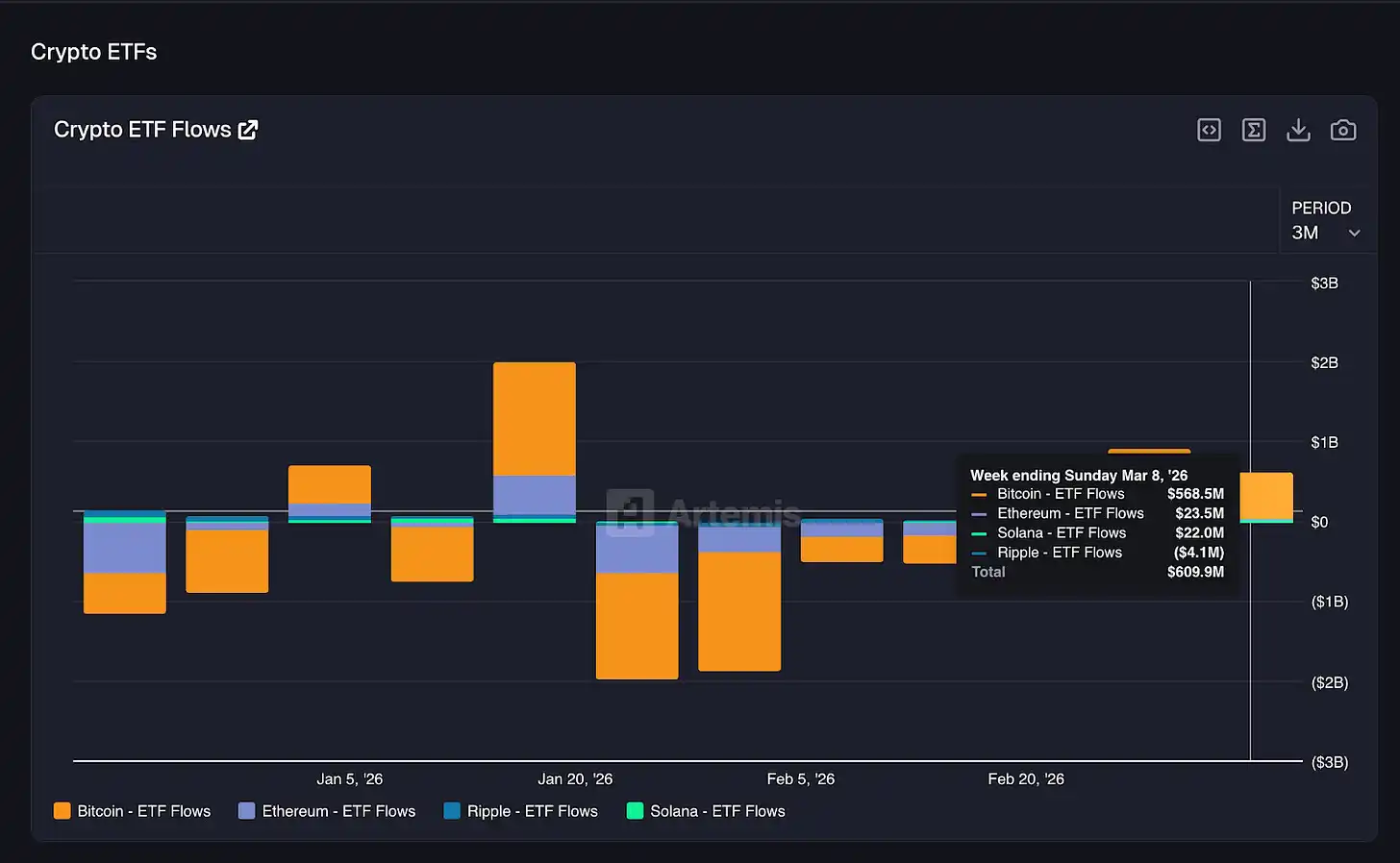
The more critical takeaway: this no longer appears to be a one-week rebound. After weeks of pressure, two consecutive weeks of positive data suggest asset allocators are gradually rebuilding crypto exposure.

The macro logic supporting these sustained flows is directly related to the Iran conflict.
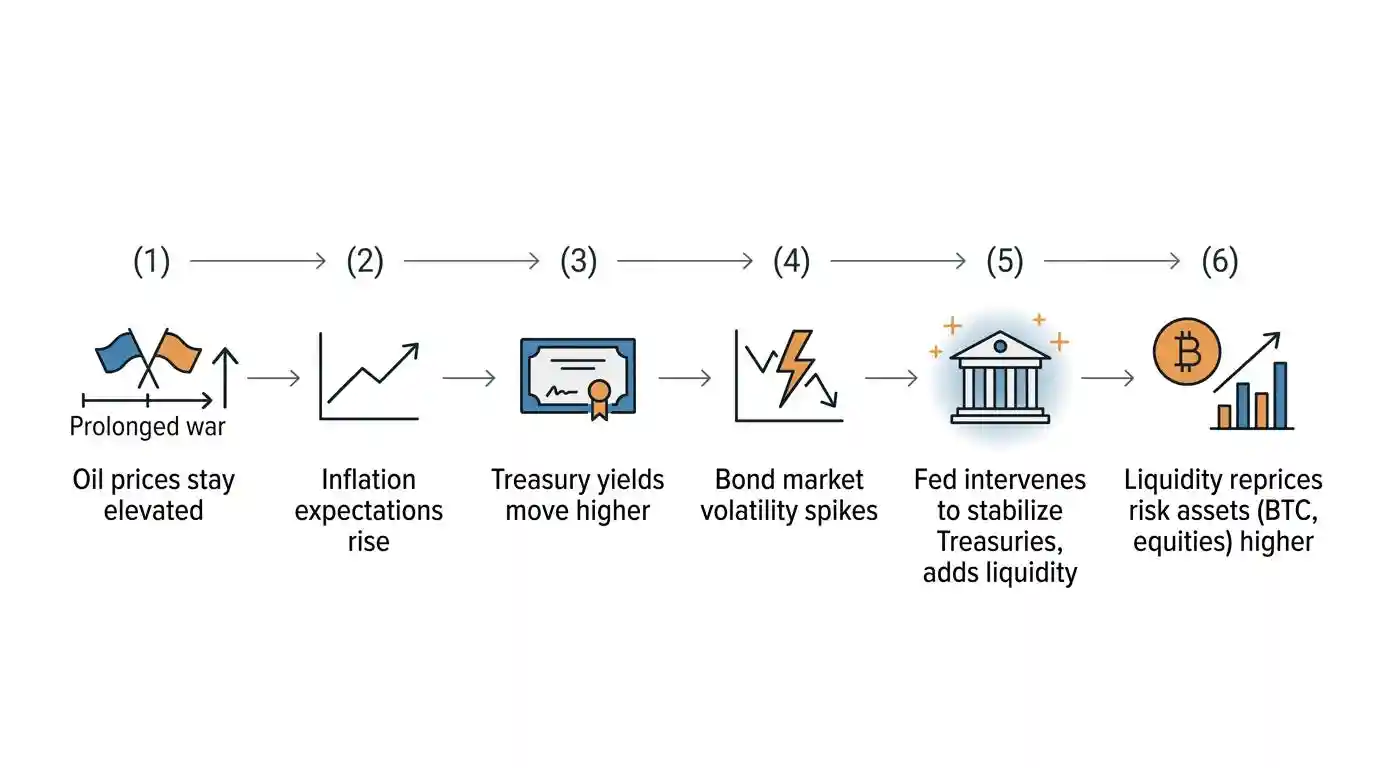
(Hayes' "iOS Warfare" is currently the most detailed exposition of this logic.)

The macro backdrop may continue to provide support. Geopolitical tensions, rising oil prices, and the market's reassessment of Fed rate cut expectations are pushing investors to more seriously consider hard assets and alternative stores of value. If macro uncertainties persist, ETF demand could remain robust as allocators rebuild crypto positions.

3. On-Chain Tokenized Gold Supply Exceeds 1.2 Million Ounces

Tokenized gold supply continued to breakneck growth this week, with on-chain holdings reaching approximately 1.2 million ounces, equivalent to about $6.1 billion. Compared to less than $2 billion just under a year ago, the rapid growth highlights investors' accelerating demand for blockchain-based hard asset exposure.
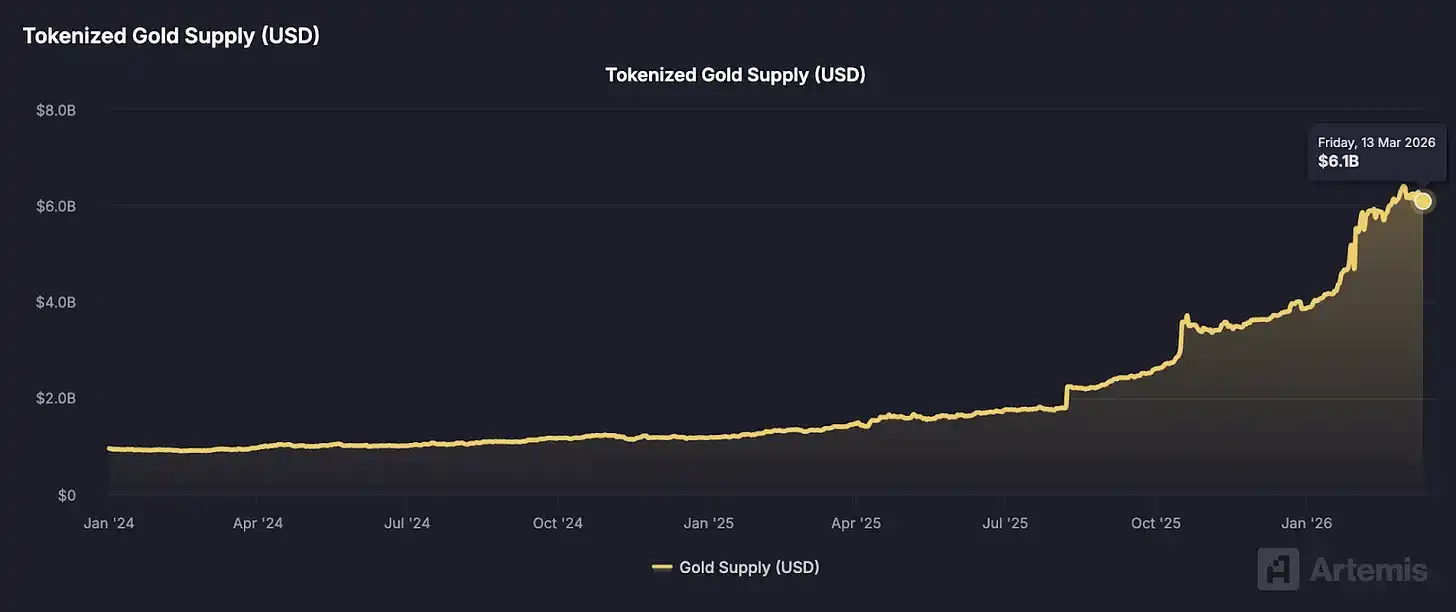
Amid increasing macro uncertainty dominating markets, tokenized gold is benefiting from two trends: gold's traditional role as a safe-haven asset, and growing acceptance of its on-chain wrapped form as a circulation channel.

The bigger conclusion: tokenization is no longer just a payments or stablecoin story; it is meaningfully extending to store-of-value assets, with gold emerging as one of the clearest real-world beneficiaries.

Chart of the Week

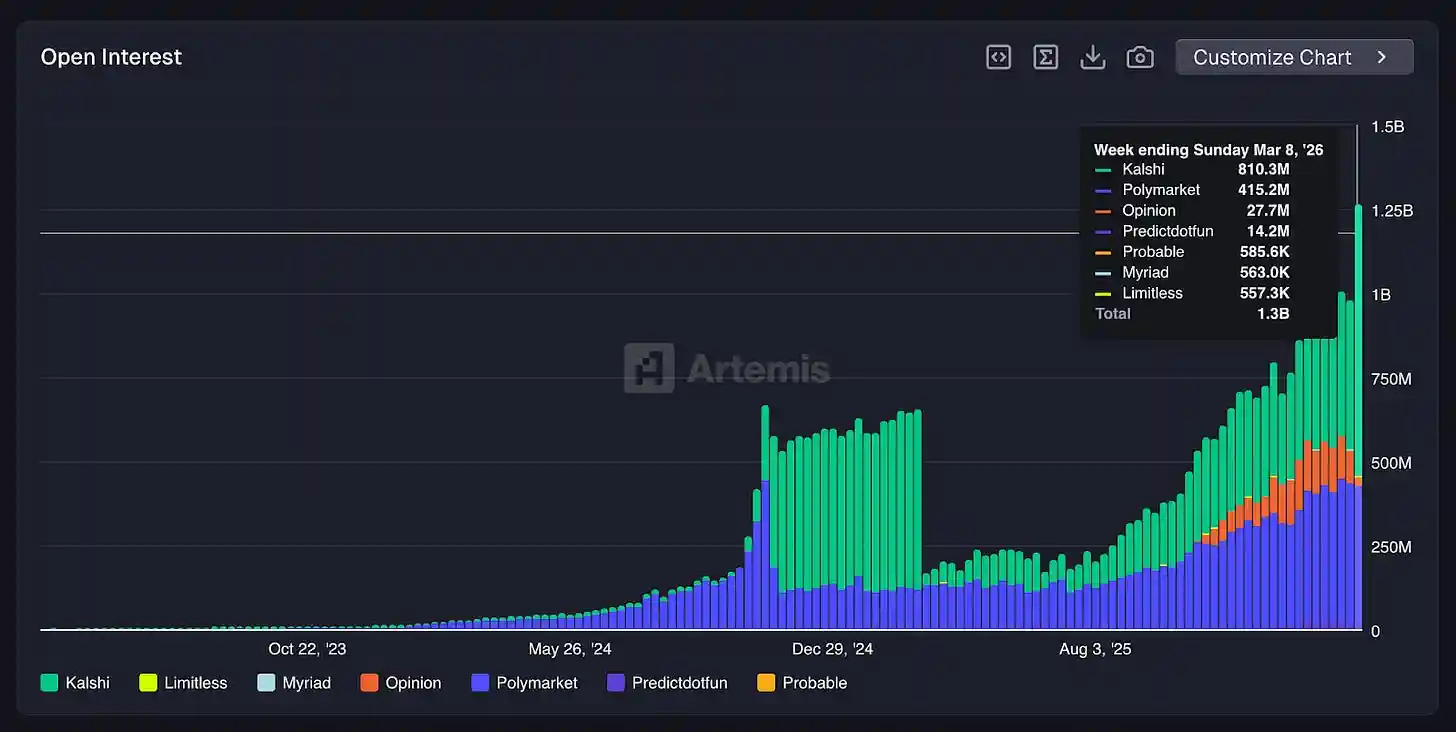
Prediction markets continued growing this week, with total open interest reaching approximately $1.3 billion, led by Kalshi and Polymarket. Traders are increasingly using event markets to express real-time views on political, macro, and geopolitical volatility. This landscape is worth watching—it indicates demand has expanded beyond pure crypto price speculation into broader real-world information and probability pricing markets.
Other Noteworthy News

Mastercard launches large-scale crypto partnership program. On March 11, Mastercard announced a new crypto collaboration program involving over 85 institutions, including Binance, Circle, Ripple, PayPal, Gemini, and Paxos. The initiative aims to leverage stablecoins and digital assets to support cross-border payments, B2B transfers, and global settlement on networks like Solana, Polygon, Avalanche, and Aptos. This marks another step in the integration of blockchain payment infrastructure with the mainstream financial system.

Coinbase in talks with Bybit for potential investment partnership. Reports on March 14 indicated Coinbase is negotiating a possible investment or strategic partnership with Bybit. A deal would bring Bybit closer to the compliant US market, while Coinbase would gain access to one of the largest offshore exchanges globally. From a macro perspective, such talks confirm a trend: as market structure matures, major global exchanges are increasingly aligning with regulated counterparts.

BitGo selected by SoFi to provide infrastructure and institutional distribution support for SoFiUSD. This partnership makes BitGo the core provider for issuance, custody, and distribution of SoFi's bank-issued stablecoin, with institutional clients able to access SoFiUSD directly via BitGo's platform. This again shows regulated banks moving from stablecoin experimentation to actual deployment, backed by crypto-native infrastructure providers.

Kraken's banking unit moves closer to US direct payment access. Kraken Financial's pursuit of a Federal Reserve master account continues to draw attention as one of the most significant infrastructure developments in the space. Direct access to Fedwire and related payment channels would reduce friction for institutional fiat transfers, representing another case of crypto companies integrating into core financial plumbing rather than building alternatives.

Preguntas relacionadas

QWhat were the main drivers behind the record high in HIP-3 open interest, and why is this significant?

AThe record high in HIP-3 open interest was primarily driven by a surge in oil futures, which grew from a negligible share to 31% of the total in under two weeks. This is significant because it signals that HIP-3 is evolving from a crypto-native experiment into a permissionless venue for macro-economic expression, potentially capturing global commodity flows on-chain.

QWhat does the data show about cryptocurrency ETF flows for the week ending March 8th?

ACryptocurrency ETF flows were positive for the second consecutive week, with a net inflow of $609.9 million. Bitcoin ETFs led with an inflow of $568.5 million, followed by Ethereum ($23.5 million) and Solana ($22 million), indicating a rebuilding of institutional crypto exposure.

QHow much has the supply of on-chain tokenized gold grown, and what does this trend indicate?

AThe supply of on-chain tokenized gold has grown to approximately 1.2 million ounces, valued at around $6.1 billion, a significant increase from less than $2 billion a year ago. This rapid growth indicates rising investor demand for blockchain-based hard asset exposure and greater acceptance of tokenized forms of traditional safe-haven assets.

QAccording to the report, how did the performance of crypto assets compare to traditional stocks this week?

ACrypto assets significantly outperformed traditional stocks this week. Major cryptocurrencies like HYPE (+18.8%), Ethereum (+5.2%), Solana (+4.7%), and Bitcoin (+4.7%) posted gains, while traditional benchmarks like the S&P 500 (-1.5%) and Nasdaq 100 (-1.0%) declined, showing a clear shift in risk appetite towards crypto assets.

QWhat major partnership did Mastercard announce, and what is its goal?

AMastercard announced a new Crypto Partner Program involving over 85 institutions, such as Binance, Circle, and PayPal. The program aims to leverage stablecoins and digital assets on networks like Solana and Polygon to support cross-border payments, B2B transfers, and global settlement, marking a step towards integrating blockchain payment infrastructure with the mainstream financial system.

Lecturas Relacionadas

Can Generative Models Finally Be Trained End-to-End? The Core Is a For Loop

This article introduces a novel training paradigm for generative models called Explorative Modeling (XM), which enables true end-to-end training. Traditionally, powerful generative models like autoregressive and diffusion models are not trained end-to-end. They are trained to predict a single small step but require iterative multi-step sampling for inference. This "exposure bias" leads to error accumulation and limits performance. The core challenge XM addresses is "mode blurring." In generative tasks, a single input (e.g., "generate a dog") corresponds to many valid outputs (multiple modes). Standard training objectives like reconstruction loss force the model to average these modes, producing unrealistic, blurry outputs. To avoid this, existing models break generation into many small, almost deterministic steps, sacrificing end-to-end training. XM tackles this by restructuring the training loop itself. Its key insight is to amplify "generative expressivity." For each training input, instead of generating one sample, the model generates K candidate outputs. Only the candidate closest to the real data is used for computing the loss and updating the model via backpropagation. This simple "best-of-K" mechanism is implemented as a short for-loop. By exploring multiple possibilities, the model learns to distribute its guesses across different modes rather than collapsing to their uninformative average. The paper demonstrates that "exploration" acts as a new, powerful scaling axis. Gains from XM increase with model size, data scale, and compute. Experiments show improvements in FID scores for image generation and significant efficiency gains, sometimes outperforming larger models without exploration. When pushed to the limit, XM enables fully single-step, end-to-end generative models. In robotics tasks, an "Explorative Policy" matched the performance of a 100-step Diffusion Policy with a single forward pass, drastically improving inference speed. While the best-of-K concept is not entirely new, the authors' contribution lies in formally understanding it as a direct method to boost generative expressivity without fragmenting the generation process. This work suggests that as models scale, enhancing exploration during training may become crucial for overcoming fundamental performance bottlenecks.

marsbitHace 48 min(s)

Can Generative Models Finally Be Trained End-to-End? The Core Is a For Loop

marsbitHace 48 min(s)

Annual Salary of Millions Competing for Electricians, Meta Rushes to Open Its Own Technical School

The AI boom is facing an unexpected bottleneck: a severe shortage of skilled construction workers and electricians. As tech giants like Meta, OpenAI, and Alphabet race to build massive data centers—such as OpenAI's $16 billion "Stargate" project—they are hitting a critical labor wall. The U.S. needs an estimated 130,000 more electricians, 240,000 construction workers, and 150,000 supervisors by 2030 for AI infrastructure alone, but tens of thousands of electrician jobs go unfilled each year. While AI companies offer high premiums, with electricians earning up to $280,000 annually, worker scarcity still causes massive losses—delays on a single project can cost $14.2 million per month. The complexity of building AI data centers, which require immense power (equivalent to powering hundreds of thousands of homes), sophisticated electrical systems, and advanced liquid cooling solutions, demands highly skilled technicians who are in short supply. To combat this, companies are investing heavily in training. Meta has committed $115 million to a free training school offering tuition, housing, and stipends, targeting 5,000 new workers. OpenAI is partnering with unions to secure skilled labor. These efforts are paying off, with a significant rise in Gen Z interest in trade schools over college. However, the power demands are staggering. AI data centers are driving a rapid surge in electricity consumption, projected to account for up to 12% of U.S. power use by 2028 and raising costs for consumers. Furthermore, the construction boom is project-based, leading to a potential future glut of trained workers once building peaks, which could depress wages industry-wide. The race for AI supremacy now depends as much on skilled hands as on advanced chips.

marsbitHace 2 hora(s)

Annual Salary of Millions Competing for Electricians, Meta Rushes to Open Its Own Technical School

marsbitHace 2 hora(s)

Trading

Spot
活动图片