Eric Trump Goes to War With Big Banks Over ‘Anti‑American’ Crypto Lobbying

bitcoinistPublicado a 2026-03-05Actualizado a 2026-03-05

Resumen

Eric Trump has publicly criticized major U.S. banks, including JPMorgan Chase, Wells Fargo, and Bank of America, accusing them of pursuing an "anti-American" agenda by lobbying against crypto and stablecoins. He claims these institutions are trying to block Americans from earning higher yields on savings—often 4–5% in crypto platforms—to protect their low-interest monopoly and prevent deposit flight. According to Trump, banks are supporting bills like the Clarity Act to restrict yields and rewards on stablecoins, undermining competition and consumer freedom. He argues this contradicts American ideals and reflects the banking industry's panic over losing dominance in digital finance. The conflict centers on the GENIUS Act, which allowed stablecoins but banned interest payments, and the proposed Clarity Act, which aims to further limit yields.

Eric Trump lashed out against Big Banks for targeting Crypto and stablecoins, essentially not letting Americans make as much money as they could be.

An “Anti-American” Crypto Agenda

In a post on social network X on March 4, following his father Donald Trump’s message accusing banks of “undermining” the GENIUS Act, Eric Trump subsequently called out big banks like JPMorgan Chase, Wells Fargo and Bank of America.

He claims these banks are actively blocking Americans from “getting higher yields on their savings” and preventing “any rewards or perks from being given to customers,” arguing this is happening because they are “desperately targeting crypto/stablecoins, where platforms plan to offer 4–5% yields or rewards.” He goes as far as saying this stance betrays America’s freedom ideals:

The ABA and other lobbyists are spending millions trying to ban or restrict those yields via bills like the Clarity Act, crying “fairness” and using words like “stability”—when it’s really about protecting their low-rate monopoly and preventing deposit flight. his is anti-retail, anti-consumer, and straight-up anti-American.

The Greatest Hypocrites

In a different post from the same day, Eric Trump doubled down, accusing Big Banks of “doing everything they can to block the crypto industry” and branding them institutions that have “held a monopoly and screwed their customers for years.”

As Eric Trump sees it, this comes as a sort of tantrum, the last-ditch effort of a scared institution to keep control of Americans’ savings:

They are the greatest hypocrites and are in mass panic given they know they are losing the digital finance race!

The GENIUS Act vs. The Clarity Act

Both Donald and Eric Trump’s rants respond to a broader context: two flagship Trump-era bills are being weaponized against each other by the TradFi institutions.

The GENIUS Act, last year’s “big win” for payment stablecoins, legalized fully‐backed dollar tokens while explicitly banning issuers from paying interest on customer balances, a compromise that pushed yield into exchanges, fintech apps and DeFi protocols instead of killing it outright.

Now the banking lobby wants the CLARITY Act to finish the job: they are demanding a blanket prohibition on “yields, rewards or inducements” for stablecoin holders, closing the GENIUS loophole that still lets platforms compete with near‐zero bank accounts.

This is the fight the Trumps are now front running: an active opposition against those that are trying to make sure digital dollars can never pay ordinary savers more than the legacy system does.
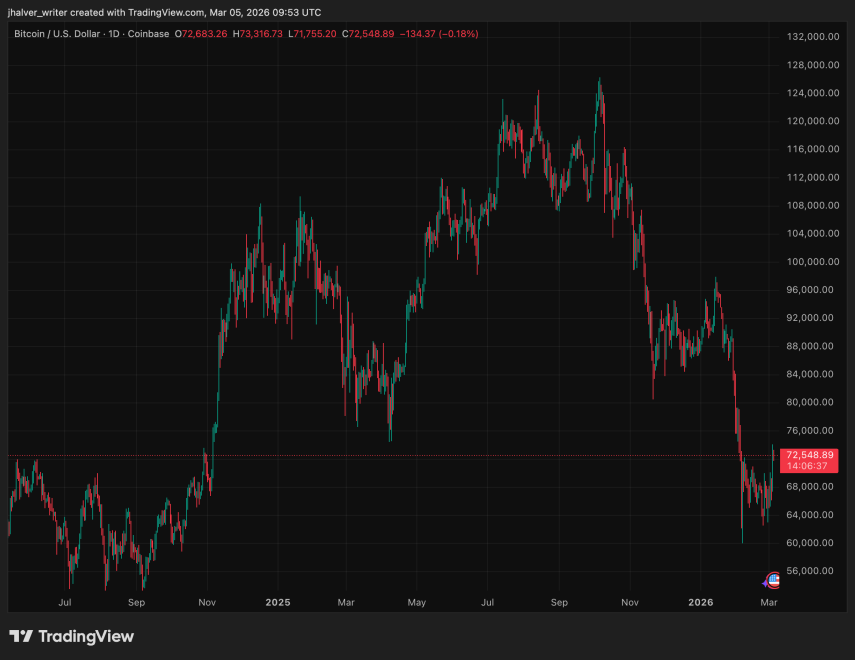
BTC’s price trends to the downside on the daily chart. Source: BTCUSD on Tradingview

Cover image from ChatGPT, BTCPUSD chart from Tradingview

Preguntas relacionadas

QWhat did Eric Trump accuse big banks like JPMorgan Chase, Wells Fargo, and Bank of America of doing?

AEric Trump accused big banks of actively blocking Americans from getting higher yields on their savings and preventing rewards or perks from being given to customers, claiming they are desperately targeting crypto and stablecoins to protect their low-rate monopoly.

QWhich two acts are central to the conflict between the Trump family and big banks regarding crypto and stablecoins?

AThe GENIUS Act and the Clarity Act are central to the conflict, with the GENIUS Act legalizing fully-backed dollar tokens but banning interest on customer balances, while the Clarity Act seeks to prohibit yields, rewards, or inducements for stablecoin holders.

QWhy does Eric Trump label the actions of big banks and their lobbyists as 'anti-American'?

AHe labels them as 'anti-American' because he believes they are undermining America's freedom ideals by protecting their monopoly, preventing deposit flight, and restricting consumers from earning higher yields through crypto and stablecoins.

QWhat does Eric Trump claim is the real motivation behind the banking lobby's support for bills like the Clarity Act?

AHe claims the real motivation is to protect their low-rate monopoly and prevent deposit flight, rather than genuine concerns about fairness or stability.

QHow does Eric Trump describe the big banks' response to the rise of digital finance?

AHe describes it as a mass panic and tantrum, accusing them of being hypocrites who are desperately trying to block the crypto industry because they are losing the digital finance race.

Lecturas Relacionadas

Why Bitcoin Holds Above $64,000 After Fed's Hard Pause

**Bitcoin Stabilizes Near $64,000 Following Hawkish Fed Pause** The cryptocurrency market, led by Bitcoin, remained stable around $64,000 despite a volatile reaction to the latest U.S. Federal Reserve meeting. The Fed paused interest rates but signaled a hawkish stance, with three committee members voting for an increase—the highest dissent since 2016. This limits risk appetite but hasn't triggered panic selling. Key market highlights include Bitcoin ETFs seeing a net inflow of $32.1 million, breaking a streak of outflows, while Ethereum ETFs experienced outflows of $18.65 million. Liquidations affected about 90,000 traders. Technically, Bitcoin finds support around $63,000-$63,500, with major resistance near $66,000. While its price is about 49% below its all-time high, institutional demand via ETFs and the absence of mass capitulation support a potential recovery scenario in the second half of the year. Major altcoins showed mixed movements, with Solana attracting capital while Ethereum faced selling pressure despite strong on-chain metrics like a growing staking queue. Regulatory news took a pause as the U.S. Senate delayed the CLARITY Act vote until at least autumn. For the final trading day of July, U.S. inflation and consumer spending data will be crucial. Bitcoin's key levels to watch are $63,000 support and $66,000 resistance. Sustained ETF inflows and Bitcoin holding above $63,000 are seen as positive signs for a potential market recovery later in the year.

cryptonews.ruHace 14 min(s)

Why Bitcoin Holds Above $64,000 After Fed's Hard Pause

cryptonews.ruHace 14 min(s)

Participants in XRP Fraud Scheme That Stole $9 Million from 71 Investors Arrested

South Korean police have arrested three individuals accused of operating a fraudulent investment platform that stole approximately 3.4 million XRP (worth about $9 million) from 71 investors between October 16 and 23. The suspects promoted the site Fxrpntwork.com through blogs, online articles, and YouTube videos, promising guaranteed principal and monthly returns of 1.5% to 1.8%. Investors were instructed to transfer XRP from Korean exchanges to overseas platforms and then to wallets controlled by the group before the site was shut down. The scammers copied the branding of legitimate projects Flare Network and FXRP to appear credible. Authorities warn that such impersonation frauds, which use familiar branding and urgent promises of guaranteed profits, are a common red flag. Legitimate companies do not solicit cryptocurrency transfers through unsolicited promotions. Seoul police have issued an Interpol Red Notice for a fourth suspect abroad and are investigating others involved in creating and promoting the fraudulent website. While investigators froze 17.3 billion won in assets, approximately 10 billion won was moved during the probe, with wallet analysis revealing transfers totaling 27.3 billion won, suggesting there may be additional unidentified victims and accomplices. The case underscores the organized, cross-border nature of crypto investment fraud.

cryptonews.ruHace 17 min(s)

Participants in XRP Fraud Scheme That Stole $9 Million from 71 Investors Arrested

cryptonews.ruHace 17 min(s)

Trading

Spot
活动图片





