ERC-8004 Launch: Issuing ID Cards for AI, Ethereum's New Business?

marsbitPublicado a 2026-01-28Actualizado a 2026-01-28

Resumen

Ethereum is set to launch ERC-8004, a new standard referred to as "Trustless Agents," which aims to provide on-chain digital identities for AI Agents. The initiative, backed by the Ethereum Foundation and supported by companies like Google, Coinbase, and MetaMask, introduces three core registries: an identity registry (using ERC-721 NFTs to verify AI Agents), a reputation registry (tracking historical performance), and a verification registry (for third-party audits). The goal is to establish trust between AI Agents operating on-chain, enabling them to securely interact, execute transactions, and manage assets without human intervention. This move is seen as Ethereum’s strategic response to its declining dominance in the AI Agent space, where platforms like Solana and Base currently lead in adoption due to lower fees and higher throughput. However, the immediate practical need for such a standard is questioned, as most current AI Agents operate within trusted platforms and lack the cross-protocol autonomy that ERC-8004 targets. The standard is viewed as a forward-looking effort to position Ethereum as the trust layer for future AI economies, though its broader impact remains uncertain.

Author: Deep Tide TechFlow

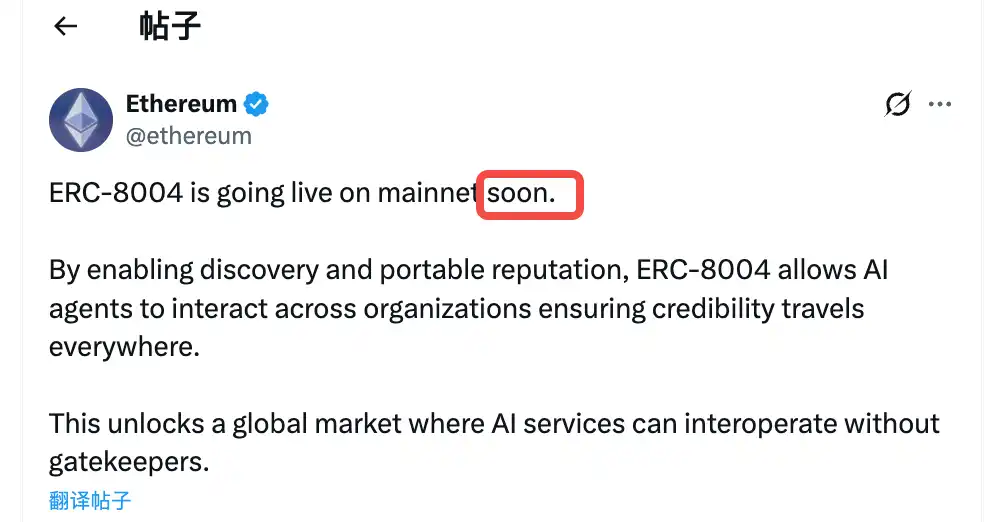
On January 28, Ethereum officially announced that the ERC-8004 protocol is about to launch on the mainnet.

We mentioned this standard in our article last October. If you are completely unfamiliar with it, you can refer here: "x402 Gradually Becoming Inward-Looking, Exploring New Asset Opportunities in ERC-8004 in Advance"

Actually, it has a formal name: "Trustless Agents." In plain language, it roughly means:

Issuing on-chain ID cards for AI Agents.

The Ethereum Foundation rarely promotes an ERC standard so vigorously. They specifically formed a team called dAI, included ERC-8004 in the 2026 strategic roadmap, collaborated with Google, Coinbase, and MetaMask to draft the proposal, and even hosted a Trustless Agents Day at DevConnect in November to build momentum.
The last time Ethereum was this serious about promoting a standard was with ERC-20 and ERC-721.

One defined tokens, the other defined NFTs.

Now it's AI's turn?

Ethereum's AI Anxiety

Why the rush?

Look at some data. According to statistics from Cookie.fun, the market cap distribution of AI Agent tokens shows that Solana and Base together account for 96%. There are only a handful of notable AI Agent projects on the Ethereum mainnet.

In April 2025, the ETH/BTC exchange rate fell to 0.017, a five-year low. Back then, everyone said Ethereum was not the future.

During the DeFi boom, Ethereum was the main stage. During the NFT boom, Ethereum was also the main stage. Now that AI Agents are heating up, the main stage has changed hands.

Solana processes 36 million transactions per day, while the Ethereum mainnet handles 1.13 million. High gas fees and slow speeds have developers voting with their feet. Virtuals Protocol launched on Base, ai16z (now ElizaOS) chose Solana, and even Coinbase's own AI project wasn't placed on the Ethereum mainnet.

Ethereum needs a new story.

ERC-8004 might be the beginning of that story.

Recapping ERC-8004

Back to the standard itself.

How exactly does ERC-8004 issue on-chain ID cards for AI Agents?

You don't need to understand the technical details; just know about three registries.

The first is the Identity Registry. Based on ERC-721, each AI Agent mints an NFT to prove "this is me."

The second is the Reputation Registry. It records the Agent's historical performance, who has used it, their reviews, and whether it has engaged in malicious activities.

The third is the Verification Registry. It allows third-party institutions to endorse the Agent, such as "this Agent has passed a certain security audit."
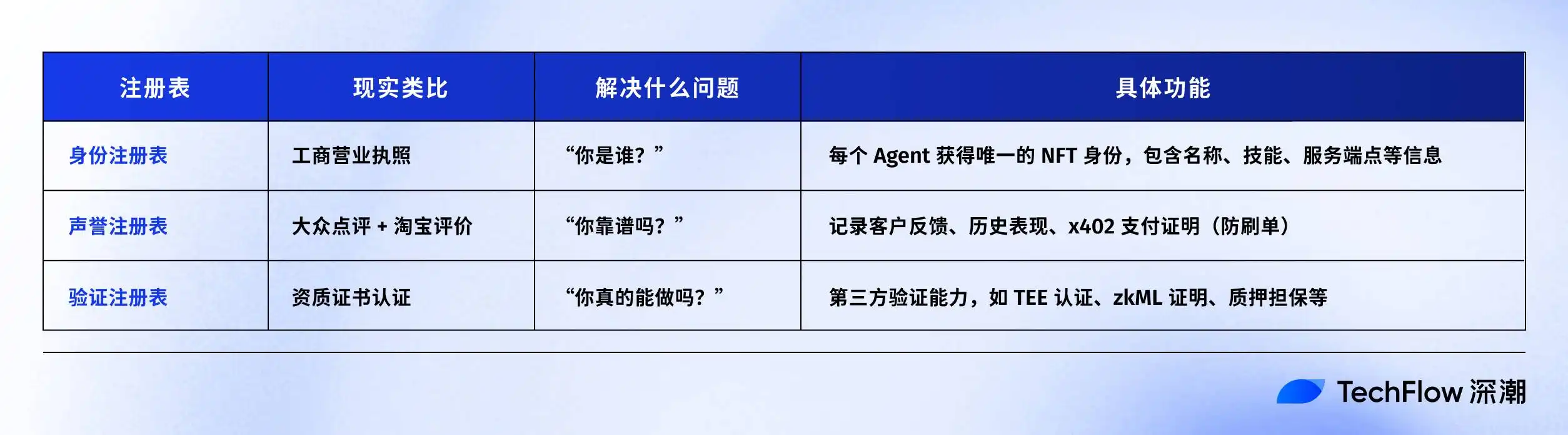
These three registries combined solve one problem: when two AI Agents meet on-chain, how do they know if the other is trustworthy?

The old answer was: they didn't know and had to rely on humans. ERC-8004's answer is: check the on-chain records.

This system wasn't entirely Ethereum's own idea.

Its underlying logic comes from the A2A (Agent-to-Agent) protocol released by Google last year, which enables AIs to communicate and call upon each other. ERC-8004 adds a layer on top of this:

Blockchain-backed trust.

Google's A2A solves the communication problem; Ethereum's ERC-8004 solves the trust problem. One manages the conversation, the other verifies identities.

Is Issuing ID Cards a Good Business?

Daring to speculate, Ethereum's logic might be this:

For AI Agents to be truly useful, they need to manage money themselves. Not just sending tweets or chatting, but directly operating on-chain assets. Signing transactions, calling contracts, cross-protocol arbitrage...

No one dares to do this on a large scale right now. The reason is simple: how do you know this Agent won't transfer your money away? The recently popular ClawdBot already has community members posting about related negative incidents.

The Web2 solution is platform endorsement. You use OpenAI's API, and the trust comes from OpenAI. If something goes wrong, you go to OpenAI.

Web3 doesn't have this. Agents are open-source, deployment is permissionless, and they run on-chain with no one overseeing them. If you call a service from an unknown Agent, you can't check who is behind it, whether the code has issues, or if it has a history of malicious acts...

Simply put, ERC-8004 essentially moves the traditional finance KYC process on-chain. Ethereum is betting that when AI Agents start handling real money, this system will become a necessity.

DeFi protocols wanting to integrate external Agents will first need to check their on-chain identity. Institutions using Agents for trade execution will need to review their historical records. Auditing firms can issue on-chain certifications for Agents, similar to security audits for smart contracts.

This is a competitive positioning move.

Ethereum knows it has lost on the execution layer, but the trust layer is still up for grabs. Institutional recognition, security audit ecosystems, TVL scale—these are Ethereum's existing assets. ERC-8004 is packaging these assets into a standard, aiming to define "what AI Agent compliance looks like" before anyone else.

The question is, does this demand exist now?

Standard Preceding Demand

After discussing Ethereum's calculations, let's talk about reality. What are on-chain AI Agents doing now?

After the AI meme wave subsided last year and the rapid advancements made by leading AI companies in the past couple of years, few people are still paying attention to on-chain AI Agents.

However, they are still making progress.

For example, ai16z has been renamed ElizaOS, evolving from a single Agent to a cross-chain platform; Virtuals Protocol is working on AI DAPPs, planning to venture into physical robots in 2026; others, like the AI Agents in Surf, can automatically execute DeFi trading strategies.

But the question arises: do they really need ERC-8004?

Luna's users trust Luna because it's made by the core Virtuals team. Agents on ElizaOS are used because they run within the ElizaOS framework; Surf executes strategies for you often because you trust the application itself.

Trust comes from the platform, not from an on-chain identity.

The scenario ERC-8004 envisions is: a陌生 (strange) Agent approaches you, with no platform endorsement or brand recognition, and you can only judge its trustworthiness through on-chain records.

When will this scenario occur?

When AI Agents truly achieve autonomous calls across protocols, platforms, and organizational boundaries. An Agent borrowing from Aave, trading on Uniswap, then generating yield in another protocol, all without human approval...

But, this scenario does not exist now.

Current AI Agents, no matter how complex their functions, essentially operate within a single platform. They don't need to prove themselves to陌生 protocols because they never knock on their doors.

Given the current hype in the crypto market, they also have no reason to knock on each other's doors, unless they can jointly create a new narrative.

Therefore, ERC-8004 solves a future problem.

If AI Agents evolve from toys to tools, Ethereum's trust infrastructure will have value. If the Agent economy grows large enough and cross-platform calls become the norm, ERC-8004 can collect tolls.

There are many "ifs."

Thus, for this future-oriented布局 (layout), institutions might be the first to act.

In late 2025, SharpLink Gaming announced investing $170 million into Ethereum restaking strategies. Around the same time, net outflows of ETH from exchanges exceeded 23,000 coins, flowing into private wallets and staking protocols.

This money might be betting on Ethereum 12 to 18 months from now.

For retail investors, however, ERC-8004 isn't a great catalyst.

Betting on ERC-8004 itself? It's an open standard with no token; you can't invest directly, only find some associated small projects. Betting on Ethereum is possible, but Ethereum's price is influenced by too many factors, with AI Agents being just one narrative.

Therefore, there is currently no clean asset that allows you to accurately bet on the proposition "AI Agents need on-chain identities."

Ethereum is not solely AI infrastructure, and Ethereum's identity anxiety won't be completely alleviated by AI. The business of issuing AI ID cards still has a long way to go.

Criptos en tendencia

Preguntas relacionadas

QWhat is the main purpose of the ERC-8004 protocol announced by Ethereum?

AThe main purpose of ERC-8004, also known as 'Trustless Agents', is to provide a chain-based identity system for AI Agents. It creates a decentralized framework for issuing and verifying digital identities, reputation, and third-party attestations for AI Agents on the blockchain, enabling trustless interactions between them.

QWhy is Ethereum heavily promoting the ERC-8004 standard according to the article?

AEthereum is promoting ERC-8004 aggressively because it aims to capture the emerging AI Agent market, where it currently lags behind chains like Solana and Base. By establishing a trust layer for AI Agents, Ethereum seeks to leverage its strengths in security, institutional recognition, and ecosystem maturity to define the standard for AI Agent compliance and trust in the blockchain space.

QWhat are the three key registries proposed in the ERC-8004 standard?

AThe three key registries in ERC-8004 are: 1) The Identity Registry, which uses ERC-721 to mint NFTs as proof of identity for each AI Agent; 2) The Reputation Registry, which records historical performance and user evaluations of Agents; and 3) The Verification Registry, which allows third-party entities to provide attestations or audits for Agents.

QDoes the current AI Agent ecosystem on blockchain have an immediate need for ERC-8004?

ANo, the current AI Agent ecosystem does not have an immediate need for ERC-8004. Most AI Agents operate within single platforms or under trusted brands, where trust is derived from the platform itself rather than decentralized identity verification. ERC-8004 addresses a future scenario where cross-protocol, autonomous AI interactions become common.

QWhat underlying protocol does ERC-8004 build upon for AI Agent communication?

AERC-8004 builds upon Google's A2A (Agent-to-Agent) protocol, which enables AI Agents to communicate and invoke each other. Ethereum's contribution adds a blockchain-based trust layer to this framework, ensuring decentralized identity verification mechanisms for secure interactions.

Lecturas Relacionadas

Ethereum Q1 2026 Report: Fees Decline, Users and Transaction Volume Hit New Highs

Ethereum Q1 2026 Report: Fees Down, Users & Transactions Hit New Highs Token Terminal's Q1 2026 report on Ethereum presents a pivotal development: the network achieved record highs in monthly active users (13.2M, +85.9% YoY), total transactions (200.4M, +81.5% YoY), and throughput (25.78 TPS), while transaction fees on the mainnet plummeted by 47.9% quarter-over-quarter. This shift is attributed to the network's strategic move into a "low fees for scale" phase, exemplified by the Fusaka upgrade which increased data capacity and lowered block space costs, releasing pent-up demand (a manifestation of Jevons's Paradox). The report highlights a core narrative shift for Ethereum: from a DeFi-centric blockchain to a global financial settlement layer. It maintains a dominant position in tokenized assets, holding majority market shares among top chains in stablecoins (61.8%), tokenized funds (73.0%), and tokenized commodities (84.0%). Growth in tokenized funds (+73.1% YoY) and commodities (+325.9% YoY) was particularly strong, driven by institutions like BlackRock and JPMorgan entering the space. Contrasting these usage gains, several USD-denominated value metrics declined in Q1: fully diluted market cap fell 30.3% QoQ, total value locked (TVL) dropped 11.0%, and ecosystem transaction volume decreased 24.0%. The report interprets this as Ethereum prioritizing long-term network expansion and cementing its role as the default settlement layer for finance over short-term fee capture. The commentary from Etherealize argues that, much like the early internet, Ethereum's open, permissionless model is poised to win over closed alternatives as institutional tokenization accelerates.

marsbitHace 4 min(s)

Ethereum Q1 2026 Report: Fees Decline, Users and Transaction Volume Hit New Highs

marsbitHace 4 min(s)

He Just Raised 2.7 Billion, and Li Fei-Fei Also Invested

Pete Florence, a former senior research scientist at Google DeepMind and a key contributor to the Vision-Language-Action (VLA) model architecture, is deliberately distancing his startup, Generalist AI, from the trendy "world model" label. He argues that the industry should prioritize concrete goals over buzzwords. His goal is to create robots that can perform a vast range of unseen tasks with high speed and success rates, without needing task-specific training data. Recently, his company raised $400 million (¥2.7 billion) at a $2 billion valuation. Notable investors include NVIDIA's NVentures, Bezos Expeditions, NFDG, as well as Xiaomi co-founder Lin Bin, Zoom founder Eric Yuan, and renowned AI scientist Fei-Fei Li. Florence's approach stems from his academic background at MIT under Professor Russ Tedrake, focusing on understanding the physical world. After joining DeepMind, he developed models like Transporter Network and co-created the VLA framework. He left in 2025 to found Generalist AI. The company has launched two models: GEN-0, which demonstrated that scaling laws apply to physical motion, and GEN-1. GEN-1 was trained on over 500,000 hours of physical interaction data collected via a specialized wearable device. It achieves a 99% success rate on precise mechanical tasks like folding boxes and maintains performance three times faster than its predecessor. Florence believes GEN-1 is reaching a commercial utility threshold similar to the GPT-3 inflection point. The substantial funding round, following GEN-1's release, signifies strong investor confidence in Generalist AI's practical, goal-driven path to creating versatile, useful robots, regardless of the "world model" terminology.

marsbitHace 11 min(s)

He Just Raised 2.7 Billion, and Li Fei-Fei Also Invested

marsbitHace 11 min(s)

Two Legends Lost in Three Days: Is Google's AI Talent Dam Cracking?

In three days, Google lost two AI legends. On June 18, Noam Shazeer, co-author of the seminal "Attention is All You Need" paper and Gemini co-lead, left for OpenAI. Just 48 hours later, John Jumper, 2024 Nobel laureate and AlphaFold lead, departed DeepMind for Anthropic. This follows Andrej Karpathy joining Anthropic in May. These moves highlight a structural trend: top AI talent is concentrating at mission-driven, pre-IPO firms like OpenAI and Anthropic, while Google becomes a primary source. The exodus stems from a core mission mismatch. Google's ad-centric model often subordinates AI research to product and revenue goals, creating friction for pioneers like Shazeer, who returned in 2024 only to leave again. In contrast, OpenAI and Anthropic offer singular focus on pushing AI boundaries, whether towards AGI or safety-aligned models, which deeply appeals to top researchers like Jumper. Financial incentives amplify the pull. With both OpenAI and Anthropic nearing IPO, employees stand to gain immensely from equity, an upside Google's mature stock cannot match. Furthermore, the 2023 merger of Google Brain and DeepMind, intended to consolidate strength, has instead created cultural tension and slowed the path from research to product, as evidenced by Gemini's pace. This talent redistribution is reshaping the AI landscape. While Google retains vast data and compute resources, its true crisis is the quiet, continuous loss of the people who define the field's future. The real moat in AI is not infrastructure, but the concentration of brilliant minds—a battle Google is currently losing.

marsbitHace 2 hora(s)

Two Legends Lost in Three Days: Is Google's AI Talent Dam Cracking?

marsbitHace 2 hora(s)

Behind the AI Report Card, Lies a Chinese 'Exam Setter'

Beyond the familiar performance charts like MMLU-Pro and MMMU, which major AI models strive to ace, stands a key "examiner": Chinese-Canadian researcher Wenhu Chen. An assistant professor at the University of Waterloo and founder of TIGERLab, Chen addresses the crucial need for more rigorous AI evaluation. As models like GPT-4 began scoring near-perfect results on older benchmarks like MMLU, it became difficult to distinguish their true capabilities. In response, Chen introduced MMLU-Pro in 2024, featuring harder, more reasoning-focused questions with more answer choices, successfully reintroducing meaningful performance gaps. His work extends to multi-modal evaluation with MMMU and its enhanced version, MMMU-Pro. These benchmarks test a model's ability to understand and reason with complex information from images, charts, and text across diverse academic subjects, exposing the significant challenges even top models face in genuine comprehension. Chen's background in complex QA, table reasoning, and his experience at Google DeepMind on projects like Gemini inform his approach. He understands that effective benchmarks must anticipate how models might "cheat" by memorizing data or avoiding visual analysis. His lab also actively researches video understanding and generation models (e.g., UniVideo, Vamba), ensuring his evaluation work is grounded in practical model-building challenges. Now at Meta's Super Intelligence Lab, Chen continues his focus on multi-modal data and evaluation, representing the deep yet often unseen contributions of Chinese talent in shaping the fundamental tools of the AI industry.

marsbitHace 2 hora(s)

Behind the AI Report Card, Lies a Chinese 'Exam Setter'

marsbitHace 2 hora(s)

Trading

Spot
Futuros

Artículos destacados

Cómo comprar ID

¡Bienvenido a HTX.com! Hemos hecho que comprar SPACE ID (ID) sea simple y conveniente. Sigue nuestra guía paso a paso para iniciar tu viaje de criptos.Paso 1: crea tu cuenta HTXUtiliza tu correo electrónico o número de teléfono para registrarte y obtener una cuenta gratuita en HTX. Experimenta un proceso de registro sin complicaciones y desbloquea todas las funciones.Obtener mi cuentaPaso 2: ve a Comprar cripto y elige tu método de pagoTarjeta de crédito/débito: usa tu Visa o Mastercard para comprar SPACE ID (ID) al instante.Saldo: utiliza fondos del saldo de tu cuenta HTX para tradear sin problemas.Terceros: hemos agregado métodos de pago populares como Google Pay y Apple Pay para mejorar la comodidad.P2P: tradear directamente con otros usuarios en HTX.Over-the-Counter (OTC): ofrecemos servicios personalizados y tipos de cambio competitivos para los traders.Paso 3: guarda tu SPACE ID (ID)Después de comprar tu SPACE ID (ID), guárdalo en tu cuenta HTX. Alternativamente, puedes enviarlo a otro lugar mediante transferencia blockchain o utilizarlo para tradear otras criptomonedas.Paso 4: tradear SPACE ID (ID)Tradear fácilmente con SPACE ID (ID) en HTX's mercado spot. Simplemente accede a tu cuenta, selecciona tu par de trading, ejecuta tus trades y monitorea en tiempo real. Ofrecemos una experiencia fácil de usar tanto para principiantes como para traders experimentados.

183 Vistas totalesPublicado en 2024.12.12Actualizado en 2026.06.02

Cómo comprar ID

Discusiones

Bienvenido a la comunidad de HTX. Aquí puedes mantenerte informado sobre los últimos desarrollos de la plataforma y acceder a análisis profesionales del mercado. A continuación se presentan las opiniones de los usuarios sobre el precio de ID (ID).

活动图片