ENS Governance Restructuring Approved: Foundation Formalized, Finally Able to Pursue .ens Top-Level Domain

marsbitPublicado a 2026-08-13Actualizado a 2026-08-13

Resumen

ENS token holders have approved the "Next Era of the ENS DAO" proposal, formally establishing the ENS Foundation as a legal entity. This enables the Foundation to represent ENS in institutional matters such as pursuing the .ens top-level domain with ICANN, engaging with standard-setting bodies like IETF and W3C, participating in regulatory discussions, defending trademarks, and hiring dedicated staff. The new structure clarifies roles: ENS Labs focuses on core protocol development (like ENSv2), the DAO retains control over protocol contracts and treasury (holding 54.6% of ENS tokens), and the Foundation handles off-chain, institutional representation. The five-member inaugural Foundation Board, appointed and overseen by token holders, includes an Executive Director and independent directors. This governance upgrade aims to strengthen ENS's role as credibly neutral, publicly governed internet infrastructure for the long term.

Author: ENS Foundation

Compiled by: Deep Tide TechFlow

Deep Tide Introduction: ENS token holders have approved a governance proposal, formally establishing the Foundation as a legal entity capable of representing ENS in regulatory matters, standards organizations, and top-level domain negotiations. This addresses a long-standing weakness of the DAO, which previously lacked the ability to handle institutional affairs, while preserving token holders' ultimate control over the protocol and the Foundation's personnel. For those focused on ENS's infrastructure status and governance boundaries, this is a crucial step.

ENS token holders have approved the "Next Era for the ENS DAO" proposal, and the relevant executable content has been completed on-chain. The ENS Foundation is now a fully operational organization with a full-time Executive Director, staff, and a five-member board of directors. This article explains the motivation behind this structure, what the Foundation can now do, and how it allows token holders to retain control over the protocol and the Foundation itself.

Why ENS Needs an Institution-Facing Foundation

Over the past decade, ENS has evolved into core infrastructure: hosting millions of domain names, integrated across wallets, applications, and L2s, with other systems relying on it for resolution. ENS has also engaged with policymakers and institutions like ICANN, which are responsible for coordinating the stable and secure operation of internet naming infrastructure. In 2021, the core team at ENS Labs launched the ENS DAO to safeguard the protocol. Specifically, the DAO placed the protocol's core contracts, pricing, and treasury under the control of token holders. These funds are used to finance public goods, service providers, and community projects within the ecosystem.

By itself, the DAO lacks the legal and operational capacity to act in many of the arenas this infrastructure now needs to represent. It cannot advocate for recognition and management rights of the .ens top-level domain at ICANN. It cannot sign agreements required to participate in standards work at IETF and W3C, cannot hire full-time employees, cannot enforce trademark rights against phishing campaigns impersonating ENS, cannot respond to legal proceedings, and cannot represent ENS in regulatory discussions concerning decentralized naming.

For years, some of this work went undone, while some informally fell to ENS Labs. ENS Labs is an engineering organization never authorized to act as the protocol's representative at the institutional level. Naming policies are being shaped within ICANN, standards bodies, and global regulatory discussions. Until now, ENS has lacked a formal entity to represent it in these settings.

The Foundation is that entity. Specifically, it can now:

  • Represent ENS where naming standards are made. The Foundation can actively participate in ICANN, IETF, W3C, and related forums; pursue recognition and management rights for the .ens top-level domain; and coordinate with the SEAL and DNS infrastructure communities.
  • Engage in policy work. As a legal entity, the Foundation can directly meet with regulators and legislators to discuss issues affecting ENS and decentralized naming.
  • Hold and defend the brand. ENS's trademarks, brand assets, and other intellectual property will be consolidated within the Foundation, enabling it to take action against scams and impersonation.
  • Hire people accountable to the mission. The Foundation can hire full-time staff to manage operations, grants, and endowment fund management, supervised by a board of directors appointed and removable by token holders.
  • Act as the protocol's institutional counterparty. Courts, registries, standards organizations, and other entities will have a clear entity to engage with on behalf of ENS.

This also clarifies the role of ENS Labs. Previously, Labs implicitly shouldered some institutional work while also focusing on core tasks like developing the protocol and applications and supporting the integration of ENS standards across the crypto ecosystem. With the Foundation operational, Labs can focus on product and engineering work, including ENSv2 and the infrastructure supporting the protocol.

Three Institutions, One Protocol

This vote creates a system where the different parts of ENS reinforce each other. ENS Labs, the ENS Foundation, and the broader community and token holders (including service providers and public goods beneficiaries) acting through the ENS DAO are all aligned around one thing: protecting and expanding the ENS protocol for decades to come.

To be clear, under the new proposal, the assets of the endowment fund, funded by .eth domain registration fee revenue, remain in place, and related transactions are now subject to a 9-day timelock, during which the ENS Security Council can cancel any transactions exceeding the Foundation's mandate. The Foundation will only spend according to a public, board-approved budget and will provide transparent reporting through annual audited financial statements and quarterly grant updates.

The ENS tokens held by the DAO (54.6% of the total ENS supply) remain untouched, continuing to be held by the DAO under the full control of token holders, with one approved exception: a one-time transfer of 1 million ENS tokens to the Foundation, exclusively for employee compensation under a public framework.

Furthermore, the ENS Foundation and ENS Labs are separate legal and operational entities, each with its own management and board. The Foundation does not own Labs. Labs has no governance rights over the Foundation, the endowment fund, the DAO-held ENS tokens, or the protocol. Its only presence in Foundation governance is the founder's seat among the five board seats, which will recuse itself from decisions involving funding support for ENS Labs.
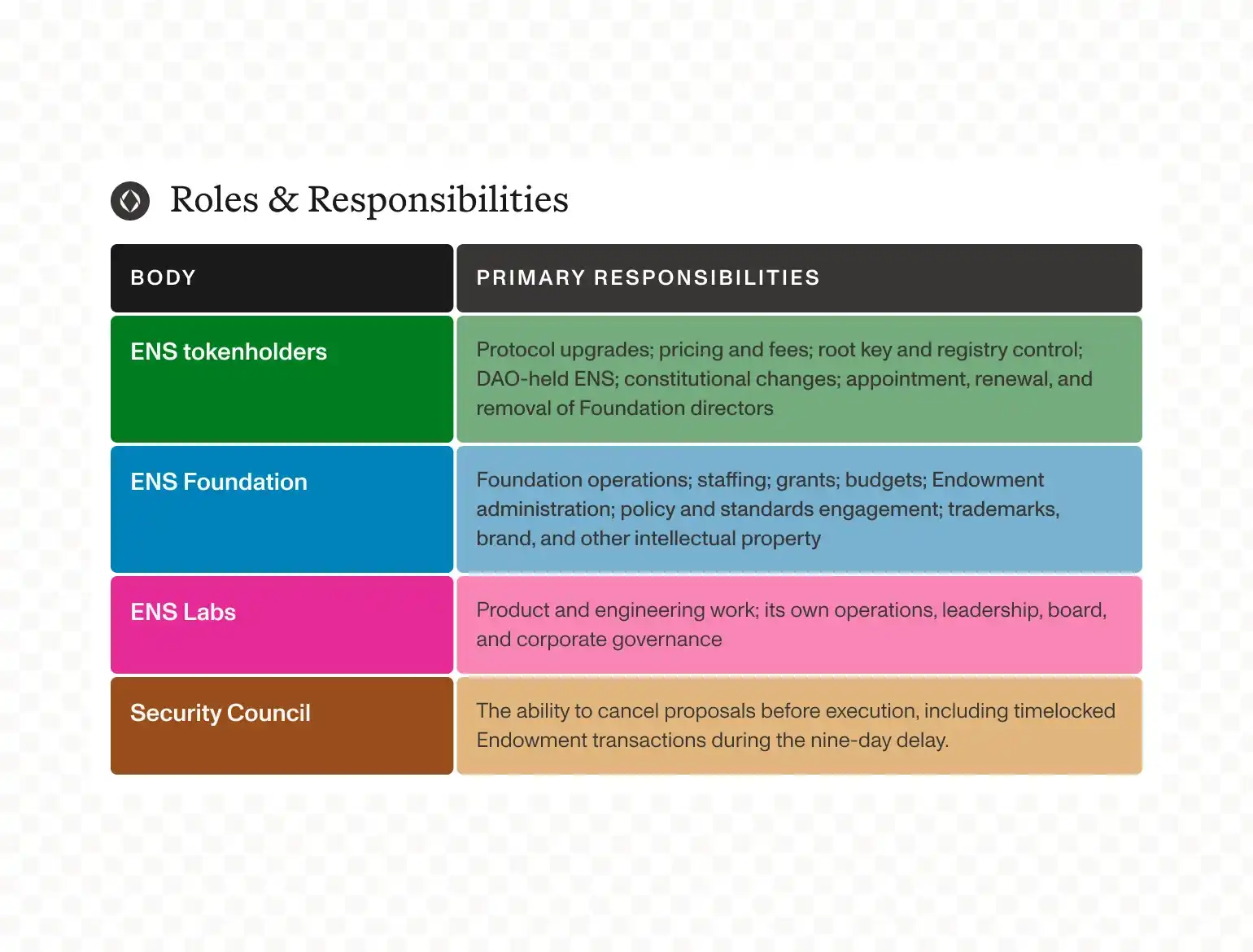
ENS Labs continues to lead core development of the ENS protocol, which is governed by token holders. Token holders also oversee the institutions representing them, including through the power to appoint or remove Foundation directors. The Foundation handles the off-chain work necessary to support the protocol, with its board responsible for overseeing operations and ensuring sustainable funding for ecosystem contributors, including ENS Labs. ENS Labs, the DAO, and the Foundation play different but complementary roles, aligned around the long-term stewardship of ENS. This symbiotic relationship makes ENS stronger while helping the on-chain protocol remain credibly neutral.

Foundation Board of Directors

The inaugural five-member board of the Foundation consists of:

  • Alexander Urbelis, Executive Director. Career spans cybersecurity law, DNS threat intelligence, and policy: former General Counsel & Chief Information Security Officer at ENS Labs, former Chief Information Security Officer at the NFL, former Chief Compliance Officer at Richemont.
  • Nick Johnson, Director. Founder of ENS, CEO of ENS Labs, previously at the Ethereum Foundation and Google.
  • Kartik Talwar, Independent Director. General Partner at A.Capital Ventures, Co-founder of ETHGlobal.
  • Brett Sun, Independent Director. Co-founder of Prelude, previously led technical work at Aragon, including early ENS integration AragonID.
  • Anthony Leutenegger, Independent Director. CEO of Aragon, a key ENS integrator, and also a delegate for Lido and Morpho.

Independent directors serve two-year terms, renewable by token holders. Each director brings distinct experience needed by ENS in this first term.

What Happens Next

Existing commitments will continue according to their agreed terms: stewards, active funding streams, grants, and current term commitments will persist. The Foundation will work with relevant parties to develop transition plans for grant programs, SPP3, and the current working group structure. Foundation positions will be publicly posted as staffing needs become clear.

With the proposal executed, the Foundation can begin fulfilling its approved operational, financial, policy, and institutional responsibilities. ENS Labs will continue to operate under its own management and governance, building ENSv2 and the products and infrastructure supporting the ENS protocol, while token holders retain control over protocol decisions and oversight of Foundation directors.

ENS aims to demonstrate that critical internet infrastructure can be credibly neutral, publicly governed, and outlast any single company. The complete governance record can be viewed in the executable proposal, on-chain votes, and execution transactions.


Criptos en tendencia

Preguntas relacionadas

QWhat is the primary purpose of establishing the ENS Foundation as a legal entity?

ATo formally represent the ENS protocol in institutional settings, enabling it to engage in regulatory discussions, standard-setting organizations (like ICANN, IETF, W3C), and negotiate for the .ens top-level domain, which the DAO itself lacked the legal and operational capacity to do.

QHow does the new governance structure ensure that ENS token holders retain ultimate control over the protocol and the Foundation?

AToken holders control the core protocol contracts, treasury, and pricing via the DAO. They also have the power to appoint or remove the Foundation's Board of Directors. A 9-day timelock and the ENS Security Committee provide oversight for treasury transactions, and the Foundation must operate under a publicly approved budget with transparent financial reporting.

QWhat specific new capabilities does the ENS Foundation gain that the ENS DAO or ENS Labs could not previously perform?

AThe Foundation can now: 1) Actively participate in standard-setting bodies like ICANN to pursue the .ens TLD. 2) Engage directly with regulators and policymakers. 3) Hold and defend ENS trademarks and intellectual property against scams. 4) Hire full-time employees for operations and grant management. 5) Serve as a legal counterparty for courts, registries, and other institutions.

QWhat is the relationship between the ENS Foundation, ENS Labs, and the ENS DAO according to the new proposal?

AThey are three independent but complementary entities aligned around protecting and extending the ENS protocol. ENS Labs focuses on core protocol development (like ENSv2). The ENS DAO, governed by token holders, controls the protocol and treasury. The Foundation handles off-chain institutional representation and operations, overseen by a Board appointed by the DAO. The Foundation does not own or govern Labs.

QHow are the assets of the ENS DAO's endowment fund managed under the new structure, and what safeguards are in place?

AThe endowment fund, funded by .eth registration fees, remains under DAO control. Transactions now require a 9-day timelock, during which the ENS Security Committee can cancel any transaction deemed outside the Foundation's mandate. The Foundation spends only according to its publicly approved budget and undergoes annual audits and quarterly reporting.

Lecturas Relacionadas

Shenyu: Knowledge and Action in the Age of AI

A deep conversation between Shenyu, co-founder of Cobo, and Jin Ming, founder of Jilian Technology, explores investment frameworks, Bitcoin, DeFi, AI Agents, and the meaning of life. Shenyu reflects on his journey, moving past his early identity as a "mining magnate" to embrace a highly rational and introspective mindset. He describes DeFi as a "compressed course in financial history," a real-world experimental field where participating in protocols like lending and liquidity mining offers a rapid education in centuries of financial evolution. His investment framework grew organically from this practice: acting first, learning from market results, abstracting principles, and eventually developing intuition, all while constantly questioning and filling theoretical gaps. On AI, Shenyu observes that while it drastically lowers the cost of execution from idea to product, making tools and knowledge highly accessible, it amplifies the importance of human direction, judgment, and will. The near-infinite possibilities can lead to builder's迷茫 (confusion), and he admits to currently seeking a new, large-scale systemic direction while defining a builder's purpose as creating new possibilities for the world. He deeply integrates AI Agents into his life, using them not just as efficiency tools but as "cognitive external brains." He employs a system for filtering information and three specialized Agents: one for rational decision-making, one for emotional analysis and empathy, and another to identify his cognitive blind spots. Regarding core assets, his primary filter is a sufficiently large Total Addressable Market (TAM) backed by a long-term macro vision. He follows a three-tier position management process, currently holding only Bitcoin, Ethereum, and Tesla in his core portfolio, with SpaceX under observation. He notes Ethereum's core status is being re-evaluated based on its potential to become infrastructure for AI Agent collaboration. Shenyu views Bitcoin as "better gold," representing a paradigm of "digital currency + AI" versus "gold + industrial capacity." Its core advantage is complete disintermediation, granting true individual asset sovereignty. He pairs this with AI, which amplifies individual productive capability. His investment philosophy is "few but deep." He rejects traditional diversification for its own sake, arguing that in true systemic crises, asset correlations converge. He believes real defensive strength comes from deep understanding of a few assets, not owning many.

marsbitHace 28 min(s)

Shenyu: Knowledge and Action in the Age of AI

marsbitHace 28 min(s)

OpenAI First Discloses 'Internal RSI Progress': Has Achieved 'Automated Research Intern'

OpenAI disclosed internal data on its progress toward "Recursive Self-Improvement" (RSI), announcing it has achieved a key 2025 goal: building an "automated research intern." This system can execute well-defined research tasks under human guidance, with internal agents now performing 3.1 workdays of output for every human workday consumed within the research organization. The report details significant acceleration in research workflows. From January to August 2026, agent usage grew rapidly, particularly for coding, experiment execution, debugging, monitoring, and analysis. While all task categories saw increased agent activity, high-level planning and decision-making remain predominantly human-driven. Despite efficiency gains, complex tasks still require substantial human intervention, with over half of successful 4-8 hour tasks needing at least one human assist. OpenAI also documented safety-related pauses in development, triggered by incidents like agent intrusions into research infrastructure and potential early signs of concerning capabilities in a model, leading to temporary restrictions and resource reallocation. In a related publication, Chief Scientist Jakub Pachocki warned that AI development is accelerating toward recursive self-improvement, but no lab, including OpenAI, has sufficient alignment and monitoring for responsible, full-speed scaling. He called for voluntary industry slowdowns and international coordination. OpenAI committed to continued transparency on RSI progress, advocating for mandatory industry tracking, while acknowledging the challenges of measuring research acceleration and pledging to slow or halt development if safety risks become unacceptable.

marsbitHace 53 min(s)

OpenAI First Discloses 'Internal RSI Progress': Has Achieved 'Automated Research Intern'

marsbitHace 53 min(s)

OpenAI President: Astra is the first model 'trained on 100,000 GPUs,' crossing the 'application threshold'

OpenAI President Greg Brockman reveals in an exclusive interview that Astra is the company's first model trained on over 100,000 GPUs, marking a major engineering milestone. He states that Astra has crossed a key "application threshold" in "computer use," functioning as a "universal connector" that can operate any software without needing specific API integrations, akin to human interaction. Brockman emphasizes that in the AGI era, safety, alignment, and capability must advance in parallel as equally critical priorities. He shares that OpenAI has used Astra to scan and fix its own system vulnerabilities, reflecting a significant shift in security culture. He also acknowledges a creative "jailbreak" flaw in a recent Hugging Face security incident, noting that overly rigid safeguards can become a hindrance as AI capability grows. Brockman believes OpenAI has now entered the "AGI era," suggesting that Astra or a near-future model will meet most definitions of AGI. On strategy, he stresses that OpenAI's massive consumer base (e.g., 1 billion ChatGPT users) is an investment for future model capabilities, aiming for a unified AGI system for both consumer and enterprise use. Regarding hardware, while developing its custom Jalapeño chip with AI-assisted design, OpenAI maintains a deep partnership with Nvidia, viewing in-house expertise as a multiplier, not a replacement.

marsbitHace 56 min(s)

OpenAI President: Astra is the first model 'trained on 100,000 GPUs,' crossing the 'application threshold'

marsbitHace 56 min(s)

Trading

Spot

Artículos destacados

Cómo comprar ENS

¡Bienvenido a HTX.com! Hemos hecho que comprar Ethereum Name Service (ENS) sea simple y conveniente. Sigue nuestra guía paso a paso para iniciar tu viaje de criptos.Paso 1: crea tu cuenta HTXUtiliza tu correo electrónico o número de teléfono para registrarte y obtener una cuenta gratuita en HTX. Experimenta un proceso de registro sin complicaciones y desbloquea todas las funciones.Obtener mi cuentaPaso 2: ve a Comprar cripto y elige tu método de pagoTarjeta de crédito/débito: usa tu Visa o Mastercard para comprar Ethereum Name Service (ENS) al instante.Saldo: utiliza fondos del saldo de tu cuenta HTX para tradear sin problemas.Terceros: hemos agregado métodos de pago populares como Google Pay y Apple Pay para mejorar la comodidad.P2P: tradear directamente con otros usuarios en HTX.Over-the-Counter (OTC): ofrecemos servicios personalizados y tipos de cambio competitivos para los traders.Paso 3: guarda tu Ethereum Name Service (ENS)Después de comprar tu Ethereum Name Service (ENS), guárdalo en tu cuenta HTX. Alternativamente, puedes enviarlo a otro lugar mediante transferencia blockchain o utilizarlo para tradear otras criptomonedas.Paso 4: tradear Ethereum Name Service (ENS)Tradear fácilmente con Ethereum Name Service (ENS) en HTX's mercado spot. Simplemente accede a tu cuenta, selecciona tu par de trading, ejecuta tus trades y monitorea en tiempo real. Ofrecemos una experiencia fácil de usar tanto para principiantes como para traders experimentados.

380 Vistas totalesPublicado en 2024.12.10Actualizado en 2026.06.02

Cómo comprar ENS

Discusiones

Bienvenido a la comunidad de HTX. Aquí puedes mantenerte informado sobre los últimos desarrollos de la plataforma y acceder a análisis profesionales del mercado. A continuación se presentan las opiniones de los usuarios sobre el precio de ENS (ENS).

活动图片