End Of Bitcoin Distribution? Key Data Reveals A Shift In LTH Behavior

bitcoinistPublicado a 2025-12-31Actualizado a 2025-12-31

Resumen

Bitcoin is trading below $90,000 amid deteriorating market sentiment, with analysts warning of a potential bear market. However, on-chain data suggests a shift in long-term holder (LTH) behavior. While social media narratives claim LTHs are distributing Bitcoin at record levels, analysis shows that recent large transfers—including 800,000 BTC moved from Coinbase—skewed the data. After adjusting for this anomaly, LTH supply appears to be stabilizing or even recovering, with a reduction in selling pressure. This shift, combined with short-term holders holding positions, indicates easing sell-side pressure. Bitcoin is currently consolidating around $88K, just above the 200-day moving average—a key support level. A break below could expose the $75K–$80K range, but the current data challenges the dominant bearish narrative and may signal a move toward market balance.

Bitcoin continues to trade below the $90,000 level, struggling to regain bullish momentum as market sentiment deteriorates. A growing number of analysts are now openly calling for a broader bear market, pointing to persistent weakness, failed breakouts, and declining risk appetite across crypto. Despite this gloomy backdrop, not all market participants are convinced that Bitcoin’s next major move will be lower.

Some investors remain focused on 2026, arguing that structural conditions could begin to shift in the coming months. One of the key debates centers on long-term holders (LTHs). While social media narratives increasingly claim that LTHs are distributing Bitcoin at record levels, on-chain data suggests a more nuanced reality.

According to a report by analyst Darkfost, much of the perceived LTH selling has been distorted by large, isolated movements—particularly nearly 800,000 BTC transferred from Coinbase—which skewed traditional LTH metrics.
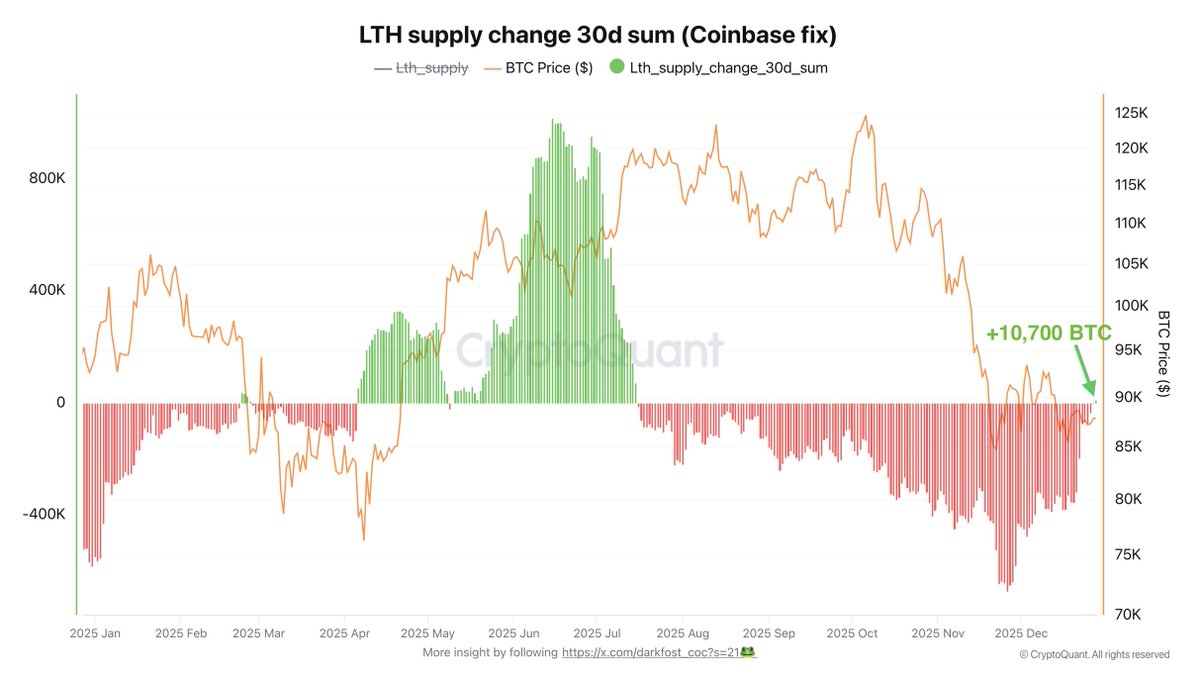
LTH Supply Change 30d sum (Coinbase) | Source: CryptoQuant

After adjusting the data to exclude this anomaly, a clear change in supply dynamics emerges. Rather than accelerating distribution, the adjusted chart shows signs that long-term holder supply is stabilizing, and in some cases beginning to recover. This challenges the dominant bearish narrative and suggests that selling pressure from seasoned holders may be fading.

As Bitcoin consolidates below key resistance, the divergence between price weakness and shifting on-chain behavior sets the stage for a critical inflection point ahead.

Long-Term Holders Reduce Selling Pressure

Darkfost adds important context to the evolving Bitcoin narrative by focusing on long-term holder (LTH) supply dynamics. According to his analysis, the monthly LTH supply change—measured as a 30-day rolling sum—had remained firmly locked in a distribution phase since July 16.

For several months, this metric consistently showed negative readings, confirming that long-term holders were gradually reducing their exposure and releasing supply into the market.

That trend has now shifted. The latest data shows the metric moving back into positive territory, with approximately 10,700 BTC transitioning into long-term held coins. While this figure is still relatively small in absolute terms, it marks a clear inflection from sustained distribution to early re-accumulation.

In practical terms, it suggests that LTHs have slowed their selling activity to the point where their aggregate supply is beginning to grow again.

This shift is particularly notable because it is occurring while short-term holders (STHs) continue to hold their positions rather than aggressively selling. The combination points to a cooling of sell-side pressure from both cohorts, even as price remains under pressure.

Historically, similar transitions in LTH supply behavior have often preceded periods of sideways consolidation or, in more constructive cases, the early stages of bullish recoveries.

While this signal alone does not guarantee an upside move, it does suggest that the market may be moving away from forced distribution and toward a more balanced phase, depending on how broader macro and price trends develop.

Bitcoin Consolidates Above Long-Term Support

Bitcoin’s price action continues to reflect a market caught between structural support and lingering downside pressure. After failing to hold above the $100K–$105K region earlier in the quarter, BTC entered a sharp corrective phase that accelerated into November. That move pushed price decisively below the 50-day and 100-day moving averages, confirming a short-term trend shift from expansion to contraction.
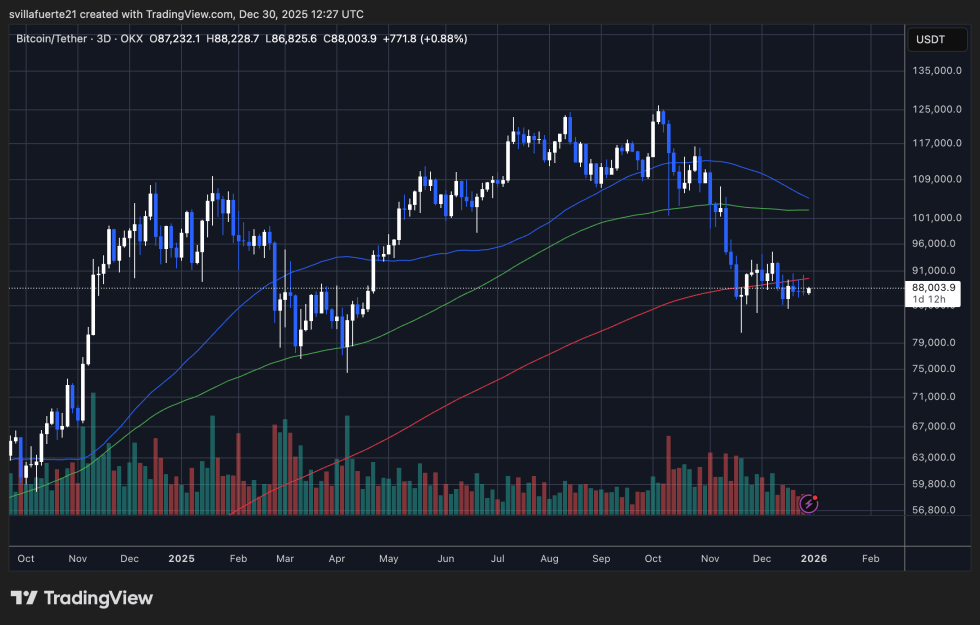
BTC price testing critical level | Source: BTCUSDT chart on TradingView

At present, Bitcoin is consolidating around the $88K zone, hovering just above the rising 200-day moving average, which sits slightly lower and continues to act as a critical long-term support.

This area has become a key battleground: repeated downside wicks suggest buyers are defending the level, but upside follow-through remains limited. The declining slope of the shorter moving averages reinforces the idea that bullish momentum has not yet returned.

Volume dynamics also support a consolidation narrative rather than active accumulation. Selling pressure has eased compared to the November breakdown, but demand has not expanded meaningfully enough to reclaim prior resistance. Structurally, the market appears to be transitioning from a high-volatility selloff into a compression phase.

As long as BTC holds above the 200-day moving average, the broader bullish structure from earlier in the cycle remains technically intact. However, a failure to defend this level would expose the $80K–$75K region as the next major support.

Featured image from ChatGPT, chart from TradingView.com

Criptos en tendencia

Preguntas relacionadas

QWhat key data suggests a shift in long-term holder (LTH) behavior according to the article?

AThe key data is the monthly LTH supply change (30-day rolling sum), which has moved back into positive territory with approximately 10,700 BTC transitioning into long-term held coins, indicating a shift from sustained selling to early re-accumulation.

QWhat event distorted the traditional LTH metrics and created a perception of record selling?

AThe perception was distorted by a large, isolated movement of nearly 800,000 BTC transferred from Coinbase, which skewed the data.

QWhat is the significance of Bitcoin's current price level in relation to the 200-day moving average?

AThe $88K zone, where Bitcoin is consolidating, is just above the rising 200-day moving average, which acts as a critical long-term support. Holding above it keeps the broader structure intact, while a break below could expose the $80K–$75K region.

QHow does the article describe the current market sentiment and the actions of short-term holders (STHs)?

AThe article describes market sentiment as deteriorating, with many analysts calling for a broader bear market. However, short-term holders (STHs) are described as continuing to hold their positions rather than aggressively selling, contributing to a cooling of sell-side pressure.

QWhat does the shift in LTH behavior historically indicate for Bitcoin's price, according to the article?

AHistorically, similar transitions in LTH supply behavior from distribution to re-accumulation have often preceded periods of sideways consolidation or the early stages of bullish recoveries.

Lecturas Relacionadas

The End of the Gold Rush? Global Demand for Precious Metals Is Changing

Global demand for precious metals is shifting. Gold started 2026 strongly, surpassing $5,500 per ounce, but experienced a sharp correction to below $4,000 by mid-year. It now behaves more like a risk asset, sensitive to interest rate changes, rather than a traditional safe haven. However, Chinese central bank purchases continue to provide fundamental support, with its gold reserves reaching record highs and approaching 10% of its total forex reserves. Analysts from J.P. Morgan forecast a year-end recovery to the $4,350-$4,650 range. Silver followed a more volatile path, soaring to $120 per ounce early in the year before halving in value, though current prices remain 70% above last year's levels. The industrial sector, particularly solar panel manufacturers (accounting for a fifth of global demand), is responding to high prices and supply deficits by increasing recycling and reducing metal usage per unit. Analysts note the supply deficit is easing due to increased mining investment, with WisdomTree projecting a gradual rise to $70 per ounce by Q2 2027, supported by expected gains in gold. In conclusion, the precious metals market demands in-depth analysis, as prices are driven by a complex mix of industrial demand and central bank policies. Investors are advised to rely on verified analysis, diversify risks, and make decisions based on objective market facts.

cryptonews.ruHace 42 min(s)

The End of the Gold Rush? Global Demand for Precious Metals Is Changing

cryptonews.ruHace 42 min(s)

Expect news tomorrow: this time the Bank of Japan will announce its interest rate decision! What impact will this have on Bitcoin?

A day before the Bank of Japan's (BOJ) interest rate decision announcement, the Japanese yen surged nearly 3% against the US dollar. The sharp move in the currency market fueled speculation that the Japanese government may have intervened again to support the yen. The USD/JPY pair fell over 400 pips to 158.5, its steepest daily drop since Japan's currency intervention earlier this year. Market participants suspect the rapid, strong yen appreciation could be due to direct foreign currency sales by Japanese authorities, though the Ministry of Finance has made no official statement. The yen had previously fallen to its weakest level against the dollar in nearly 40 years. In late April and May, the government intervened with roughly 9.6 trillion yen to prevent the USD/JPY from rising sustainably above 160, but the yen faced renewed selling pressure afterward. Investors are now focused on the BOJ's rate decision and its signals on future monetary policy. Potential hawkish signals from the BOJ are seen as a factor that could support further yen strength. A sharp yen appreciation could create short-term selling pressure on Bitcoin by increasing the risk of unwinding carry trades, where investors borrow low-yielding yen to invest in Bitcoin and other risky assets. This pressure could intensify if the BOJ takes a hawkish stance or raises interest rates.

cryptonews.ruHace 1 hora(s)

Expect news tomorrow: this time the Bank of Japan will announce its interest rate decision! What impact will this have on Bitcoin?

cryptonews.ruHace 1 hora(s)

Trading

Spot

Artículos destacados

Cómo comprar O

¡Bienvenido a HTX.com! Hemos hecho que comprar O1 exchange (O) sea simple y conveniente. Sigue nuestra guía paso a paso para iniciar tu viaje de criptos.Paso 1: crea tu cuenta HTXUtiliza tu correo electrónico o número de teléfono para registrarte y obtener una cuenta gratuita en HTX. Experimenta un proceso de registro sin complicaciones y desbloquea todas las funciones.Obtener mi cuentaPaso 2: ve a Comprar cripto y elige tu método de pagoTarjeta de crédito/débito: usa tu Visa o Mastercard para comprar O1 exchange (O) al instante.Saldo: utiliza fondos del saldo de tu cuenta HTX para tradear sin problemas.Terceros: hemos agregado métodos de pago populares como Google Pay y Apple Pay para mejorar la comodidad.P2P: tradear directamente con otros usuarios en HTX.Over-the-Counter (OTC): ofrecemos servicios personalizados y tipos de cambio competitivos para los traders.Paso 3: guarda tu O1 exchange (O)Después de comprar tu O1 exchange (O), guárdalo en tu cuenta HTX. Alternativamente, puedes enviarlo a otro lugar mediante transferencia blockchain o utilizarlo para tradear otras criptomonedas.Paso 4: tradear O1 exchange (O)Tradear fácilmente con O1 exchange (O) en HTX's mercado spot. Simplemente accede a tu cuenta, selecciona tu par de trading, ejecuta tus trades y monitorea en tiempo real. Ofrecemos una experiencia fácil de usar tanto para principiantes como para traders experimentados.

337 Vistas totalesPublicado en 2026.06.19Actualizado en 2026.06.29

Cómo comprar O

Cómo comprar PROS

¡Bienvenido a HTX.com! Hemos hecho que comprar Pharos (PROS) sea simple y conveniente. Sigue nuestra guía paso a paso para iniciar tu viaje de criptos.Paso 1: crea tu cuenta HTXUtiliza tu correo electrónico o número de teléfono para registrarte y obtener una cuenta gratuita en HTX. Experimenta un proceso de registro sin complicaciones y desbloquea todas las funciones.Obtener mi cuentaPaso 2: ve a Comprar cripto y elige tu método de pagoTarjeta de crédito/débito: usa tu Visa o Mastercard para comprar Pharos (PROS) al instante.Saldo: utiliza fondos del saldo de tu cuenta HTX para tradear sin problemas.Terceros: hemos agregado métodos de pago populares como Google Pay y Apple Pay para mejorar la comodidad.P2P: tradear directamente con otros usuarios en HTX.Over-the-Counter (OTC): ofrecemos servicios personalizados y tipos de cambio competitivos para los traders.Paso 3: guarda tu Pharos (PROS)Después de comprar tu Pharos (PROS), guárdalo en tu cuenta HTX. Alternativamente, puedes enviarlo a otro lugar mediante transferencia blockchain o utilizarlo para tradear otras criptomonedas.Paso 4: tradear Pharos (PROS)Tradear fácilmente con Pharos (PROS) en HTX's mercado spot. Simplemente accede a tu cuenta, selecciona tu par de trading, ejecuta tus trades y monitorea en tiempo real. Ofrecemos una experiencia fácil de usar tanto para principiantes como para traders experimentados.

332 Vistas totalesPublicado en 2026.06.22Actualizado en 2026.06.29

Cómo comprar PROS

Qué es VERONA

I. Introducción al Proyecto VERONA es una blockchain construida para todos, en todas partes a través de la abstracción de cadenas. Utilizando su capa de Abstracción Generalizada, VERONA se distingue por integrar funcionalidades complejas de blockchain, como cuentas, firmas e interoperabilidad, directamente a nivel de protocolo. Este enfoque permite interactuar con aplicaciones de blockchain sin necesidad de entender las tecnologías subyacentes.1) Información Básica Nombre: VERONA (VERONA)III. Enlaces Relacionados Enlace al sitio web oficial: https://xion.burnt.com/ Libro Blanco: https://xion.burnt.com/whitepaper.pdf Exploradores: https://explorer.burnt.com/ Redes Sociales: https://x.com/burnt_xion Nota: La introducción del proyecto proviene de los materiales publicados o proporcionados por el equipo oficial del proyecto, que es solo para referencia y no constituye asesoramiento de inversión. HTX no se hace responsable de ninguna pérdida directa o indirecta resultante.

406 Vistas totalesPublicado en 2026.06.22Actualizado en 2026.06.22

Qué es VERONA

Discusiones

Bienvenido a la comunidad de HTX. Aquí puedes mantenerte informado sobre los últimos desarrollos de la plataforma y acceder a análisis profesionales del mercado. A continuación se presentan las opiniones de los usuarios sobre el precio de A (A).

活动图片