Encrypted Workplace Survey: Low Salaries Widespread and Layoffs Without Compensation, How Should Practitioners Respond?

比推Publicado a 2025-12-26Actualizado a 2025-12-26

Resumen

Based on a survey of 506 professionals, the crypto industry's workplace reality is revealed to be starkly different from its "get-rich-quick" myth. Key findings show over 70% of respondents earn a monthly salary below $4,000, with compensation and benefits lagging behind traditional tech sectors. Nearly half have experienced layoffs, and 40% of those received no severance pay. Furthermore, 70% reported never receiving token-based incentives, and a quarter are in a "pay-to-work" situation, having lost money overall in the sector. Despite these challenges, factors like remote work flexibility (available to 70%), manageable working hours, and the freedom to take on side jobs contribute to a moderate job satisfaction score of 3.51/5. Over 80% of respondents plan to remain in the industry, driven by the long-term goal of accumulating $1-5 million for retirement, though most are pessimistic about the 2026 job market outlook.

Author: Deep Tide TechFlow

Original Title: 2025 Crypto Industry Workplace Survey: 70% Earn Less Than $4,000 Monthly, N+1 Severance Becomes a Distant Hope


While Xiaohongshu still glorifies the "get-rich-quick myths" and "six-figure salaries" of Web3, what is the true state of the crypto industry?

Through 506 survey questionnaires, we engaged in a candid conversation with practitioners, and the results were surprising, even harsh: there is no gold rush here. Over 70% of people earn less than $4,000 per month, which is generally lower than in developed regions like Europe and the United States. Even a quarter of respondents are in a "pay-to-work" loss-making state; there is also no comprehensive protection, with nearly half having experienced layoffs, and most not receiving N+1 compensation.

Yet, despite this, over 80% choose to stay. Is it because of the 70% remote work freedom? Or is it because of the shared dream of "retiring with $5 million"?

In this report, we attempt to use cold, hard data to reveal the most genuine anxieties, desires, and survival strategies of Web3 workers.

This content is the questionnaire results section of the "Web3 Recruitment and Job Hunting 2025 Year-End Review: Who's Making Money, Who's Paying to Work?" Full report available at:

https://www.techflowpost.com/article/detail_29702.html

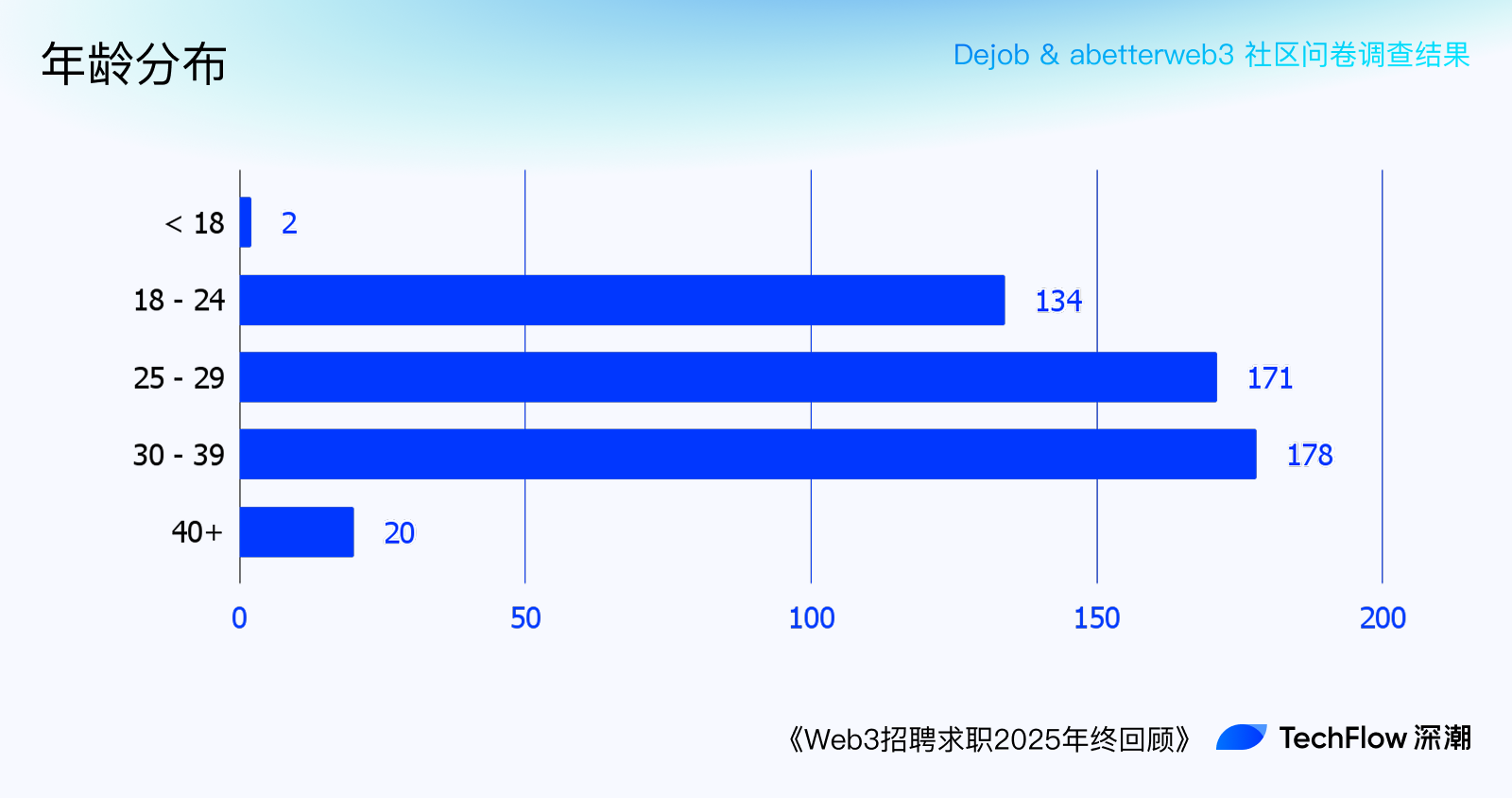
Regarding age distribution, the main workforce aged 18-29 is indeed the majority, but middle-aged practitioners (>30 years old) are also quite numerous. This might be related to the less severe "age 35 ceiling" in the Web3 industry. Compared to internet companies, Web3 companies value experience, ability, and efficiency more, with many hoping that seasoned professionals can quickly build products "plug-and-play".
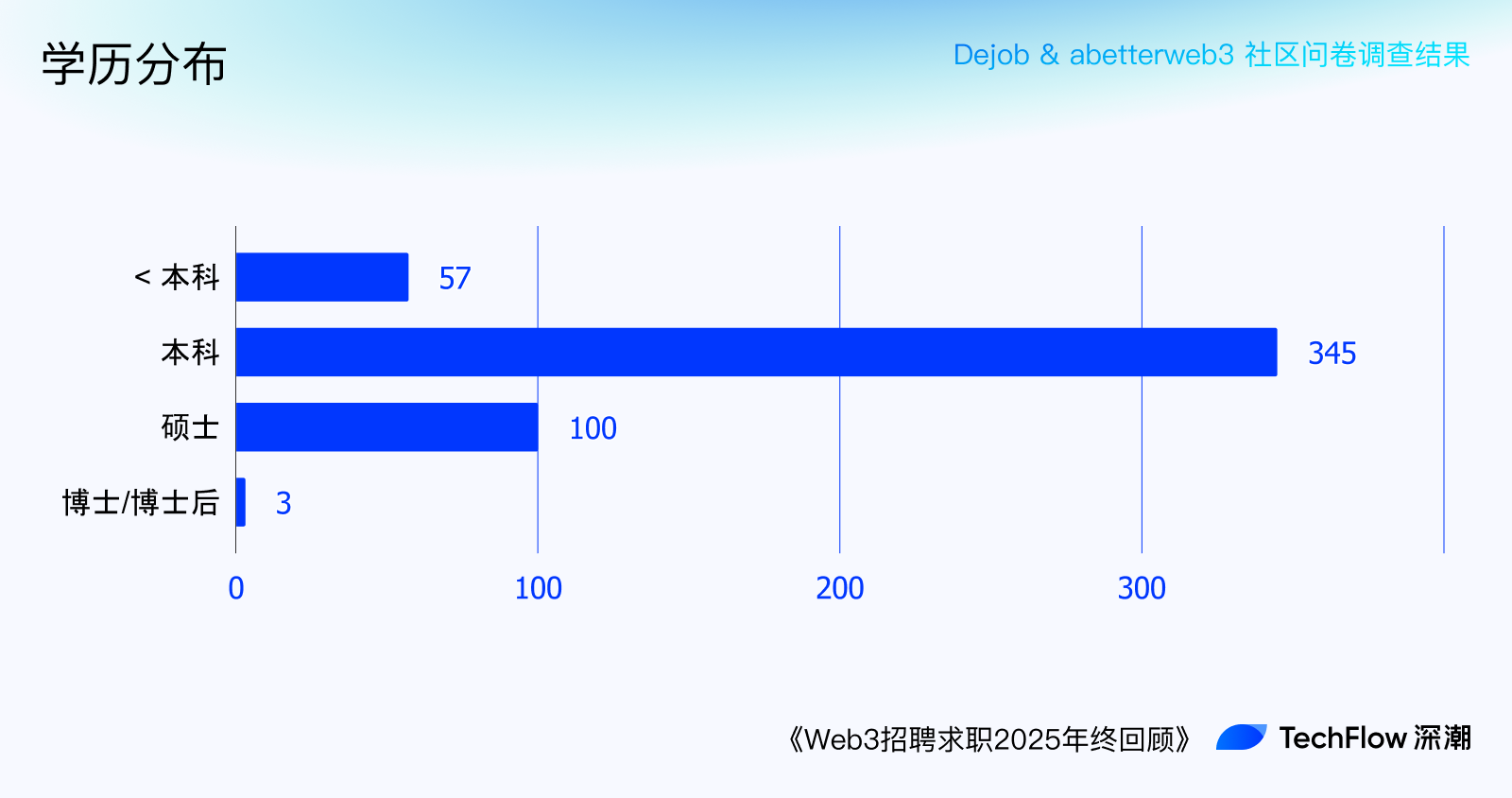
The distribution of educational background is largely consistent with the earlier talent data statistics, predominantly undergraduate degrees, with some having less than a bachelor's and others holding master's or doctoral degrees, though the proportion of postgraduates is not high.
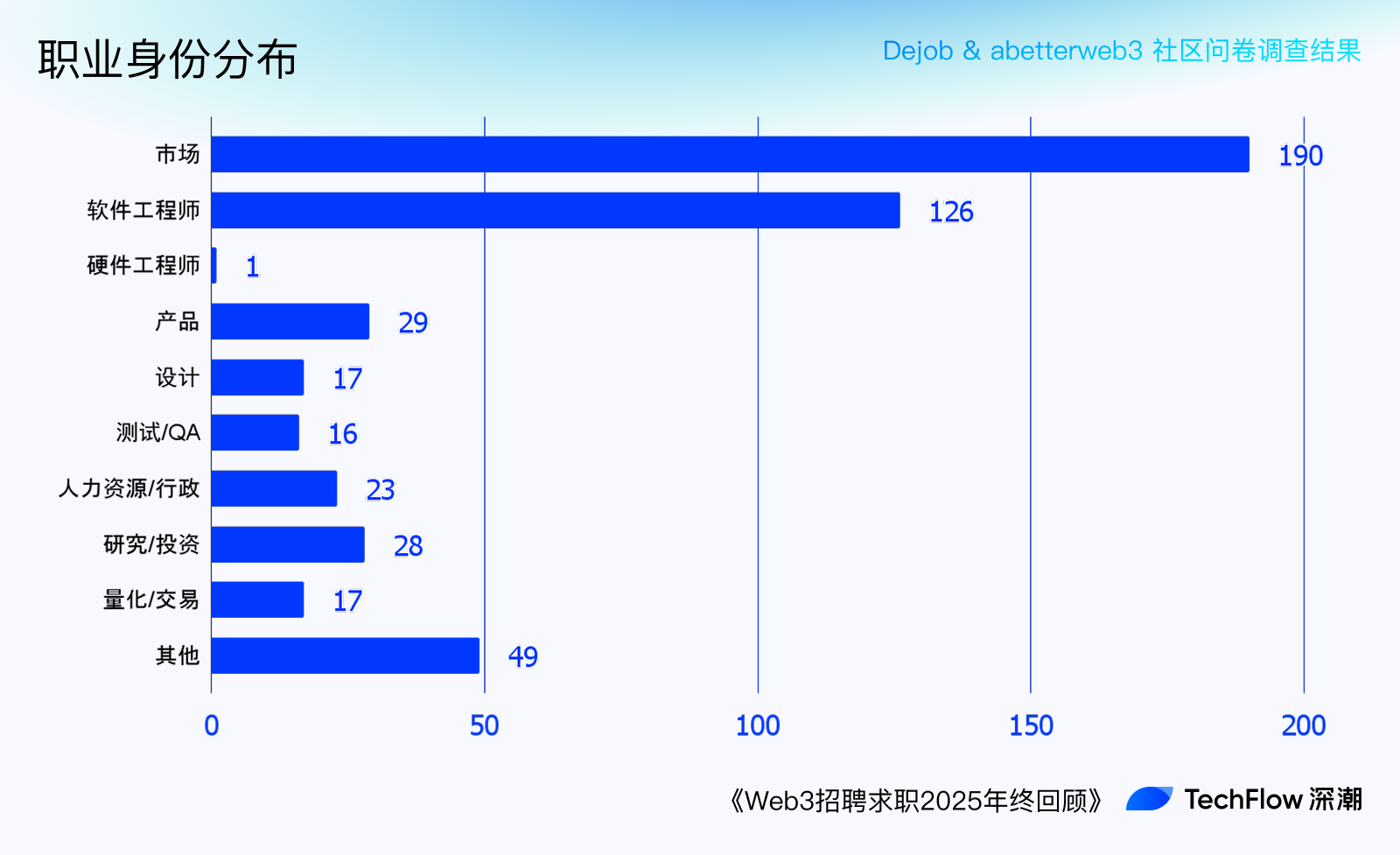
In terms of professional roles, the largest group is in market-related roles (operations/BD/customer service, etc.), followed by developers (front-end/back-end/smart contracts/blockchain, etc.). Then come product, human resources, investment research, design, trading, etc. Among the "other" submissions, common roles included risk control & security, KOLs, etc.
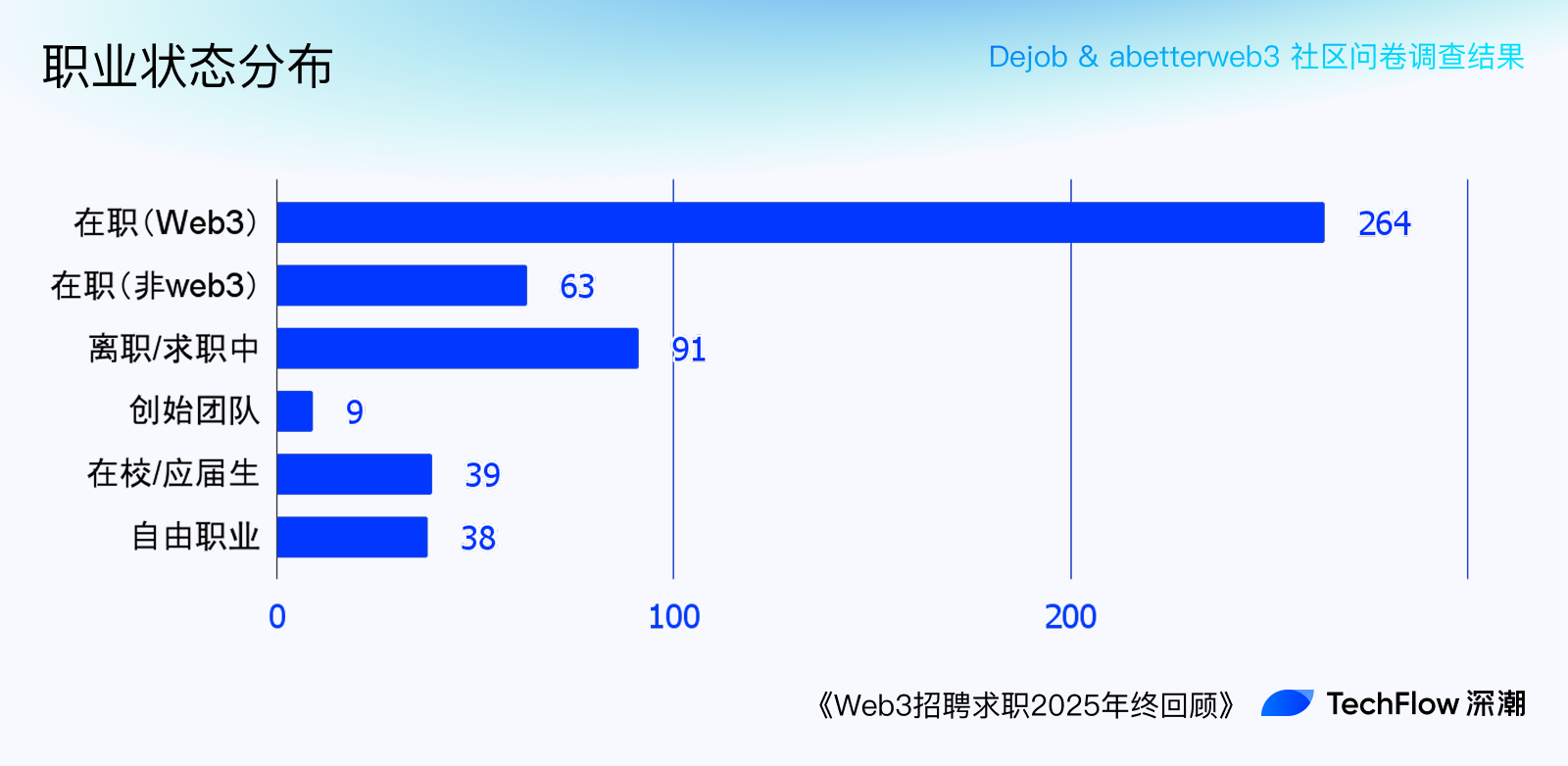
Regarding employment/attrition status, only 52% of respondents are currently employed in Web3. Over 30% are in a more flexible life situation. This indicates, on one hand, that market conditions affecting company headcount have impacted many; on the other hand, it might be because certain unique Web3 business models have made some people less reliant on traditional employment for cash flow, such as KOLs and traders.
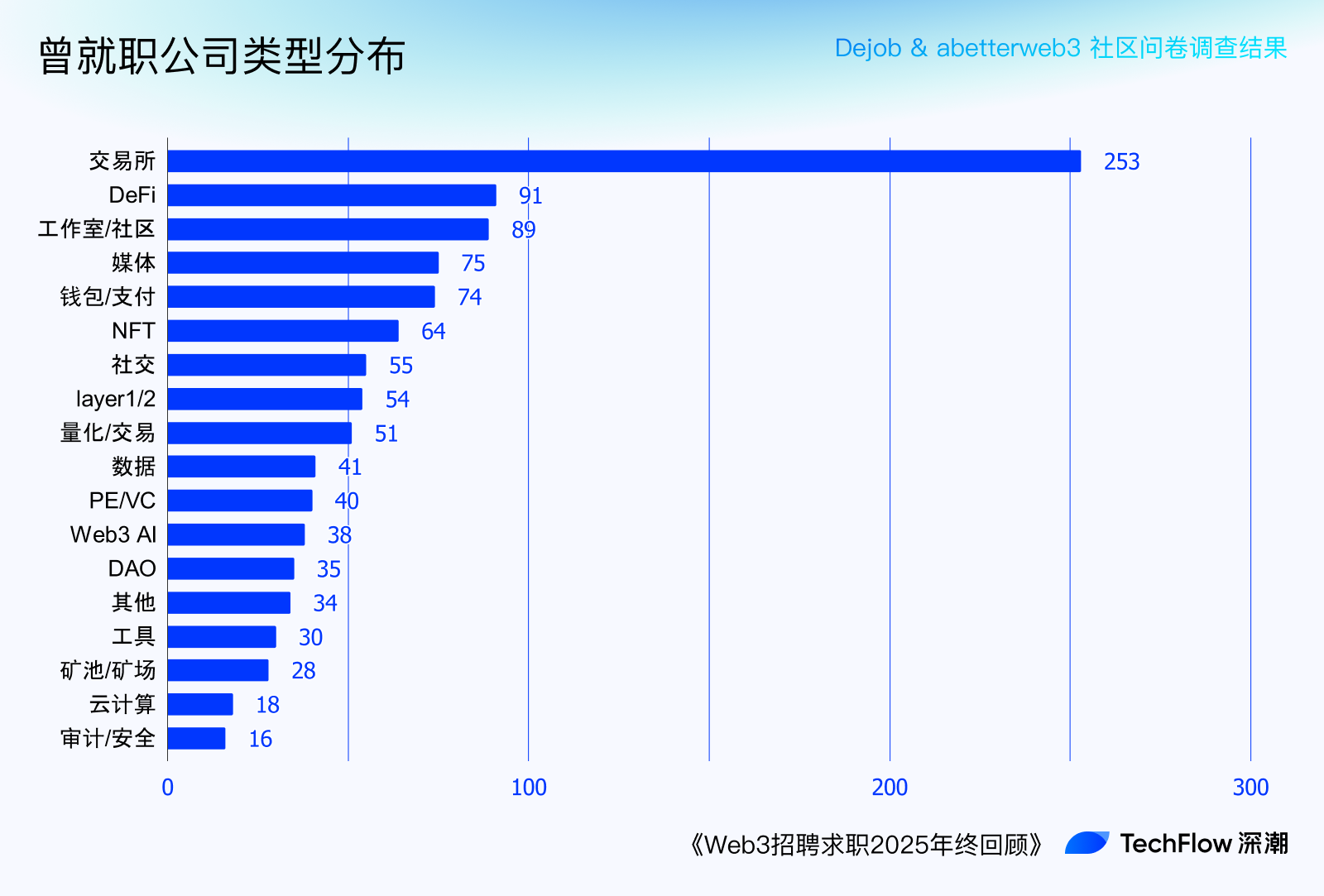
Over half of the submissions indicated having worked at exchanges, followed by studios/communities, DeFi, media, wallets, and other common business types. Both talent and job providers are heavily concentrated in exchanges due to the Matthew Effect. This also reflects, to some extent, the current industry dilemma: apart from exchanges, the revenue-generating capabilities of other business models mostly decrease from C-end — tools — underlying layers.
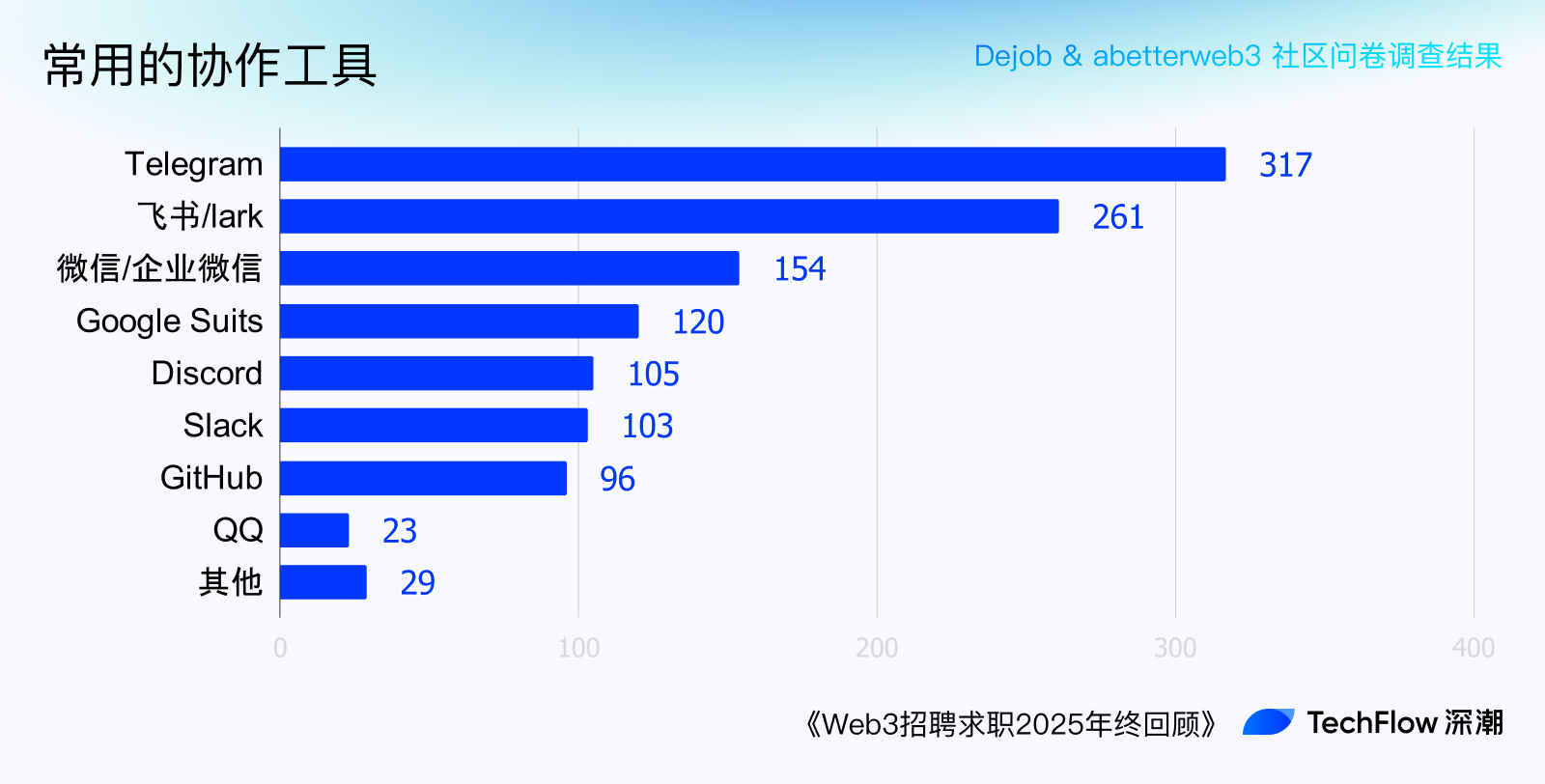
Regarding remote collaboration tools, as this survey took place in a Chinese-language vertical Web3 recruitment community, Telegram is favored by most companies for its confidentiality and usability, followed by mainstream Chinese tools like Feishu and WeChat, and finally tools commonly used by foreign companies like Google Suite, Discord, Slack, etc.
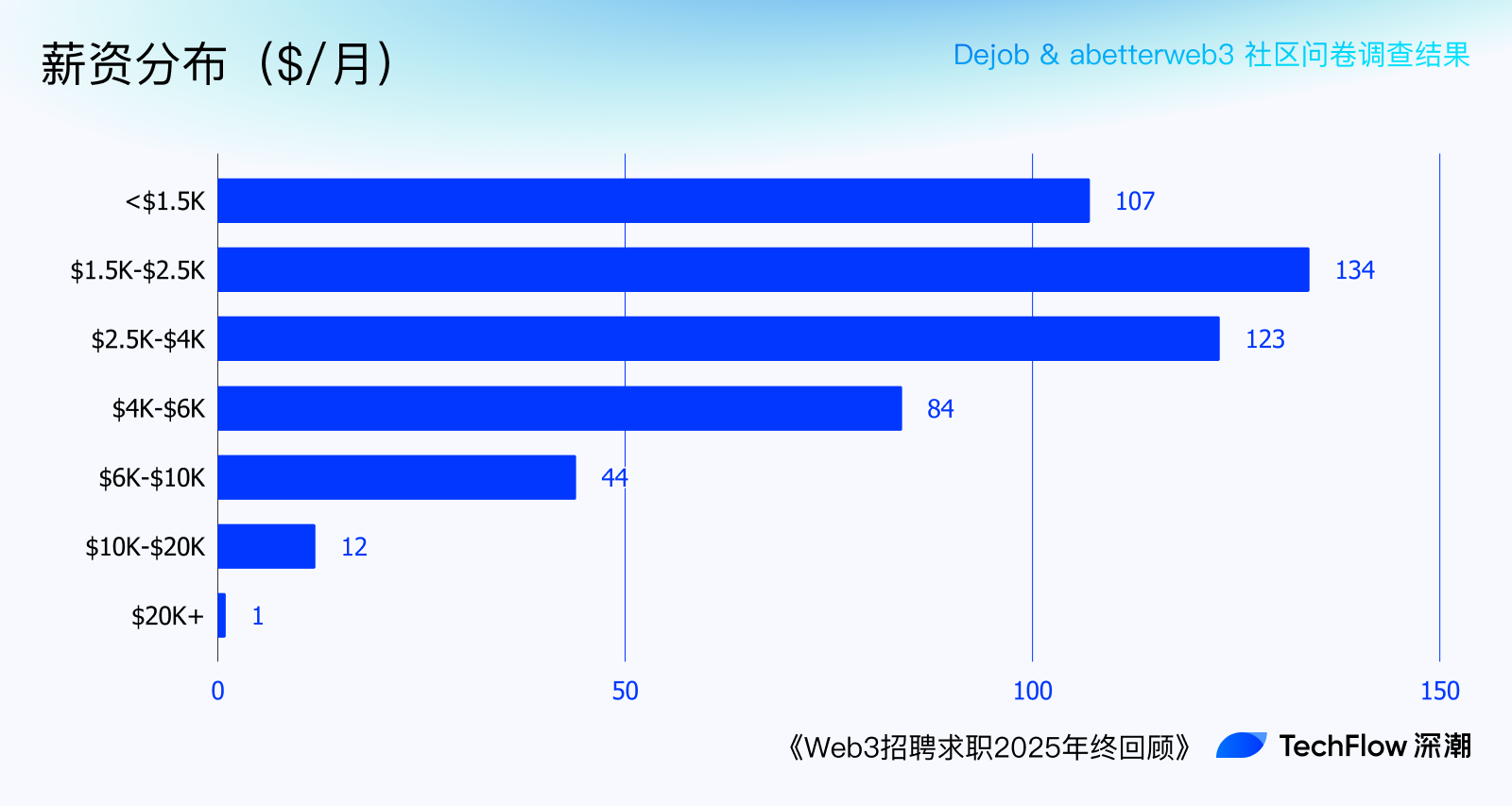
In terms of income levels, contrary to the external myths of immense wealth, most Web3 workers' incomes are not only lower than those in many top internet companies but also severely lacking in long-term incentives (tokens/equity), year-end bonuses, and layoff compensation.

Over 70% of people have a monthly salary income of less than $4,000 (approximately RMB 28,000), and the frequently mentioned monthly salary of $10,000 on Xiaohongshu is a rarity.
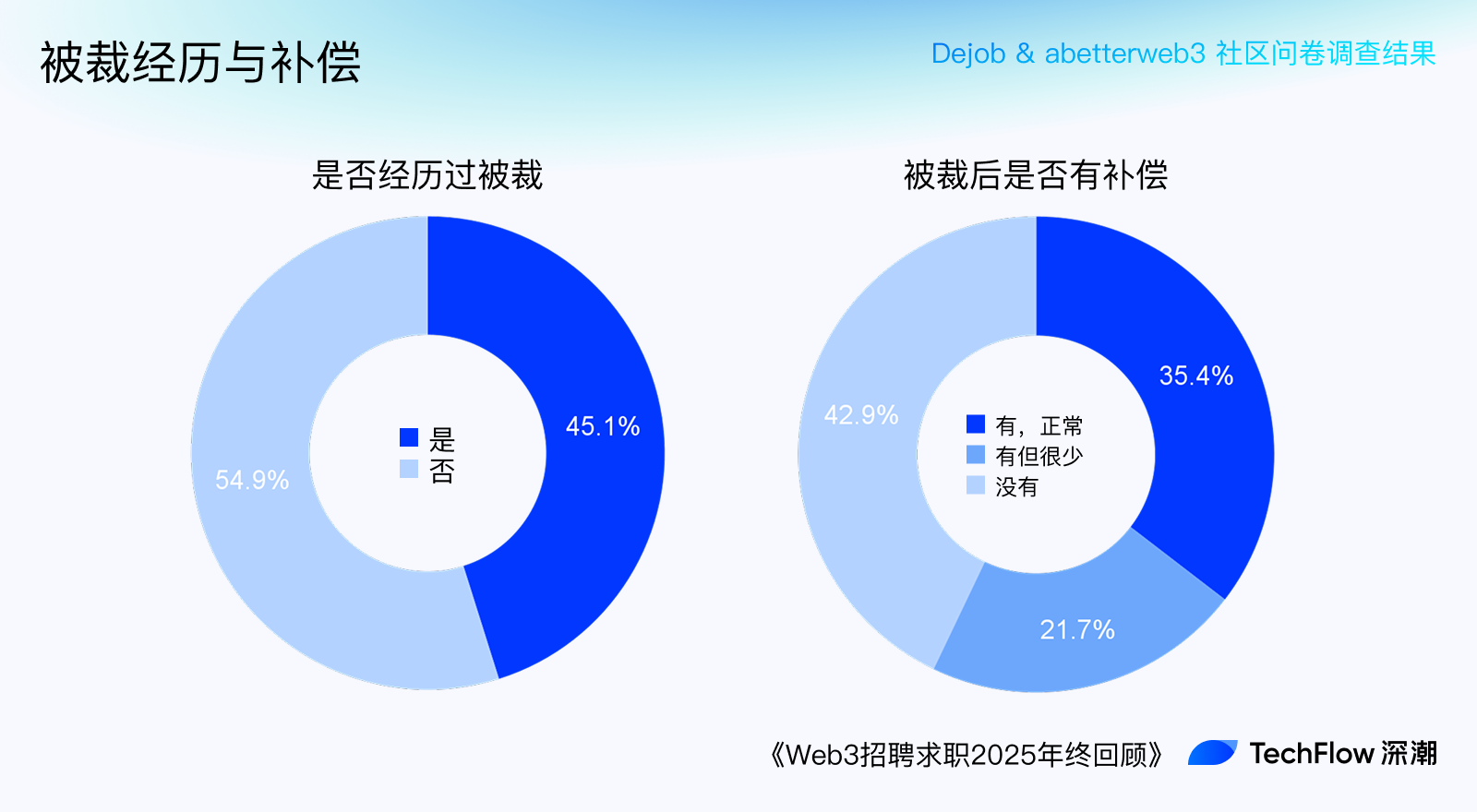
Close to half of the people have experienced layoffs, and 40% of those laid off reported no compensation, while 21% said that even if there was compensation, it fell far short of legal standards (e.g., n+1).
Nearly half reported not having received a year-end bonus; even among those who did, it was generally 1-3 months' salary, on par with most internet companies outside the Web3 industry.
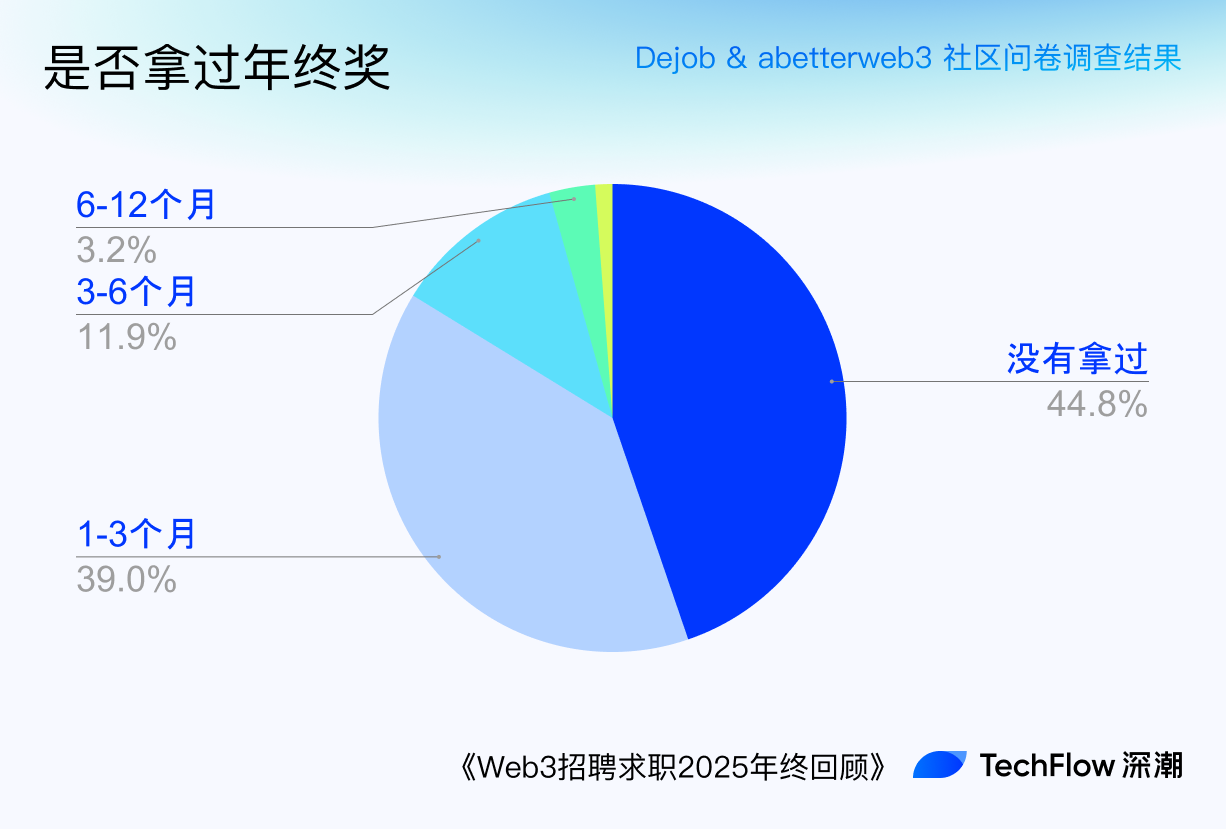
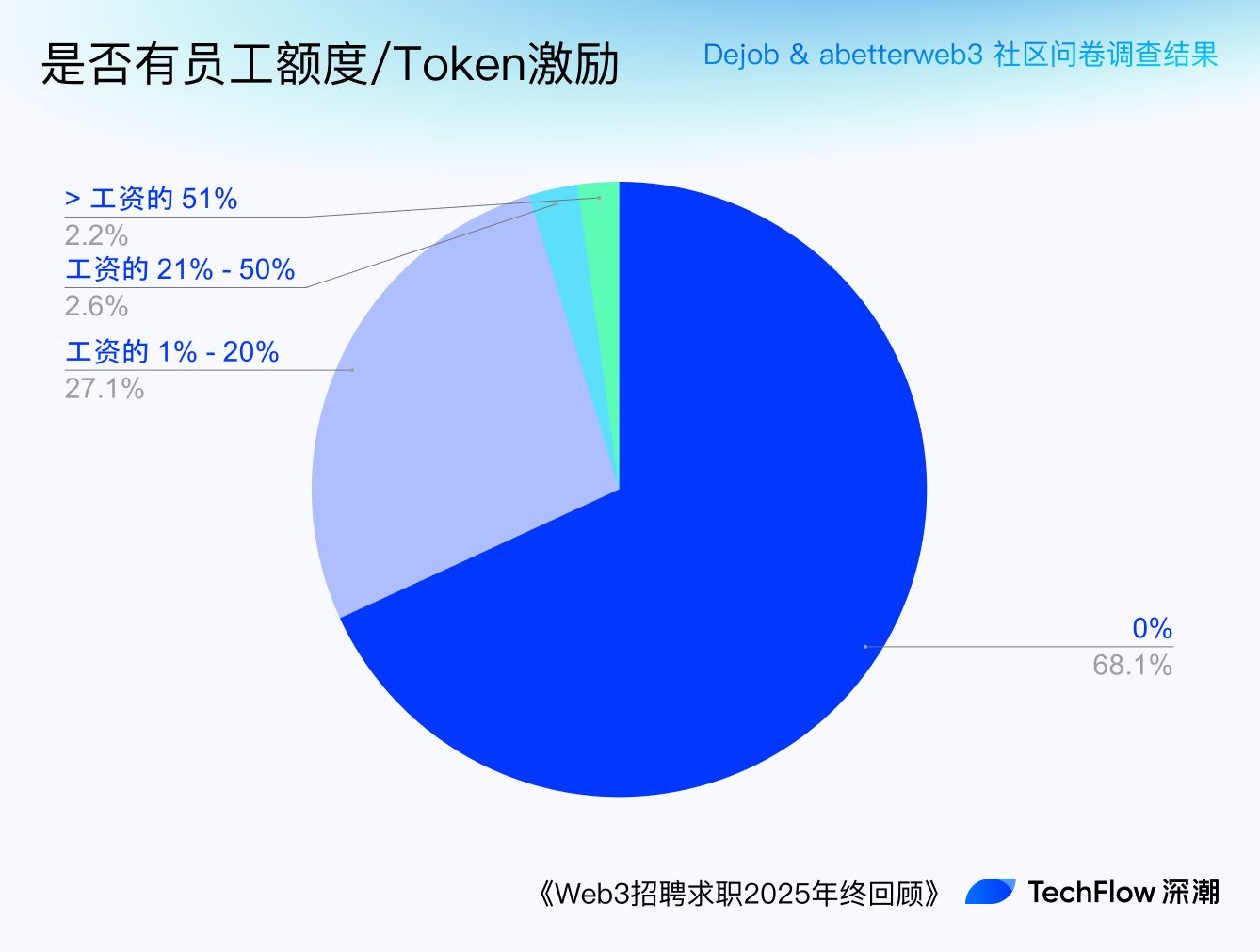
Regarding the well-known "upward channel" of token equity incentives, nearly 70% of practitioners reported not having received any. Even among those who did, very few received more than 20% of their salary's value.
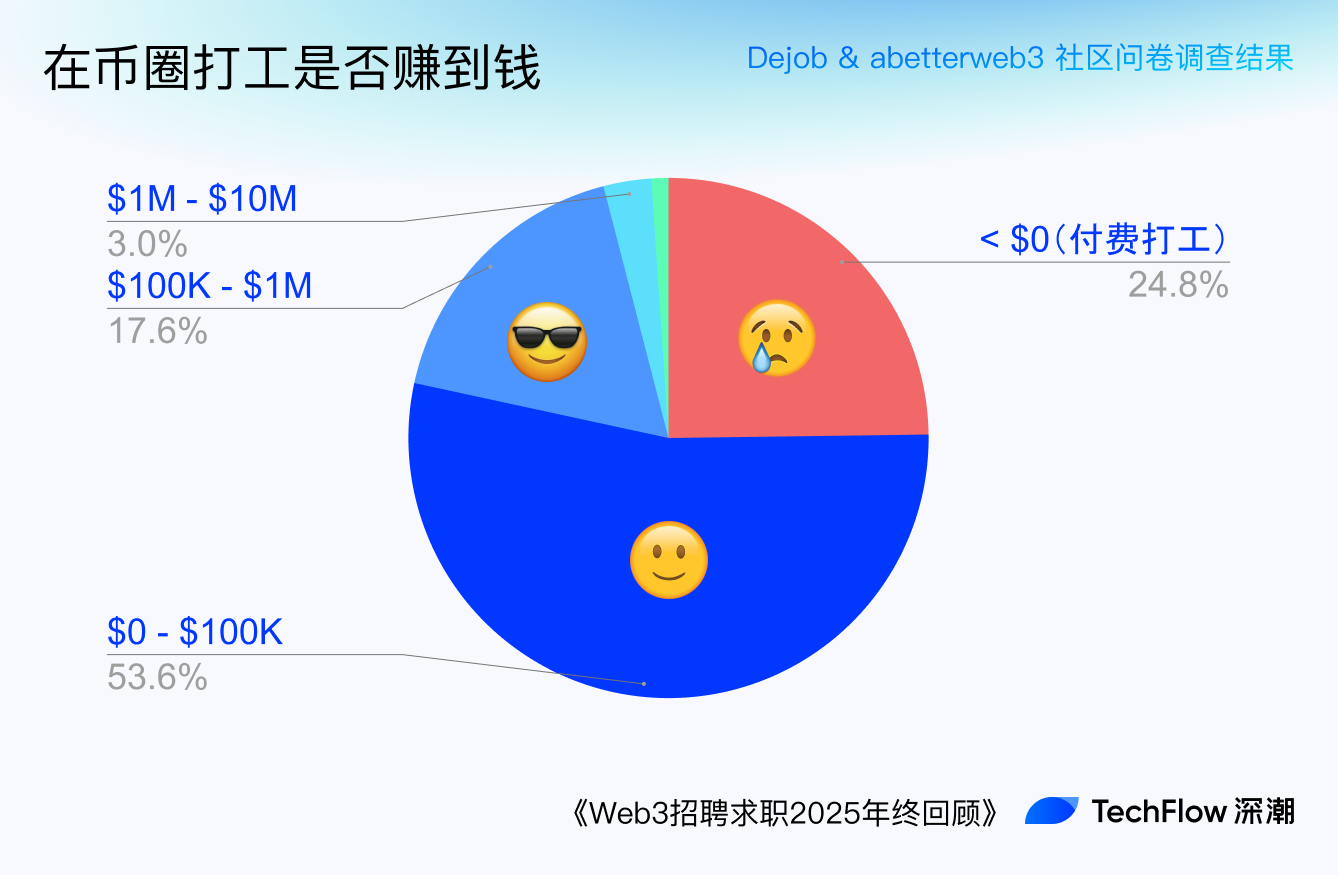
Even a quarter of people have accumulated an overall wealth "loss" since entering the crypto space, in a "pay-to-work" state; other respondents mostly accumulated wealth around $100K (approximately RMB 700,000).
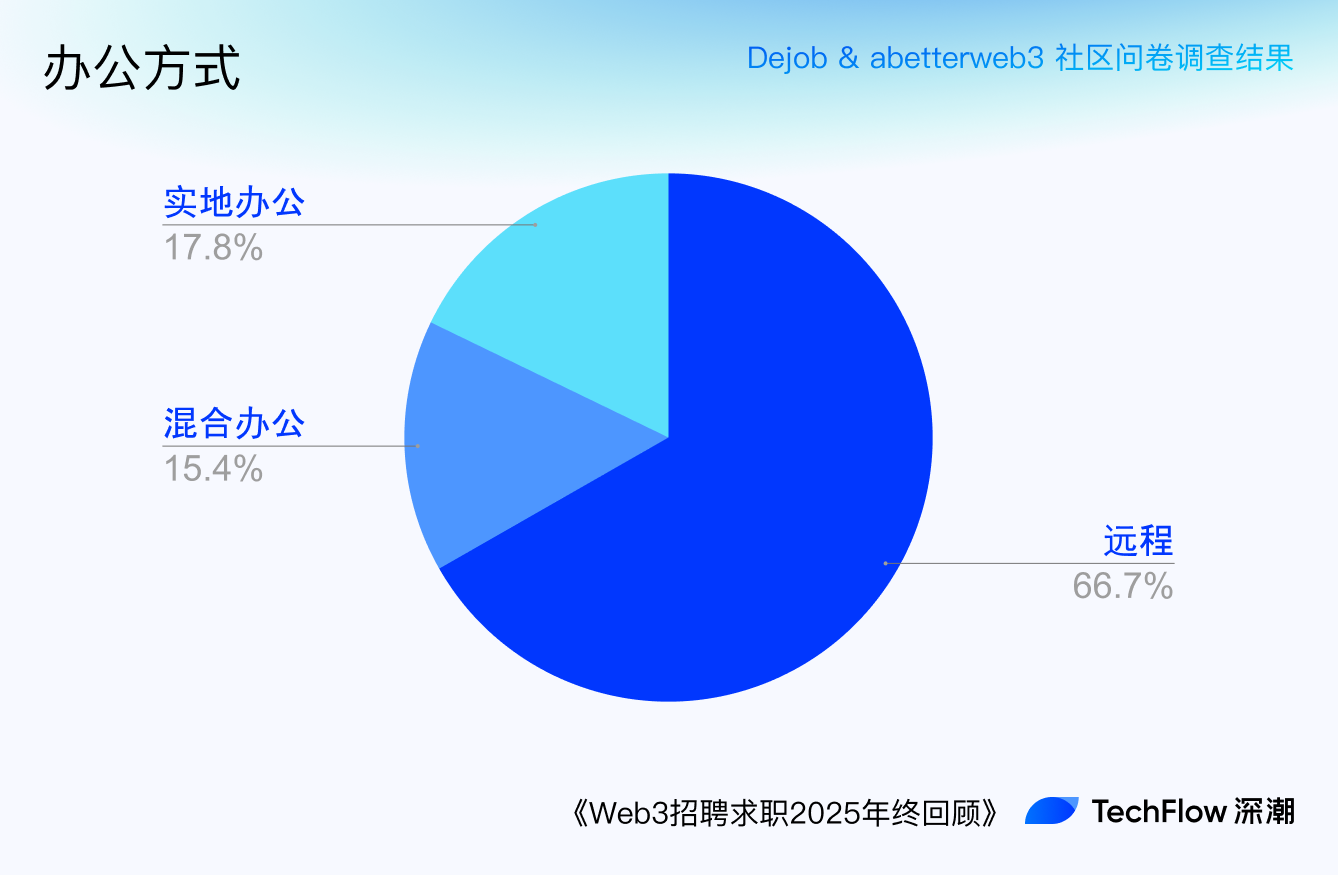
However, on the flip side of this seemingly hopeless income level, Web3's strong remote work culture offers some relief. Nearly 70% of respondents indicated their companies support remote work, and another 15% reported support for hybrid work, meaning虽然有办公室 but attendance is not mandatory, or working from home is allowed a few days a week.
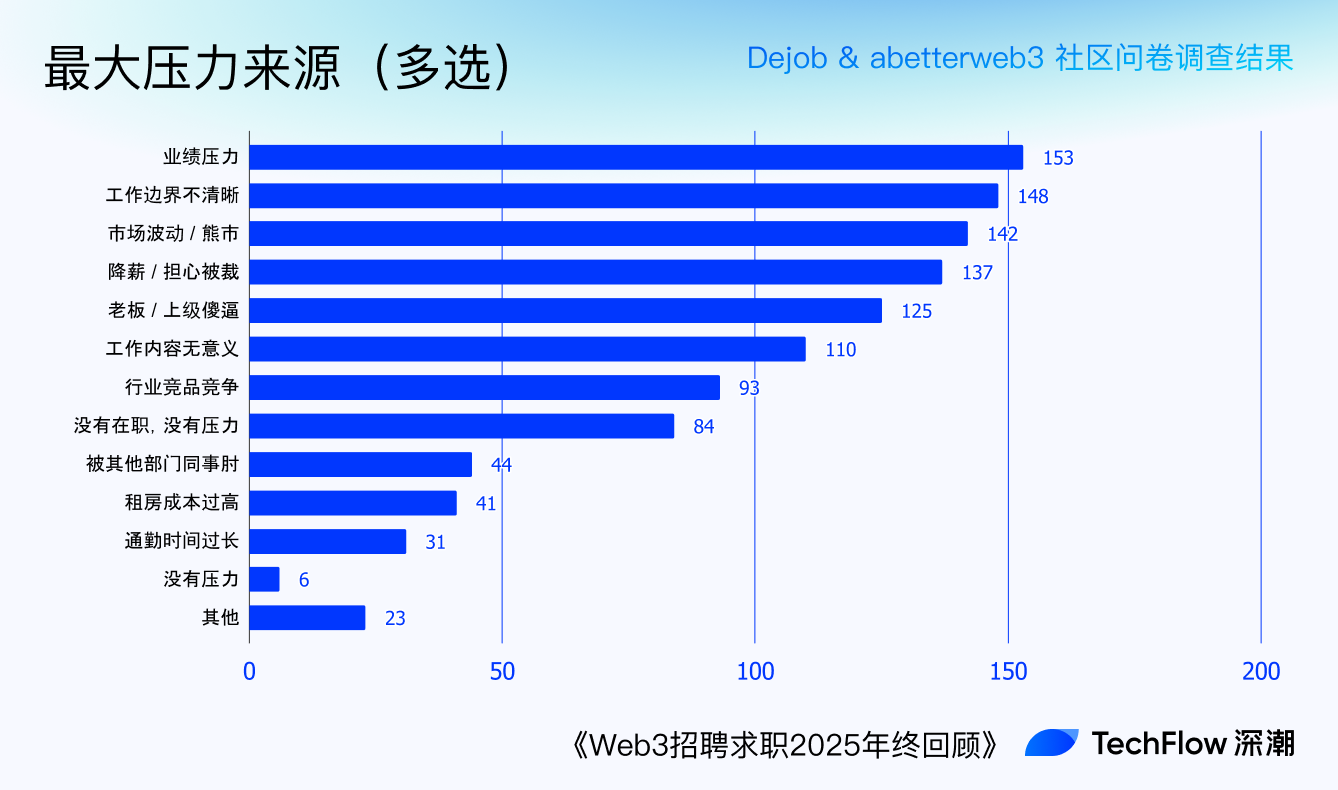
Remote work does alleviate some of the pain of being a worker. In the "biggest source of stress" question, 31 respondents selected "excessively long commute." Other top sources of stress included product growth, work boundaries, market volatility, fear of being laid off, and having a foolish boss.
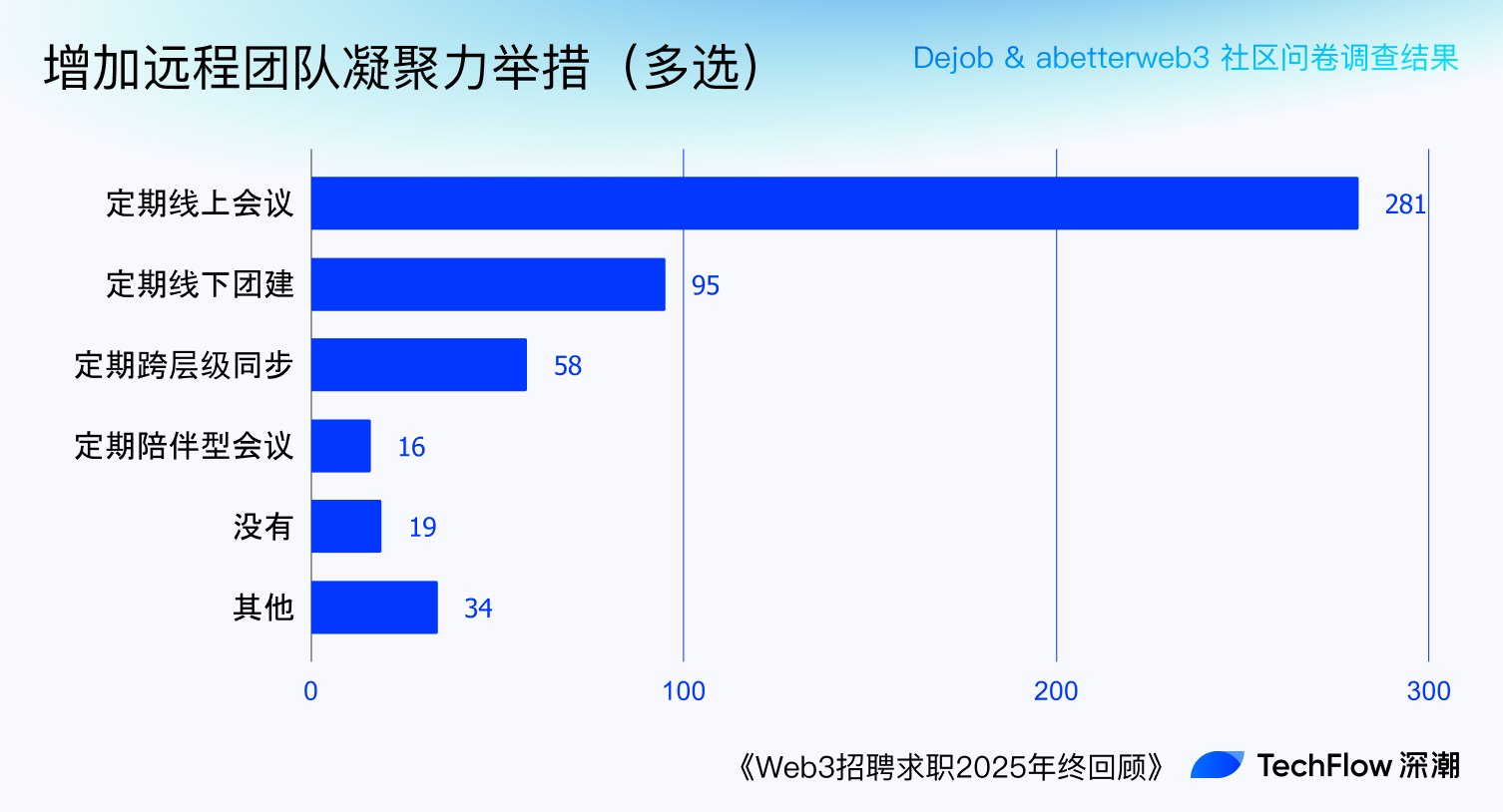
To maintain employees' mental health as social beings, many companies have taken measures to sustain team cohesion.
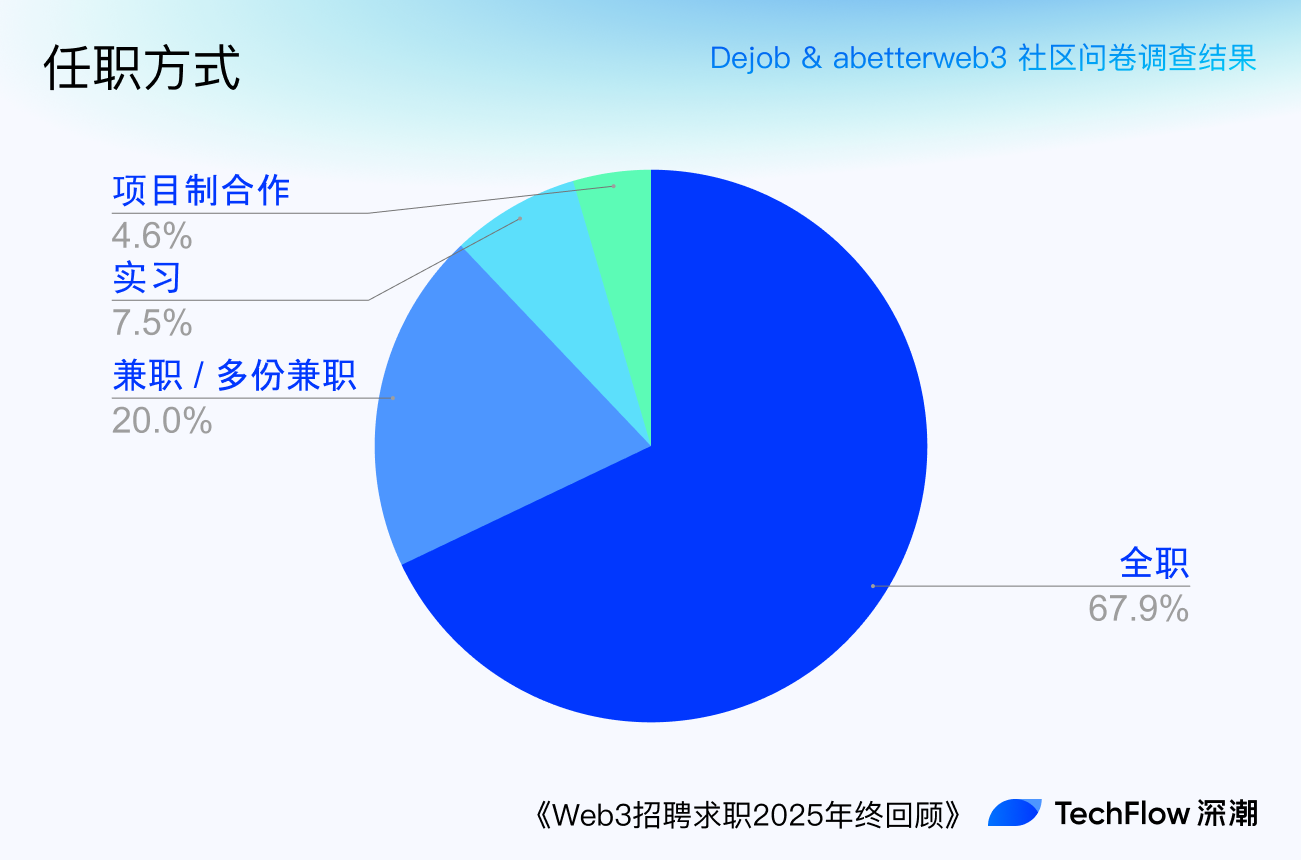
Under the combined effect of low income and instability, many choose to hold multiple jobs. 20% of respondents indicated having side jobs. This also reflects the tech-oriented culture of most Web3 companies: as long as problems are solved and competence is demonstrated, they don't interfere with employees' lifestyles and income methods.
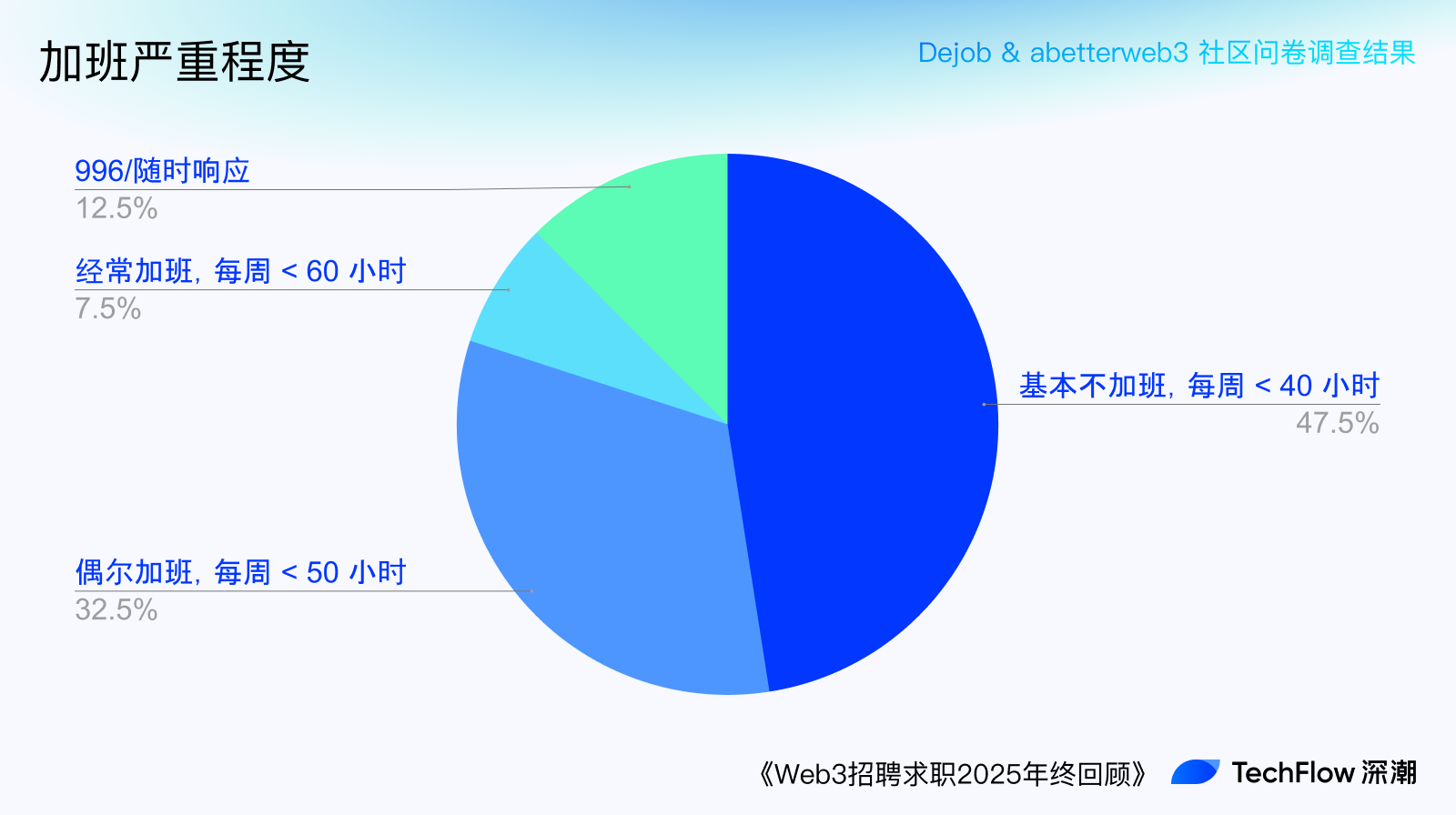
Regarding overtime intensity, 80% of people work approximately 40-50 hours per week. Thus, Web3 overtime seems less intense than many 996/007 sweatshops in web2.
Regarding job hopping, over half want to change companies, with 30% planning to do so within 3-6 months. But about a quarter are satisfied with their current situation, and 8 respondents even found "companies they hope to work for for a lifetime".

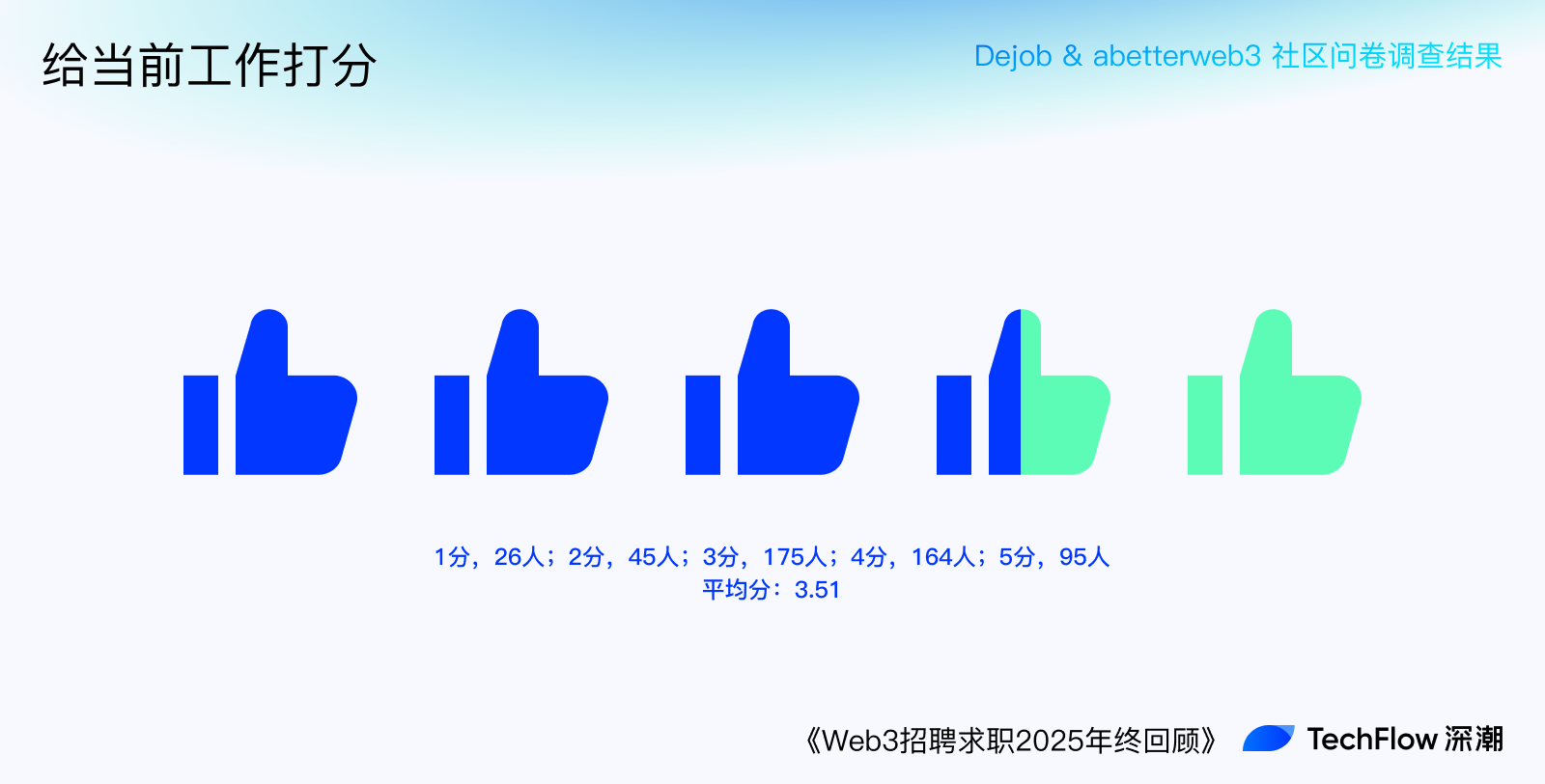
Considering factors like minimal overtime, remote work options, and side jobs allowed, many rate their current job positively. In the rating section for their current job, the average score was 3.51.
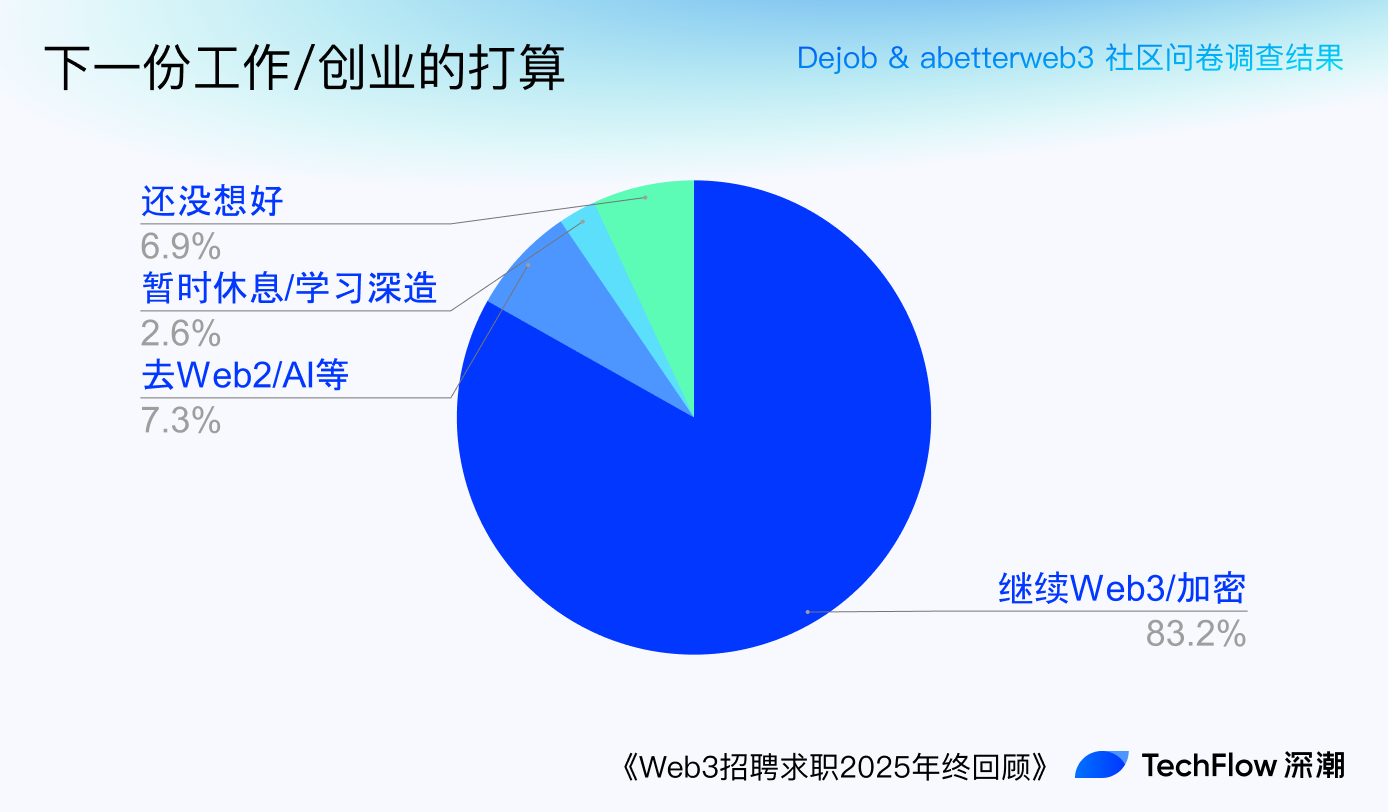
Regarding whether their next job will still be in the crypto space, over 80% choose to stay, while 7% choose to leave.
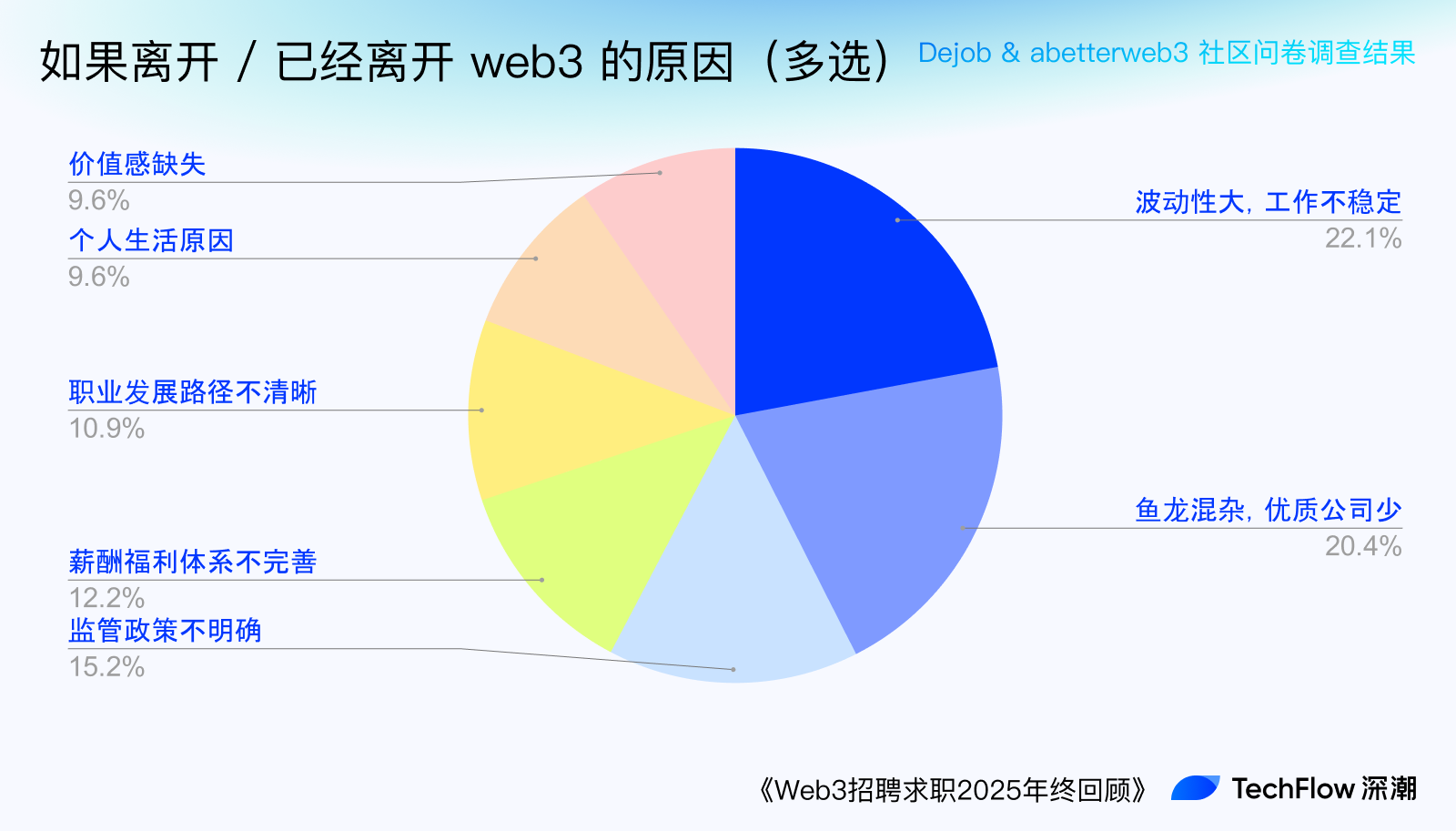
In the reasons for leaving section, the choices reflect the industry's most genuine, cold inner reality.
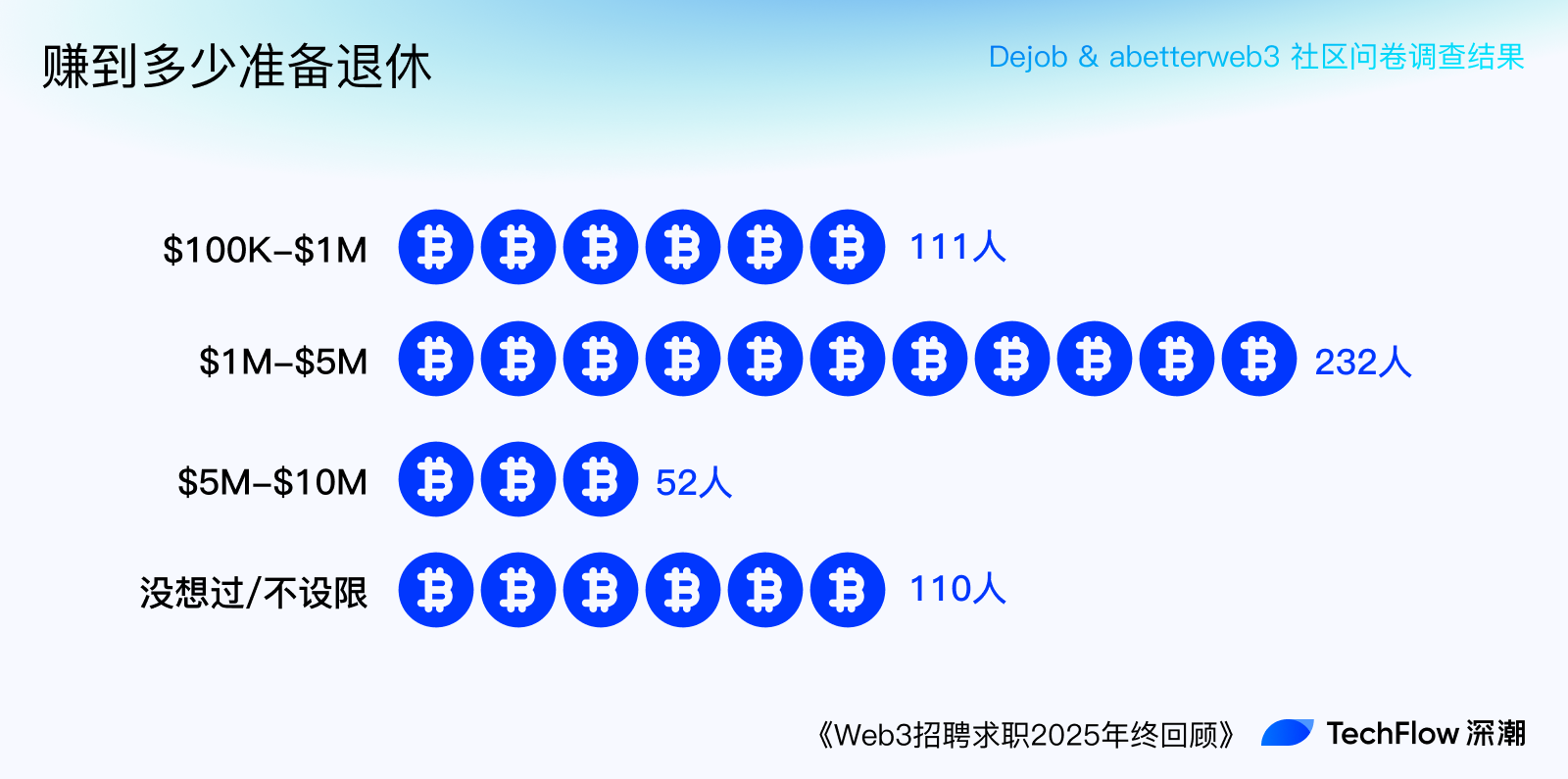
But all this preparation is for early retirement. For "how much wealth would make you consider resigning", the vast majority chose $1M – $5M (approximately RMB 7 million ~ 35 million). This might indeed be the wealth limit one can achieve through salaried work. But 20% chose "no limit", reflecting confidence in their abilities.
Regarding optimism about the 2026 job market, only 28% believe it will improve, with most being pessimistic or taking a wait-and-see attitude.

Truth Session


Original link:https://www.bitpush.news/articles/7598504

Preguntas relacionadas

QWhat percentage of crypto industry workers earn less than $4000 per month according to the survey?

AOver 70% of crypto industry workers earn less than $4000 per month.

QHow many respondents reported experiencing layoffs in the crypto industry, and what portion received no compensation?

ANearly half of the respondents experienced layoffs, and 40% of those laid off received no compensation.

QWhat is the primary reason most workers choose to stay in the crypto industry despite low pay and instability?

AOver 80% of workers choose to stay, largely due to factors like remote work flexibility (70% support remote work) and the dream of achieving financial freedom (e.g., retiring with $1-5 million).

QWhich type of company employs the most people in the crypto industry based on the survey?

AExchanges employ the most people, with over half of the respondents having worked at an exchange.

QWhat percentage of crypto workers have not received any token-based incentives (币权激励)?

ANearly 70% of crypto industry workers have not received any token-based incentives.

Lecturas Relacionadas

Fu Peng's First Public Speech in 2026: What Exactly Are Crypto Assets? Why Did I Join the Crypto Asset Industry?

Fu Peng, a renowned macroeconomist and now Chief Economist at New火 Group, delivered his first public speech of 2026 at the Hong Kong Web3 Festival. He explained his perspective on crypto assets and why he joined the industry, framing it within the context of macroeconomic trends and financial evolution. Fu emphasized that crypto assets are transitioning from an early, belief-driven phase to a mature, institutionally integrated asset class. He drew parallels to the 1970s-80s, when technological advances (like computing) revolutionized traditional finance, leading to the rise of FICC (Fixed Income, Currencies, and Commodities). Similarly, current advancements in AI, data, and blockchain are reshaping finance, with crypto assets becoming part of a new "FICC + C" (C for Crypto) framework. He noted that institutional capital, including traditional hedge funds, avoided early crypto due to its speculative nature but are now engaging as regulatory clarity emerges (e.g., stablecoin laws, CFTC classifying crypto as a commodity). Fu predicted that 2025-2026 marks a turning point where crypto becomes a standardized, financially viable asset for diversified portfolios, akin to commodities or derivatives in traditional finance. Fu defined Bitcoin not as "digital gold" in a simplistic sense but as a value-preserving, financially tradable asset. He highlighted that crypto's future lies in regulated, institutional adoption, moving away from retail-dominated trading. His entry into crypto signals this maturation, where traditional finance integrates crypto into mainstream asset management.

marsbitHace 14 min(s)

Fu Peng's First Public Speech in 2026: What Exactly Are Crypto Assets? Why Did I Join the Crypto Asset Industry?

marsbitHace 14 min(s)

Justin Sun Sues Trump Family: What $75 Million Bought Was Only a Blacklist

Justin Sun, founder of Tron, has filed a lawsuit in federal court against World Liberty Financial (WLF), alleging he was made the "primary target of a fraudulent scheme" after investing $75 million. Sun claims the investment secured him an advisor title and WLFI tokens, which were later frozen by WLF, causing "hundreds of millions in losses." The dispute began in late 2024 when Sun's investment helped revive WLF's struggling token sale, which ultimately raised $550 million. Shortly after, the SEC dropped its lawsuit against Sun following Donald Trump's inauguration. However, relations soured when Sun refused WLF's demands for additional funding. In August 2025, WLF added a "blacklist" function to its smart contract, allowing it to unilaterally freeze tokens. Sun's holdings, worth approximately $107 million, were frozen, and he was threatened with token destruction. The lawsuit highlights WLF's structure, which directs 75% of token sale profits to the Trump family, who had earned $1 billion by December 2025. WLF's CEO is Zach Witkoff, son of U.S. Middle East envoy Steve Witkoff. The project faces scrutiny for opaque operations, including a controversial loan arrangement on the Dolomite platform, co-founded by a WLF advisor. Despite Sun's history with the SEC, the case underscores centralization risks within DeFi, as WLF controls governance and holds powers to freeze assets arbitrarily. Sun's tokens remain frozen as legal proceedings begin.

marsbitHace 22 min(s)

Justin Sun Sues Trump Family: What $75 Million Bought Was Only a Blacklist

marsbitHace 22 min(s)

$500 to Buy OpenAI Stock: Silicon Valley's Most Respectable Liquidity Invitation

Silicon Valley's largest venture capital platform, AngelList, has launched a new fund called USVC, allowing U.S. retail investors to buy into high-profile AI companies like OpenAI, Anthropic, and xAI with a minimum investment of $500—no accredited investor status required. Promoted by AngelList co-founder Naval Ravikant, the fund is framed as an opportunity for ordinary people to access high-growth private tech investments traditionally reserved for VCs. However, critics argue it functions more like an exit vehicle for early insiders. USVC acquires shares not through primary rounds but largely via secondary transactions—purchasing stakes from early investors, VC funds, and employees looking to cash out at peak valuations. With companies like xAI heavily weighted in the portfolio, the fund effectively channels retail money into providing liquidity for insiders who entered at much lower valuations. The fund’s structure raises concerns: shares are illiquid, with no secondary market, and buybacks are limited and discretionary. The actual annual fee reaches 3.61%, far above the advertised 1% management fee. This model parallels the "low float, high fully diluted valuation" strategy seen in crypto, where early investors profit by selling to latecomers at inflated prices. The timing—alongside similar moves by platforms like Robinhood—suggests that Silicon Valley’s sudden interest in retail inclusion may be less about democratizing access and more about securing exits for insiders.

marsbitHace 52 min(s)

$500 to Buy OpenAI Stock: Silicon Valley's Most Respectable Liquidity Invitation

marsbitHace 52 min(s)

Trading

Spot
Futuros
活动图片




