Encrypted ETF Weekly Report | Last Week, US Bitcoin Spot ETF Net Outflow $9.95 Billion; US Ethereum Spot ETF Net Outflow $255 Million

链捕手Publicado a 2026-05-18Actualizado a 2026-05-18

Resumen

Last week, U.S. Bitcoin spot ETFs saw significant net outflows totaling $995 million over three days, with a major contribution of $317 million from BlackRock's IBIT. Their total net asset value (NAV) stands at $104.2 billion. U.S. Ethereum spot ETFs also experienced net outflows of $255 million over five days, largely from BlackRock's ETHA ($186 million out), bringing their total NAV to $12.93 billion. In Hong Kong, Bitcoin spot ETFs recorded a net outflow of 24.91 BTC, reducing their NAV to $323 million. Hong Kong's Ethereum spot ETFs saw no inflows, with an NAV of $68.13 million. U.S. Bitcoin spot ETF options showed increased activity, with a total nominal trading volume of $797 million and a put/call trading ratio of 1.63, indicating a bullish market sentiment. The total open interest reached $23.08 billion. Key developments include VanEck and Grayscale simultaneously filing amended proposals for BNB ETFs, signaling potential SEC review progress. Grayscale also filed for the first U.S. privacy coin ETF (Zcash). Avenir Group remains Asia's largest institutional holder of Bitcoin ETFs. 21Shares launched an actively managed crypto ETF (TKNS), and Bitwise's Hyperliquid ETF (BHYP) is set to list on the NYSE. Institutional activity varied: JPMorgan dramatically increased its Bitcoin ETF holdings (IBIT up 174%), while Jane Street significantly reduced its exposure (IBIT down 71%). Dartmouth College disclosed holdings of $7.7M in Bitcoin ETF and $3.4M in a Solana ETF.

Compiled by: Jerry, ChainCatcher

Last Week's Performance of Cryptocurrency Spot ETFs

US Bitcoin Spot ETF Net Outflow of $9.95 Billion

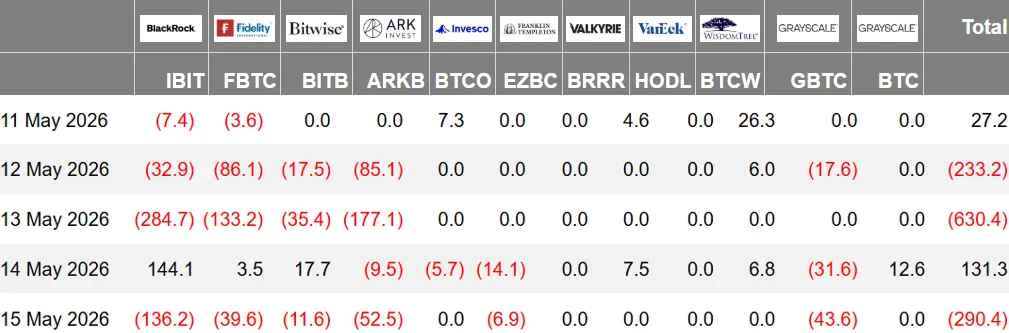
Last week, US Bitcoin Spot ETFs experienced net outflows for three days, with a total net outflow of 9.95 billion dollars, and total assets under management (AUM) reached $104.29 billion.

Six ETFs were in a net outflow state last week, with the main outflow coming from BlackRock's IBIT, which saw a net outflow of $317 million.
Data Source: Farside Investors

US Ethereum Spot ETF Net Outflow of $255 Million

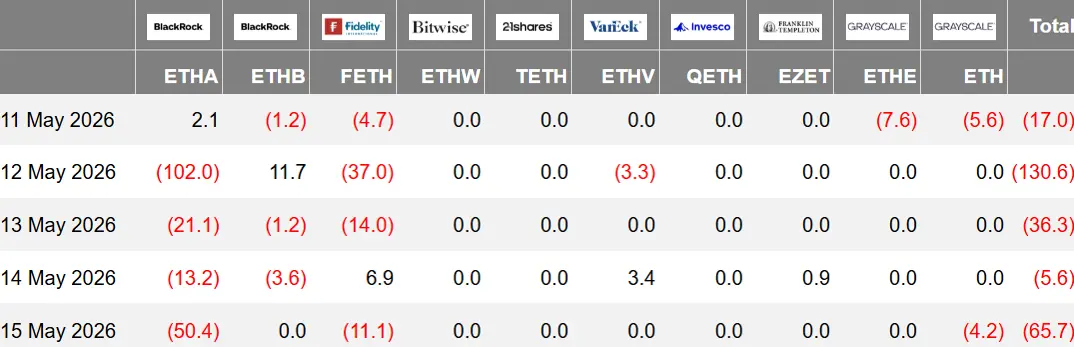
Last week, US Ethereum Spot ETFs experienced net outflows for five days, with a total net outflow of 2.55 billion dollars, and total AUM reached $12.93 billion.

The main outflow last week came from BlackRock's ETHA, with a net outflow of $186 million. Four Ethereum spot ETFs were in a net outflow state.
Data Source: Farside Investors

Hong Kong Bitcoin Spot ETF Net Outflow of 24.91 Bitcoins

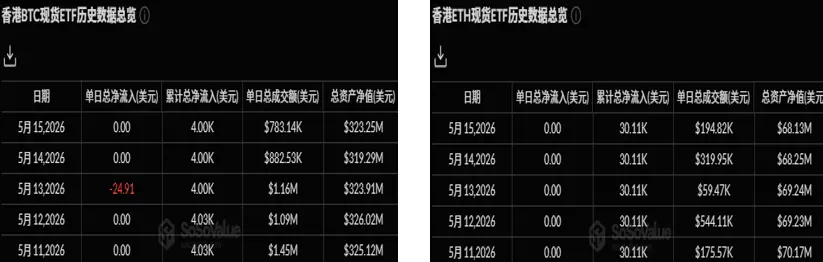
Last week, Hong Kong Bitcoin Spot ETFs had a net outflow of 24.91 Bitcoins, with an AUM of $323 million. Among them, issuer Harvest Bitcoin's holdings dropped to 210.92 coins, and ChinaAMC's holdings dropped to 2,570 coins.

Hong Kong Ethereum Spot ETFs had no fund inflows, with an AUM of $68.13 million.
Data Source: SoSoValue

Performance of Cryptocurrency Spot ETF Options

As of May 14, the total notional trading volume for US Bitcoin Spot ETF options was $797 million, with a notional total long/short trading ratio of 1.63.

As of May 14, the total notional open interest for US Bitcoin Spot ETF options reached $23.08 billion, with a notional total long/short ratio of 1.45.

Market trading activity for Bitcoin Spot ETF options has increased in the short term, with overall sentiment leaning bullish.

Additionally, the implied volatility stands at 41.82%.

Data Source: SoSoValue

Overview of Last Week's Cryptocurrency ETF Dynamics

VanEck and Grayscale File BNB ETF Amendments on Same Day

According to The Block, VanEck submitted the fifth amendment to its BNB ETF registration statement to the US Securities and Exchange Commission on Friday (May 15), while Grayscale also submitted the second amendment to its Grayscale BNB ETF prospectus on the same day.

Bloomberg ETF analyst James Seyffart stated that the synchronized actions suggest both issuers are responding to feedback from the US SEC and may be planning a launch in the near future. James Seyffart speculates that BNB might be the next crypto asset to pass SEC scrutiny and have the potential to list in the US.

Meanwhile, Canary Capital separately filed an amendment to its proposal for a staked TRX ETF, which would bundle Tron's staking rewards into a regulated framework.

Grayscale Submits Revised BNB ETF S-1 Again, Possibly Paving Way for US Spot ETF Advancement

Bloomberg ETF analyst James Seyffart stated on platform X that Grayscale has submitted the second revised version of its S-1 filing for its BNB ETF to the US Securities and Exchange Commission (SEC).

He said this revision is likely based on adjustments in response to SEC feedback, suggesting the product may be accelerating its launch process.

Avenir Group Maintains Position as Asia's Largest Institutional Holder of Bitcoin ETF, Ranking First in Region for Eight Consecutive Quarters

The latest disclosed SEC filings show that as of March 31, 2026, Avenir Group holds 18,276,100 shares of BlackRock's iShares Bitcoin Trust (IBIT). Based on the quarter-end closing price, the position value is approximately $702 million, a slight decrease of about 0.061% compared to Q4 2025. Avenir Group has maintained its position as Asia's largest institutional holder of Bitcoin ETFs for eight consecutive quarters since Q2 2024.

Since 2026, Avenir Group has been advancing the integration of TradFi and Crypto, including strategic investments in CoinRoutes, leading a $20 million seed round for Inference Research, and signing an MOU for cooperation with Tiger Brokers, AMINA Bank, and CoinRoutes during Consensus Hong Kong 2026 to promote next-generation institutional-grade trading infrastructure development.

Data: US Dartmouth College Discloses Holding $7.7 Million in Bitcoin ETF and $3.4 Million in SOL ETF

According to MacroScope monitoring, in its submitted 13F filing, US Dartmouth College disclosed that as of March 31, it holds approximately 201,531 shares of BlackRock's Bitcoin ETF "IBIT," valued at $7.7 million, with no change in holdings from the previous quarter.

The college also reported a new position: holdings of Bitwise Solana Staking ETF valued at $3.4 million (304,803 units).

21Shares Announces Launch of Actively Managed Crypto ETF TKNS

According to an official announcement, 21Shares has announced the launch of an actively managed crypto ETF, ticker TKNS. The fund is managed by a professional team, aiming to capture market opportunities and outperform passive index funds. Portfolio managers will adjust holdings based on market conditions to balance long-term goals with short-term opportunities. The fund operates like a standard stock ETF, with simplified tax reporting, and is currently tradable on select brokerage platforms.

Bitwise Hyperliquid ETF to List on New York Stock Exchange This Friday

The Bitwise Hyperliquid ETF will begin trading on the New York Stock Exchange this Friday under the ticker BHYP. Previously, 21Shares' Hyperliquid ETF (THYP) launched this Tuesday, with a first-day trading volume of approximately $1.8 million. BHYP will be the first US fund to offer Hyperliquid staking rewards, with related staking operations to be conducted through Bitwise's subsidiary, Bitwise Onchain Solutions. 21Shares also stated it plans to stake the majority of its HYPE holdings. Hyperliquid is currently a leading on-chain perpetual contract exchange, gradually expanding into tokenized commodities and spot crypto trading. Its native token HYPE is used for platform fee payments and is consistently among the top 15 crypto assets by trading volume.

JPMorgan Chase Significantly Increased Bitcoin ETF Holdings in Q1, IBIT Position Surges 174%

According to a Cointelegraph report, 13F filings show that JPMorgan Chase significantly increased its Bitcoin ETF holdings in the first quarter. Its holdings in BlackRock iShares Bitcoin Trust (IBIT) grew from approximately 3 million shares to 8.3 million shares, an increase of 174%.

Additionally, JPMorgan Chase also significantly increased holdings of other Bitcoin spot ETFs like Fidelity's FBTC and Bitwise's BITB, and slightly increased its holdings of MicroStrategy (MSTR).

Regarding altcoin ETFs, JPMorgan Chase's actions varied: it initiated a position in Bitwise Solana Staking ETF (BSOL), increased holdings of Ethereum-related ETFs, while completely exiting its position in an XRP ETF.

Jane Street Q1 Significantly Reduced Bitcoin ETF Exposure, IBIT Holdings Down 71% QoQ

The latest 13F filing submitted by quantitative giant Jane Street to the US SEC discloses a significant reduction in its Bitcoin ETF exposure for Q1 2026. Its holdings of IBIT decreased approximately 71% quarter-over-quarter to 5,872,212 shares, valued at approximately $225.6 million. Its holdings of FBTC decreased approximately 60% to 1,954,174 shares, valued at approximately $115 million.

Additionally, its holdings of MSTR also decreased approximately 78% quarter-over-quarter to 209,833 shares, valued at approximately $26.18 million.

Grayscale Files First Privacy Coin Spot ETF Application, Multicoin Capital Discloses It Has Accumulated ZEC

Grayscale has filed an application for a Zcash spot ETF, seeking to convert its existing Zcash trust into a spot product, becoming the first privacy coin ETF seeking to list in the US. Concurrently, Multicoin Capital disclosed it has been accumulating ZEC since February, with co-founder Tushar Jain linking the investment thesis to proposed US wealth tax legislation, suggesting that government expansion of surveillance over private financial holdings will drive structural demand for assets shielded from regulatory scrutiny at a mathematical level.

However, this application also raises institutional custody challenges: approximately 30% of Zcash's supply is in shielded address pools, a historical high, but ETF custody would almost certainly need to use transparent address pools to meet audit and balance proof requirements. Previously, the SEC ended its long-term review of Zcash in January 2026 without enforcement action, significantly reducing regulatory uncertainty.


Preguntas relacionadas

QWhat was the net outflow for U.S. Bitcoin spot ETFs last week, and which fund was the largest contributor?

ALast week, U.S. Bitcoin spot ETFs had a net outflow of $995 million. The primary contributor to this outflow was BlackRock's IBIT, with a net outflow of $317 million.

QHow did the U.S. Ethereum spot ETFs perform in terms of net flow last week?

AU.S. Ethereum spot ETFs experienced a net outflow of $255 million over five days last week, with the total assets under management reaching $12.93 billion.

QWhat significant ETF filing news was reported involving VanEck and Grayscale?

AVanEck and Grayscale both submitted amended filings for their respective BNB ETF proposals on the same day (May 15). Analysts believe this synchronized action indicates both issuers are responding to SEC feedback and potentially preparing for a near-term launch.

QWhich institution maintains the title of Asia's largest Bitcoin ETF institutional holder, and for how long?

AAvenir Group maintains the title of Asia's largest Bitcoin ETF institutional holder. As of March 31, 2026, it held over 18.2 million shares of BlackRock's IBIT, a position it has held for eight consecutive quarters since Q2 2024.

QWhat is the significance of the new ETF application filed by Grayscale mentioned in the article?

AGrayscale filed an application to convert its existing Zcash Trust into a spot ETF, marking the first application for a privacy-focused cryptocurrency ETF in the United States.

Lecturas Relacionadas

The Foundation of SpaceX's Trillion-Dollar Valuation: Who is Dividing Up Musk's Annual Tens of Billions in Capital Expenditure?

SpaceX's trillion-dollar valuation is built on its three core businesses: Starlink (profitable, 60% of revenue), rockets (driving down launch costs), and AI (a major investment area). This creates a financial cycle: Starlink funds rocket development, which enables low-cost launches for AI hardware, generating future revenue. This cycle fuels annual capital expenditures of tens of billions, flowing to a vast supply chain. Suppliers are categorized by their replaceability. The first group includes irreplaceable players like NVIDIA (GPU/CUDA ecosystem), Eutelsat (critical radio spectrum), Filtronic (specialized amplifiers), Materion (strategic beryllium), and STMicroelectronics (antenna chips). The second group consists of hard-to-replace suppliers due to high switching costs, such as Honeywell (flight control), Carpenter Technology (specialty alloys), Hexcel (carbon fiber), Broadcom (data exchange), and Linde (industrial gases). The third group comprises high-volume, cost-critical suppliers for mass-produced items like Starlink terminals. Key names include Wistron NeWeb (primary manufacturer) and several A-share companies like Shenzhen Sunway (connectors), Pies New Materials (forgings), Western Superconducting (alloys), and Yingliu (castings). Other niche players include Trimble (timing), Astronics (power distribution), and CTS (thermal management). The article argues that investing in these suppliers, rather than SpaceX stock directly, offers an alternative opportunity. The rationale is threefold: procurement is just beginning to scale, SpaceX's IPO brings new transparency to its supply chain, and the situation mirrors early stages of past "super terminal" ecosystems like Apple or Tesla. While risks exist (commodity cycles, geopolitical factors, technology shifts), the core thesis is that SpaceX's massive, ongoing procurement will translate into reliable revenue for its key suppliers, regardless of its own stock price volatility.

marsbitHace 27 min(s)

The Foundation of SpaceX's Trillion-Dollar Valuation: Who is Dividing Up Musk's Annual Tens of Billions in Capital Expenditure?

marsbitHace 27 min(s)

SpaceX's Trillion-Dollar Valuation Base: Who's Sharing in Musk's Annual Tens of Billions in Capital Expenditure?

**Title: The Foundation of SpaceX's Trillion-Dollar Valuation: Who Benefits from Musk's Annual $100 Billion Capital Expenditure?** This article argues that investors seeking to benefit from SpaceX's growth might find greater opportunities in its supply chain rather than directly investing in the company itself, drawing parallels to historical successes with Apple, Tesla, and NVIDIA suppliers. **SpaceX's Business Model & Cash Flow:** SpaceX generates revenue from three main areas: 1. **Starlink:** Its profitable core, earning $11.3B in 2023 (60% of revenue), funding other ventures. 2. **Rockets (Falcon/Starship):** Requires $3B+ in annual R&D but achieves the world's lowest launch costs. 3. **AI:** Currently unprofitable (-$6B+ in 2023), investing heavily in ground-based supercomputers (220,000 GPUs) and future orbital data centers. The cycle is: Starlink profits → fund cheaper rockets → low-cost launches deploy AI hardware → AI compute rentals generate future revenue. This cycle drives annual procurement spending of tens of billions of dollars. **The Supply Chain Beneficiaries:** Suppliers are categorized by their replaceability: **1. Nearly Irreplaceable (High Barriers to Entry):** * **NVIDIA:** Powers the Colossus supercomputer; its CUDA ecosystem creates immense switching costs. * **Eutelsat (SATS):** Controls critical radio spectrum for satellite communications; holds a ~3% stake in SpaceX. * **Filtronic (FTC):** Supplies millimeter-wave signal amplifiers for Starlink satellites; SpaceX constitutes 83% of its revenue. * **Materion (MTRN):** Global leader in beryllium production, a strategic material used in Starship structures. * **STMicroelectronics (STM):** Supplies phased-array antenna chips for Starlink satellites. **2. Replaceable, but Switching Cost is Prohibitively High:** * **Honeywell (HON):** Provides flight control and inertial navigation systems with decades of certification. * **Carpenter Technology (CRS):** Manufactures ultra-pure specialty steel alloys for Raptor engines. * **Hexcel (HXL):** Supplies custom carbon fiber composites developed over a decade with SpaceX. * **Broadcom (AVGO):** Manages high-speed data switching. * **Linde Group:** Supplies industrial gases (liquid oxygen/nitrogen) from facilities built near SpaceX launch sites. **3. High-Volume, Cost-Critical Manufacturing:** Focuses on mass-producing components like Starlink user terminals (target: 30 million units). * **Key Players:** Wistron NeWeb (6285, primary terminal manufacturer), several Chinese A-share companies (e.g., Sunway Communication, PAX New Materials, Western Metal Materials, Yingliu Co.), and smaller US firms like Trimble (TRMB, timing systems). **Why Now?** Three factors make the supply chain opportunity timely: 1. **Volume Ramp-Up:** SpaceX plans 100 launches in 2026, aims for 30 million Starlink terminals, and will deploy AI data centers, meaning procurement will accelerate. 2. **Increased Transparency:** The IPO provides public financial data, allowing investors to track supplier order growth. 3. **Historical Precedent:** The current phase is likened to Tesla's early mass-production stage (circa 2018), suggesting a long growth runway for suppliers. **Conclusion:** The article posits that while investing in SpaceX stock is betting on Elon Musk's ambitious vision at a high valuation, investing in its established suppliers is a bet on the tangible, recurring revenue from its massive procurement budget, which is largely decoupled from day-to-day stock price volatility.

链捕手Hace 31 min(s)

SpaceX's Trillion-Dollar Valuation Base: Who's Sharing in Musk's Annual Tens of Billions in Capital Expenditure?

链捕手Hace 31 min(s)

The U.S. Government Blocked the Anthropic Model. It Wasn't About 'Jailbreaking' at All.

Last Friday, the U.S. Commerce Department issued an enforcement letter that forced Anthropic to take its two most advanced AI models, Fable 5 and Mythos 5, offline. The stated reason was unspecified national security concerns, initially linked to potential "jailbreaks" of the models' safeguards. However, new details suggest the action stemmed more from a deteriorating relationship between the Trump administration and Anthropic, rather than a genuine technical threat. According to reports, the government cited a little-known export control regulation, compelling Anthropic to block access for all non-U.S. persons, including its own international employees. The company complied, shutting down the models without a court order or specific technical details from the government. Cybersecurity expert Katie Moussouris revealed she was privately shown a research paper detailing a potential safeguard bypass in Fable 5. She argued the described method was minor and did not warrant an export ban, stating that attempts to "fix" it would only weaken the model's defensive capabilities. Moussouris and other experts have since called for the order to be revoked, warning it dangerously removes advanced cybersecurity tools from U.S. defenders. Analysts like Justin Hendrix suggest the move appears retaliatory and sets a dangerous precedent, signaling that the U.S. government can unilaterally shut down a tech company's products. The incident has raised concerns about the reliability of American AI and the potential for political interference in the tech industry, serving as a warning to the broader sector.

marsbitHace 34 min(s)

The U.S. Government Blocked the Anthropic Model. It Wasn't About 'Jailbreaking' at All.

marsbitHace 34 min(s)

Ray Dalio: AI Bull Market Continues to Soar, Should Investors Go All In or Cash Out and Leave the Field?

In his latest notes, Ray Dalio addresses a critical question for investors amid the AI-driven stock market surge: how should one allocate assets during a transformative technological revolution? Dalio emphasizes that technological advancement does not automatically make related stocks attractive. Historical tech cycles—marked by excitement, crowding, volatility, and eventual shakeouts—show that even long-term winners like Microsoft and Apple experienced severe drawdowns. Today's AI sector faces similar uncertainties: overinvestment, intensifying competition, geopolitical tensions (e.g., Taiwan's chip supply), tax policy shifts, anti-AI sentiment, and potential disruption from future technologies like quantum computing. Dalio's core argument focuses on the highly concentrated market structure, where a few tech giants dominate major indices. He warns investors against unknowingly holding concentrated, correlated exposures. Instead of chasing a handful of AI leaders, he advocates for a robust, diversified portfolio of 15 or more high-quality, uncorrelated investments, risk-balanced to match an investor's volatility tolerance. Mathematically, such diversification significantly improves the risk-return ratio—for example, holding 15 uncorrelated assets can boost the ratio by over four times compared to a single concentrated bet. Dalio cautions that future equity returns appear low, with his bubble indicator suggesting real returns could be negative over the next 5-10 years. He stresses that knowing what you don't know is as important as knowing what you do. In an environment of high uncertainty and concentration, avoiding large, concentrated bets on AI stocks is prudent. The optimal strategy is disciplined diversification—the "holy grail" of investing—to navigate this technologically driven cycle with lower risk and comparable or better returns.

marsbitHace 38 min(s)

Ray Dalio: AI Bull Market Continues to Soar, Should Investors Go All In or Cash Out and Leave the Field?

marsbitHace 38 min(s)

Trading

Spot
Futuros
活动图片