Elon Musk Revives ‘Dogecoin To The Moon’ With Hint For 2027

bitcoinistPublicado a 2026-02-04Actualizado a 2026-02-04

Resumen

Elon Musk has reignited speculation about the Dogecoin-funded DOGE-1 lunar mission, suggesting in a recent X post that SpaceX could send Dogecoin “to the Moon” as early as next year—potentially 2027. This comment, referencing a pledge from 2021, sparked a modest 4-5% price increase in DOGE, though the reaction was more subdued compared to past Musk-driven rallies. The DOGE-1 mission, a cubesat paid for entirely in Dogecoin and set to launch on a Falcon 9, has faced multiple delays. Market conditions remain risk-averse, with DOGE still down significantly from its peaks. The project, developed by Geometric Energy Corporation in partnership with SpaceX, aims to demonstrate blockchain technology in lunar orbit.

Elon Musk on Tuesday reignited a long-running narrative linking Dogecoin to space exploration, telling a fan on X (that SpaceX “maybe next year” could send Dogecoin to the Moon — a phrase interpreted by many in the crypto community as a timeline for fulfilling the long-teased DOGE-1 lunar mission. The brief exchange with a supporter has lifted investor interest and triggered a modest price response in DOGE.

Dogecoin To The Moon, Literally?

Musk’s latest comment came in reply to a repost of his own old pledge that SpaceX would put a “literal Dogecoin on the literal Moon,” a promise dating back to 2021 and tied to the DOGE-1 lunar project. With “Maybe next year”, he signaled that the long-delayed mission might materialize as soon as 2027, reviving a narrative that has periodically surfaced over the past few years.

The DOGE-1 mission is a commercial cubesat funded entirely in Dogecoin, booked as a rideshare aboard a Falcon 9 rocket with the objective of reaching lunar orbit and collecting basic imagery and data, marking one of the first attempts to use cryptocurrency as the payment medium for a space mission.

Originally announced in 2021, the launch has been postponed multiple times, and as of the latest filings and reporting, it remains on track for a launch window in the next year or so.


Market reaction to Musk’s retweet has been measurable but subdued compared with previous comment-driven pumps. Prices for DOGE rose roughly 4–5 percent on the day of the remark, with the token reclaiming the $0.10 mark. The gain slightly outpaced broader crypto markets on the session, positioning DOGE among the better performing large cap assets in the short term after the post.

Although Musk’s social influence on meme coins is well documented, the tone this time appeared more cautious. DOGE remains more than 77 percent below the 2024 high and orders of magnitude beneath its 2021 peak. Previous Musk-linked tweets have historically triggered more pronounced rallies, including sharp single-day surges when he first reignited interest in the space mission concept.

Musk’s post also landed in an unfriendly tape. Since October, the market’s mood has shifted sharply risk-off, with many experts now treating the move as a bear-market regime rather than a routine pullback. Bitcoin has slid roughly 20% over the past two weeks alone, and DOGE has largely tracked the same drawdown, a backdrop that helps explain why the reaction to the tweet looked more like a brief headline bid than the kind of sustained momentum meme coins sometimes get in cleaner conditions.

The broader status of DOGE-1 remains that of a mission expected but not yet executed. Geometric Energy Corporation, the entity behind the payload, has partnered with SpaceX to book the flight, and the satellite is designed to demonstrate blockchain technology beyond low Earth orbit. The exact timeline for launch is still evolving, and Musk’s prompt “maybe next year” implicitly extends prior schedules into 2027.

At press time, DOGE traded at $0.10832.
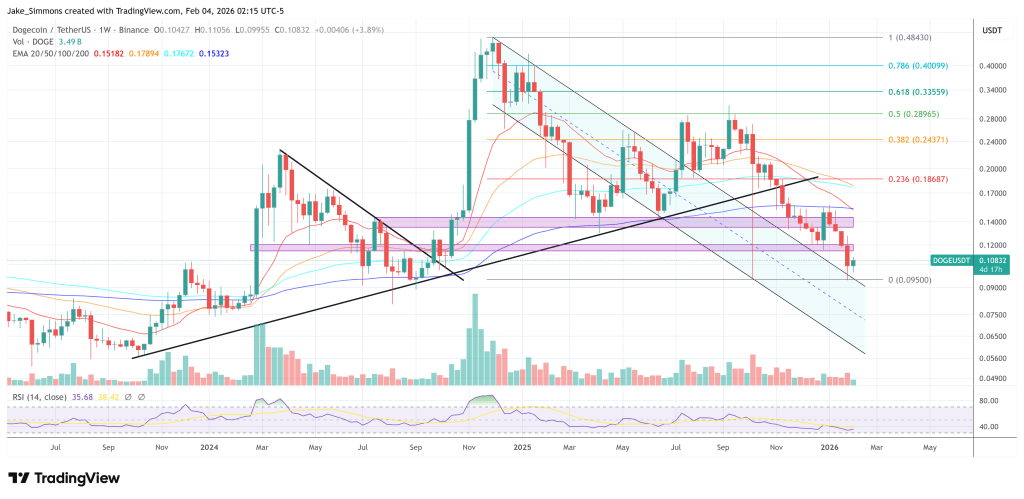
DOGE sweeps the Oct.10 low, 1-week chart | Source: DOGEUSDT on TradingView.com

Preguntas relacionadas

QWhat did Elon Musk hint at regarding Dogecoin and space exploration in his recent X post?

AElon Musk hinted that SpaceX 'maybe next year' could send Dogecoin to the Moon, which is interpreted as a timeline for the DOGE-1 lunar mission.

QWhat is the market reaction to Musk's comment about Dogecoin going to the Moon?

AThe market reaction was measurable but subdued, with DOGE prices rising roughly 4-5% on the day, reclaiming the $0.10 mark, and slightly outpacing broader crypto markets.

QWhat is the DOGE-1 mission and what is it intended to achieve?

AThe DOGE-1 mission is a commercial cubesat funded entirely in Dogecoin, booked on a Falcon 9 rocket, with the objective of reaching lunar orbit to collect basic imagery and data, marking one of the first attempts to use cryptocurrency as payment for a space mission.

QHow does the current market environment affect the reaction to Musk's Dogecoin-related tweets?

AThe current environment is risk-off, with Bitcoin down 20% in two weeks and DOGE tracking similar losses, which explains why the reaction was a brief headline bid rather than sustained momentum compared to previous rallies in cleaner conditions.

QWhat is the current trading price of DOGE mentioned at press time in the article?

AAt press time, DOGE traded at $0.10832.

Lecturas Relacionadas

OpenAI Post-Training Engineer Weng Jiayi Proposes a New Paradigm Hypothesis for Agentic AI

OpenAI engineer Weng Jiayi's "Heuristic Learning" experiments propose a new paradigm for Agentic AI, suggesting that intelligent agents can improve not just by training neural networks, but also by autonomously writing and refining code based on environmental feedback. In the experiment, a coding agent (powered by Codex) was tasked with developing and maintaining a programmatic strategy for the Atari game Breakout. Starting from a basic prompt, the agent iteratively wrote code, ran the game, analyzed logs and video replays to identify failures, and then modified the code. Through this engineering loop of "code-run-debug-update," it evolved a pure Python heuristic strategy that achieved a perfect score of 864 in Breakout and performed competitively with deep reinforcement learning (RL) algorithms in MuJoCo control tasks like Ant and HalfCheetah. This approach, termed Heuristic Learning (HL), contrasts with Deep RL. In HL, experience is captured in readable, modifiable code, tests, logs, and configurations—a software system—rather than being encoded solely into opaque neural network weights. This offers potential advantages in explainability, auditability for safety-critical applications, easier integration of regression tests to combat catastrophic forgetting, and more efficient sample use in early learning stages, as demonstrated in broader tests on 57 Atari games. However, the blog acknowledges clear limitations. Programmatic strategies struggle with tasks requiring long-horizon planning or complex perception (e.g., Montezuma's Revenge), areas where neural networks excel. The future vision is a hybrid architecture: specialized neural networks for fast perception (System 1), HL systems for rules, safety, and local recovery (also System 1), and LLM agents providing high-level feedback and learning from the HL system's data (System 2). The core proposition is that in the era of capable coding agents, a significant portion of an AI's learned experience could be maintained as an auditable, evolving software system.

marsbitHace 30 min(s)

OpenAI Post-Training Engineer Weng Jiayi Proposes a New Paradigm Hypothesis for Agentic AI

marsbitHace 30 min(s)

Your Claude Will Dream Tonight, Don't Disturb It

This article explores the recent phenomenon of AI companies increasingly using anthropomorphic language—like "thinking," "memory," "hallucination," and now "dreaming"—to describe machine learning processes. Focusing on Anthropic's newly announced "Dreaming" feature for its Claude Agent platform, the piece explains that this function is essentially an automated, offline batch processing of an agent's operational logs. It analyzes past task sessions to identify patterns, optimize future actions, and consolidate learnings into a persistent memory system, akin to a form of reinforcement learning and self-correction. The article draws parallels to similar features in other AI agent systems like Hermes Agent and OpenClaw, which also implement mechanisms for reviewing historical data, extracting reusable "skills," and strengthening long-term memory. It notes a key difference from human dreaming: these AI "dreams" still consume computational resources and user tokens. Further context is provided by discussing the technical challenges of managing AI "memory" or context, highlighting the computational expense of large context windows and innovations like Subquadratic's new model claiming drastically longer contexts. The core critique argues that this strategic use of human-centric vocabulary does more than market products; it subtly reshapes user perception. By framing algorithms with terms associated with consciousness, companies blur the line between tool and autonomous entity. This linguistic shift can influence user expectations, tolerance for errors, and even perceptions of responsibility when systems fail, potentially diverting scrutiny from the companies and engineers behind the technology. The article concludes by speculating that terms like "daydreaming" for predictive task simulation might be next, continuing this trend of embedding the idea of an "inner life" into computational processes.

marsbitHace 32 min(s)

Your Claude Will Dream Tonight, Don't Disturb It

marsbitHace 32 min(s)

Trading

Spot
Futuros

Artículos destacados

Cómo comprar ELON

¡Bienvenido a HTX.com! Hemos hecho que comprar Dogelon Mars (ELON) sea simple y conveniente. Sigue nuestra guía paso a paso para iniciar tu viaje de criptos.Paso 1: crea tu cuenta HTXUtiliza tu correo electrónico o número de teléfono para registrarte y obtener una cuenta gratuita en HTX. Experimenta un proceso de registro sin complicaciones y desbloquea todas las funciones.Obtener mi cuentaPaso 2: ve a Comprar cripto y elige tu método de pagoTarjeta de crédito/débito: usa tu Visa o Mastercard para comprar Dogelon Mars (ELON) al instante.Saldo: utiliza fondos del saldo de tu cuenta HTX para tradear sin problemas.Terceros: hemos agregado métodos de pago populares como Google Pay y Apple Pay para mejorar la comodidad.P2P: tradear directamente con otros usuarios en HTX.Over-the-Counter (OTC): ofrecemos servicios personalizados y tipos de cambio competitivos para los traders.Paso 3: guarda tu Dogelon Mars (ELON)Después de comprar tu Dogelon Mars (ELON), guárdalo en tu cuenta HTX. Alternativamente, puedes enviarlo a otro lugar mediante transferencia blockchain o utilizarlo para tradear otras criptomonedas.Paso 4: tradear Dogelon Mars (ELON)Tradear fácilmente con Dogelon Mars (ELON) en HTX's mercado spot. Simplemente accede a tu cuenta, selecciona tu par de trading, ejecuta tus trades y monitorea en tiempo real. Ofrecemos una experiencia fácil de usar tanto para principiantes como para traders experimentados.

159 Vistas totalesPublicado en 2024.12.12Actualizado en 2025.03.21

Cómo comprar ELON

Discusiones

Bienvenido a la comunidad de HTX. Aquí puedes mantenerte informado sobre los últimos desarrollos de la plataforma y acceder a análisis profesionales del mercado. A continuación se presentan las opiniones de los usuarios sobre el precio de ELON (ELON).

活动图片













