Elon Musk Revives ‘Dogecoin To The Moon’ With Hint For 2027

bitcoinistPublicado a 2026-02-04Actualizado a 2026-02-04

Resumen

Elon Musk has reignited speculation about the Dogecoin-funded DOGE-1 lunar mission, suggesting in a recent X post that SpaceX could send Dogecoin “to the Moon” as early as next year—potentially 2027. This comment, referencing a pledge from 2021, sparked a modest 4-5% price increase in DOGE, though the reaction was more subdued compared to past Musk-driven rallies. The DOGE-1 mission, a cubesat paid for entirely in Dogecoin and set to launch on a Falcon 9, has faced multiple delays. Market conditions remain risk-averse, with DOGE still down significantly from its peaks. The project, developed by Geometric Energy Corporation in partnership with SpaceX, aims to demonstrate blockchain technology in lunar orbit.

Elon Musk on Tuesday reignited a long-running narrative linking Dogecoin to space exploration, telling a fan on X (that SpaceX “maybe next year” could send Dogecoin to the Moon — a phrase interpreted by many in the crypto community as a timeline for fulfilling the long-teased DOGE-1 lunar mission. The brief exchange with a supporter has lifted investor interest and triggered a modest price response in DOGE.

Dogecoin To The Moon, Literally?

Musk’s latest comment came in reply to a repost of his own old pledge that SpaceX would put a “literal Dogecoin on the literal Moon,” a promise dating back to 2021 and tied to the DOGE-1 lunar project. With “Maybe next year”, he signaled that the long-delayed mission might materialize as soon as 2027, reviving a narrative that has periodically surfaced over the past few years.

The DOGE-1 mission is a commercial cubesat funded entirely in Dogecoin, booked as a rideshare aboard a Falcon 9 rocket with the objective of reaching lunar orbit and collecting basic imagery and data, marking one of the first attempts to use cryptocurrency as the payment medium for a space mission.

Originally announced in 2021, the launch has been postponed multiple times, and as of the latest filings and reporting, it remains on track for a launch window in the next year or so.


Market reaction to Musk’s retweet has been measurable but subdued compared with previous comment-driven pumps. Prices for DOGE rose roughly 4–5 percent on the day of the remark, with the token reclaiming the $0.10 mark. The gain slightly outpaced broader crypto markets on the session, positioning DOGE among the better performing large cap assets in the short term after the post.

Although Musk’s social influence on meme coins is well documented, the tone this time appeared more cautious. DOGE remains more than 77 percent below the 2024 high and orders of magnitude beneath its 2021 peak. Previous Musk-linked tweets have historically triggered more pronounced rallies, including sharp single-day surges when he first reignited interest in the space mission concept.

Musk’s post also landed in an unfriendly tape. Since October, the market’s mood has shifted sharply risk-off, with many experts now treating the move as a bear-market regime rather than a routine pullback. Bitcoin has slid roughly 20% over the past two weeks alone, and DOGE has largely tracked the same drawdown, a backdrop that helps explain why the reaction to the tweet looked more like a brief headline bid than the kind of sustained momentum meme coins sometimes get in cleaner conditions.

The broader status of DOGE-1 remains that of a mission expected but not yet executed. Geometric Energy Corporation, the entity behind the payload, has partnered with SpaceX to book the flight, and the satellite is designed to demonstrate blockchain technology beyond low Earth orbit. The exact timeline for launch is still evolving, and Musk’s prompt “maybe next year” implicitly extends prior schedules into 2027.

At press time, DOGE traded at $0.10832.
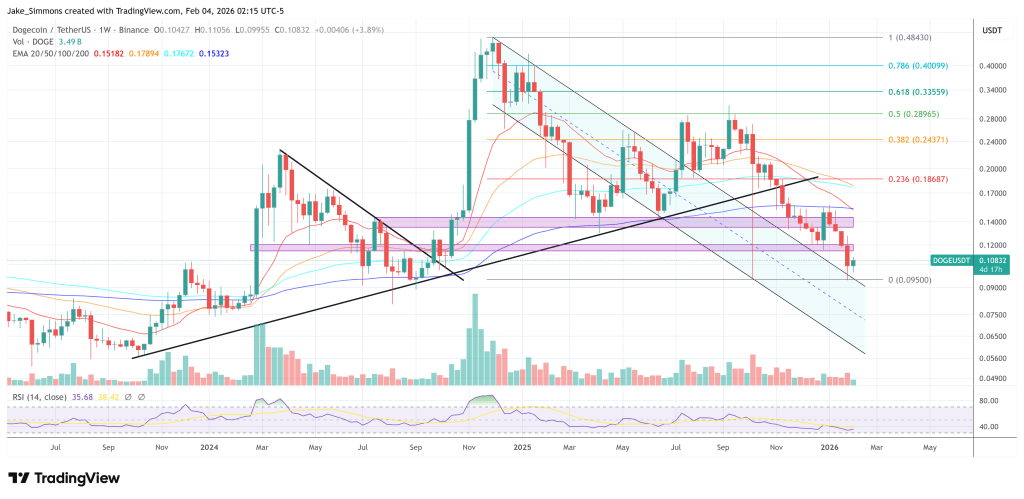
DOGE sweeps the Oct.10 low, 1-week chart | Source: DOGEUSDT on TradingView.com

Criptos en tendencia

Preguntas relacionadas

QWhat did Elon Musk hint at regarding Dogecoin and space exploration in his recent X post?

AElon Musk hinted that SpaceX 'maybe next year' could send Dogecoin to the Moon, which is interpreted as a timeline for the DOGE-1 lunar mission.

QWhat is the market reaction to Musk's comment about Dogecoin going to the Moon?

AThe market reaction was measurable but subdued, with DOGE prices rising roughly 4-5% on the day, reclaiming the $0.10 mark, and slightly outpacing broader crypto markets.

QWhat is the DOGE-1 mission and what is it intended to achieve?

AThe DOGE-1 mission is a commercial cubesat funded entirely in Dogecoin, booked on a Falcon 9 rocket, with the objective of reaching lunar orbit to collect basic imagery and data, marking one of the first attempts to use cryptocurrency as payment for a space mission.

QHow does the current market environment affect the reaction to Musk's Dogecoin-related tweets?

AThe current environment is risk-off, with Bitcoin down 20% in two weeks and DOGE tracking similar losses, which explains why the reaction was a brief headline bid rather than sustained momentum compared to previous rallies in cleaner conditions.

QWhat is the current trading price of DOGE mentioned at press time in the article?

AAt press time, DOGE traded at $0.10832.

Lecturas Relacionadas

From South Korea to the United States: Blue-Collar Jobs Are Becoming Increasingly Popular, Thanks to AI

AI is reshaping the labor market's value proposition. The traditional four-year college degree is losing its appeal as a guaranteed career path, while skilled blue-collar trades like electricians, welders, and plumbers are experiencing historic demand and wage premiums. This shift is driven by dual pressures: AI's displacement of certain white-collar roles and a booming need for physical infrastructure and data center construction. Data confirms the trend. In the U.S., vocational school revenue surged, and a significant portion of recent layoffs are AI-related. Surveys show a majority of Gen Z adults plan to pursue blue-collar work, citing better job security against AI automation. Vocational education interest has exploded recently. Experts cite a psychological shift as younger generations seek tangible, AI-resistant careers and avoid high student debt. In many cases, salaries for skilled trades now match or exceed those requiring a bachelor's degree. In South Korea, semiconductor vocational high schools boast near-total employment, with graduates securing high-paying roles at companies like Samsung. The shortage is structural, exacerbated by a retiring baby boomer workforce and massive infrastructure projects. Companies like JPMorgan Chase, Meta, and Lowe's are investing heavily in training programs. However, overcoming historical stigma and a "perception gap" around trade careers remains a key challenge to closing the talent gap.

marsbitHace 56 min(s)

From South Korea to the United States: Blue-Collar Jobs Are Becoming Increasingly Popular, Thanks to AI

marsbitHace 56 min(s)

Qualcomm: AI Hype Subsides, When Will Smartphones Emerge from the Gloom?

Qualcomm reported its Q3 FY2026 results (ending June 2026), with revenue of $9.95B, down 4% YoY but above expectations. Gross margin declined to 53.1%, pressured by rising costs across manufacturing and memory. Key business segments showed mixed performance: Handset revenue fell 19.6% YoY to $5.09B, dragged by an 11% decline in non-Apple Android shipments and weaker high-end mix. Conversely, Automotive revenue surged 61% to $1.59B, and IoT grew 9% to $1.83B. Core operating profit dropped 41% YoY due to margin compression and higher expenses. Management's Q4 FY2026 guidance projects revenue of $9.7B-$10.5B, in line with consensus, but Non-GAAP EPS guidance of $2.05-$2.25 fell short of expectations. Amidst persistent weakness in its core handset market, Qualcomm is pursuing growth in AI, focusing on Edge AI (smartphones, PCs, automotive) and Data Center AI. Its data center strategy includes four pillars: AI accelerators (e.g., AI200), commercial CPUs (Dragonfly C1000), custom silicon, and connectivity solutions. While these initiatives initially boosted its stock, concerns over AI capital expenditure sustainability have since erased those gains. The company targets $5B in data center revenue for FY2027 and $15B for FY2029. The report concludes that with the traditional handset business still under pressure, the data center opportunity is currently viewed as a longer-term option, and a more conservative valuation based on core operations may be warranted until AI contributions materialize.

marsbitHace 1 hora(s)

Qualcomm: AI Hype Subsides, When Will Smartphones Emerge from the Gloom?

marsbitHace 1 hora(s)

From TPU to Self-Evolving Agents: How Jeff Dean Predicts the Next Step in AI

At the 2026 YC Startup School, Jeff Dean outlined his vision for AI's next phase, shifting focus from simply scaling models to building intelligent, autonomous systems. He believes AI's progress is no longer just about creating smarter models, but about integrating them into systems capable of long-term, iterative work, automated experimentation, and continuous learning. This evolution moves the competition from "who has the bigger model" to "who can best organize intelligence." Dean suggests AI capabilities are now comparable to a junior engineer, enabling the automation of complex workflows. However, the true challenge and opportunity lie in managing these AI "workers" at scale. He emphasizes the importance of **context engineering**—structuring tools, memory, and feedback loops—over raw model power. For startups, this means building deep expertise in niche domains where general models currently fail (near 0-1% success rates), leveraging proprietary data, specialized tools, and domain-specific evaluators. A recurring theme is re-examining fundamental constraints. Dean's past work, like moving Google's search index to memory or creating the TPU, stemmed from questioning outdated assumptions about hardware and cost. He sees similar inflection points today, particularly in **specialized inference hardware** to drastically reduce latency and energy consumption for real-time Agent operation. Notably, he points out that in modern AI systems, the dominant cost is often not computation but **data movement**. Reliable, long-running Agents require robust system design, borrowing concepts from distributed computing like checkpointing, state management, and parallel exploration to handle failures and maintain progress over days or weeks. As AI automates execution, the scarcest human skills will shift to **defining clear specifications**, **judging what problems are worth solving** (taste), and designing effective feedback loops. Ultimately, Dean's framework prioritizes understanding the problem deeply, identifying the true bottlenecks, and systematically building closed-loop systems where AI can not only perform tasks but also improve AI itself.

marsbitHace 1 hora(s)

From TPU to Self-Evolving Agents: How Jeff Dean Predicts the Next Step in AI

marsbitHace 1 hora(s)

Trading

Spot

Artículos destacados

Cómo comprar ELON

¡Bienvenido a HTX.com! Hemos hecho que comprar Dogelon Mars (ELON) sea simple y conveniente. Sigue nuestra guía paso a paso para iniciar tu viaje de criptos.Paso 1: crea tu cuenta HTXUtiliza tu correo electrónico o número de teléfono para registrarte y obtener una cuenta gratuita en HTX. Experimenta un proceso de registro sin complicaciones y desbloquea todas las funciones.Obtener mi cuentaPaso 2: ve a Comprar cripto y elige tu método de pagoTarjeta de crédito/débito: usa tu Visa o Mastercard para comprar Dogelon Mars (ELON) al instante.Saldo: utiliza fondos del saldo de tu cuenta HTX para tradear sin problemas.Terceros: hemos agregado métodos de pago populares como Google Pay y Apple Pay para mejorar la comodidad.P2P: tradear directamente con otros usuarios en HTX.Over-the-Counter (OTC): ofrecemos servicios personalizados y tipos de cambio competitivos para los traders.Paso 3: guarda tu Dogelon Mars (ELON)Después de comprar tu Dogelon Mars (ELON), guárdalo en tu cuenta HTX. Alternativamente, puedes enviarlo a otro lugar mediante transferencia blockchain o utilizarlo para tradear otras criptomonedas.Paso 4: tradear Dogelon Mars (ELON)Tradear fácilmente con Dogelon Mars (ELON) en HTX's mercado spot. Simplemente accede a tu cuenta, selecciona tu par de trading, ejecuta tus trades y monitorea en tiempo real. Ofrecemos una experiencia fácil de usar tanto para principiantes como para traders experimentados.

206 Vistas totalesPublicado en 2024.12.12Actualizado en 2025.03.21

Cómo comprar ELON

Discusiones

Bienvenido a la comunidad de HTX. Aquí puedes mantenerte informado sobre los últimos desarrollos de la plataforma y acceder a análisis profesionales del mercado. A continuación se presentan las opiniones de los usuarios sobre el precio de ELON (ELON).

活动图片













