Elon Musk wrote on social network X that the traffic of AI agents will "definitely significantly exceed" human traffic, citing a forecast by Cloudflare. The entrepreneur's comment referred to the company's assessment that in five years, bot traffic will exceed human traffic by 1,000 times.
The traffic of AI agents will clearly and significantly exceed human traffic, there is no question about it. The Cloudflare forecast is accurate.
Cloudflare has been developing the idea that automated systems are surpassing humans in terms of internet activity volume for several months. Back on June 3, 2026, the company's CEO, Matthew Prince, announced that bot traffic had for the first time in internet history surpassed human traffic. According to him, the company expected this event closer to the end of 2027, then shifted the forecast to early 2027, but AI agent traffic grew so rapidly that the tipping point was recorded in May 2026.
Humans as a 'Statistical Error'
At the conference on the results of the second quarter of 2026, held on August 6, Cloudflare's CFO, Thomas Seifert, stated that if the current trend continues, in five years, bot traffic will exceed human traffic by 1,000 times. Seifert clarified that the company's previous forecasts on this topic had been incorrect — but not in the usual direction: reality consistently outpaced expectations. In his words, humans risk becoming a "statistical error" on the internet — not due to a decrease in human activity, but due to the rate of growth in agent activity.
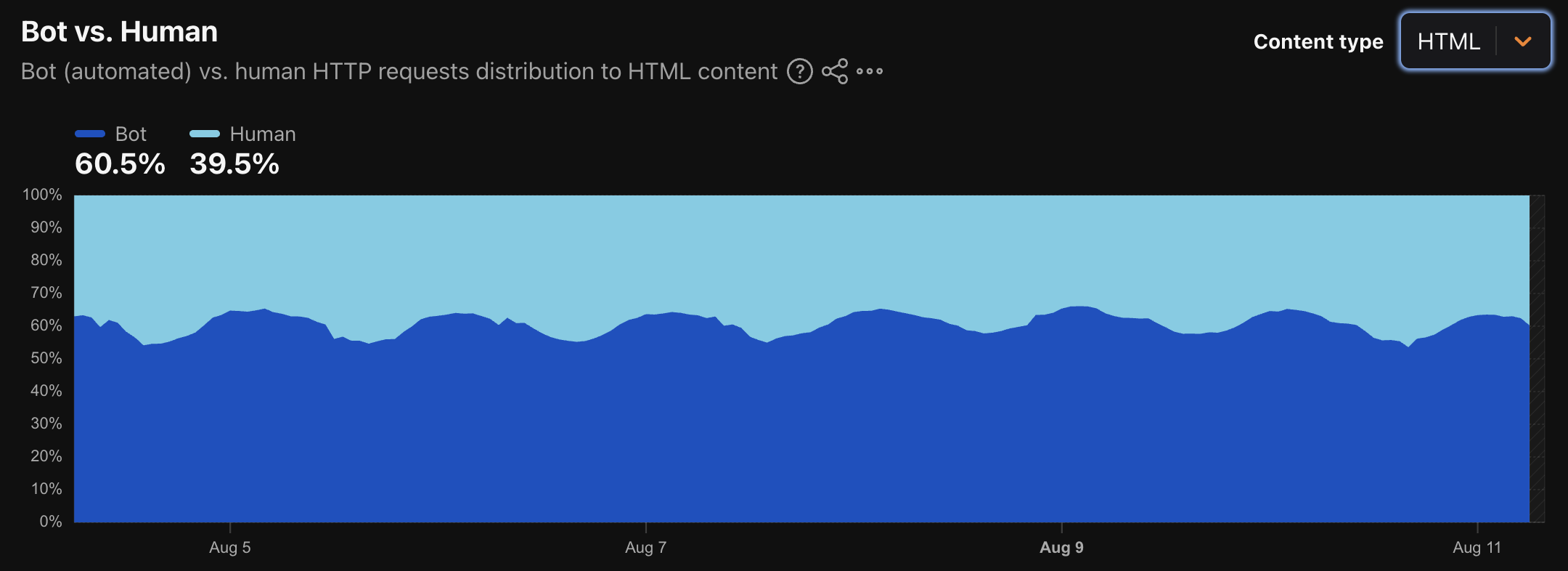
The data referenced by Prince and Seifert is updated daily on the Cloudflare Radar dashboard, which tracks the ratio of bot traffic to human traffic. It was this section that Prince linked to in his June post, and a month later, Musk drew attention to it while commenting on Cloudflare's conclusions.
AI's Opinion
From a methodological standpoint, comparing different sources of telemetry opens an interesting perspective. Cloudflare Radar measures the share of bots based on HTTP requests for HTML content on the company's servers, whereas Thales/Imperva recorded a different figure in its annual report: in 2025, the share of automated traffic across the entire global network reached 53%, compared to 51% the previous year. The discrepancy in numbers between providers is explained by different domain samples and different criteria for classifying a request as a "bot" — a unified measurement standard does not yet exist.
A historical parallel can be drawn with early disputes about internet provider coverage in the 1990s, when each company used its own methodology for counting users. The technical risk that remains off-screen: the more vendor metrics diverge, the harder it becomes for regulators and infrastructure developers to rely on a unified picture of what's happening. Will the market be left without a common standard for accounting for agent traffic?
end-content