EIP-8363 Explained: Burning Staking Rewards to Save Ethereum? Independent Node Operators Might Be the First to Leave

marsbitPublicado a 2026-08-12Actualizado a 2026-08-12

Resumen

Analysis of EIP-8363: A Proposal to Burn Staking Rewards and its Potential Impacts on Ethereum A new Ethereum Improvement Proposal, EIP-8363, has sparked significant debate. Its core mechanism is to progressively burn validator consensus rewards, aiming to reduce the issuance rate to 0% once 50% of the total ETH supply is staked. Proponents argue this would cap the staked ETH ratio, enhancing credible neutrality and censorship resistance by discouraging excessive centralization among large staking operators and liquid staking token (LST) providers. However, a critical analysis suggests the proposal may create more problems than it solves. While it compresses the ETH staking range where profitability turns negative (from 70-100 million ETH down to 50-60 million ETH), it does not fundamentally alter the competitive disadvantage of independent stakers. Due to economies of scale, large operators would still retain advantages in costs and MEV opportunities. Independent stakers are predicted to be the first to face negative real returns under the new curve. The economic repercussions could be severe. A sharp decline in base staking yield would disrupt DeFi ecosystems built around this yield, potentially reversing incentives for borrowing ETH and triggering large-scale unwinding of leveraged staking strategies. This could lead to significant selling pressure on ETH as professional staking operations become unprofitable and exit. The proposal is criticized for being based on unce...

Author: ETH Daily News

Compiled by: TechFlow Deep Tide

Deep Tide TechFlow Introduction: EIP-8363 proposes burning validator rewards, reducing the staking yield to zero to compress the scale of staking. However, this analysis suggests that the new proposal not only fails to solve oligopoly but will also cause independent stakers to fall into losses first and may trigger a chain reaction of DeFi lending and deleveraging. For ETH holders or DeFi users, this is a risk in the economic model change that must be taken seriously.

Understanding the Issuance Burn Proposal

Gradual issuance burn compresses the unprofitable range for staking, but independent stakers may still be the first to experience negative returns.

Happy Monday, August 10, 2026.

The issuance burn proposal (EIP-8363) has dominated timelines over the past week. Proposed on August 4, 2026, it aims to burn validator consensus layer rewards along a new issuance curve, reducing issuance to 0% once 50% of all ETH is staked. This is an economic change, not a technical one. Related discussions have been confusing.

Important note: This is not a technical explanation, only my (incomplete) understanding.

Current situation: With a minimum issuance floor of 1.5% annualized yield, the supply of staked ETH is growing and will continue to grow.

EIP-8363: Under this proposal, the supply of staked ETH will not exceed 50%, as issuance will be 0% at that point (no incentive to stake).

Difference: The new proposal compresses the unprofitable ETH staking range from 70 million-100 million ETH to 50 million-60 million ETH (<50%).

My judgment: EIP-8363 attempts to address real issues, but the cost outweighs the benefits.

What It Does

Gradual issuance burn reduces issuance by burning a portion of validator rewards. It will burn the base reward along a gradual curve, reaching a 100% burn ratio (0% issuance) when the staked supply hits 50%. This change will be implemented gradually over an 18-month transition period. The proposal aims to suppress the staked ETH supply from exceeding 50%, helping to maintain a balanced staking ratio.

Why It Was Proposed

The publicly stated goals of EIP-8363 are to enhance credible neutrality and capture resistance. The current issuance curve has a floor of 1.5% annualized yield, even if 100% of ETH is staked. Since everyone has an incentive to keep staking ETH, more staking share tends to concentrate with large operators, custodians, and liquid staking providers. The proposal (paraphrased) argues:

Too big to fail: If a major operator gets slashed or exploits the system, it could become too big to fail, and the network would have a moral obligation to compensate its users via a hard fork.

Weakened social slashing: Large operators could collude to circumvent social slashing events. The social layer would find it harder to coordinate a fork.

Dilution: As more ETH is issued, the total ETH supply increases, diluting everyone's real yield. The proposal argues independent stakers are hit especially hard and suggests ETH holders are overpaying for security through dilution.

Forced staking: The increasing ETH supply forces non-staking holders to either stake or face dilution risk. This reduces available ETH in the market.

LST replaces ETH: As more ETH gets staked, LSTs become the default asset in DeFi. This introduces systemic risk due to increased smart contract risk, governance risk, and issuer risk.

Dependency: Apps and protocols issuing derivatives gain outsized political and economic leverage over the network.

The Same Endgame

Both the current situation and issuance burn lead to unfavorable final states. Issuance burn is framed as slightly better than the status quo because it compresses the ETH staking range where independent stakers, institutions, and LSTs become unprofitable. But both lead to the same place, with large staking entities retaining advantages.

The capture resistance issue persists. In both scenarios, independent stakers would be the first to hit negative real returns. Professional staking operators always have economies of scale: lower fixed costs, more MEV opportunities, better uptime, bulk discounts. In fact, MaxEB (EIP-7251) has further reduced operational overhead for large stakers.

This is the crux of the debate: What's the difference between ETH staking becoming unprofitable at 70 million-100 million ETH (current) vs. around 50 million-60 million ETH (issuance burn)?

Issuance-driven base staking yield drives demand for ETH, incentivizing entities from digital asset finance firms, institutions, ETFs, liquid staking protocols, to individual holders to buy and stake ETH. Staked ETH reduces circulating supply, easing sell pressure on the asset. Reducing issuance would have the opposite effect.

With lower yield, currently profitable validators would fall into losses sooner and need to exit. As noted, independent stakers would be the first among all stakers to reach negative real returns. I disagree with the claim that this proposal specifically protects independent stakers. When other opportunities offer better returns, stakers will be incentivized to unstake and take their gains to seek profits elsewhere.

Businesses Forced to Close

Some businesses are built on Ethereum's yield. They buy ETH, participate in network validation, and provide real services. They are using the network as designed. Declining yield squeezes their profit margins, and we will see businesses shut down and unstake ETH. This would also create significant selling pressure on ETH.
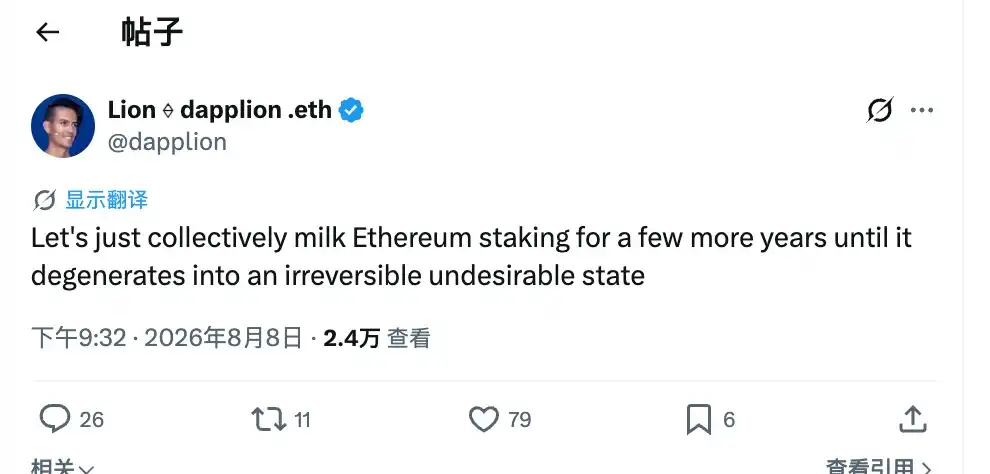
Some supporters of this EIP describe businesses built on Ethereum's yield as "extracting" from the network or receiving a "systemic subsidy." This rhetoric dismisses the real work being done: teams like Obol building DVT infrastructure, or public goods funding mechanisms like Octant—they are solving hard problems, not extracting rents.

Impact on DeFi

The entire Ethereum DeFi ecosystem utilizes the base staking yield. A sudden drop in ETH staking yield would directly reduce the lending rate for ETH across all of DeFi. Currently, market participants borrow ETH to stake, lend ETH to capture yield, and use ETH as collateral to borrow stablecoins and buy more ETH.

Reducing staking yield reverses these incentives. Market participants would borrow ETH to sell. They would stop lending ETH due to low yield and switch to stablecoins as collateral instead of ETH. This would trigger a massive unwind of staking yield strategies: DeFi vaults would see outflows, DeFi Total Value Locked would drop, and demand for ETH would decline.

Not all DeFi users are yield farmers. DeFi provides financial services access to users worldwide. Many rely on it for savings, investment, and hedging against local currency inflation. They too would be hit by falling yield. A sudden change of this magnitude has far-reaching consequences. More concerning is the turmoil it could unleash.

Based on Expectations

One reason this EIP is controversial is that it's based on expectations. How the market reaches equilibrium in two years under either curve remains unknown.

The new curve reaches equilibrium when real yield is greater than 0%, so self-funded stakers can still sustain themselves.
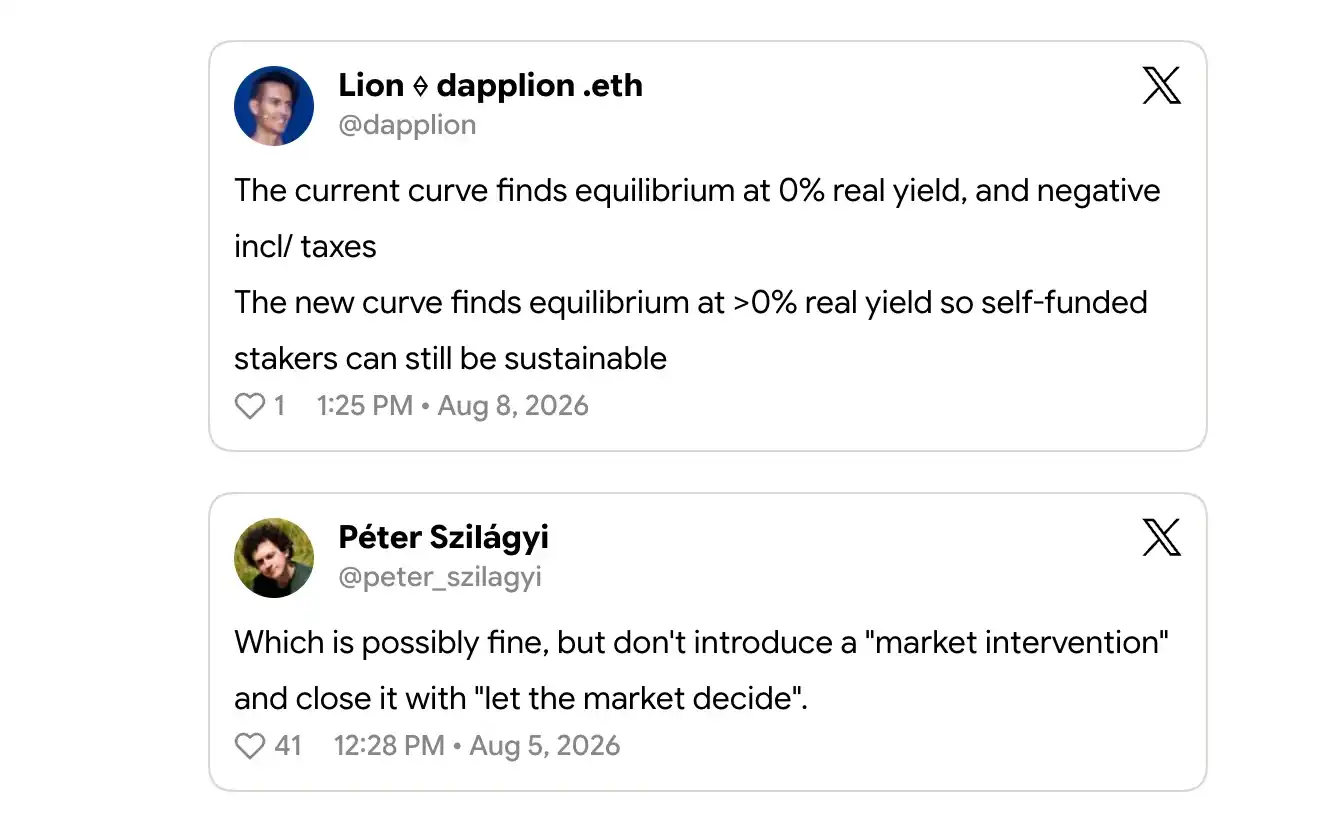
A key argument from supporters is that under the new proposal, the market will find equilibrium above 0%. Analysis by pa7x1 ("Shape of Future Issuance Curves") shows that under the current curve, independent stakers hit negative real returns first when 70 million ETH is staked. This expectation is based on cost estimates. Under the new proposal, independent stakers hit negative real returns when less than 60 million ETH is staked. If actual costs are higher than estimated, this threshold could arrive even sooner.

The Longer-Term Roadmap

I haven't seen discussion about EIP-8363's relation to the target validator set of 128,000. The Ethereum roadmap includes changes to reduce the number of validators. A smaller validator set helps reduce the load of signatures, attestations, and state on the consensus layer. MaxEB (EIP-7251) aims to ease this burden by consolidating validators. This long-term series of improvements helps Ethereum move closer to single-slot finality.

Issuance burn effectively caps the amount of staked ETH, thereby reducing the number of validators. It's unclear if reducing the validator set is an indirect goal of the issuance burn proposal. Clarification from researchers would be helpful.

I think the goal of a balanced staking ratio is good.

I think it alleviates, but does not solve, the problems it claims to address.

I think the cost outweighs the benefits.

Criptos en tendencia

Preguntas relacionadas

QWhat is the main purpose of the EIP-8363 proposal described in the article?

AThe main purpose of EIP-8363 is to gradually burn validator rewards, reducing the issuance rate to 0% once 50% of all ETH is staked. It aims to limit the staked ETH supply from exceeding 50%, thereby enhancing credible neutrality, reducing capture risk, and maintaining a balanced staking ratio.

QAccording to the article, how does the author believe EIP-8363 affects independent stakers compared to large staking entities?

AThe author argues that under EIP-8363, independent stakers will still be the first to reach negative real yields, just at a lower staking threshold (around 50-60 million ETH) compared to the current situation (70-100 million ETH). Large operators retain advantages like economies of scale, lower costs, and better MEV opportunities.

QWhat is one of the potential negative consequences for the DeFi ecosystem mentioned in the article if EIP-8363 is implemented?

AA potential negative consequence is that a sudden drop in ETH staking yield could trigger a large-scale unwinding of staking yield strategies. This could lead to capital outflows from DeFi vaults, a decrease in Total Value Locked (TVL), and reduced demand for ETH as lending rates and incentives shift.

QWhat does the article claim is a significant problem with the current Ethereum issuance curve that EIP-8363 attempts to address?

AThe article states the current issuance curve has a minimum Annual Percentage Yield (APY) floor of 1.5%, which incentivizes staking even at 100% ETH staked. This leads to concentration among large operators and Liquid Staking Token (LST) providers, forces non-stakers into staking to avoid dilution, and increases systemic risks as LSTs become the default DeFi asset.

QWhat long-term Ethereum roadmap goal might EIP-8363 indirectly support, as suggested in the article's conclusion?

AThe article suggests EIP-8363 might indirectly support the long-term goal of reducing the validator set size (e.g., to a target of 128,000 validators). By capping the total staked ETH, it reduces the number of validators, which aligns with improvements like MaxEB (EIP-7251) aimed at reducing consensus layer load and moving towards single-slot finality.

Lecturas Relacionadas

"Ontology Faction" vs. "Supplier Faction": In-depth Observation of Dexterous Hand Track Financing in 2026

The article analyzes the robotics "dexterous hand" sector in 2026, revealing intense investment activity. Key insights include: The sector is divided into two camps: "Body Manufacturers" (15 companies like Zhuji Power, Xingdong Era, Xingchen Intelligence) that integrate self-developed dexterous hands into their humanoid robots, and "Third-Party Suppliers" (32 companies) that independently sell complete dexterous hands or core components like tactile sensors and micro-motors. Body Manufacturers secured significantly larger average funding rounds (over ¥8B vs. under ¥2B for suppliers), reflecting bets on the broader humanoid robot market. While body makers now view in-house hand R&D as essential for differentiation, they still heavily rely on external suppliers for key underlying components like sensors and actuators. The supplier landscape is further segmented. "Complete Hand" suppliers (e.g., Critical Point AGILINK, Lingxin Qiaoshou, Xynova) face fierce consolidation as scale becomes critical. "Tactile Perception" specialists (e.g., Paxini, Daimeng, Qianjue) possess high technical barriers and early-mover advantages. "Core Component" makers (e.g., Wuji Tech, Zhijian Zhiqing, Nuoshi Robotics) are "hidden champions" with deep expertise in motors and drive systems, benefiting from import substitution. The analysis concludes the industry is structurally diverging. A hybrid model of body-maker integration plus specialist outsourcing will likely dominate. Suppliers will undergo significant consolidation, particularly among complete hand makers, while component specialists with deep technical moats are poised for sustained growth.

marsbitHace 2 min(s)

"Ontology Faction" vs. "Supplier Faction": In-depth Observation of Dexterous Hand Track Financing in 2026

marsbitHace 2 min(s)

Is 'Light In, Memory Out' Becoming the New Trading Narrative in the U.S. Stock Market?

Is "Light in, Memory out" Becoming the New Narrative in U.S. Stock Trading? Following the growing market consensus that AI chip valuations may have peaked, capital is seeking the next AI-related theme. In this context, the "Light in, Memory out" narrative is emerging – signaling a shift where optical communication stocks are taking the baton from memory. Optical communication, utilizing light signals (primarily via fiber optics) for data transmission, is critical for AI. AI model training and inference rely on massive GPU clusters that require frequent exchange of vast data, generating immense east-west traffic. Traditional copper interconnects face physical limits at high speeds (short distances, high power, interference). Optical interconnects solve this with higher bandwidth density, longer reach, and better energy efficiency, becoming crucial for scaling AI clusters. The narrative is validated by diverging stock performance. While memory stocks (like Micron, SK Hynix) have corrected amid crowded positioning and growth concerns, optical communication stocks (AAOI, COHR, LITE) have surged roughly 40-50% since August, driven by strong earnings and accelerating demand from AI cluster expansion and the transition to 800G/1.6T technology. LITE’s recent earnings solidified the story, beating estimates with impressive margins (gross margin above 50%, operating margin 36.4%). Its guidance projected an operating margin near 40% next quarter, faster than expected. Management noted laser capacity remains insufficient to meet strong demand and confirmed its key CPO (Co-Packaged Optics) client is accelerating plans. COHR's upcoming earnings are highly anticipated for further confirmation. However, risks are evident after the sector's sharp rally. The current dilemma is believing the narrative while avoiding buying at a peak. In a thematic rotation market, survival is key – prepare your tools before deciding how to position. Disclaimer: This summary is for informational purposes only and does not constitute investment advice.

marsbitHace 3 min(s)

Is 'Light In, Memory Out' Becoming the New Trading Narrative in the U.S. Stock Market?

marsbitHace 3 min(s)

OpenClaw Founder Peter Steinberg's Latest Speech: The Life and Death Revelation of an Open Source Project, How OpenClaw Emerged from the Eye of the Storm

Peter Steinberg, founder of the wildly popular open-source AI agent project OpenClaw, reflects on its turbulent journey from creation to near-collapse and resurgence. It began in late 2024 from his personal frustration with sending prompts from phone to computer. He built a WhatsApp relay that felt "magical," but initial excitement was limited to friends. After adding Discord support and launching a public server, the project exploded virally overnight, attracting massive attention, rebranding requests (from "Claudis" to OpenClaw), and even praise from NVIDIA's CEO. The intense scrutiny and pressure nearly broke Steinberg. The biggest technical crisis came from over-optimizing for a specific AI model provider, which suddenly canceled subscriptions, forcing a rushed shift to open-weight models. OpenClaw's weekly downloads plummeted before surging to a record high after being "declared dead." Steinberg realized he had stopped enjoying the build process and using his own product, making it a duty rather than a passion. His key lesson: "Fun is speed." Recovery came by refocusing on building for himself, forming a non-profit, and receiving crucial support (e.g., from NVIDIA for security). The team is now using OpenClaw to build OpenClaw itself, emphasizing its core value: a private, open alternative where "your agent, your machine, your life." He shares insights: the first user should be yourself; balance bug fixes with new features to maintain interest; the current bottleneck is reliable toolchains, especially for Mac testing. His story underscores that creation thrives on personal need, endures through storms when the joy of building returns, and persists by "living in the future and building what's missing."

marsbitHace 42 min(s)

OpenClaw Founder Peter Steinberg's Latest Speech: The Life and Death Revelation of an Open Source Project, How OpenClaw Emerged from the Eye of the Storm

marsbitHace 42 min(s)

Trading

Spot

Artículos destacados

Qué es ETH 2.0

ETH 2.0: Una Nueva Era para Ethereum Introducción ETH 2.0, conocido ampliamente como Ethereum 2.0, marca una actualización monumental para la blockchain de Ethereum. Esta transición no es solo una mejora superficial; busca mejorar fundamentalmente la escalabilidad, seguridad y sostenibilidad de la red. Con un cambio del mecanismo de consenso intensivo en energía Prueba de Trabajo (PoW) a una Prueba de Participación (PoS) más eficiente, ETH 2.0 promete un enfoque transformador para el ecosistema blockchain. ¿Qué es ETH 2.0? ETH 2.0 es un conjunto de actualizaciones interconectadas y distintivas centradas en optimizar las capacidades y el rendimiento de Ethereum. La reestructuración está diseñada para abordar desafíos críticos que el mecanismo actual de Ethereum ha enfrentado, particularmente en lo que respecta a la velocidad de transacción y la congestión de la red. Objetivos de ETH 2.0 Los objetivos principales de ETH 2.0 giran en torno a mejorar tres aspectos clave: Escalabilidad: Con el objetivo de aumentar significativamente el número de transacciones que la red puede manejar por segundo, ETH 2.0 busca superar la limitación actual de aproximadamente 15 transacciones por segundo, potencialmente alcanzando miles. Seguridad: Las medidas de seguridad mejoradas son fundamentales para ETH 2.0, particularmente a través de una mejor resistencia contra ciberataques y la preservación del ethos descentralizado de Ethereum. Sostenibilidad: El nuevo mecanismo PoS está diseñado no solo para mejorar la eficiencia, sino también para reducir drásticamente el consumo de energía, alineando el marco operativo de Ethereum con consideraciones ambientales. ¿Quién es el Creador de ETH 2.0? La creación de ETH 2.0 se puede atribuir a la Fundación Ethereum. Esta organización sin fines de lucro, que desempeña un papel crucial en el apoyo al desarrollo de Ethereum, es liderada por el notable cofundador Vitalik Buterin. Su visión de un Ethereum más escalable y sostenible ha sido la fuerza motriz detrás de esta actualización, involucrando contribuciones de una comunidad global de desarrolladores y entusiastas dedicados a mejorar el protocolo. ¿Quiénes son los Inversores de ETH 2.0? Si bien los detalles sobre los inversores de ETH 2.0 no se han hecho públicos, se sabe que la Fundación Ethereum recibe apoyo de varias organizaciones e individuos en el ámbito de blockchain y tecnología. Estos socios incluyen firmas de capital de riesgo, compañías tecnológicas y organizaciones filantrópicas que comparten un interés mutuo en apoyar el desarrollo de tecnologías descentralizadas e infraestructura blockchain. ¿Cómo Funciona ETH 2.0? ETH 2.0 se distingue por introducir una serie de características clave que lo diferencian de su predecesor. Prueba de Participación (PoS) La transición a un mecanismo de consenso PoS es uno de los cambios más destacados de ETH 2.0. A diferencia de PoW, que se basa en la minería intensiva en energía para la verificación de transacciones, PoS permite a los usuarios validar transacciones y crear nuevos bloques de acuerdo con la cantidad de ETH que apuestan en la red. Esto conduce a una mayor eficiencia energética, reduciendo el consumo en aproximadamente un 99.95%, convirtiendo a Ethereum 2.0 en una alternativa considerablemente más verde. Cadenas Shard Las cadenas shard son otra innovación crítica de ETH 2.0. Estas cadenas más pequeñas operan en paralelo con la cadena principal de Ethereum, lo que permite que múltiples transacciones sean procesadas simultáneamente. Este enfoque mejora la capacidad general de la red, abordando las preocupaciones de escalabilidad que han afectado a Ethereum. Cadena Beacon En el núcleo de ETH 2.0 se encuentra la Cadena Beacon, que coordina la red y gestiona el protocolo PoS. Funciona como un organizador de cierta manera: supervisa a los validadores, asegura que los shards permanezcan conectados a la red y monitorea la salud general del ecosistema blockchain. Cronología de ETH 2.0 El viaje de ETH 2.0 ha estado marcado por varios hitos clave que trazan la evolución de esta importante actualización: Diciembre 2020: El lanzamiento de la Cadena Beacon marcó la introducción de PoS, preparándose para la migración hacia ETH 2.0. Septiembre 2022: La finalización de “La Fusión” representa un momento crucial en el que la red Ethereum se trasladó exitosamente de un marco PoW a uno PoS, anunciando una nueva era para Ethereum. 2023: El lanzamiento esperado de cadenas shard tiene como objetivo mejorar aún más la escalabilidad de la red Ethereum, consolidando a ETH 2.0 como una plataforma robusta para aplicaciones y servicios descentralizados. Características Clave y Beneficios Escalabilidad Mejorada Una de las ventajas más significativas de ETH 2.0 es su escalabilidad mejorada. La combinación de PoS y cadenas shard permite que la red expanda su capacidad, permitiendo acomodar un volumen mucho mayor de transacciones en comparación con el sistema heredado. Eficiencia Energética La implementación de PoS representa un gran paso hacia la eficiencia energética en la tecnología blockchain. Al reducir drásticamente el consumo de energía, ETH 2.0 no solo disminuye los costos operativos, sino que también se alinea más estrechamente con los objetivos de sostenibilidad global. Seguridad Mejorada Los mecanismos actualizados de ETH 2.0 contribuyen a mejorar la seguridad en toda la red. El despliegue de PoS, junto con las medidas de control innovadoras establecidas a través de cadenas shard y la Cadena Beacon, asegura un mayor grado de protección contra posibles amenazas. Costos Más Bajos para los Usuarios A medida que la escalabilidad mejora, los efectos sobre los costos de transacción también serán evidentes. Se espera que una mayor capacidad y una menor congestión se traduzcan en tarifas más bajas para los usuarios, haciendo que Ethereum sea más accesible para transacciones cotidianas. Conclusión ETH 2.0 marca una evolución significativa en el ecosistema blockchain de Ethereum. A medida que aborda problemas fundamentales como la escalabilidad, el consumo de energía, la eficiencia en las transacciones y la seguridad general, la importancia de esta actualización no puede ser subestimada. La transición a la Prueba de Participación, la introducción de cadenas shard y el trabajo fundamental de la Cadena Beacon son indicativos de un futuro donde Ethereum puede satisfacer las crecientes demandas del mercado descentralizado. En una industria impulsada por la innovación y el progreso, ETH 2.0 se erige como un testimonio de las capacidades de la tecnología blockchain para allanar el camino hacia una economía digital más sostenible y eficiente.

313 Vistas totalesPublicado en 2024.04.04Actualizado en 2024.12.03

Qué es ETH 2.0

Qué es ETH 3.0

ETH3.0 y $eth 3.0: Un Examen Profundo del Futuro de Ethereum Introducción En el paisaje en rápida evolución de las criptomonedas y la tecnología blockchain, ETH3.0, a menudo denotado como $eth 3.0, ha surgido como un tema de considerable interés y especulación. El término abarca dos conceptos principales que merecen aclaración: Ethereum 3.0: Esto representa una posible actualización futura destinada a aumentar las capacidades de la blockchain existente de Ethereum, enfocándose particularmente en mejorar la escalabilidad y el rendimiento. ETH3.0 Meme Token: Este proyecto de criptomoneda distinto busca aprovechar la blockchain de Ethereum para crear un ecosistema centrado en memes, promoviendo la participación dentro de la comunidad de criptomonedas. Comprender estos aspectos de ETH3.0 es esencial no solo para los entusiastas de las criptomonedas, sino también para aquellos que observan tendencias tecnológicas más amplias en el espacio digital. ¿Qué es ETH3.0? Ethereum 3.0 Ethereum 3.0 se presenta como una actualización propuesta para la red de Ethereum ya establecida, que ha sido la columna vertebral de muchas aplicaciones descentralizadas (dApps) y contratos inteligentes desde su inicio. Las mejoras previstas se concentran principalmente en la escalabilidad, integrando tecnologías avanzadas como sharding y pruebas de conocimiento cero (zk-proofs). Estas innovaciones tecnológicas tienen como objetivo facilitar un número sin precedentes de transacciones por segundo (TPS), potencialmente alcanzando millones, abordando así una de las limitaciones más significativas que enfrenta la tecnología blockchain actual. La mejora no es meramente técnica, sino también estratégica; está destinada a preparar la red de Ethereum para su adopción generalizada y utilidad en un futuro marcado por una mayor demanda de soluciones descentralizadas. ETH3.0 Meme Token En contraste con Ethereum 3.0, el ETH3.0 Meme Token se aventura en un ámbito más ligero y juguetón al combinar la cultura de memes de internet con la dinámica de las criptomonedas. Este proyecto permite a los usuarios comprar, vender e intercambiar memes en la blockchain de Ethereum, proporcionando una plataforma que fomenta la participación comunitaria a través de la creatividad y los intereses compartidos. El ETH3.0 Meme Token tiene como objetivo demostrar cómo la tecnología blockchain puede intersectarse con la cultura digital, creando casos de uso que son tanto entretenidos como financieramente viables. ¿Quién es el Creador de ETH3.0? Ethereum 3.0 La iniciativa hacia Ethereum 3.0 es impulsada principalmente por un consorcio de desarrolladores e investigadores dentro de la comunidad de Ethereum, incluyendo notablemente a Justin Drake. Conocido por sus ideas y contribuciones a la evolución de Ethereum, Drake ha sido una figura prominente en las discusiones sobre la transición de Ethereum a una nueva capa de consenso, denominada “Beam Chain.” Este enfoque colaborativo para el desarrollo significa que Ethereum 3.0 no es el producto de un creador singular, sino más bien una manifestación de ingenio colectivo centrado en avanzar la tecnología blockchain. ETH3.0 Meme Token Los detalles sobre el creador del ETH3.0 Meme Token son actualmente inidentificables. La naturaleza de los tokens de memes a menudo conduce a una estructura más descentralizada y dirigida por la comunidad, lo que podría explicar la falta de atribución específica. Esto se alinea con la ética de la comunidad cripto más amplia, donde la innovación a menudo surge de esfuerzos colaborativos en lugar de individuales. ¿Quiénes son los Inversores de ETH3.0? Ethereum 3.0 El apoyo a Ethereum 3.0 proviene principalmente de la Fundación Ethereum junto con una entusiasta comunidad de desarrolladores e inversores. Esta asociación fundamental proporciona un grado significativo de legitimidad y mejora la perspectiva de una implementación exitosa, ya que aprovecha la confianza y credibilidad construidas a lo largo de años de operaciones en la red. En el clima cambiando rápidamente de las criptomonedas, el apoyo de la comunidad juega un papel crucial en impulsar el desarrollo y la adopción, posicionando a Ethereum 3.0 como un contendiente serio para futuros avances en blockchain. ETH3.0 Meme Token Si bien las fuentes actualmente disponibles no proporcionan información explícita sobre las fundaciones o organizaciones de inversión que respaldan el ETH3.0 Meme Token, es indicativo del modelo de financiamiento típico para tokens de memes, que a menudo depende del apoyo de base y la participación comunitaria. Los inversores en tales proyectos suelen consistir en individuos motivados por el potencial de innovación impulsada por la comunidad y el espíritu de cooperación que se encuentra dentro de la comunidad cripto. ¿Cómo Funciona ETH3.0? Ethereum 3.0 Las características distintivas de Ethereum 3.0 radican en su implementación propuesta de sharding y tecnología zk-proof. Sharding es un método de particionamiento de la blockchain en piezas más pequeñas y manejables o “shards,” que pueden procesar transacciones de manera concurrente en lugar de secuencial. Esta descentralización del procesamiento ayuda a prevenir la congestión y asegura que la red permanezca receptiva incluso bajo una carga pesada. La tecnología de prueba de conocimiento cero (zk-proof) contribuye con otra capa de sofisticación al permitir la validación de transacciones sin revelar los datos subyacentes involucrados. Este aspecto no solo mejora la privacidad, sino que también aumenta la eficiencia general de la red. También se habla de incorporar una Máquina Virtual de Ethereum de conocimiento cero (zkEVM) en esta actualización, amplificando aún más las capacidades y utilidad de la red. ETH3.0 Meme Token El ETH3.0 Meme Token se distingue al capitalizar la popularidad de la cultura de memes. Establece un mercado para que los usuarios participen en el comercio de memes, no solo por entretenimiento sino también por el posible beneficio económico. Al integrar características como staking, provisión de liquidez y mecanismos de gobernanza, el proyecto fomenta un entorno que incentiva la interacción y participación de la comunidad. Al ofrecer una mezcla única de entretenimiento y oportunidad económica, el ETH3.0 Meme Token tiene como objetivo atraer a una audiencia diversa, que abarca desde entusiastas de las criptomonedas hasta conocedores casuales de memes. Línea de Tiempo de ETH3.0 Ethereum 3.0 11 de noviembre de 2024: Justin Drake insinúa la próxima actualización de ETH 3.0, centrada en mejoras de escalabilidad. Este anuncio significa el comienzo de las discusiones formales sobre la futura arquitectura de Ethereum. 12 de noviembre de 2024: Se espera que la propuesta anticipada para Ethereum 3.0 se desvele en Devcon en Bangkok, preparando el escenario para una mayor retroalimentación de la comunidad y posibles próximos pasos en el desarrollo. ETH3.0 Meme Token 21 de marzo de 2024: El ETH3.0 Meme Token se lista oficialmente en CoinMarketCap, marcando su incursión en el dominio público de las criptomonedas y mejorando la visibilidad de su ecosistema basado en memes. Puntos Clave En conclusión, Ethereum 3.0 representa una evolución significativa dentro de la red de Ethereum, enfocándose en superar las limitaciones en términos de escalabilidad y rendimiento a través de tecnologías avanzadas. Sus actualizaciones propuestas reflejan un enfoque proactivo hacia las demandas y la usabilidad futura. Por otro lado, el ETH3.0 Meme Token encapsula la esencia de la cultura impulsada por la comunidad en el espacio de las criptomonedas, aprovechando la cultura de memes para crear plataformas atractivas que fomentan la creatividad y participación del usuario. Comprender los distintos propósitos y funcionalidades de ETH3.0 y $eth 3.0 es fundamental para cualquiera interesado en los desarrollos en curso dentro del espacio cripto. Con ambas iniciativas abriendo caminos únicos, subrayan colectivamente la naturaleza dinámica y multifacética de la innovación en blockchain.

330 Vistas totalesPublicado en 2024.04.04Actualizado en 2024.12.03

Qué es ETH 3.0

Cómo comprar ETH

¡Bienvenido a HTX.com! Hemos hecho que comprar Ethereum (ETH) sea simple y conveniente. Sigue nuestra guía paso a paso para iniciar tu viaje de criptos.Paso 1: crea tu cuenta HTXUtiliza tu correo electrónico o número de teléfono para registrarte y obtener una cuenta gratuita en HTX. Experimenta un proceso de registro sin complicaciones y desbloquea todas las funciones.Obtener mi cuentaPaso 2: ve a Comprar cripto y elige tu método de pagoTarjeta de crédito/débito: usa tu Visa o Mastercard para comprar Ethereum (ETH) al instante.Saldo: utiliza fondos del saldo de tu cuenta HTX para tradear sin problemas.Terceros: hemos agregado métodos de pago populares como Google Pay y Apple Pay para mejorar la comodidad.P2P: tradear directamente con otros usuarios en HTX.Over-the-Counter (OTC): ofrecemos servicios personalizados y tipos de cambio competitivos para los traders.Paso 3: guarda tu Ethereum (ETH)Después de comprar tu Ethereum (ETH), guárdalo en tu cuenta HTX. Alternativamente, puedes enviarlo a otro lugar mediante transferencia blockchain o utilizarlo para tradear otras criptomonedas.Paso 4: tradear Ethereum (ETH)Tradear fácilmente con Ethereum (ETH) en HTX's mercado spot. Simplemente accede a tu cuenta, selecciona tu par de trading, ejecuta tus trades y monitorea en tiempo real. Ofrecemos una experiencia fácil de usar tanto para principiantes como para traders experimentados.

4.6k Vistas totalesPublicado en 2024.12.10Actualizado en 2026.06.02

Cómo comprar ETH

Discusiones

Bienvenido a la comunidad de HTX. Aquí puedes mantenerte informado sobre los últimos desarrollos de la plataforma y acceder a análisis profesionales del mercado. A continuación se presentan las opiniones de los usuarios sobre el precio de ETH (ETH).

活动图片