EDGEX drops 10% as sentiment flips bearish: Will long positions unwind next?

ambcryptoPublicado a 2026-04-09Actualizado a 2026-04-09

Resumen

EDGEX has declined by 10.5% in the past 24 hours, signaling a potential reversal after a strong two-week rally where it gained up to 92%. The downturn is driven by weakening fundamentals and a sharp shift in investor sentiment. Bullish sentiment dropped from over 80% to just 33% within a day, with two-thirds of investors now expecting further downside. The number of holders also decreased significantly, accelerating capital outflows and reducing market capitalization by over $34 million. Despite bearish spot market conditions, futures traders maintain a positive funding rate, indicating dominant long positions. This divergence raises the risk of cascading liquidations if the decline continues, potentially amplifying selling pressure.

EDGEX has emerged as one of the market’s top losers over the past 24 hours, posting a 10.5% decline.

The drop follows a strong two-week rally that saw the asset gain as much as 92% at its peak, suggesting the current move may mark a reversal from recent highs.

Current analysis points to weakening fundamentals as the primary driver of the downturn. The data shows that the underlying support that fueled the rally has begun to fade, leaving price action exposed to downside pressure.

Fundamentals lose momentum

The shift in fundamentals is most evident in investor sentiment. Data from CoinMarketCap shows that market participants are steadily withdrawing support from EdgeX [EDGEX].

Community Sentiment, which tracks whether investors are bullish or bearish, has flipped decisively. Historically, strong imbalances in this metric tend to align with broader market direction.
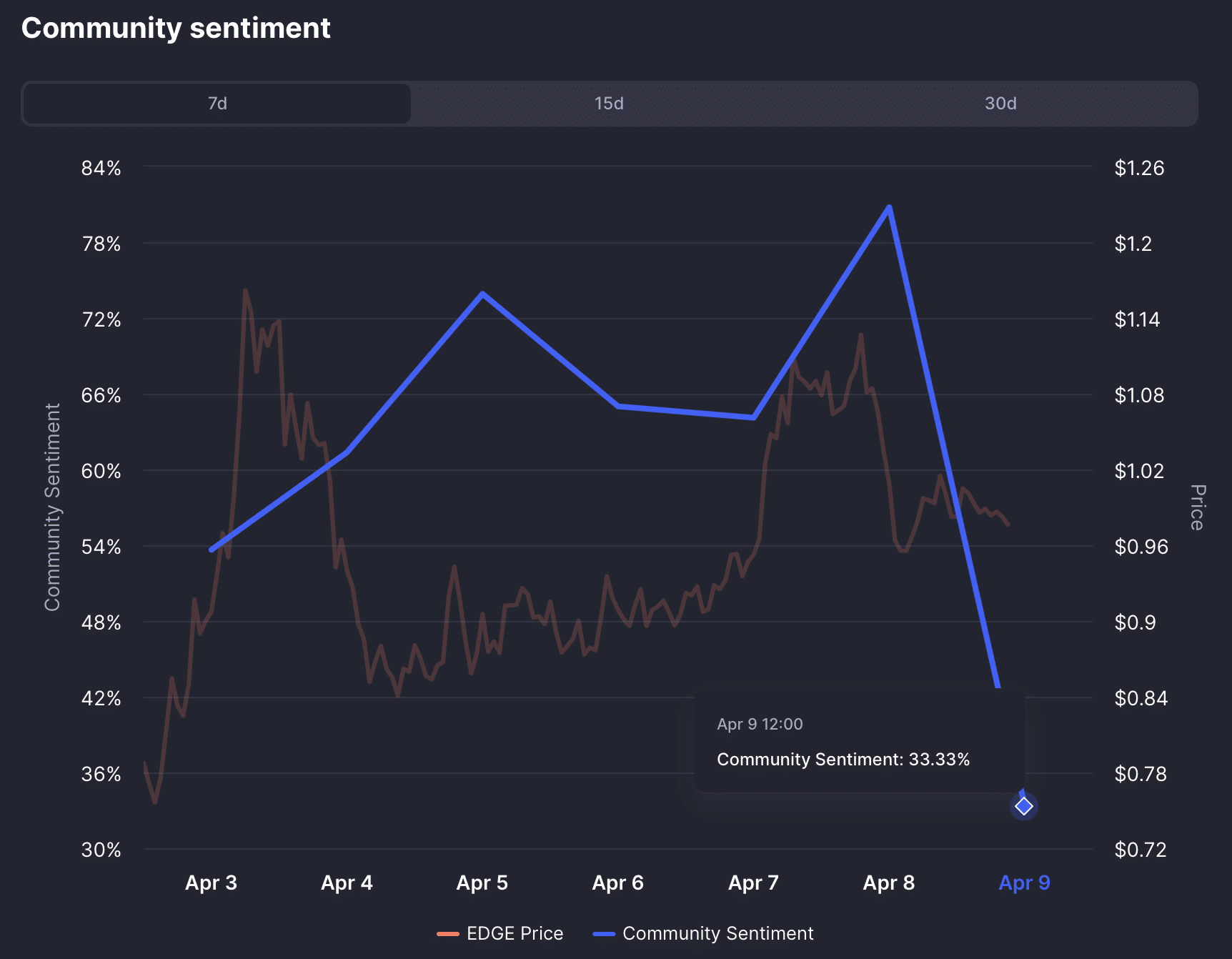
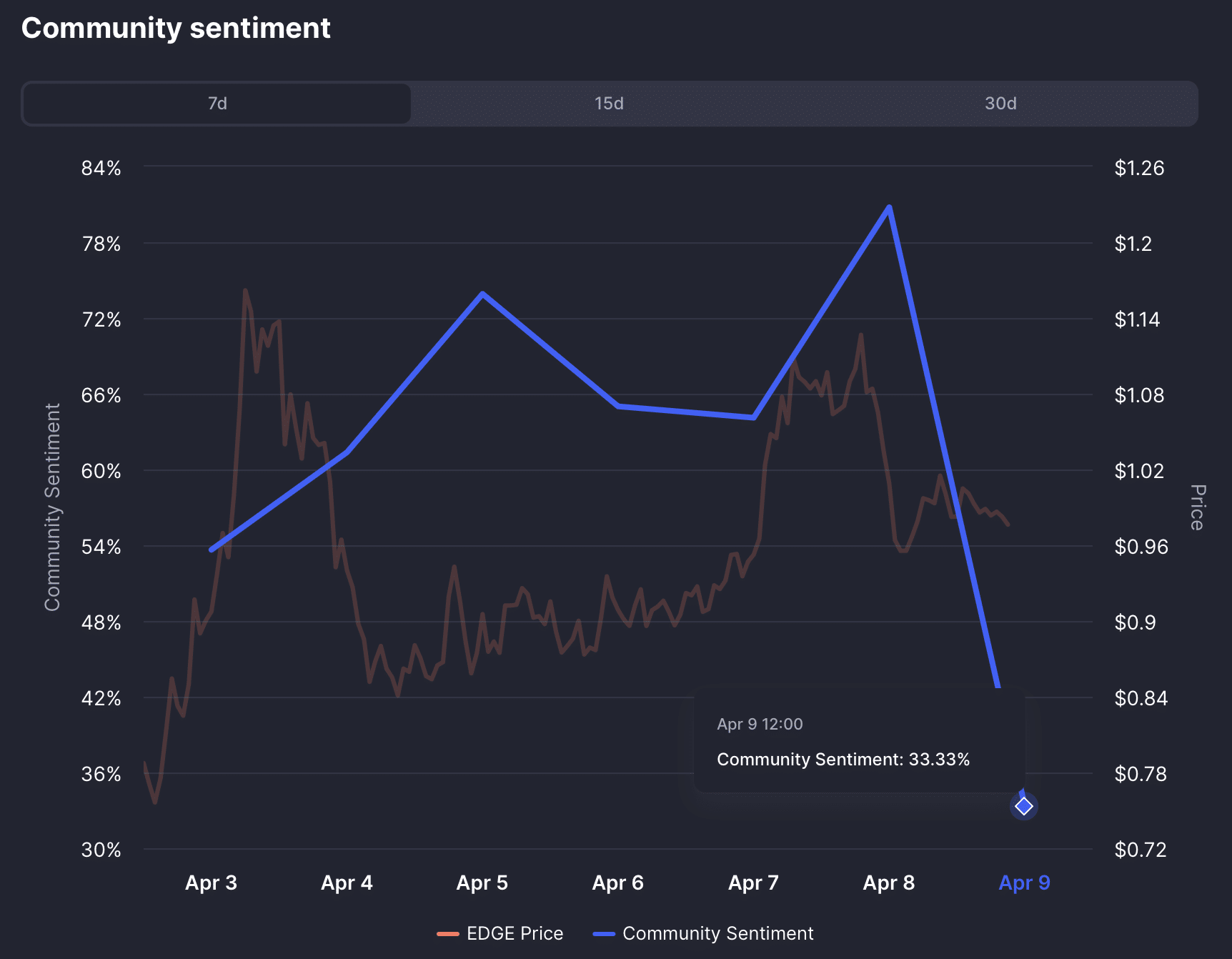
Source: CoinMarketCap

Within 24 hours, bullish sentiment dropped from over 80% on the 8th of April to just 33% at press time. This sharp reversal indicates that roughly 66% of investors now expect a further downside, marking a clear transition from optimism to caution.

That shift has translated directly into price action, with EDGEX trending lower as bearish expectations take hold.

Holder exits accelerate capital outflow

Beyond sentiment, on-chain participation also reflects growing weakness.

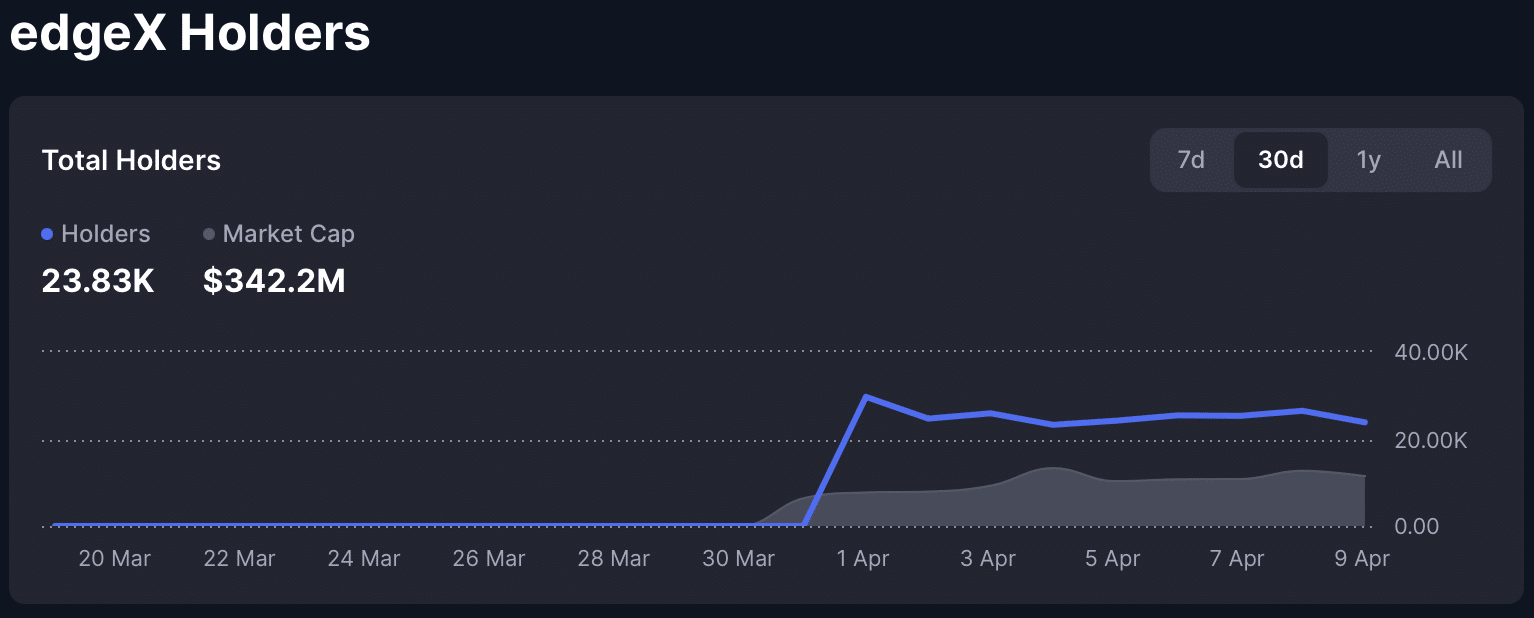
The total number of holders fell from 26,480 to 24,890, meaning approximately 1,600 wallets exited their positions entirely within a short period.

Although it remains unclear whether the selling pressure came primarily from whales, who control 79.89% of supply, or retail investors holding the remaining 20.11%, such a contraction in holder base typically signals declining confidence and reduced market participation.
Source: CoinMarketCap

This exit has had a measurable impact on valuation. EDGEX’s market capitalization dropped by over $34.4 million, bringing its total value down to approximately $344 million at the time of writing.

Unless fundamentals stabilize, the asset is likely to remain under pressure, with price structure pointing toward the formation of lower highs and lower lows.

Futures traders resist the broader trend

While Spot market conditions weaken, derivatives traders continue to position for upside.

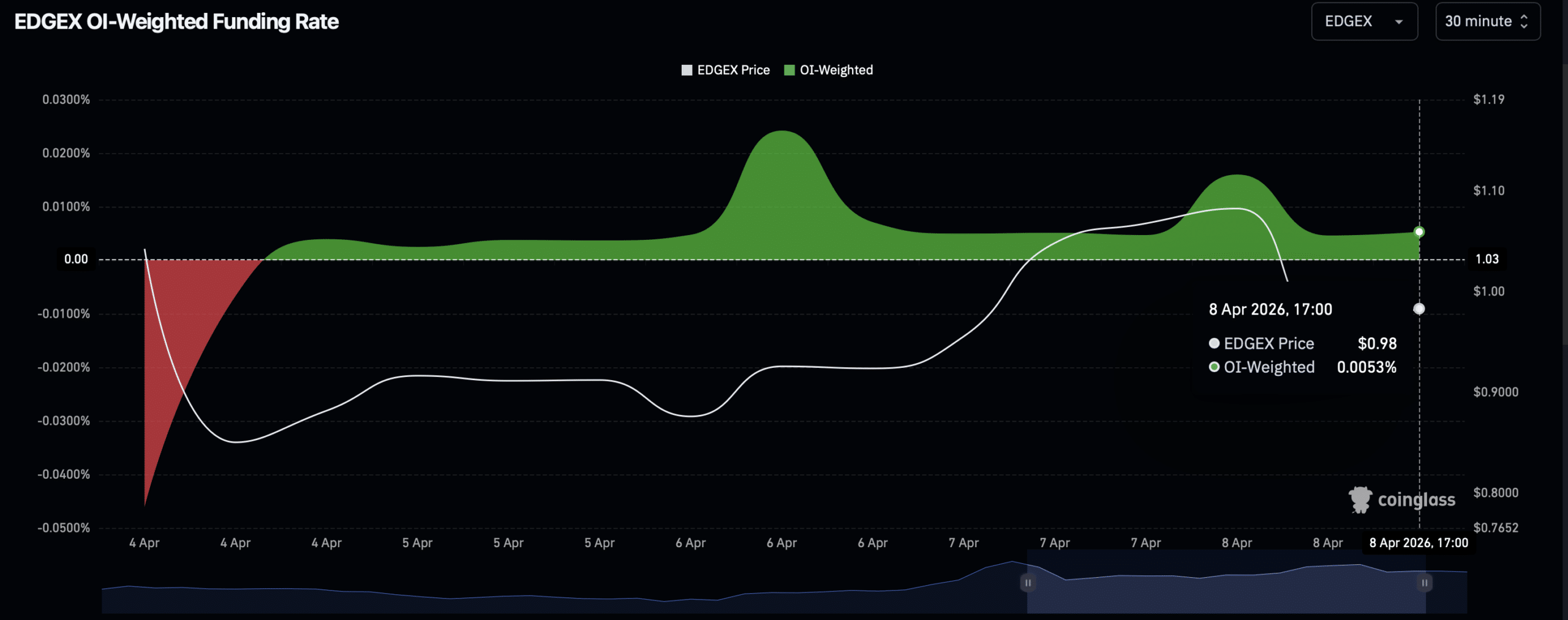
At press time, the Open Interest-Weighted Funding Rate remained positive at 0.0053%, indicating that long positions still dominated the Futures market.

This comes despite visible capital outflows and declining Spot demand.

This divergence suggests that Futures traders may be pricing in a short-term rebound, viewing the current decline as a temporary correction rather than a sustained reversal.
Source: CoinGlass

However, this positioning introduces downside risk. If bearish momentum persists, the concentration of long positions could trigger a cascade of liquidations, amplifying selling pressure and accelerating the decline.


Final Summary

  • EDGEX faces a sharp decline in fundamentals, with two-thirds of investors now leaning bearish as holder count drops.
  • Despite weakening Spot conditions, the Futures market maintains a positive Funding Rate, reflecting persistent long positioning.


Criptos en tendencia

Preguntas relacionadas

QWhat was the percentage decline in EDGEX's price over the past 24 hours?

AEDGEX posted a 10.5% decline over the past 24 hours.

QWhat significant change occurred in investor sentiment according to CoinMarketCap data?

ABullish sentiment dropped from over 80% on April 8th to just 33% at press time, meaning approximately 66% of investors became bearish.

QHow did the number of EDGEX holders change, and what does this indicate?

AThe total number of holders fell from 26,480 to 24,890, indicating that approximately 1,600 wallets exited their positions, which signals declining confidence and reduced market participation.

QDespite the bearish spot market trend, what does the positive Open Interest-Weighted Funding Rate indicate?

AThe positive funding rate of 0.0053% indicates that long positions still dominate the Futures market, suggesting traders are positioning for a potential short-term rebound.

QWhat is the potential risk associated with the high concentration of long positions in the Futures market?

AIf bearish momentum persists, the concentration of long positions could trigger a cascade of liquidations, which would amplify selling pressure and accelerate the price decline.

Lecturas Relacionadas

Amidst Capital's Encirclement, Decentralization is the Sole Defense for Public Blockchains

In a landscape dominated by power and profit motives, the author argues that decentralization is not merely one desirable feature among many in blockchain design—it is the singular, non-negotiable defense against corporate and capital capture. The article adopts a Machiavellian, realist perspective on human institutions, positing that businesses will inevitably attempt to co-opt any valuable network to protect their profits and dominance. While external attacks like 51% forks are often discussed, the greater existential risk is internal capture—the gradual erosion of a protocol’s neutrality by vested interests, as seen historically with platforms like Visa and Google. The piece critiques permissioned chains, highly centralized “permissionless” layer-1s, and layer-2s without sufficient decentralization (e.g., single sequencers) as inherently vulnerable. These compromised systems, promoted by established financial players, are framed as delaying tactics to stifle truly open networks that threaten existing high-fee, inefficient business models. Real-world examples, such as closed enterprise consortiums that exclude competitors, illustrate how such systems cement oligopolies rather than foster innovation. The author concludes that while decentralized protocols like Ethereum are imperfect and costly to operate, they represent the only viable long-term equilibrium. In a market where value naturally flows to the most secure and neutral settlement layer, only maximally decentralized public blockchains can resist being subsumed by capital and powerful incumbents.

Foresight NewsHace 11 min(s)

Amidst Capital's Encirclement, Decentralization is the Sole Defense for Public Blockchains

Foresight NewsHace 11 min(s)

Who Decides the Rules of Bitcoin? BIP-110 Ignites Governance Debate

Bitcoin's governance is once again at the center of a heated debate, this time ignited by BIP-110, the "Reduced Data Temporary Softfork." This proposal aims to curb non-monetary data (like inscriptions and Runes) by introducing seven new consensus-layer restrictions over a year, such as limiting new output scripts to 34 bytes and restoring the OP_RETURN cap to 83 bytes. The controversy stems from BIP-110's fundamental shift: it moves the battle against "spam" from node relay and miner policies to the consensus layer, rendering currently valid transactions invalid. Supporters, arguing that default policy governance has failed (highlighted by Bitcoin Core v30's relaxation of OP_RETURN limits), see this as necessary to protect node resources and Bitcoin's monetary focus. Opponents, led by figures like Michael Saylor and Adam Back, warn it dangerously centralizes governance. Saylor listed 110 reasons against it, criticizing its low 55% miner activation threshold and potential for chain splits. Back emphasized Bitcoin's "permissionless" ethos, arguing no single group should impose value judgments via consensus rules. Further complicating matters, technical critiques suggest BIP-110 may be technically circumventable, and a "BlockSlop" vulnerability in its upgrade path poses a consensus risk. The debate has drawn in diverse stakeholders: miners (with pools like Ocean signaling support and Foundry polling clients), node operators (like Bitcoin Knots), and new players like corporate treasury holder MicroStrategy (Saylor), whose market influence adds a novel dimension. Ultimately, BIP-110 acts as a governance stress test, exposing the unresolved question: who decides Bitcoin's rules? It pits the authority of miners, node operators, developers, and capital holders against each other, with each side claiming to defend Bitcoin's core principles of neutrality and security.

marsbitHace 28 min(s)

Who Decides the Rules of Bitcoin? BIP-110 Ignites Governance Debate

marsbitHace 28 min(s)

Who Decides Bitcoin's Rules? BIP-110 Ignites Governance Debate

Title: Who Decides Bitcoin's Rules? BIP-110 Ignites Governance Debate A new technical proposal, BIP-110 (Reduced Data Temporary Softfork), has sparked a fundamental governance debate within the Bitcoin community. It aims to impose new consensus rules for one year to limit non-financial data (like inscriptions and Runes) on-chain, moving beyond simple node and miner policy filters to invalidate currently valid transactions. Supporters argue that default policies have failed due to workarounds, necessitating consensus-layer changes to protect Bitcoin's core monetary function from data spam. Critics, including Michael Saylor and Adam Back, contend this dangerously centralizes judgment, undermines permissionlessness, and sets a risky governance precedent. They advocate for market-based solutions like fees or Layer 2s instead. The debate exposes deeper tensions: miners are divided on activation; node operators assert their sovereignty; Bitcoin Core developers influence defaults without direct accountability; and large corporate holders like MicroStrategy now wield narrative influence. Technically, BIP-110 may not fully block data and carries a disclosed consensus bug risk. Ultimately, BIP-110 acts as a stress test, forcing the community to confront the unresolved question: who legitimately decides what Bitcoin is and how it evolves, amidst competing claims from miners, nodes, developers, and capital holders.

链捕手Hace 40 min(s)

Who Decides Bitcoin's Rules? BIP-110 Ignites Governance Debate

链捕手Hace 40 min(s)

Zcash's New Node Zakura Goes Live: Privacy Payments Can Reach 50,000 TPS, Aiming to Rival Visa and Mastercard

Zcash, a privacy-focused cryptocurrency, has launched a new full node software called Zakura version 1.0.0. Developed by Zcash co-founder Sean Bowe and Dev Ojha, with private ZEC donations, its goal is to enable Zcash to process over 50,000 transactions per second (TPS)—matching the scale of Visa and Mastercard—while maintaining full transaction privacy and verifiability. This addresses a key bottleneck, as Zcash currently handles only about 1 private transaction per second. Zakura is a fork of the Zcash Foundation's Zebra node. It features chain pruning and snapshots, reducing disk usage and allowing new nodes to sync in under two minutes. It also offers compatibility with the legacy `zcashd` client interface. The scalability challenge stems from the large data size of privacy proofs. Bowe's Tachyon project aims to use recursive proofs to reduce consensus-layer data needs from ~500 MB/s to ~100 MB/s. For wallet scalability, Valar Group is researching Private Information Retrieval (PIR) tech to allow wallets to fetch their data privately. Zakura supports fast block propagation and the upcoming "Ironwood" network upgrade (NU6.3), scheduled for activation around July 28th. Ironwood was created to contain a critical inflation bug discovered in the Orchard shielded pool in May 2024. The fix uses "turnstiles" to trap any counterfeit ZEC created during the vulnerability period within the shielded pool, preventing it from entering circulation and restoring supply integrity.

marsbitHace 55 min(s)

Zcash's New Node Zakura Goes Live: Privacy Payments Can Reach 50,000 TPS, Aiming to Rival Visa and Mastercard

marsbitHace 55 min(s)

Trading

Spot

Artículos destacados

Cómo comprar ONE

¡Bienvenido a HTX.com! Hemos hecho que comprar Harmony (ONE) sea simple y conveniente. Sigue nuestra guía paso a paso para iniciar tu viaje de criptos.Paso 1: crea tu cuenta HTXUtiliza tu correo electrónico o número de teléfono para registrarte y obtener una cuenta gratuita en HTX. Experimenta un proceso de registro sin complicaciones y desbloquea todas las funciones.Obtener mi cuentaPaso 2: ve a Comprar cripto y elige tu método de pagoTarjeta de crédito/débito: usa tu Visa o Mastercard para comprar Harmony (ONE) al instante.Saldo: utiliza fondos del saldo de tu cuenta HTX para tradear sin problemas.Terceros: hemos agregado métodos de pago populares como Google Pay y Apple Pay para mejorar la comodidad.P2P: tradear directamente con otros usuarios en HTX.Over-the-Counter (OTC): ofrecemos servicios personalizados y tipos de cambio competitivos para los traders.Paso 3: guarda tu Harmony (ONE)Después de comprar tu Harmony (ONE), guárdalo en tu cuenta HTX. Alternativamente, puedes enviarlo a otro lugar mediante transferencia blockchain o utilizarlo para tradear otras criptomonedas.Paso 4: tradear Harmony (ONE)Tradear fácilmente con Harmony (ONE) en HTX's mercado spot. Simplemente accede a tu cuenta, selecciona tu par de trading, ejecuta tus trades y monitorea en tiempo real. Ofrecemos una experiencia fácil de usar tanto para principiantes como para traders experimentados.

328 Vistas totalesPublicado en 2024.12.12Actualizado en 2026.06.02

Cómo comprar ONE

Discusiones

Bienvenido a la comunidad de HTX. Aquí puedes mantenerte informado sobre los últimos desarrollos de la plataforma y acceder a análisis profesionales del mercado. A continuación se presentan las opiniones de los usuarios sobre el precio de ONE (ONE).

活动图片