Early Trading Made a Fortune? A Comprehensive Guide to Genius's New Rules

Odaily星球日报Publicado a 2026-01-20Actualizado a 2026-01-20

Resumen

**Title: Early Traders Made Huge Gains? Understanding Genius' New Rules** Genius, a highly discussed DEX, announced new GP points rules for its Season 1, ending April 12, with a 50% increase in airdrop allocation. The team confirmed that GP points earned from early trading volume remain valid, benefiting users who followed initial interaction guides. Key updates: - Total S1 GP points are fixed at 200 million, with 75 million already distributed from pre-whitepaper trading. The remaining 125 million will be distributed weekly starting January 20, at 10 million GP per week. - Distribution is weighted to prevent whales from dominating, allowing smaller traders to earn points. - Stablecoin swaps (e.g., USDT/USDC) now have a 0.5x weight; other spot trades retain 1.0x. - Previous task-based and referral GP rewards were removed. Now, points are earned solely via spot trading volume. - New trading tiers introduce fee discounts based on cumulative trading volume, though zero-fee trading remains active indefinitely. - Referrals now offer 35% commission on invitees’ trading fees post-zero-fee campaign. - The GENIUS token will be created before April 12, 2026, with a TGE expected randomly before then. Despite platform bugs from high traffic, Genius’ strong backing (including investment from YZi Labs and CZ as advisor) and confirmed TGE make it noteworthy. With a potential $300M FDV and 10% airdrop, each GP point could be worth ~$0.15. Early participants may have profitable opportuniti...

Original | Odaily Planet Daily (@OdailyChina)

Author | Asher (@Asher_ 0210)
Yesterday, Genius, a DEX that has been highly discussed recently, announced new point rules on platform X: Season 1 will end on April 12, with an additional 50% airdrop quota.

Notably, the Genius team stated that the GP points earned from trading volume have been retained. Congratulations to those who participated early through the point-earning guide shared by Odaily Planet Daily (click here to jump to the article: YZi Labs Invests Tens of Millions, CZ as Advisor—How to Earn Genius Points?). These users may have already "made a fortune" in GP points (platform website: https://www.tradegenius.com/).
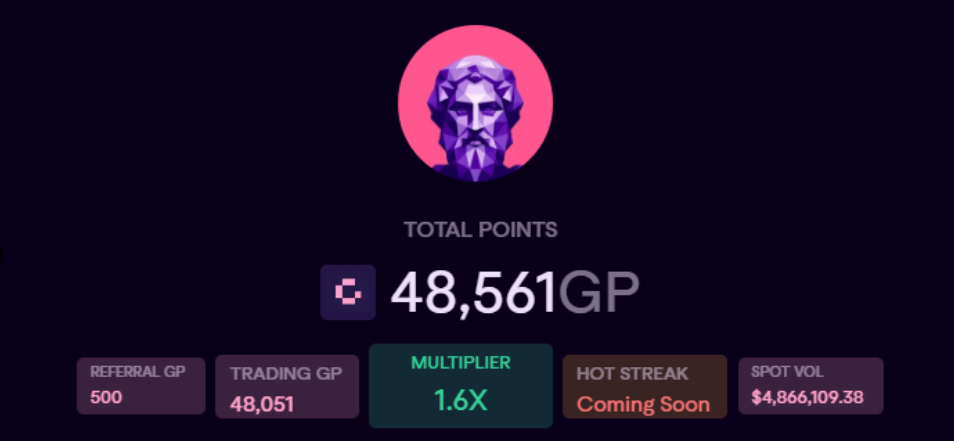
Early users "aggressively" traded to earn massive GP points from volume

Below, Odaily Planet Daily explains Genius's new GP point rules to help users better participate in platform interactions and earn GP points.

Season 1 Total of 200 Million GP Points, 125 Million GP Points Still to Be Distributed

The community had many questions about GP point distribution. This time, the official emphasized that Season 1 has a total of 200 million GP points, with no additional issuance. The specific distribution is as follows:

  • 75 million GP points have been distributed, which are the trading points earned by users before the platform updated the whitepaper. GP points from referral rewards have been reclaimed;
  • 125 million GP points are still to be distributed, including 5 million GP points from the wheel-of-fortune reward. Referral reward points and trading task points have been canceled.

The remaining 125 million GP points will be distributed starting at 5:00 AM UTC+8 today (January 20), with 10 million GP points distributed every weekend. Additionally, points are allocated using a weighted distribution to ensure that whale traders do not monopolize all GP releases, allowing smaller traders to also receive GP allocations.

Notably, the trading volume weight for stablecoin USDT to USDC conversions has been adjusted to 0.5x, while the weight for other spot trading volumes remains 1.0x.

Other Changes in the New Rules

As explained by the team members in the official Telegram, on one hand, all previous GP task points (trading tasks + referral tasks) have been cleared; on the other hand, under the new rules, GP points can only be earned through spot trading volume.
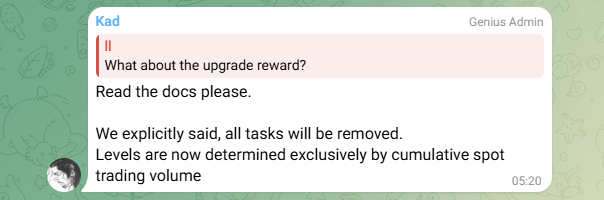
Official explanation of the new rules

New Trading Tiers

The new trading tier divisions and fee discounts are as follows:

  • Level 1—Smart: Cumulative trading volume of $100,000, trading fee 0.3%;
  • Level 2—Ultra Genius: Cumulative trading volume of $1 million, trading fee 0.2%;
  • Level 3—Mastermind: Cumulative trading volume of $10 million, trading fee 0.1%;
  • Level 4—Mogger Genius: Cumulative trading volume of $100 million, trading fee 0.05%.

The current zero-fee trading promotion's end date has not been announced.

Referral Rewards

Referring friends for trading no longer earns GP points, but after the zero-fee promotion ends, users can earn a 35% commission from the trading fees of invited friends.

For example, if an invited user's trading fee tier is 0.2%, the rebate earned would be 0.07% (35% * 0.2%).

GENIUS Token to Be Created Before April 12, 2026

According to the documentation, the GENIUS token will be created before the end of Season 1. Therefore, TGE will occur randomly between now and April 12.

Platform Has Many Bugs, But Strong Funding Background and Confirmed TGE Make It Worth Attention

Since its launch a few days ago, Genius has been overloaded due to a large influx of studios, resulting in frequent bugs. Although the team has been working to resolve issues, some functions still have problems and cannot fully satisfy users. As of now, referral points and trading tasks have not been fully removed, and the wheel-of-fortune reward is still under maintenance.

With the new rules update, TGE will occur before April 12, significantly increasing the certainty of earning from Genius. With only 200 million GP points distributed before TGE, GP points will be particularly "valuable," and the cost of earning them will only increase. KOL Nathan stated, "With tens of millions in investment, the FDV should be around $300–500 million. Congratulations to those who got on board early, earning 37.5% of the total airdrop in just 3 days." Based on the data below, with a $300 million FDV and a 10% airdrop allocation, each point would be worth $0.15.
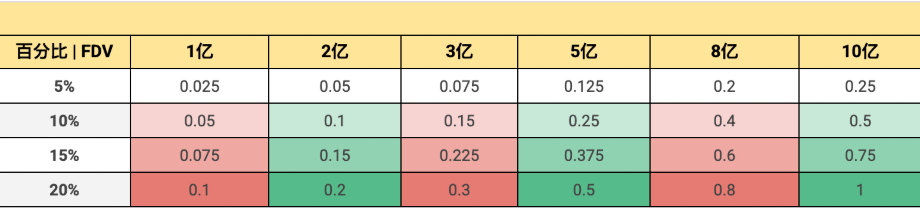
Genius Point Value Estimation

Perhaps it is still worth interacting now, while trading fees are still zero and the new rules have just been launched.


Preguntas relacionadas

QWhat is the total amount of GP points allocated for Season 1 on Genius, and how much remains to be distributed?

AThe total amount of GP points for Season 1 is 200 million. 75 million GP points have already been distributed, and 125 million GP points remain to be distributed.

QHow has the new rule changed the way users can earn GP points?

AThe new rule has removed all previous GP task points (trading tasks and invitation tasks). Users can now only earn GP points by generating trading volume through spot trades.

QWhat is the new weight assigned to the trading volume of stablecoin USDT to USDC conversions?

AThe trading volume weight for stablecoin USDT to USDC conversions has been adjusted to 0.5x.

QWhen is the GENIUS token expected to be created (TGE)?

AThe GENIUS token is expected to be created before the end of Season 1, which is April 12, 2026. The TGE will occur randomly between now and that date.

QWhat is the referral reward structure under the new rules?

AReferring friends no longer generates GP point rewards. However, after the platform's zero-fee trading activity ends, users can earn a 35% commission from the trading fees of the users they invite.

Lecturas Relacionadas

From South Korea to the United States: Blue-Collar Jobs Are Becoming Increasingly Popular, Thanks to AI

AI is reshaping the labor market's value proposition. The traditional four-year college degree is losing its appeal as a guaranteed career path, while skilled blue-collar trades like electricians, welders, and plumbers are experiencing historic demand and wage premiums. This shift is driven by dual pressures: AI's displacement of certain white-collar roles and a booming need for physical infrastructure and data center construction. Data confirms the trend. In the U.S., vocational school revenue surged, and a significant portion of recent layoffs are AI-related. Surveys show a majority of Gen Z adults plan to pursue blue-collar work, citing better job security against AI automation. Vocational education interest has exploded recently. Experts cite a psychological shift as younger generations seek tangible, AI-resistant careers and avoid high student debt. In many cases, salaries for skilled trades now match or exceed those requiring a bachelor's degree. In South Korea, semiconductor vocational high schools boast near-total employment, with graduates securing high-paying roles at companies like Samsung. The shortage is structural, exacerbated by a retiring baby boomer workforce and massive infrastructure projects. Companies like JPMorgan Chase, Meta, and Lowe's are investing heavily in training programs. However, overcoming historical stigma and a "perception gap" around trade careers remains a key challenge to closing the talent gap.

marsbitHace 18 min(s)

From South Korea to the United States: Blue-Collar Jobs Are Becoming Increasingly Popular, Thanks to AI

marsbitHace 18 min(s)

Qualcomm: AI Hype Subsides, When Will Smartphones Emerge from the Gloom?

Qualcomm reported its Q3 FY2026 results (ending June 2026), with revenue of $9.95B, down 4% YoY but above expectations. Gross margin declined to 53.1%, pressured by rising costs across manufacturing and memory. Key business segments showed mixed performance: Handset revenue fell 19.6% YoY to $5.09B, dragged by an 11% decline in non-Apple Android shipments and weaker high-end mix. Conversely, Automotive revenue surged 61% to $1.59B, and IoT grew 9% to $1.83B. Core operating profit dropped 41% YoY due to margin compression and higher expenses. Management's Q4 FY2026 guidance projects revenue of $9.7B-$10.5B, in line with consensus, but Non-GAAP EPS guidance of $2.05-$2.25 fell short of expectations. Amidst persistent weakness in its core handset market, Qualcomm is pursuing growth in AI, focusing on Edge AI (smartphones, PCs, automotive) and Data Center AI. Its data center strategy includes four pillars: AI accelerators (e.g., AI200), commercial CPUs (Dragonfly C1000), custom silicon, and connectivity solutions. While these initiatives initially boosted its stock, concerns over AI capital expenditure sustainability have since erased those gains. The company targets $5B in data center revenue for FY2027 and $15B for FY2029. The report concludes that with the traditional handset business still under pressure, the data center opportunity is currently viewed as a longer-term option, and a more conservative valuation based on core operations may be warranted until AI contributions materialize.

marsbitHace 22 min(s)

Qualcomm: AI Hype Subsides, When Will Smartphones Emerge from the Gloom?

marsbitHace 22 min(s)

From TPU to Self-Evolving Agents: How Jeff Dean Predicts the Next Step in AI

At the 2026 YC Startup School, Jeff Dean outlined his vision for AI's next phase, shifting focus from simply scaling models to building intelligent, autonomous systems. He believes AI's progress is no longer just about creating smarter models, but about integrating them into systems capable of long-term, iterative work, automated experimentation, and continuous learning. This evolution moves the competition from "who has the bigger model" to "who can best organize intelligence." Dean suggests AI capabilities are now comparable to a junior engineer, enabling the automation of complex workflows. However, the true challenge and opportunity lie in managing these AI "workers" at scale. He emphasizes the importance of **context engineering**—structuring tools, memory, and feedback loops—over raw model power. For startups, this means building deep expertise in niche domains where general models currently fail (near 0-1% success rates), leveraging proprietary data, specialized tools, and domain-specific evaluators. A recurring theme is re-examining fundamental constraints. Dean's past work, like moving Google's search index to memory or creating the TPU, stemmed from questioning outdated assumptions about hardware and cost. He sees similar inflection points today, particularly in **specialized inference hardware** to drastically reduce latency and energy consumption for real-time Agent operation. Notably, he points out that in modern AI systems, the dominant cost is often not computation but **data movement**. Reliable, long-running Agents require robust system design, borrowing concepts from distributed computing like checkpointing, state management, and parallel exploration to handle failures and maintain progress over days or weeks. As AI automates execution, the scarcest human skills will shift to **defining clear specifications**, **judging what problems are worth solving** (taste), and designing effective feedback loops. Ultimately, Dean's framework prioritizes understanding the problem deeply, identifying the true bottlenecks, and systematically building closed-loop systems where AI can not only perform tasks but also improve AI itself.

marsbitHace 22 min(s)

From TPU to Self-Evolving Agents: How Jeff Dean Predicts the Next Step in AI

marsbitHace 22 min(s)

Trading

Spot
活动图片




