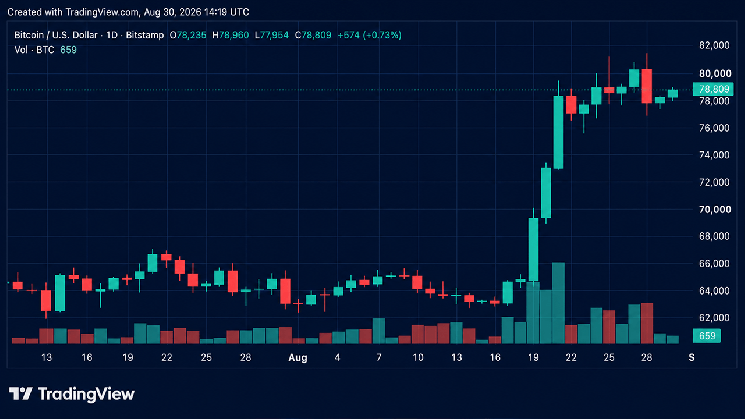
It all began on July 30, when Bitcoin.com News reported the first data on losses caused by a vulnerability in the Coldcard firmware, with the total losses ultimately increasing to approximately 2,000 $BTC. At the same time, last month, two hardware wallet manufacturers—Safepal and Trezor—reported data leaks that exposed customer information, including names, email addresses, phone numbers, and delivery addresses.
While a direct link cannot be established, the wave of early users moving old bitcoins may reflect heightened caution and broader efforts to reassess and reorganize their storage schemes. In the first ten days of August, the number of transactions involving "dormant" bitcoins exceeded the July figures. In July, a total of 30 transactions were recorded from wallets created between 2010 and 2017, moving 1,264.16 $BTC.
Dormant Bitcoin Activity in August Significantly Surpassed July Figures
Over the past 30 days of August, a significant average of 214.25 $BTC per day was recorded. This is 5.3 times higher than July's average of 40.78 $BTC per day. Btcparser.com recorded 188 individual transactions that moved 6,427.59 "dormant" bitcoins. During this activity, eight transfers from old wallets created in 2010 or 2011 were recorded. In two 2010 transfers, 50 $BTC were moved, while six 2011 transfers moved 155.57 $BTC.
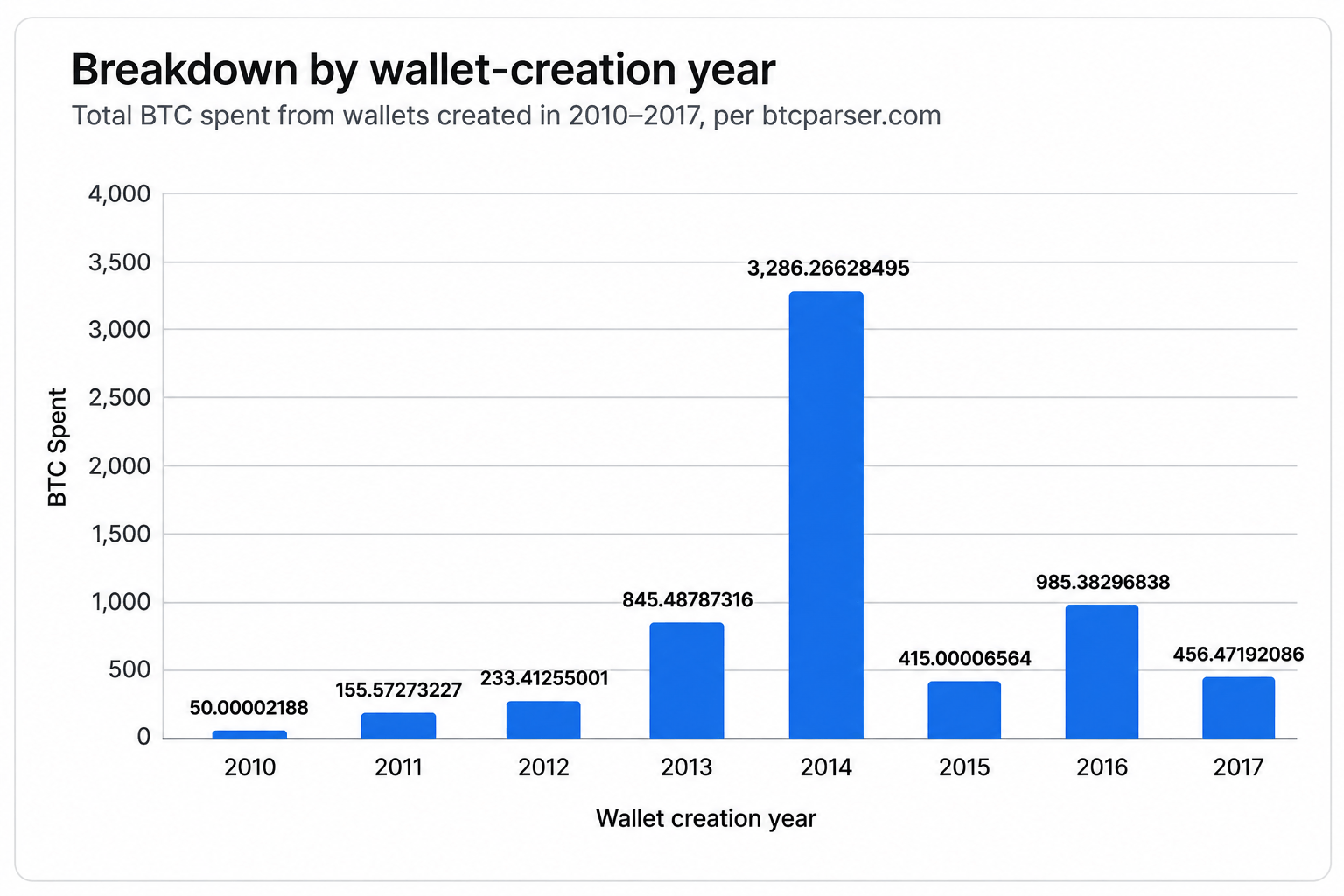
The majority of the activity came from wallets created between 2012 and 2017, with the 2014 wallet group dominating. Data shows that 94 transactions from bitcoin addresses created in 2014 moved approximately 3,286.26 $BTC between August 1 and 30, while 2016 wallets took second place: 985.38 $BTC changed hands across 29 transactions. Wallets from 2013 ranked third, recording 16 separate transfers totaling 845.48 $BTC.
2012 wallets moved 233.41 $BTC, 2015 addresses moved around 415 $BTC, and 2017 wallets moved 456.47 $BTC across 26 operations. However, the overall 2014 figure did not represent one broad wave of inactive bitcoin movement. It breaks down into two distinct groups with noticeably different behaviors, which is perhaps the most intriguing pattern in the dataset.
Two 2014 Groups Exhibit Starkly Different Behaviors
The first group consists of 64 addresses created between January 27 and February 4, 2014, which collectively transferred 1,672 $BTC. The coins were not moved all at once but gradually over 11 separate days from August 3 to 13, with a few later straggler transactions and individual transfers ranging from 0.31 $BTC to 33 $BTC. The second group tells a completely different story. Twenty-five addresses created between November 30 and December 26, 2014, moved 1,514 $BTC in nearly identical batches of approximately 50 $BTC each, with 22 of the 25 addresses being emptied on August 19 within about one hour.
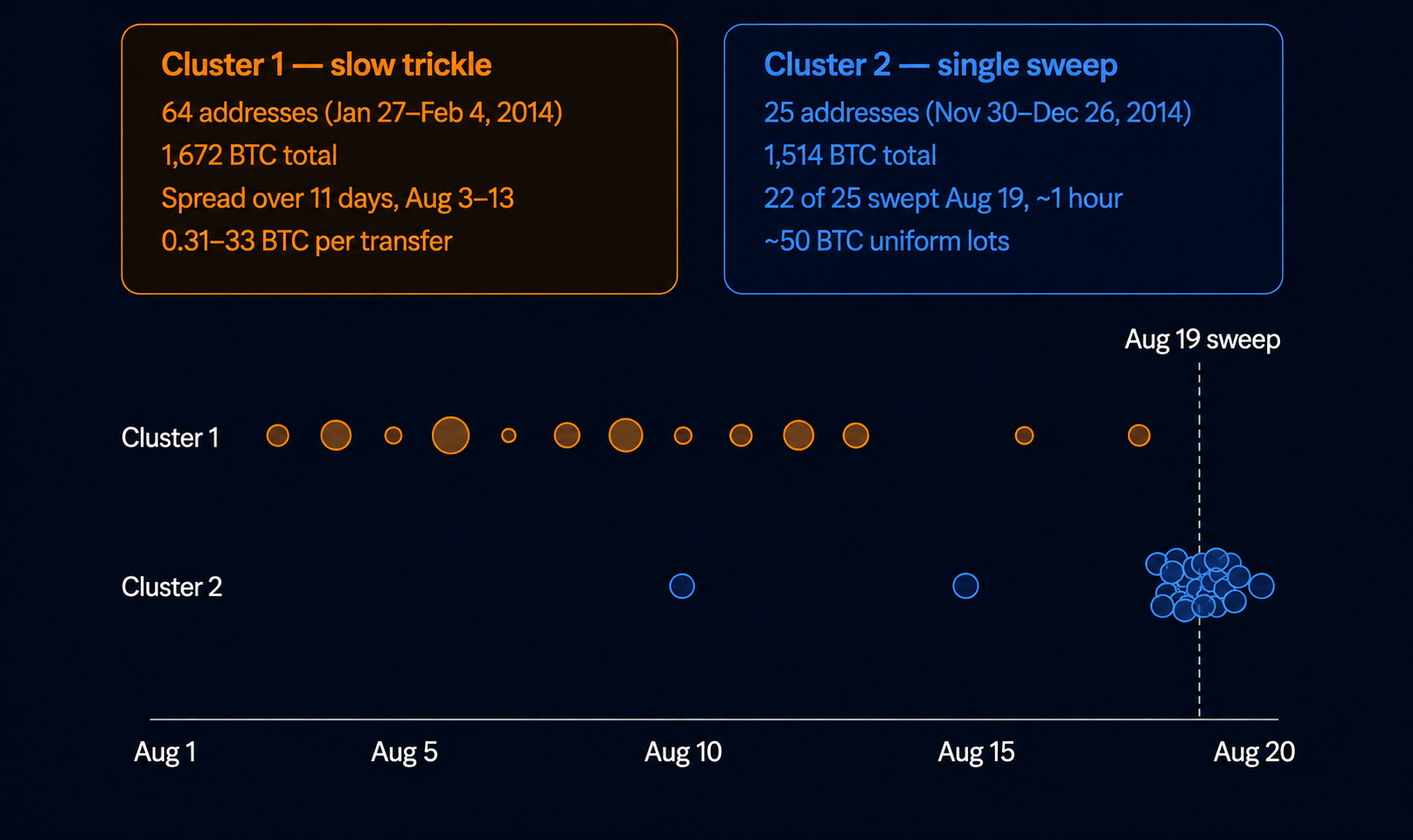
This level of coordination makes it unlikely that several unrelated owners independently moved decade-old coins on the same day and instead points to a single custodian or key owner executing a pre-planned batch withdrawal. It appears these wallets were funded simultaneously in late 2014, possibly reflecting an exchange cold storage reorganization, the release of funds from escrow, or a mass paper wallet distribution.
Bitcoin's "Sleeping Giants" Leave No Trace of Their Motives on the Blockchain
Certainly, the deeper essence of the issue may extend beyond technical vulnerabilities to a breach of trust strong enough to compel even early users to reconsider their passive storage approach. The coordinated series of transactions from old bitcoin addresses indicates that large holders may be proactively consolidating their legacy assets, increasingly viewing old keys as operational liabilities rather than digital trophies. The true motives remain unknown, and the only evidence capable of revealing this story remains the on-chain movements themselves.