Duan Yongping, CZ, Mar-a-Lago... What Have Crypto KOLs Been Talking About in the Past 24 Hours?

比推Publicado a 2026-02-19Actualizado a 2026-02-19

Resumen

Over the past 24 hours, Chinese crypto KOLs on X (formerly Twitter) have been actively discussing several key topics. Legendary investor Duan Yongping’s investment moves drew significant attention. His fund, H&H International Investment, held a portfolio worth approximately $17.5 billion at the end of 2025. In Q4, he made a major 11x increase in his Nvidia position, signaling strong confidence in AI computing demand. He also added to his holdings in Pinduoduo and Berkshire Hathaway, while reducing exposure to Apple, Alibaba, and Occidental Petroleum. A controversy emerged around Binance founder CZ (Changpeng Zhao) unfollowing a well-known KOL, "Enheng." Their relationship, which began with CZ helping Enheng profit in early 2025, reportedly soured due to the latter's "bootlicking" and other controversial actions, highlighting the fragile, interest-driven nature of relationships within the crypto circle. Amid the bear market, a common sentiment among discussions was the strategy of "buying when there is silence" and practicing dollar-cost averaging (DCA) into assets like Bitcoin. Many expressed belief that patience and faith in the long-term value of crypto would eventually be rewarded. Finally, the exclusive, invitation-only World Liberty Forum (WLFI) summit, held at Mar-a-Lago and supported by the Trump family, was a hot topic. High-profile attendees included executives from Goldman Sachs, Nasdaq, Coinbase, and Binance. The native token of the event's organizer, WLFI, su...

Sleep in on the third day of the Lunar New Year, then catch up on some reading.

What have the KOLs in the crypto space been talking about in the past 24 hours—

Note: The following content is compiled from the X platform and represents personal opinions. It does not represent the stance of this platform and should not be considered investment advice.

Details of Legendary Investor Duan Yongping's Holdings

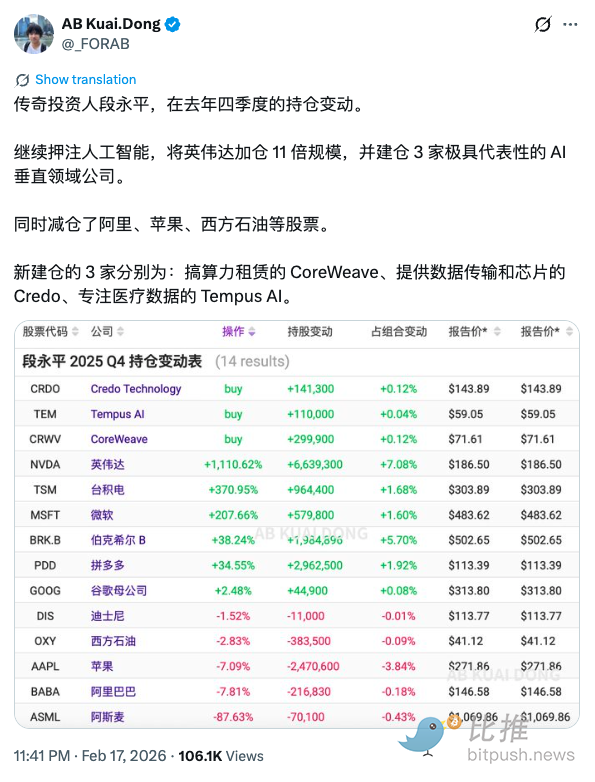
Editor's Note: As of the end of 2025, the total market value of holdings managed by Duan Yongping's H&H International Investment was approximately $17.489 billion, equivalent to over RMB 120 billion. Overall, H&H International Investment holds 14 companies, including Apple, Berkshire Hathaway, NVIDIA, Pinduoduo, and others.

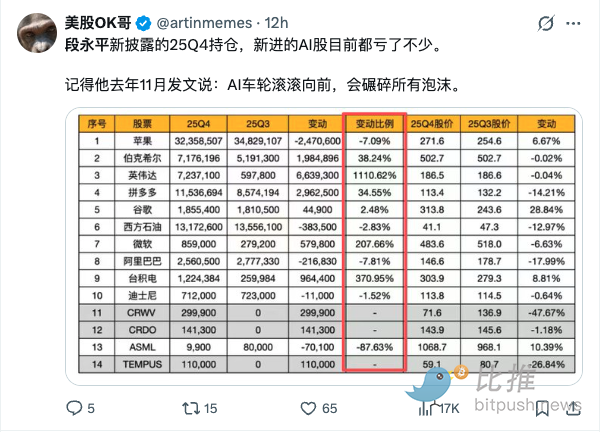
In the fourth quarter of 2025, Duan Yongping significantly increased his holdings in NVIDIA, as well as added to his positions in Pinduoduo and Berkshire Hathaway, while also taking new small positions in three AI-related companies. Meanwhile, he reduced his holdings in Apple, Alibaba, Occidental Petroleum, and others.
Popular replies:

Unlike Buffett, Duan Yongping has a very open mindset towards new tech trends;

Judging from the 13F and stock price, Duan Yongping's investment in Occidental Petroleum (OXY) is likely at a floating loss and not yet profitable;

As someone who's in San Francisco every day, he really dared to invest in corewave;

Duan Yongping increased his NVIDIA holdings by 11 times—this signal is clear enough. He has always had a concentrated, non-diversified style, showing strong confidence in AI computing demand;

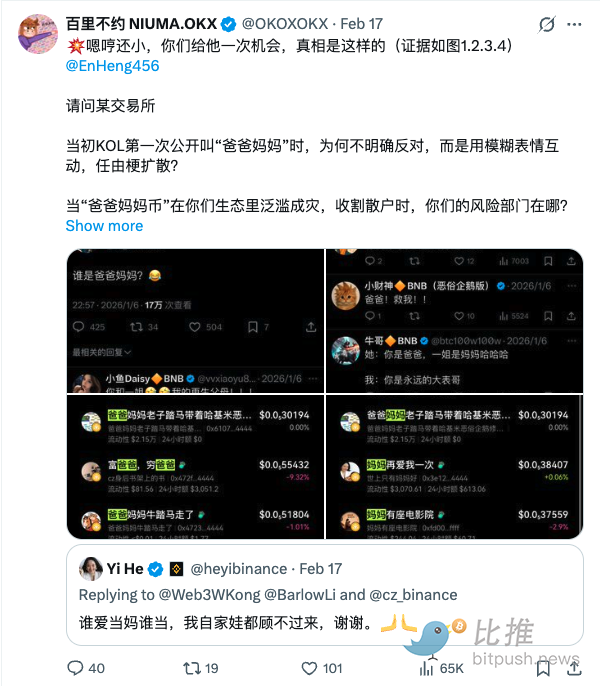
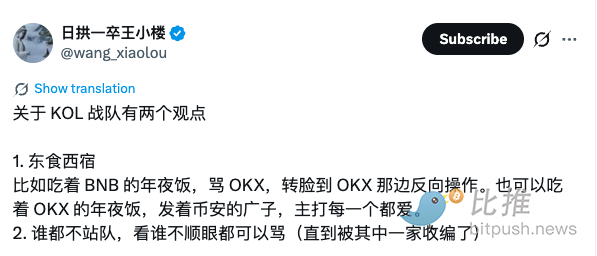
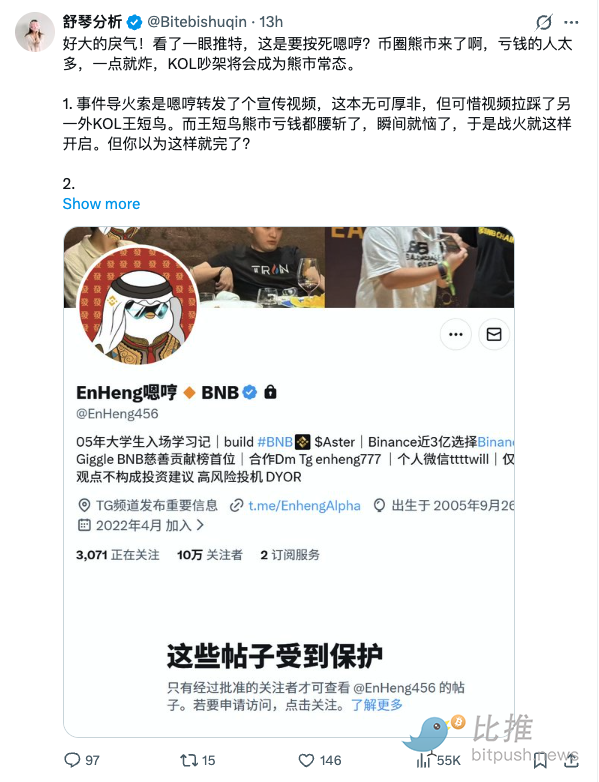
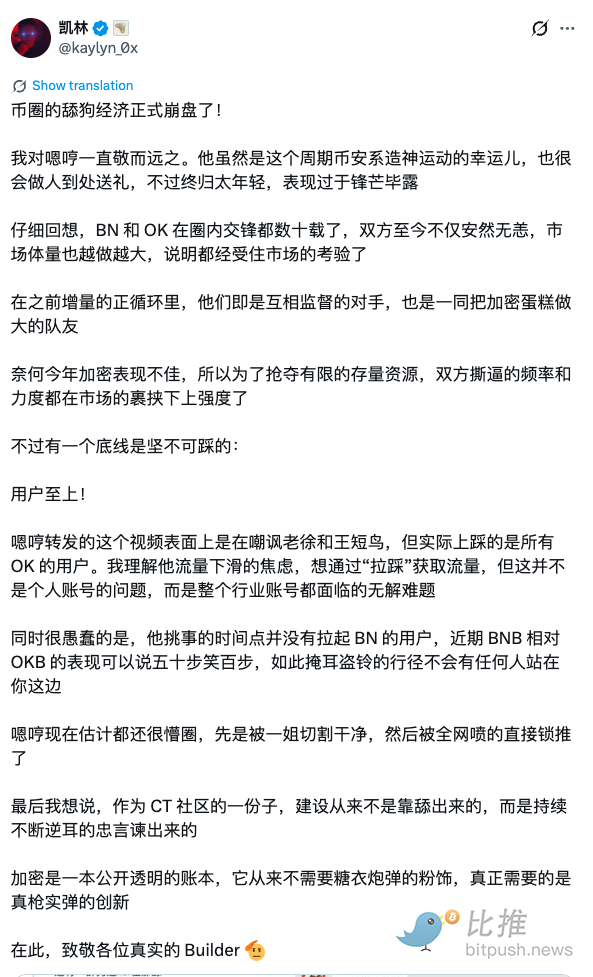
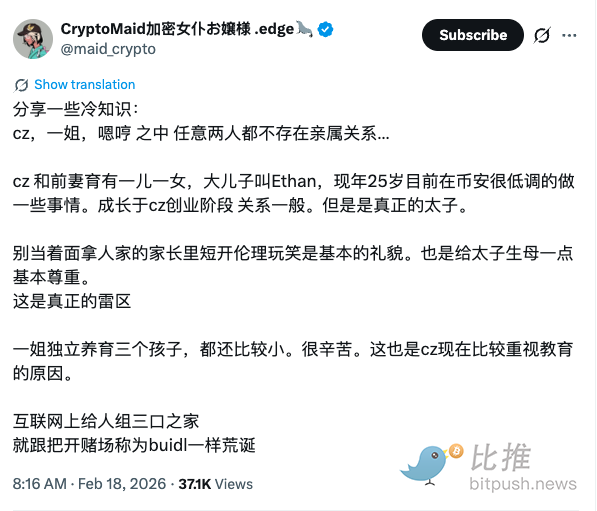
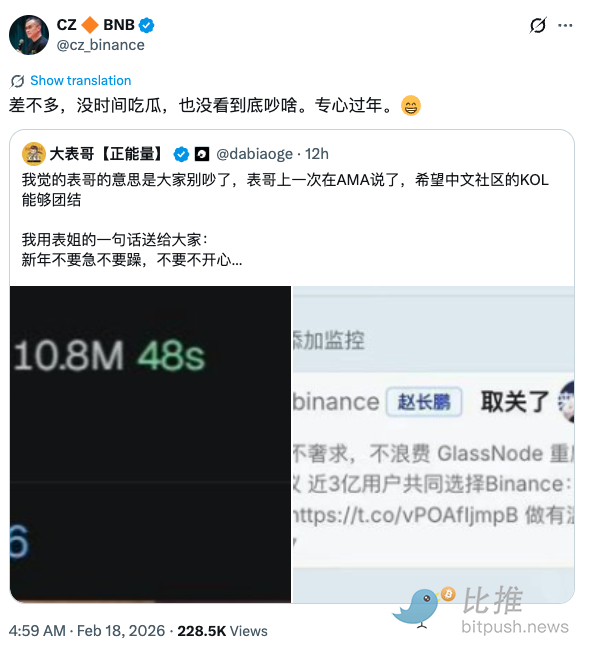
CZ Unfollows a "Well-Known" KOL, Sparking Controversy

Editor's Note: The shift from CZ's interactions with Enheng in early 2025 (CZ reposting to help him profit) to the current split (unfollowing due to Enheng's bootlicking and a series of puzzling actions) reflects the fragile relationships driven by interests in the crypto circle. Enheng's rise relied on CZ's halo, but controversy and失控的舆论 accelerated the collapse of his "crown prince" aura.
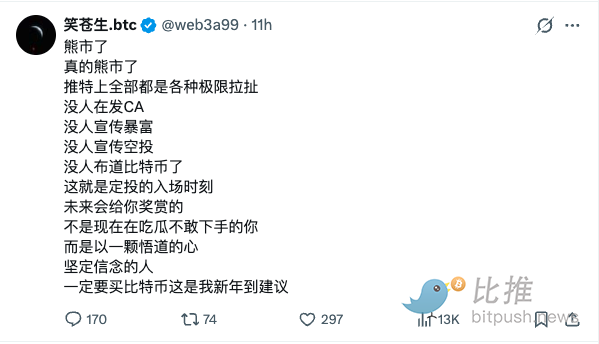
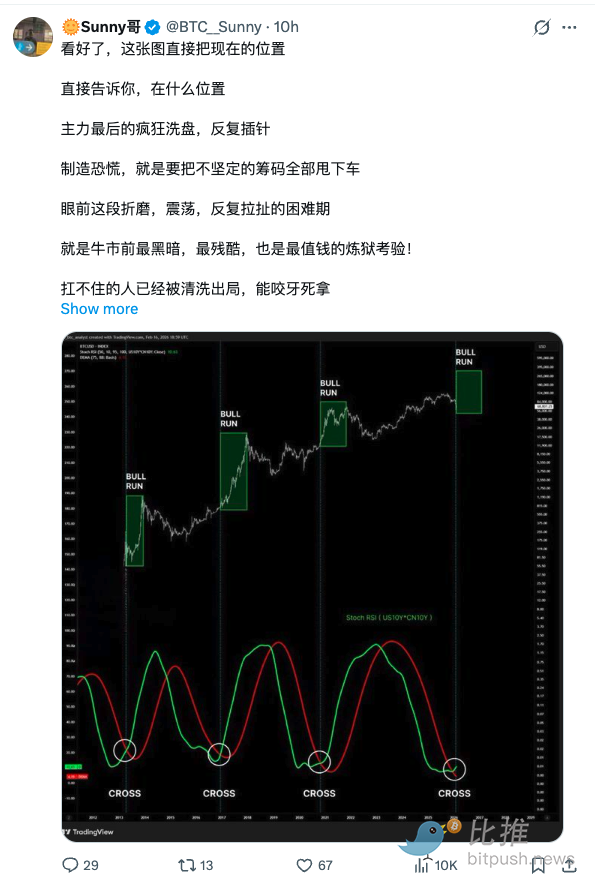
Bear Market Reflection: Buy When No One is Interested?
Popular replies:

It's a bear market. Unless it's a project with certain outcomes, it's really better to DCA into BTC at the right price. The power of belief will eventually bring you returns and not辜负 your efforts.

DCA slowly, be friends with time, and good results will follow.

Mar-a-Lago WLFI Summit

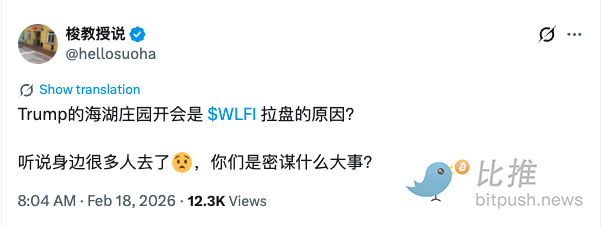
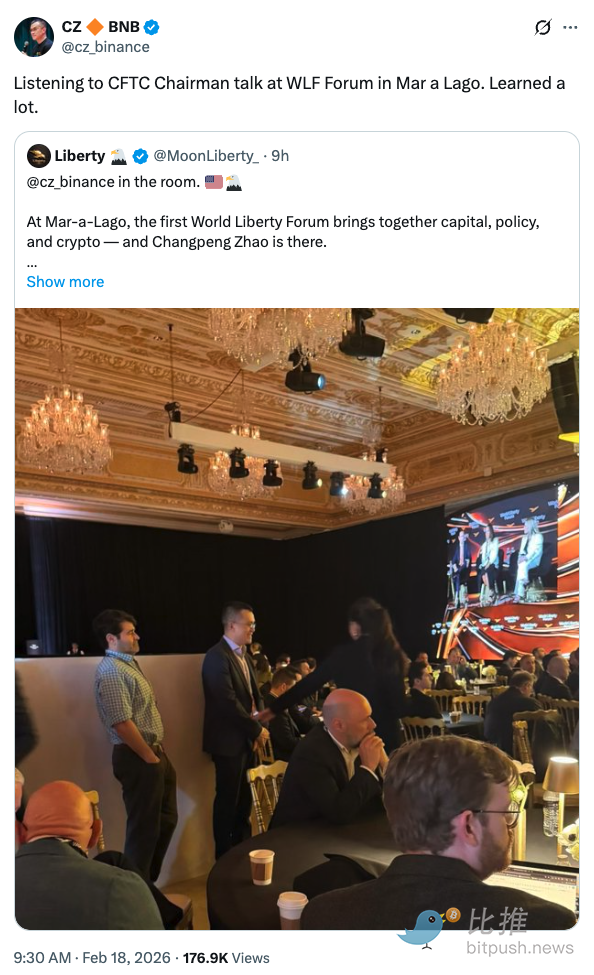
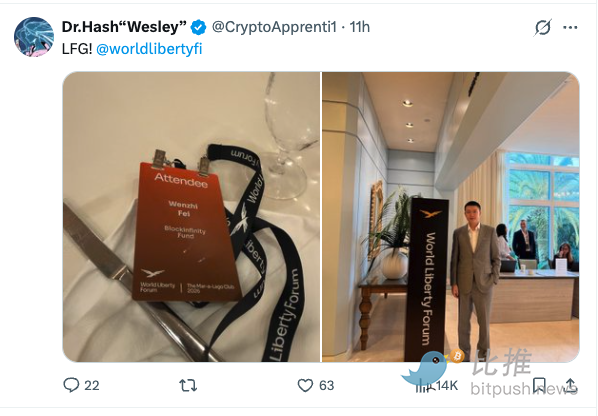
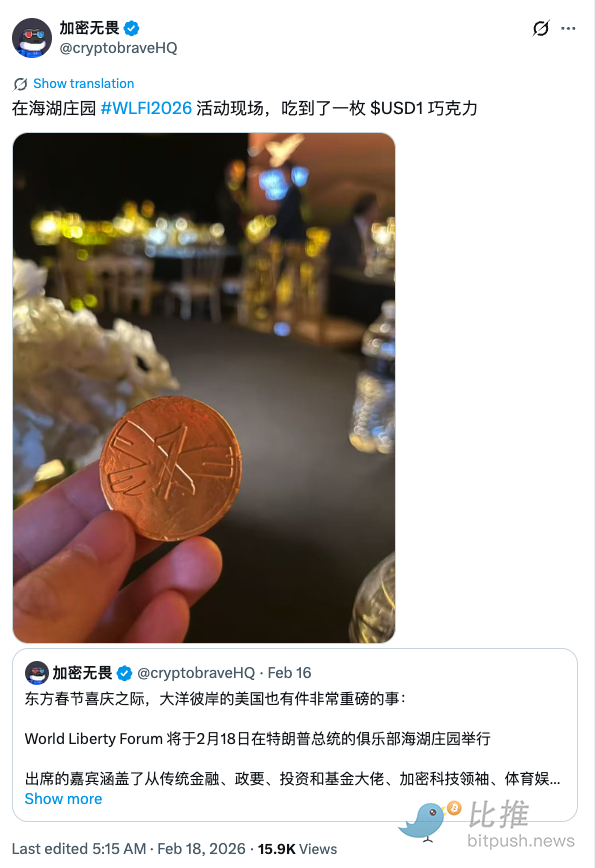
The World Liberty Forum is an invitation-only closed-door summit hosted by the Trump family-supported DeFi protocol World Liberty Financial (WLFI). Attendees included Goldman Sachs CEO David Solomon, Nasdaq Chair Adena Friedman, Coinbase founder Brian Armstrong, Binance's CZ, and others. Many Chinese-speaking KOLs were also invited and shared from the scene. Possibly influenced by this news, WLFI rose over 22% in 24 hours.
Twitter:https://twitter.com/BitpushNewsCN

BitPush TG Discussion Group:https://t.me/BitPushCommunity

BitPush TG Subscription: https://t.me/bitpush

Original link:https://www.bitpush.news/articles/7612948

Preguntas relacionadas

QWhat were the key changes in Duan Yongping's investment portfolio in Q4 2025?

AIn Q4 2025, Duan Yongping significantly increased his holdings in NVIDIA, Pinduoduo, and Berkshire Hathaway. He also made small new investments in three AI-related companies. Meanwhile, he reduced his positions in Apple, Alibaba, and Occidental Petroleum.

QWhy did CZ unfollow the well-known KOL 'Enheng' on social media?

ACZ unfollowed the KOL 'Enheng' due to a series of controversial actions, including excessive flattery, which led to a breakdown in their previously beneficial relationship that had helped Enheng gain profits and prominence earlier in 2025.

QWhat investment strategy is suggested for a bear market according to the crypto KOLs discussed?

AThe suggested strategy for a bear market is to gradually dollar-cost average into Bitcoin (BTC) at appropriate price levels, emphasizing patience and long-term faith in its value rather than chasing uncertain projects.

QWhat is the World Liberty Forum (WLFI) and who were some notable attendees?

AThe World Liberty Forum is an invitation-only closed-door summit supported by the Trump family and hosted by the DeFi protocol World Liberty Financial (WLFI). Notable attendees included David Solomon (CEO of Goldman Sachs), Adena Friedman (Chair of Nasdaq), Brian Armstrong (Founder of Coinbase), and CZ (Binance).

QHow did the WLFI token perform following the announcement of the summit, and why?

AThe WLFI token increased by over 22% in 24 hours, likely influenced by the announcement of the high-profile summit and the attendance of prominent financial and crypto industry leaders.

Lecturas Relacionadas

The Value Distribution of Stablecoins

**Summary: The Value Distribution of Stablecoins** The article argues that stablecoins are evolving from mere trading tools into broader channels for dollar access. It divides the stablecoin ecosystem into four layers to analyze how value is distributed: 1. **Issuance Layer:** Mints stablecoins, holds reserve assets, and captures the spread between reserve yield and user costs (e.g., Tether, Circle). This layer currently earns the largest profit margin. 2. **Infrastructure Layer:** Connects stablecoins to the traditional financial system, handling fiat on/off-ramps, banking integration, compliance (KYC/AML), and asset management (e.g., Bridge, BVNK). This is the "unglamorous" but critical work, building the essential bridges between crypto and real-world finance. 3. **Acquiring/Distribution Layer:** Integrates stablecoins into merchant systems, manages payment flows, and provides enterprise financial software (e.g., Stripe, Coinbase). They act as the access point for businesses. 4. **Application Layer:** The end-users and businesses that ultimately use stablecoins for payments, settlements, or as a store of value. They benefit from convenience but have little pricing power. The core thesis is that while the issuance layer currently dominates profits, the often-overlooked **infrastructure layer holds significant long-term potential**. The real challenge and barrier to mass adoption is not the on-chain transfer of stablecoins (which is simple), but the complex "last mile" integration into existing business workflows, banking systems, and regulatory frameworks across different countries. Companies in this layer are currently in a "land grab" phase, investing heavily to build networks, secure bank partnerships, and establish compliance pathways. While their position is currently pressured by the profitable issuers above and distribution platforms below, the article suggests that if stablecoins become a default financial rail for businesses, the infrastructure providers who have done the hard work of integration will ultimately gain strong pricing power and become entrenched, essential players.

marsbitHace 4 hora(s)

The Value Distribution of Stablecoins

marsbitHace 4 hora(s)

The Value Distribution of Stablecoins

The Value Distribution of Stablecoins The article argues that stablecoins are evolving from a mere trading tool into a broad "dollar channel." It analyzes the industry's value chain through four layers: 1. **Issuance Layer (e.g., Tether, Circle):** The top layer that mints stablecoins, holds reserve assets, and captures the thickest interest rate spread. 2. **Infrastructure Layer (e.g., Bridge, BVNK):** Connects stablecoins to the traditional financial system, handling critical but complex "dirty work" like fiat on/off-ramps, banking integration, compliance (KYC/AML), and cross-border settlement. 3. **Acquiring/Distribution Layer (e.g., Stripe, Coinbase):** Embeds stablecoins into merchant systems, manages payment flows, and integrates with enterprise software. 4. **Application Layer:** End-users and businesses that ultimately use stablecoins for payments, settlement, or storing value. The author posits that while the issuance layer currently captures the most profit, the most overlooked and potentially critical layer is infrastructure. The core challenge for stablecoin adoption isn't the on-chain transfer (which is simple), but bridging the gap between blockchain and the real-world financial system. This involves solving practical problems for businesses: fiat conversion, reconciliation, tax handling, and user onboarding. Infrastructure companies are currently in a difficult "land-grab" phase—building networks, securing banking relationships, and achieving compliance country-by-country. They face pressure from both the profitable issuance layer above and distribution platforms below. However, the author suggests this layer is building a crucial moat. Once stablecoins become a default business rail, the infrastructure players who have done the hard work of integration may gain significant, durable value and pricing power.

链捕手Hace 4 hora(s)

The Value Distribution of Stablecoins

链捕手Hace 4 hora(s)

How to Do Research Well: Deliberately Practice the Real Skills That Matter

No one truly teaches you how to do research. You're often given a desk, a pre-selected problem, and vague instructions to "create something new." Consequently, many people reverse-engineer the job based on visible outputs—papers, posts, announcements—learning only how to *appear* like a researcher rather than how to *become* one. True research capability is built from stacking small, trainable skills, nearly all of which can be developed through deliberate practice. **Pick Your Own Problem:** Most researchers absorb problems from advisors or trends, lacking the underlying reasoning. Choosing a problem you genuinely care about, as John Schulman advises, leads to original work. Develop "taste" like a muscle: predict experiment outcomes, guess paper results from methods, and track which findings remain important over time. **Upgrade Your Inputs:** Relying on shared reading lists (arXiv hot lists, filtered group chats) leads to unoriginal conclusions. Undervalued old literature often holds crucial insights (e.g., MoE, LSTM, backpropagation). Richard Sutton's "The Bitter Lesson" or Claude Shannon's 1952 talk on creative thinking are more predictive than lengthy modern surveys. Breadth matters as much as depth: draw from neuroscience, mechanism design, hardware knowledge, and honest statistics. Read papers directly, especially appendices and limitations sections. **Write Everything Down:** As Paul Graham noted, writing exposes flaws in seemingly mature ideas. Writing is the cheapest defense against self-deception. Following Feynman's principle, Darwin programmatically wrote down facts contradicting his theory to combat memory bias. Maintain a detailed log of hypotheses, setups, predictions, results, and updated understandings. Reviewing past logs fosters essential humility.

marsbitHace 6 hora(s)

How to Do Research Well: Deliberately Practice the Real Skills That Matter

marsbitHace 6 hora(s)

Trading

Spot
Futuros
活动图片