Dragonfly Partner Haseeb: Why the Fastest-Growing Companies of the Future May All Stagnate at 149 Employees

链捕手Publicado a 2026-06-24Actualizado a 2026-06-24

Resumen

Dragonfly partner Haseeb analyzes AI service pricing, particularly Anthropic's model, as a form of "tax policy" on AI labor. He observes a stark contrast: small companies (under ~150 users) benefit from low or zero marginal cost via flat-rate subscriptions, incentivizing them to maximize AI usage ("tokenmaxxing"). In contrast, large enterprises pay per-token API costs with high (e.g., 75%) markups, creating a disincentive for experimental or marginal automation. This pricing cliff at 150 users acts like a regulatory notch, potentially causing the fastest-growing AI-native companies to artificially cap their headcount to retain subsidized rates. Consequently, large-scale direct AI-for-human substitution within big corporations may not happen as expected; instead, job displacement may occur indirectly as lean, AI-heavy startups outcompete and erode their market share. The article concludes that token pricing, though not designed as such, functions as a powerful de facto tax policy shaping company structure and automation incentives.

Author: Haseeb

Compiler: Jiahuan, ChainCatcher

@SemiAnalysis_ recently discovered an incredible phenomenon in the economics of AI programming subscriptions. If you max out your usage, you actually pay 20 to 70 times less per token than buying tokens via the API.

Many people see this and say: My God, look at how much these LLM companies are subsidizing on tokens, the bubble must burst soon.
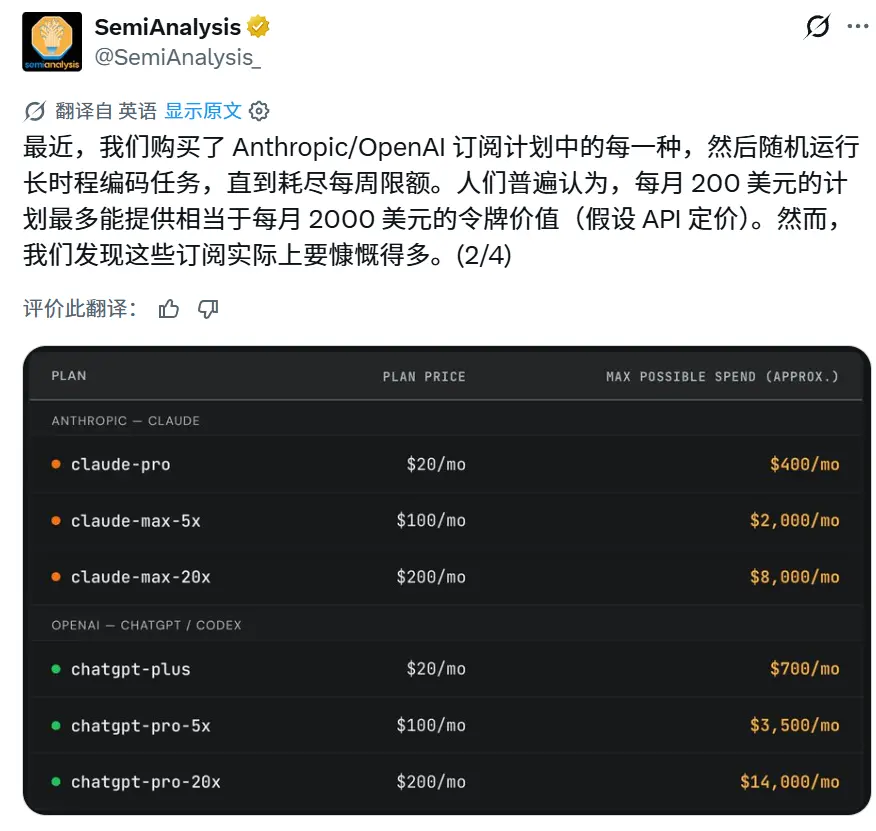
This reaction is wrong. The reason LLM companies are willing to offer such generous plans is naturally because most users rarely hit the cap. This product is like a gym membership: the allowance is generous because the vast majority of people hardly use it.

But I spent a long time pondering this; there's something genuinely odd here.

We don't know their actual comprehensive profit margin on subscriptions, but according to SemiAnalysis's estimates, at an average utilization rate of 20%, Anthropic's Max 5x plan barely breaks even. A 20% utilization rate might even be on the high side, especially in organizations where everyone (including non-programmers) has a subscription but only uses it occasionally. Most institutions I know, including Dragonfly, generously distribute Claude Code subscriptions and encourage non-programming staff to try them.

But what SemiAnalysis didn't delve into is that this is entirely a phenomenon for small businesses. Large enterprises cannot access this subscription pricing.

Here's why: When you exceed 150 users, you are forced out of the subscription model called "Team." You must switch to "Enterprise," priced at a base of $20/seat plus API fees calculated based on actual token usage. Enterprises can only pay linearly by token cost, and SemiAnalysis estimates the gross margin on API tokens to be around 75%. This is a massive price hike that suddenly kicks in at 150 users.

So, if you're a small business or startup (or an individual user), your perception of AI spending is distorted. Your token pricing is actually heavily subsidized; Anthropic likely operates on very low or even negative margins on you.

You might wonder why Microsoft and Uber are making a fuss about token spending and talking about "token-mining." This is the reason. They pay a structurally higher cost per token than startups and individuals.

But Anthropic doesn't care! For a B2B company, extracting maximum value from small companies or individuals isn't very meaningful. Look at companies like Datadog or Cloudflare: 80% to 90% of their revenue comes from large contracts (Annual Recurring Revenue > $100k). Making zero profit on the long tail is just a customer acquisition cost.

This is classic B2B sales thinking.

But there's another way to view the same situation: through the lens of tax policy.

Because if tokens are replacing labor, then the gross margin that OpenAI and Anthropic charge on tokens is effectively a tax on AI labor.

Viewing token pricing this way leads to two main consequences.

Token Pricing as Tax Policy

Assuming the profit margins from SemiAnalysis's article hold: subscriptions break even, large enterprise API gross margin is 75%. The immediate reaction is to call this a 75% tax on AI labor for large organizations and a 0% tax for startups.

Standard tax analysis would say this discourages large companies from using AI labor internally, incentivizing them, at the margin, to automate less and retain more human labor. (Obviously, it also encourages using smaller or open-source models, but the net effect incentivizes both. Remember, we're talking about the margin here.)

However, what drives behavior more strongly is not the average tax rate. In tax policy, it never is. What we really care about is the marginal tax rate.

For startups on flat-rate subscriptions, the marginal price of the next token is zero until the cap is hit. And a zero marginal price is the maximum distortion a policy can create.

For startups, the subscription model is essentially an innovation subsidy. The most overwhelming incentive is to figure out how to spend the entire token budget as efficiently as possible. This means running Ralph loops, keeping screens full of Claude Code sessions, and scheduling swarms of agents to work together.
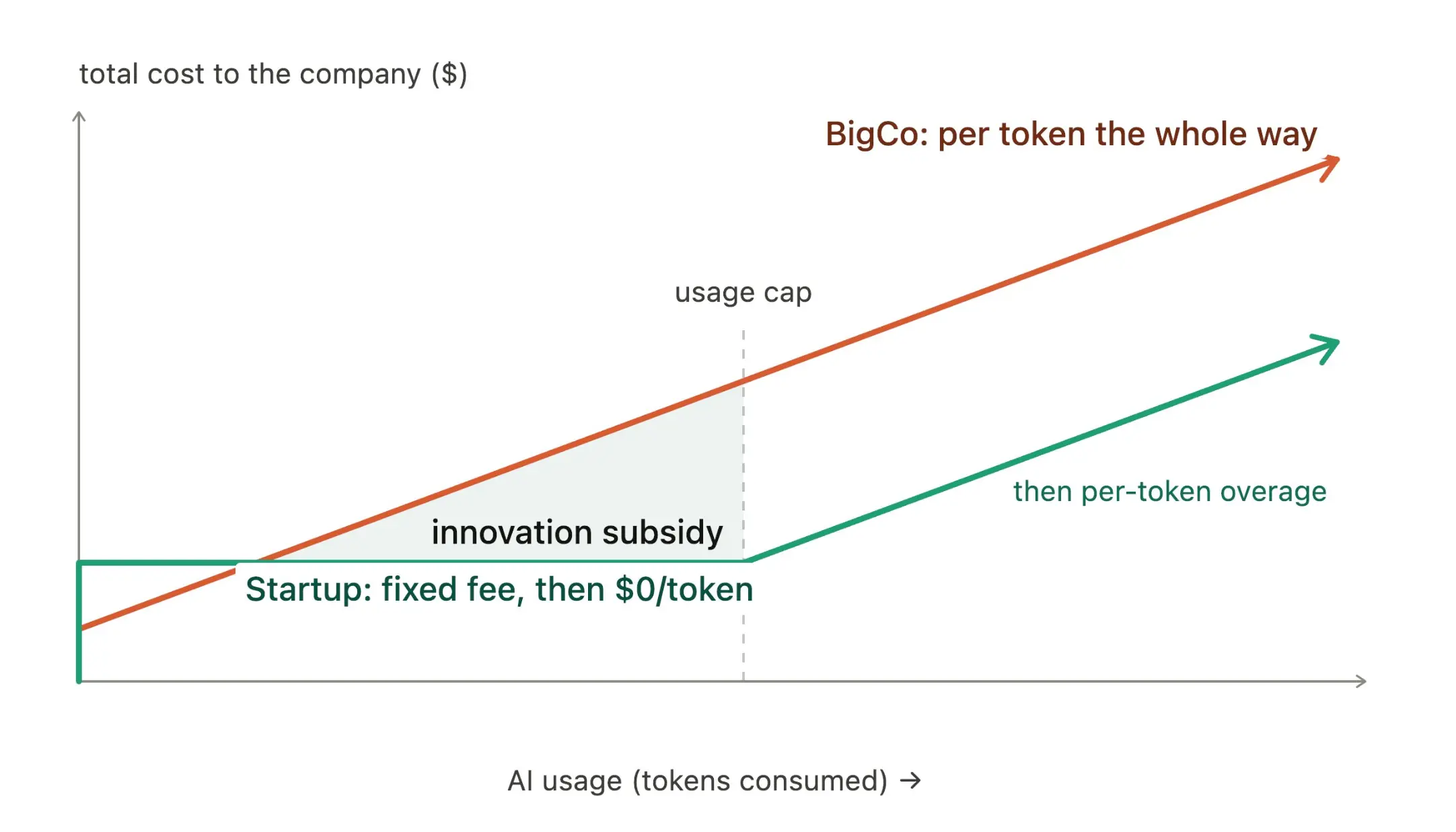
Until the cap is reached, exploration is free. So startups are essentially racing to squeeze every last drop of value from the subscription, overwhelming competitors with output. Paradoxically, the more you use, the lower the average token price gets. Every startup wants to be the one that costs Anthropic the most on the subscription.

Large enterprises face the opposite incentive. If you exceed 150 seats, every token in exploration is charged at full markup (with a 75% surcharge!). So they face a linearly increasing penalty for every step of exploratory frontier they probe.

Large firms will still automate the obvious high-volume tasks, but the marginal, experimental, risky automation is never discovered because the cost of discovery is too high. This tax structure ultimately encourages them to retain more human labor and maintain their original organizational structure.

This is the exact opposite of Japan. Due to a declining population, Japan faces a huge labor shortage. Historically, this meant Japan pursued high automation because expensive human labor incentivized it. That's why Japan has robots in restaurants, factories, hotels, and hospitals.

But curiously, large enterprises find themselves in the opposite dilemma: if they have to pay a high tax on using AI, it weakens the incentive to automate and strengthens the motive to retain existing employees (which is even more pronounced if wages stagnate during this period).

So where does the labor substitution flow in this model?

Everyone is watching large companies, waiting for the wave of AI layoffs. But with a 75% tax, aggressively replacing your own employees with AI might simply not be cost-effective; the token budget would explode.

But that doesn't mean substitution won't happen; it just manifests differently.

When large enterprises lose market share to AI-native startups with extremely low composite human costs, the large firms' declining revenue and stock prices trigger layoffs. But those eliminated jobs never reappear in the winning startups. The net reduction effect is the same; this unemployment gap is simply transferred to a lower-taxed part of the economy.

This is also why "AI-washing" (framing ordinary layoffs as newfound AI efficiency) might not be a temporary phenomenon. AI-washing refers to a company attributing layoffs to AI efficiency when it's really just masking ordinary business weakness.

Many think this is just a fad in the current AI hype cycle. But even though everyone is ready to witness large enterprises conducting real AI layoffs, replacing positions with AI, this might never happen on a large scale.

Labor substitution may unfold differently: startups defeat large companies, large companies disguise decline under the banner of AI until they fail, and startups never rebuild those old jobs. Job substitution still occurs, just not where everyone is looking.

This is the first consequence of this model. But there's a second, even more bizarre consequence.

The 150-Person Cliff

A regulatory notch is a regulatory boundary that incentivizes a huge behavioral jump. For example: the 30-hour weekly threshold for full-time employment has spawned a lot of jobs that are exactly 29 hours per week.

It's well known that France has extremely strict labor regulations that kick in once a company reaches 50 employees (work councils, mandatory profit-sharing, firing protections), while small companies are exempt. This gives employers a huge incentive to desperately keep their headcount below 50.
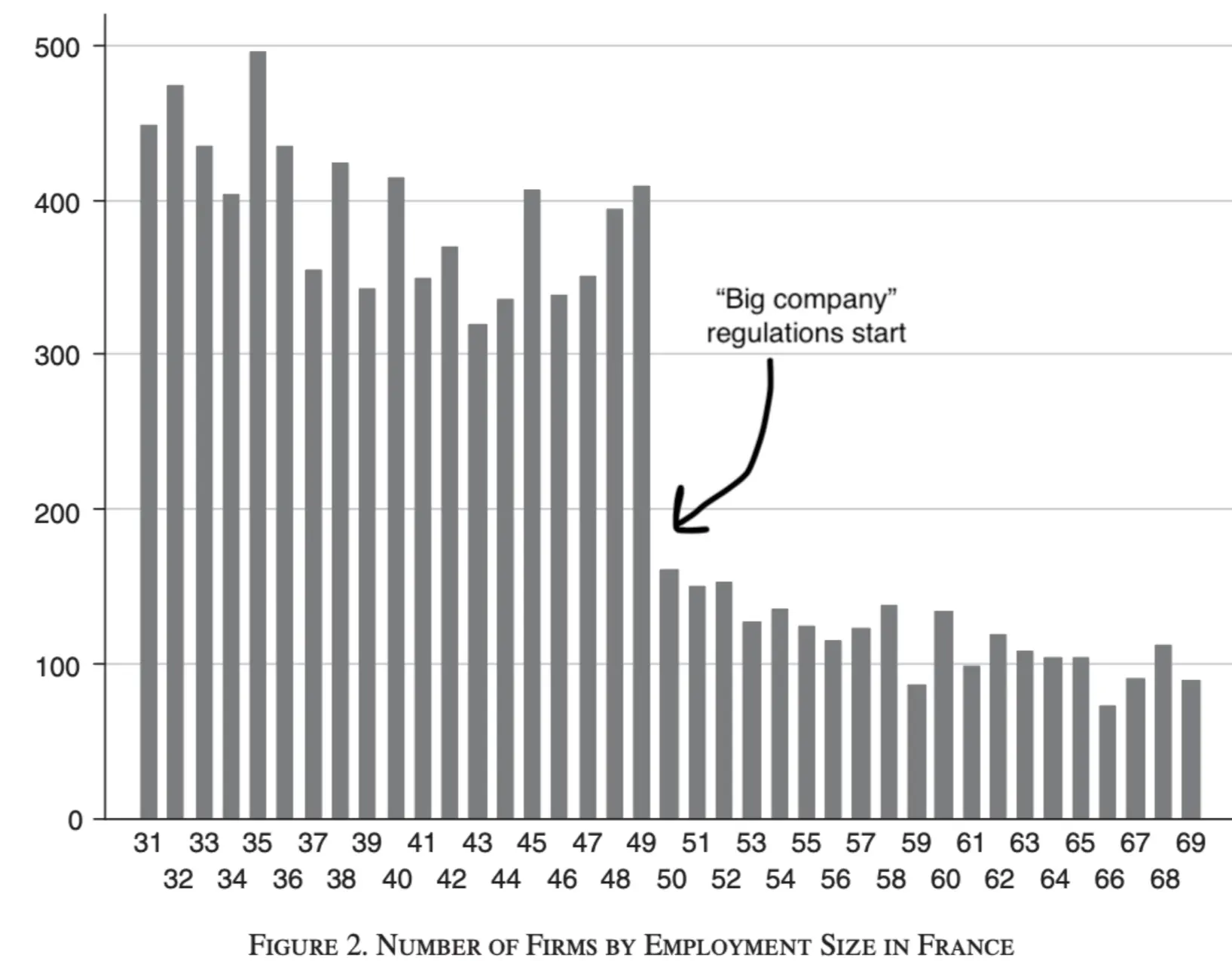
From: Garicano, Luis, Claire Lelarge, and John Van Reenen, 2016, "Firm Size Distortions and the Productivity Distribution: Evidence from France."

Extend this analogy to AI. LLM companies have created a tax threshold that punishes companies exceeding 150 seats. This means you must stay small to keep that wonderful subsidized subscription price, where tokens are taxed at roughly 0% (or even negative), not 75%.

This could give rise to an entirely new philosophy of corporate management. Startups will become obsessed with using agents for everything, having smaller teams, frequent layoffs, more outsourcing, exhausting all means to minimize the parts that require humans.

Not because it's the "optimal" level of automation, but because the incentives push them there. If the magic number is 149, every seat is crucial; you can't waste a single person outside the company's core functions.

This discontinuity might be hailed by Harvard Business School types as "the new generation of AI-first management." But understood correctly, it's simply a rational response to enterprise pricing plans.

This might sound exaggerated. But you can already see the behavioral divergence between organizations. Talk to developers at large enterprises; they are meticulously counting tokens, growing anxious as leadership cuts token budgets. Meanwhile, developers at startups are aggressively tokenmaxxing, launching swarms of agents overnight to check the logs in the morning. I expect this trend to accelerate.

No one designed this intentionally. No committee decided to subsidize innovation for startups and tax incumbents. It flows directly from those tried-and-true enterprise pricing strategies.

But tax law has always been this way: a pile of incidental rules that ultimately determine which companies get built and how those companies contort themselves to minimize their tax burden.

You might argue this is temporary, that LLM companies will eventually meter everyone. Github Copilot already made this transition. Maybe, maybe not. But before pricing normalizes, the 149-person company and this new AI-first management style might have already exploded, swallowed large market shares, and written the playbook for the next generation of startups.

Tax policy matters immensely. The entire "gig economy" concept exists precisely because of the legal distinction between W-2 (employee) and 1099 (independent contractor). As more and more labor is cannibalized by AI, token pricing could become the most impactful tax policy of the next decade. Yet, no one will ever vote on it.

(Don't be surprised if the fastest-growing companies in the next cycle are all conspicuously stuck at 149 seats.)


Preguntas relacionadas

QAccording to the article, what is the primary reason why AI model companies offer generous subscription plans to small businesses and individuals?

AThe primary reason is that most users rarely hit their usage limits. These subscription plans function like gym memberships, where the generous allowances are possible because the vast majority of users do not utilize them heavily. This allows companies to attract customers and cover costs based on low average utilization, making it a customer acquisition strategy rather than a direct profit center for these segments.

QWhat is the key difference in pricing and cost structure for companies with over 150 users compared to smaller ones, as described in the text?

AFor companies with over 150 users, they are forced to switch from the 'Team' subscription model to the 'Enterprise' model. The Enterprise pricing charges a base fee per seat plus API fees based on actual token usage at a much higher marginal cost. The article suggests the gross margin on API tokens is around 75%, representing a significant price hike that suddenly takes effect at the 150-user threshold.

QHow does the article frame the AI token pricing for large enterprises in terms of economic policy?

AThe article frames it as a form of taxation on AI labor. Since tokens are replacing human labor, the high gross margin (around 75%) charged by companies like OpenAI and Anthropic on API tokens for large enterprises acts as a 'tax' on using AI workforce. This high marginal cost discourages large companies from aggressively automating marginal or experimental tasks, incentivizing them to retain more human labor instead.

QWhat behavioral incentive does the 'zero marginal price' of tokens create for startups under the subscription model?

AThe zero marginal price for tokens until the subscription cap is reached creates a powerful incentive for startups to maximize token usage. It acts as an innovation subsidy, driving startups to figure out how to spend their entire token budget as efficiently as possible. This leads to behaviors like running automated loops, maximizing concurrent AI sessions, and scheduling swarms of AI agents to work, all to extract the maximum value from their fixed-cost subscription.

QWhat is the '150-person cliff' analogy, and what potential long-term consequence does the article suggest it might lead to?

AThe '150-person cliff' is compared to a regulatory notch, like France's labor laws that trigger at 50 employees. It's the pricing threshold where companies lose subsidized subscription rates and face much higher 'taxed' API costs. The article suggests this could lead to a new management philosophy where the fastest-growing companies consciously stay under 149 employees. They would become obsessed with using AI agents for everything, keeping teams extremely lean, outsourcing, and avoiding human roles outside core functions—not because it's optimally efficient, but to avoid crossing the costly pricing threshold.

Lecturas Relacionadas

Must-Watch Events Next Week|CLARITY Act Could Face Senate Vote; SpaceX, Circle to Report Earnings (8.3-8.9)

**Summary: Key Events and Developments to Watch (August 3-9)** The upcoming week is marked by significant financial disclosures, key legislative deadlines, and notable product updates. **Major Financial Events:** Several companies are scheduled to release their Q2 2026 earnings. American Bitcoin (ABTC) will report on August 3, followed by SpaceX and Hut 8 Mining Corp. on August 4, and Circle on August 5. Notably, a significant portion of SpaceX shares (up to 12% of total shares) will be unlocked on August 6 following their earnings release. **Key Legislative Deadline:** The U.S. Senate faces an August 7 deadline to secure 60 votes for the CLARITY Act, a bipartisan bill aiming to establish a federal regulatory framework for cryptocurrencies. The Senate may hold a full vote on the bill during the week. **Economic Data:** The U.S. July Non-Farm Payrolls report will be released on August 7, providing crucial labor market data. **Technology & Product Updates:** * **Shutdowns:** DeFi portfolio tracker Zapper and wallet app Ctrl Wallet will cease operations on August 3. * **Upgrades:** LayerZero will deprecate its v1 relayers on August 3. XRP Ledger's new version 3.3.0, featuring five new functions, is expected next week. * **AI:** Elon Musk announced that the advanced Grok 4.6 AI model is set for release around August 7. * **Bitcoin:** The BIP-110 forced signaling for a potential Bitcoin network change is scheduled to begin around August 8. **Other Notable Events:** Chinese robotics firm Unitree Tech has set its preliminary price inquiry for its IPO for August 5. South Korean exchange Upbit will delist AQT and AERGO tokens on August 3.

marsbitHace 2 min(s)

Must-Watch Events Next Week|CLARITY Act Could Face Senate Vote; SpaceX, Circle to Report Earnings (8.3-8.9)

marsbitHace 2 min(s)

Stocks Are Plummeting More Sharply Than Cryptocurrencies. Where Has the Money Gone?

Stock Markets Plunge Deeper Than Cryptocurrencies: Where Did the Money Go? In late July, Seoul's Kospi index triggered circuit breakers for two consecutive days, plummeting over 40% from its June high. The collapse was led by heavyweight stocks like SK Hynix, whose record profits still disappointed investors, and devastating leveraged ETFs, with one major product losing over 83% of its value. This signaled a global, forced deleveraging targeting the most crowded trades. Interestingly, while stocks exhibited extreme volatility akin to crypto markets, Bitcoin rose nearly 15% in July after a prior steep drop. Analysis shows the money fleeing equities did not flow into Bitcoin. Instead, Bitcoin had already absorbed its sell-off in May-June, when U.S. spot Bitcoin ETFs saw historic outflows. The true safe-haven beneficiary was gold, whose price rose over 20% year-on-year, highlighting a decoupling between Bitcoin and gold as "digital gold." The sell-off was a targeted unwinding of leveraged positions in tech and semiconductors, accelerated by broker-dealer risk management and shifts in the AI narrative, including new competition from Chinese memory chipmakers. The retreat path was clear: from high-valuation tech stocks to cash and U.S. Treasuries, then to gold. For Bitcoin to attract sustained institutional inflows, conditions like eased global liquidity pressure, a "soft-landing" Fed rate cut, and U.S. regulatory clarity via legislation like the stalled CLARITY Act are needed. Currently, Bitcoin is not a safe haven but an already-cleared asset. Its low correlation with tech stocks, however, makes it a potential diversification play for institutional portfolios once the storm passes. The money isn't here yet, but the positioning is underway.

marsbitHace 2 min(s)

Stocks Are Plummeting More Sharply Than Cryptocurrencies. Where Has the Money Gone?

marsbitHace 2 min(s)

In Conversation with Ray Dalio: We Are Currently in an AI Bubble, with 1% of My Portfolio in Bitcoin

Ray Dalio, founder of Bridgewater Associates, warns in an interview that the current AI boom shows classic bubble characteristics, which could lead to significant economic downturns as seen in past cycles like 1929 or 2000. He explains that speculative enthusiasm, fueled by debt and overvaluation, often precedes a crash when rising rates or taxation force asset sales, causing widespread losses and recession. Dalio also outlines his "Big Cycle" theory, describing an approximate 80-year pattern where widening wealth gaps, massive government deficits, and shifting geopolitical power (like China's rise) create internal conflict and global instability. He emphasizes that we are in a late-cycle, transitional phase where traditional powers like the US and UK face decline. For personal wealth protection, Dalio advises diversification beyond cash into assets like stocks, bonds, real estate, and particularly gold, which he prefers over Bitcoin. While he holds about 1% of his portfolio in Bitcoin as a non-printable hard asset, he views gold as more secure from technological or governmental threats. Regarding AI's impact, Dalio believes it will disproportionately benefit capital owners, worsening inequality by replacing both physical and cognitive labor. He suggests that human intuition and emotional intelligence, combined with AI, will be key for future workers. On taxation, Dalio argues that wealth taxes are impractical and risk triggering asset sell-offs, reducing productive investment. He points to the UK as a cautionary example of debt, low productivity, and political strife. Geopolitically, Dalio foresees a more regionalized world, with the US showing weakness in prolonged conflicts like with Iran, akin to past imperial declines. The ideal outcome, he suggests, is coexisting powerful blocs (e.g., Americas, China-Asia Pacific) without major war.

marsbitHace 3 hora(s)

In Conversation with Ray Dalio: We Are Currently in an AI Bubble, with 1% of My Portfolio in Bitcoin

marsbitHace 3 hora(s)

Daily 7.2 Trillion KRW: Foreign Capital's Record Net Buying on Friday! Wall Street Says Headwinds for Korean Stock Fund Flows Have Subsided

South Korean stock market sees a dramatic shift in fund flows. On July 31, foreign investors made a record net purchase of approximately KRW 7.2 trillion in KOSPI stocks, marking a fundamental reversal from the persistent large-scale net outflows seen in previous months. This contributed to a significant narrowing of foreign net selling in July to KRW 9.8 trillion, down sharply from KRW 48.4 trillion in June and KRW 44.5 trillion in May. Simultaneously, domestic institutional pressure eased. South Korean pension funds and asset managers turned to a net buying position in July, purchasing KRW 1.0 trillion worth of KOSPI shares, contrasting with net sales in May and June. Market volatility is expected to be dampened by new financial regulations. Effective July 31, the Financial Services Commission tightened access for retail investors to single-stock leveraged ETFs by raising the minimum cash deposit requirement. Trading volumes for these products subsequently dropped to about 50% of their monthly average. Citigroup Research maintains its year-end KOSPI target of 10,000 points. The firm cites several supportive factors: the substantial easing of headwinds from capital outflows, a robust fundamental outlook for the semiconductor sector, historically low market valuations, strong economic fundamentals, and the potential for policy support from financial authorities if needed.

marsbitHace 3 hora(s)

Daily 7.2 Trillion KRW: Foreign Capital's Record Net Buying on Friday! Wall Street Says Headwinds for Korean Stock Fund Flows Have Subsided

marsbitHace 3 hora(s)

Trading

Spot
活动图片




