DraftKings eyes crypto offerings as it expands into prediction markets

cointelegraphPublicado a 2025-12-19Actualizado a 2025-12-19

Resumen

DraftKings is expanding beyond sports betting into prediction markets with its new DraftKings Predictions app, which allows users to trade contracts on sports and financial outcomes. Initially available in 38 states, the company plans to eventually include crypto-linked contracts, as well as entertainment and cultural events. The trading operates through Railbird Exchange, a CFTC-regulated derivatives venue, providing a established regulatory framework. This move aligns with a broader trend of prediction markets gaining mainstream traction in the U.S., driven by platforms like Polymarket and Kalshi. Other crypto-native firms, including Coinbase and Gemini, are also entering the prediction market space.

DraftKings is expanding beyond sports betting into the realm of prediction markets, laying the groundwork for future crypto-linked contracts as regulated event trading gains momentum in the United States.

As Bloomberg reported, the company announced on Friday that it has launched the DraftKings Predictions app, which allows users to trade contracts on sports and financial outcomes. At launch, the app is available in 38 states, with sports-related trading permitted in 17 of them.

DraftKings ultimately plans to expand its prediction market offerings beyond sports and finance to include contracts linked to crypto, entertainment and cultural events, according to Bloomberg.

DraftKings’ push into prediction markets is underpinned by regulated derivatives infrastructure connected to CME Group–style market standards.

The company said trading will be conducted through Railbird Exchange, a derivatives venue it acquired and which is registered with the US Commodity Futures Trading Commission, allowing DraftKings to offer event-based contracts within an established regulatory framework.
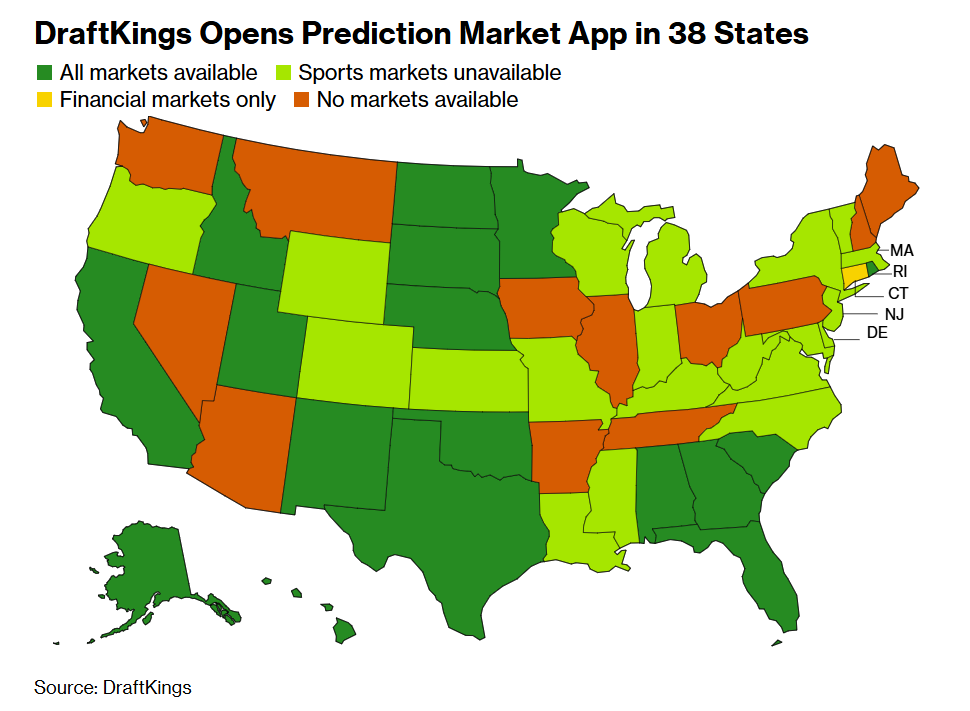
DraftKings’ growing national footprint. Source: Bloomberg

As a publicly traded US-based sports betting and entertainment company, DraftKings brings increased visibility and mainstream exposure to prediction markets and potentially crypto-linked contracts as regulated event trading gains traction in the United States.

In early November, DraftKings reported third-quarter revenue of $1.14 billion, up 4% year over year, alongside an adjusted loss of $127 million. The company said it expects to generate up to $6.1 billion in revenue this year, roughly triple the amount it generated in 2022.

Related: Polymarket shows stronger retention than most DeFi, wallets and exchanges

From Polymarket to Wall Street: Prediction markets go mainstream

While DraftKings’ prediction market offering is not built on blockchain or decentralized technology, the broader sector has gained momentum in recent years largely due to crypto-native platforms that redefined how prediction markets operate.

The most prominent example is Polymarket, which brought prediction markets onchain by using crypto rails to enable global participation and near-instant settlement.

The platform helped popularize prediction markets among crypto-native users, particularly during major political events and most notably the 2024 US presidential election. Its rise has coincided with growing interest in other event-based trading venues, including Kalshi, a US-regulated prediction market operating under the Commodity Futures Trading Commission (CFTC).

Beyond consumer-facing platforms, crypto-focused financial infrastructure providers are also expanding into the space. Bitnomial Clearinghouse, a derivatives clearing organization regulated by the CFTC, has signaled plans to support prediction markets tied to cryptocurrency and macroeconomic outcomes.

Crypto-native exchanges are also broadening their product suites to include prediction-style offerings. Coinbase recently announced plans to integrate stock trading and prediction markets into its long-term vision of becoming an “everything app.”
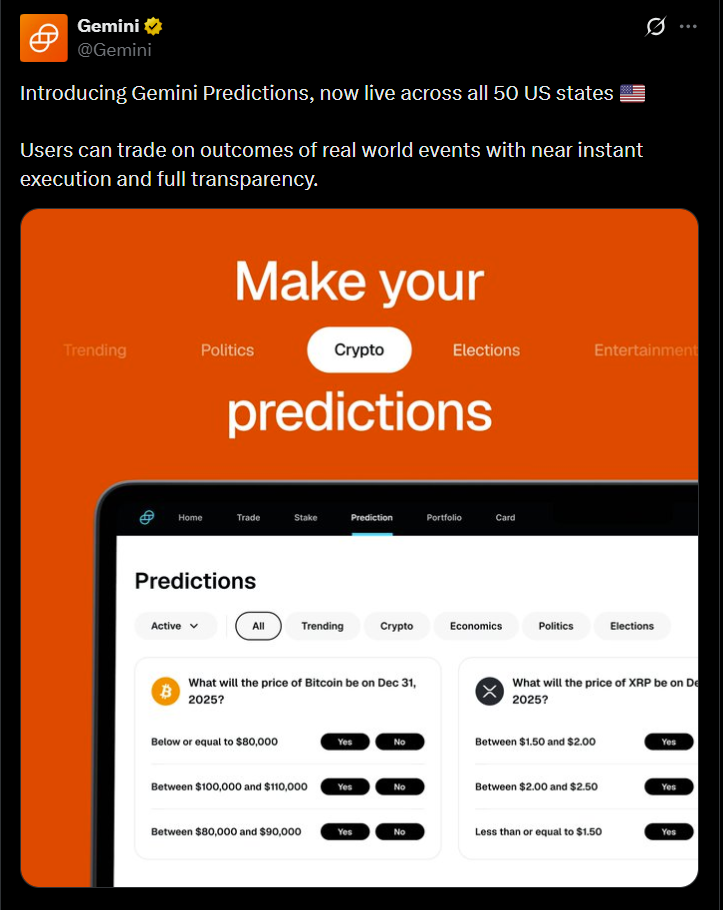
Source: Gemini

Meanwhile, the Winklevoss-led Gemini cryptocurrency exchange has launched prediction markets in the US, having secured the necessary regulatory approvals.

Related: Phantom taps Kalshi to offer regulated prediction markets in wallet

Preguntas relacionadas

QWhat new market is DraftKings expanding into, and what future offerings are they planning?

ADraftKings is expanding into prediction markets and is planning future crypto-linked contracts, as well as offerings related to entertainment and cultural events.

QThrough which regulated entity will DraftKings conduct its prediction market trading?

ADraftKings will conduct its trading through Railbird Exchange, a derivatives venue it acquired that is registered with the US Commodity Futures Trading Commission (CFTC).

QWhat is a key crypto-native platform that helped popularize onchain prediction markets?

APolymarket is the key crypto-native platform that helped popularize onchain prediction markets by using crypto rails for global participation and near-instant settlement.

QBesides DraftKings, name two other US-based companies or platforms mentioned that are involved in prediction markets.

ATwo other US-based companies involved in prediction markets are Kalshi, a CFTC-regulated prediction market, and the Gemini cryptocurrency exchange, which has launched its own prediction markets.

QWhat was DraftKings' reported third-quarter revenue and how does it compare to the previous year?

ADraftKings reported third-quarter revenue of $1.14 billion, which was up 4% year over year.

Lecturas Relacionadas

You Bet on the News, the Pros Read the Rules: The True Cognitive Gap in Losing Money on Polymarket

The article explains that the key to profiting on Polymarket, a prediction market platform, lies not just predicting real-world events correctly, but in meticulously understanding the specific rules that govern how each market will be resolved. It illustrates this with examples, such as a market on Venezuela's 2026 leader, where the official rules defining "officially holds" the office overruled the intuitive answer of who was in practical control. Other examples include debates over the definition of a "token" or what constitutes an "agreement." The core argument is that a "reality vs. rules" gap creates pricing discrepancies that savvy traders ("车头" or "whales") exploit. The platform has a formal dispute resolution process managed by UMA token holders to settle ambiguous outcomes. This process involves proposal submission, a challenge window, a discussion period, and a final vote. However, the article highlights a critical flaw in this system compared to a traditional court: the lack of separation between the arbiters (UMA voters) and the interested parties (traders with financial stakes in the outcome). This conflict of interest undermines the discussion phase, leads to herd mentality, and results in opaque final decisions without explanatory rulings. Consequently, the system lacks a body of precedent, making it difficult for users to learn from past disputes. The ultimate takeaway is that success on Polymarket requires a lawyer-like scrutiny of the rules to identify and capitalize on the cognitive gap between how events appear and how they are contractually defined for settlement.

marsbitHace 1 hora(s)

You Bet on the News, the Pros Read the Rules: The True Cognitive Gap in Losing Money on Polymarket

marsbitHace 1 hora(s)

Trading

Spot
Futuros
活动图片