Don't Rush to Criticize Bitcoin—It's Becoming the 'Next Generation Gold'

比推Publicado a 2026-03-03Actualizado a 2026-03-03

Resumen

Title: Don't Rush to Condemn Bitcoin: It's Becoming the "Next Generation Gold" Despite the "digital gold" narrative, Bitcoin has consistently failed to act as a safe-haven asset during geopolitical crises, such as the 2026 Iran-Israel conflict, where gold prices surged while Bitcoin initially plummeted. The article argues that Bitcoin is not yet a true digital gold, as it lacks state adoption (central banks accumulate gold, not Bitcoin) and exhibits asymmetric investor behavior (falling with equities but not rising proportionally during recoveries). Three structural asymmetries hinder Bitcoin's safe-haven status: 1) a derivatives-heavy market structure prone to liquidations, 2) dominance by leveraged traders rather than patient capital, and 3) a lack of long-term behavioral trust compared to gold's decades-long record. However, Bitcoin has demonstrated utility as a "crisis utility asset," enabling financial transactions in extreme scenarios like Ukraine (2022) and Iran (2026) when traditional systems failed. For Bitcoin to evolve into "next-generation gold," it must narrow these asymmetries through market structure transformation (reduced leverage), participant shift (generational adoption), and behavioral accumulation (algorithmic trust). If achieved, Bitcoin could become a new asset class rather than merely replicating gold.

Source: Tiger Research

Author: Ryan Yoon

Compiled and Edited by: BitpushNews


In February 2026, as the Iran attack incident escalated, the price of gold soared, while Bitcoin suffered a sharp decline. Can we still believe that Bitcoin is "digital gold"? This article explores the conditions Bitcoin must meet to become the "next generation gold".

Key Points

  • In every geopolitical crisis, gold rises while Bitcoin falls. After six tests, the data has never confirmed the "digital gold" narrative.

  • While governments are hoarding gold, they still exclude Bitcoin from their holdings. For investors, Bitcoin exhibits asymmetry: it falls with the stock market but fails to rebound in sync with it.

  • Three structural asymmetries hinder Bitcoin from gaining safe-haven asset status: excessive derivatives (market structure), dominance by leveraged traders (participant structure), and lack of a repeated behavioral record (behavioral accumulation).

  • Although Bitcoin is not a safe-haven asset, it is a "crisis utility asset" that proves useful in extreme environments where borders are closed and banks are shut down.

  • If these three asymmetries narrow, Bitcoin may no longer be a replica of gold but evolve into a new category—the "next generation gold". Generational shift and algorithmic adoption are variables that could accelerate this process.

1. Is Bitcoin Really "Digital Gold"?

On February 28, 2026, the U.S. and Israel launched an attack on Iran. When "Operation Epic Fury" was announced, the price of gold immediately rose. In contrast, Bitcoin fell intraday to $63,000. Although it recovered within a day, its reaction was starkly different.
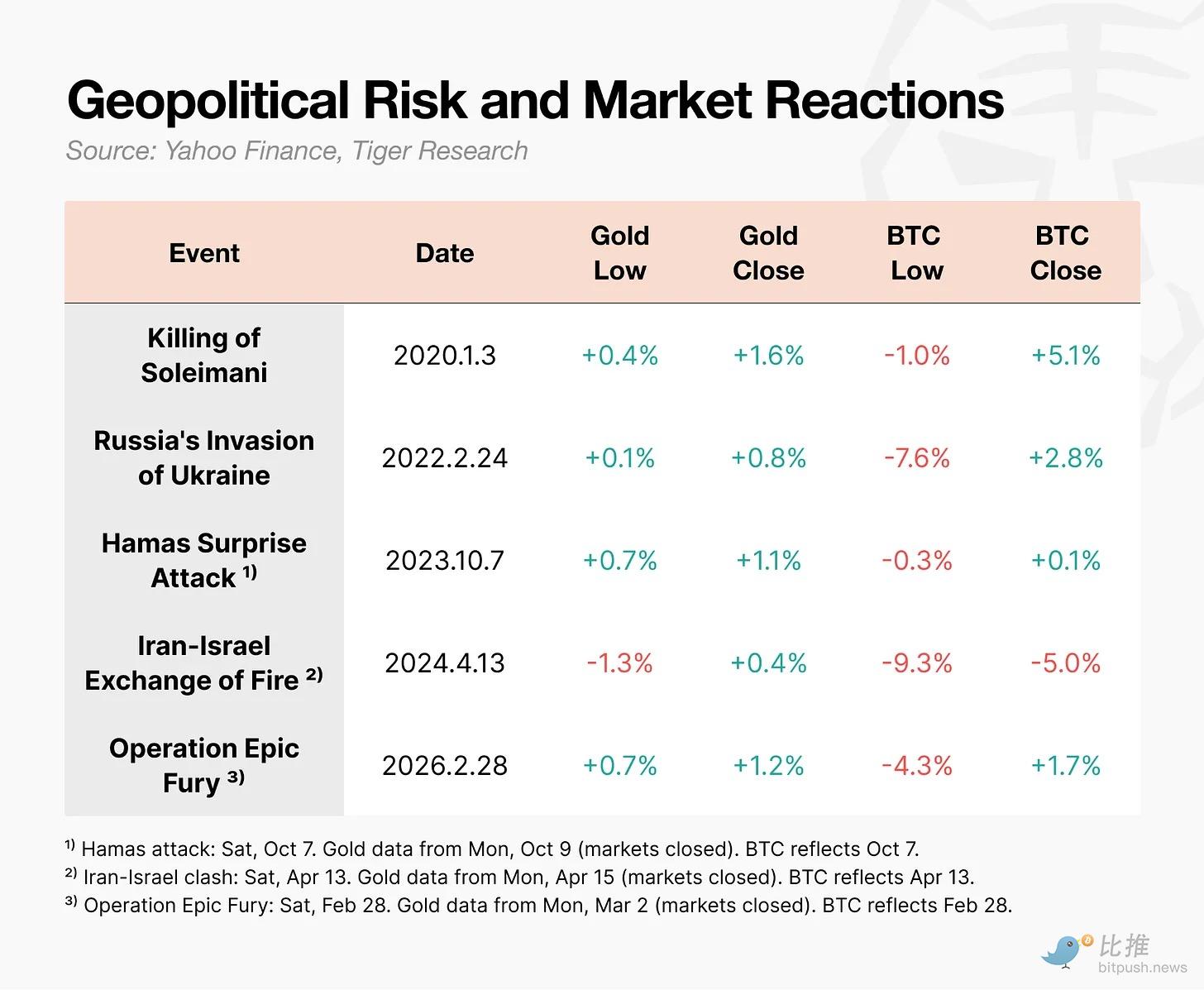
During geopolitical shocks like war, Bitcoin's performance completely diverges from gold. Although Bitcoin recovers quickly after the initial drop, chain liquidations by leveraged traders cause its decline to far exceed that of other assets. During the Iran-Israel conflict, its intraday drop reached -9.3%, while during the Ukraine war it was -7.6%. Meanwhile, gold was rising.

When an asset crashes first at the moment a crisis breaks out, can we really call it "digital gold"?

2. Bitcoin is Not "Digital Gold" for Nations or Investors

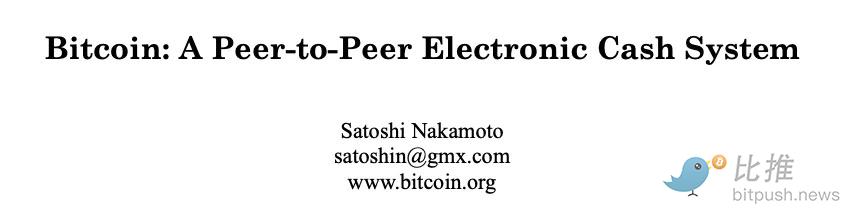
Bitcoin was not originally designed to be "digital gold". The title of Satoshi Nakamoto's 2008 whitepaper was "Bitcoin: A Peer-to-Peer Electronic Cash System". Its starting point was a transmission mechanism, not a store of value.
The "digital gold" narrative became popular during the 2020 zero-interest-rate and quantitative easing era. As concerns about currency devaluation peaked, Bitcoin gained attention as a store of value. But in practice, neither nations nor investors treat it as "digital gold".

2.1 National Level: Hoarding Gold, Only "Considering" Bitcoin

Data from the World Gold Council shows that central banks are increasing their gold holdings year by year. However, no major central bank includes Bitcoin in its official reserve assets.

Some counter that the U.S. formally established a "Strategic Bitcoin Reserve" via an executive order in March 2025. The order text even mentioned that "Bitcoin is often called 'digital gold'". But the details are crucial: its scope is limited to assets obtained through criminal and civil forfeiture. The government is not buying new Bitcoin; it is choosing to hold rather than sell seized assets.

Notably, as the appeal of U.S. debt declines, Europe and China are actively buying gold, but Bitcoin does not appear on their list of alternatives.

2.2 Investor Level: Falls with Declines, Doesn't Rise with Gains

The second half of 2025 was decisive. When the Nasdaq hit a record high, Bitcoin had plummeted more than 30% from its October peak of $125,000. The two began to decouple.

The real trouble isn't the decoupling itself, but the direction. Bitcoin fell in sync with the stock market decline but failed to rise when the market rebounded. For investors, this is the worst combination. There is no reason to hold an asset in a portfolio that only shares downside risk but misses out on upside gains.

3. Why Has Bitcoin Failed to Become "Digital Gold"?

A safe-haven asset is not just one whose price rises. In academic definition, a safe-haven asset is one whose correlation with other assets drops to zero or turns negative during extreme market downturns. The key is whether its reaction in a crisis is predictable. Measured by this standard, the gap between gold and Bitcoin is evident.
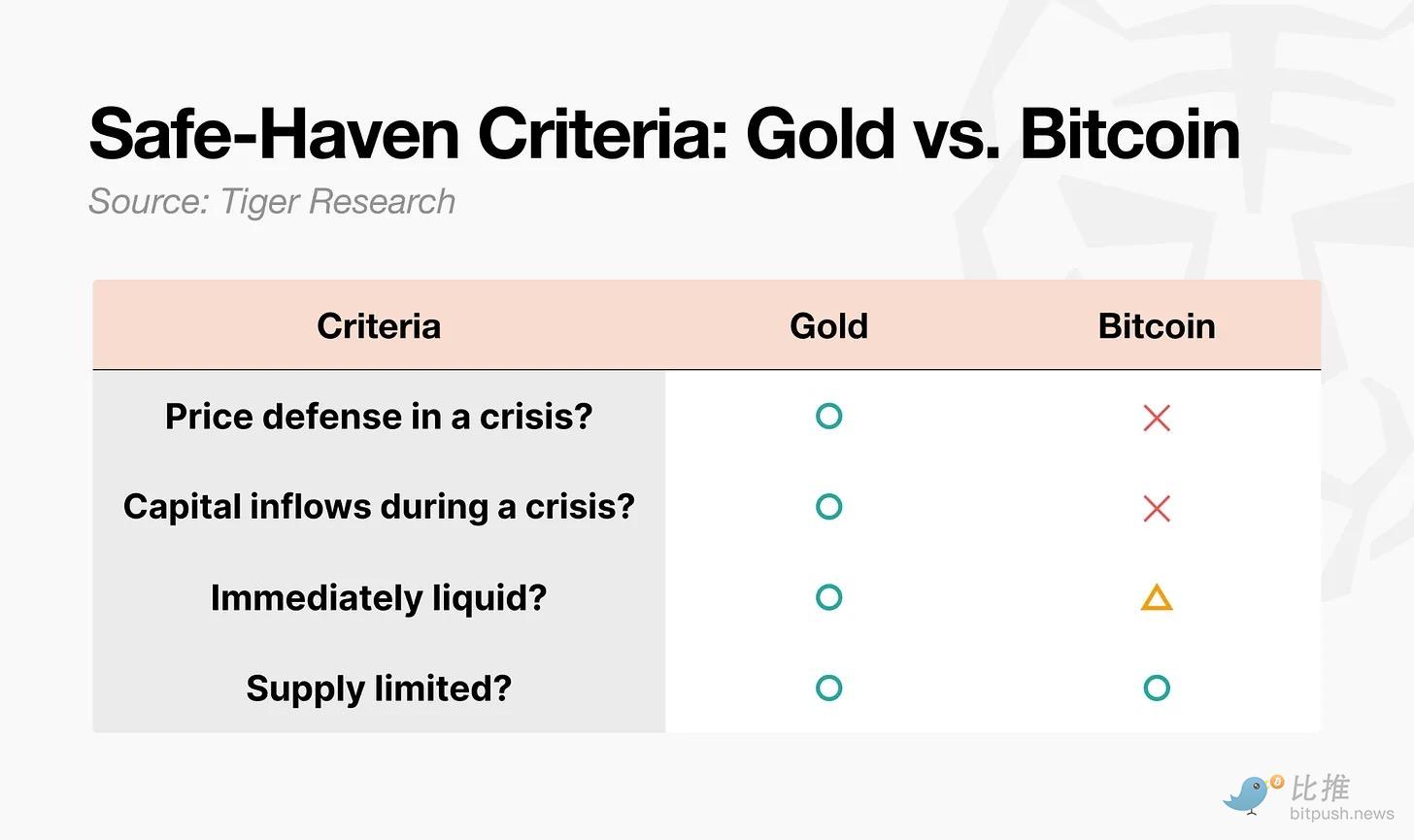
Three structural asymmetries explain this gap:

  1. Market Structure Asymmetry: Gold has physical demand supporting its price floor, and futures leverage is relatively low. Bitcoin's derivatives trading volume is about 6.5 times that of spot, and it trades 24/7, making it the first asset sold off when a crisis hits.

  2. Participant Asymmetry: Gold's crisis buyers are patient capital (central banks, pension funds). The Bitcoin market is dominated by leveraged traders and hedge funds, which are the fastest to withdraw in a crisis.

  3. Behavioral Accumulation Asymmetry: "Buy gold in times of crisis" is a behavioral pattern repeated for decades, becoming a formula. Bitcoin needs time to earn the same trust.

4. Not "Safe", But Proven "Useful"

In terms of safety, it's hard to call Bitcoin digital gold. But its utility in a crisis is real.

Ukraine (2022): After the war broke out, the Ukrainian central bank restricted electronic transfers and set withdrawal limits. Citizens couldn't access their deposits. Some refugees crossed borders with Bitcoin seed phrases stored on USB drives and exchanged them for local currency via Bitcoin ATMs or P2P transactions in Poland to sustain their lives.

UNHCR: Distributed the stablecoin USDC to displaced persons, allowing them to exchange it for cash at MoneyGram outlets.
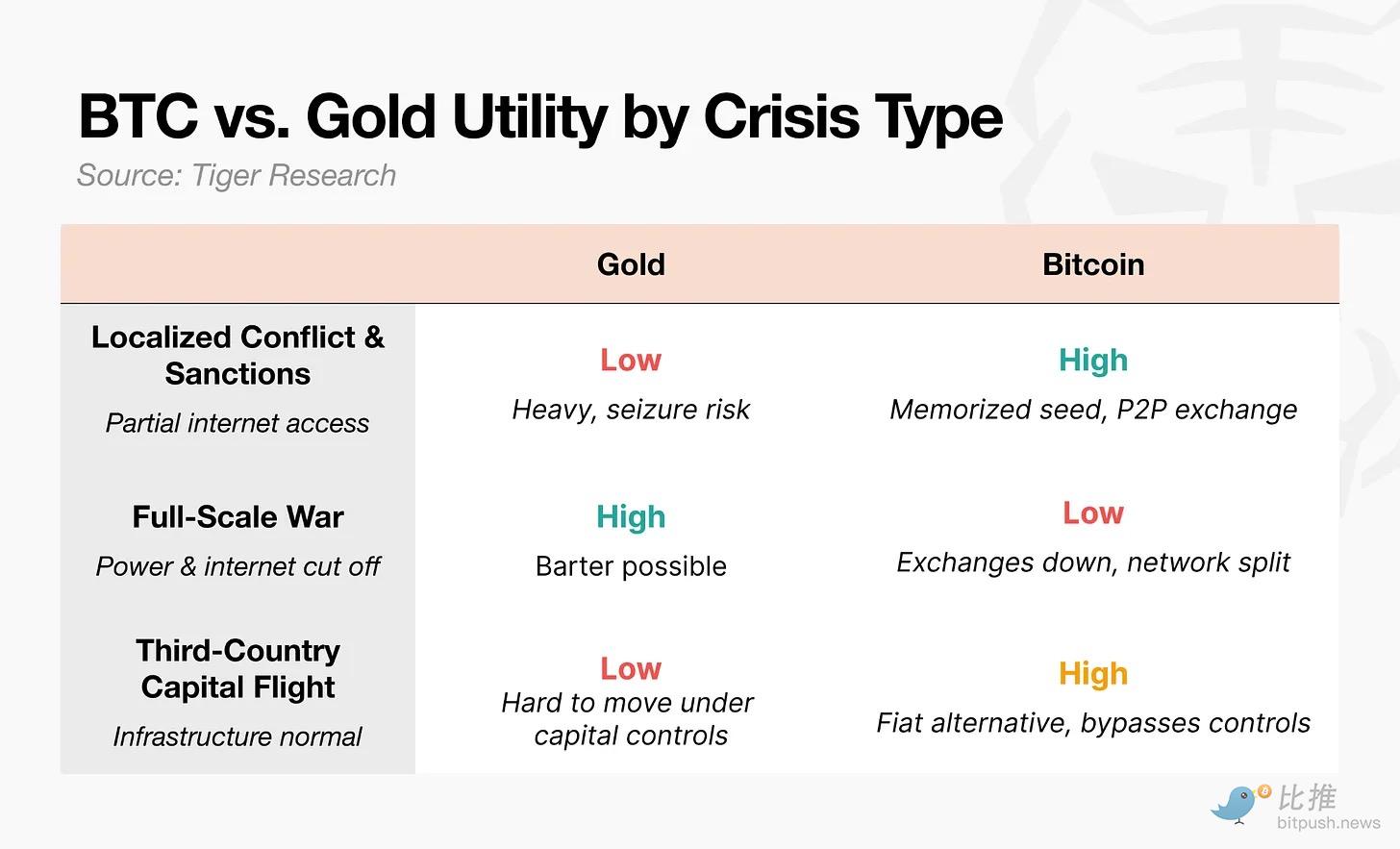

Iran (2026): After "Operation Epic Fury", fund outflows from Iran's largest crypto exchange, Nobitex, surged by 700%.

These cases show people turn to Bitcoin not because it is safe, but because it works when the financial system fails.

In finance, a "safe-haven asset" means price resilience, which is a different concept from an "asset usable in a crisis". Bitcoin provides functional value for movement and transfer in wartime but cannot defend its price.

5. Bitcoin's "Next Generation Gold" Script

Although Bitcoin currently moves opposite to gold in every crisis, the path to "next generation gold" opens if the following three asymmetries narrow:

5.1 Market Structure Transformation

Derivatives trading volume being 6.5 times spot is a trigger for chain liquidations. Recently, futures open interest has declined, and price discovery is shifting towards spot and ETFs. The real test is whether leverage will spiral out of control again in the next bull market.

5.2 Participant Shift (Generational Change)

After the spot ETF approval, institutional inflows made Bitcoin a mainstream asset. But this creates a paradox: the more institutional holdings, the more likely Bitcoin is to be sold off with the stock market in risk-aversion events.

There is an overlooked variable here: generational change. When Gen Z starts managing wealth, gold might seem like "their parents' safe haven". This generation's first investment account is often a crypto exchange. This instinctive behavioral shift could be more influential than institutional decisions.

5.3 Behavioral Accumulation Shift

Gold took about 50 years after the Nixon Shock to establish its status. Bitcoin might not need that long. Although the sixth test (Iran attack) result was again a drop followed by a rebound, the repetition of this pattern is building a belief that "it always comes back after a fall".

A more important variable is algorithms. Currently, a large amount of trading is executed by AI agents and algorithms. If a "buy Bitcoin in a crisis" strategy is embedded into algorithms, this pattern can form without the need for human psychological accumulation. Trust might be established in code before it is in humans.

Conclusion: Today's Bitcoin is not yet "digital gold". But if it can achieve transformation in market structure, participant composition, and behavioral accumulation on top of its utility, it will become the "next generation gold"—not a replica of gold, but the birth of a new category.


Twitter:https://twitter.com/BitpushNewsCN

Bitpush TG Discussion Group:https://t.me/BitPushCommunity

Bitpush TG Subscription: https://t.me/bitpush

Original link:https://www.bitpush.news/articles/7616425

Preguntas relacionadas

QAccording to the article, why has Bitcoin failed to become 'digital gold' during geopolitical crises?

AThe article states that Bitcoin has failed to become 'digital gold' because in every geopolitical crisis tested, its price fell while gold's price rose. This is due to three structural asymmetries: an oversupply of derivatives (market structure), dominance by leveraged traders (participant structure), and a lack of a repeated behavioral record (behavioral accumulation).

QWhat evidence does the article provide to show that Bitcoin is not considered a reserve asset by major central banks?

AThe article cites data from the World Gold Council showing that central banks are逐年 increasing their gold holdings, while no major central bank has included Bitcoin in its official reserve assets. It also notes that even the U.S. 'Strategic Bitcoin Reserve' established by executive order in March 2025 is limited to assets obtained through criminal and civil forfeiture, not new purchases.

QHow does the article define the practical utility of Bitcoin in crisis situations, and what examples are given?

AThe article defines Bitcoin's utility as a 'crisis utility asset' that functions in extreme environments where borders are closed or banks are shut down. Examples include Ukrainian refugees using Bitcoin seed phrases on USB drives to access funds via Polish Bitcoin ATMs or P2P exchanges, and the UNHCR distributing USDC stablecoins to displaced persons for cash conversion at MoneyGram outlets.

QWhat three structural changes does the article suggest are necessary for Bitcoin to evolve into 'next-generation gold'?

AThe article suggests that three structural asymmetries must narrow for Bitcoin to become 'next-generation gold': a transformation in market structure (reducing derivative dominance), a shift in participant structure (generational change in wealth management), and a change in behavioral accumulation (establishing a reliable crisis response pattern, potentially through algorithmic adoption).

QWhat paradoxical effect does increased institutional ownership of Bitcoin have on its behavior during risk-aversion events, according to the article?

AThe article points out a paradox: as institutional ownership of Bitcoin increases through instruments like spot ETFs, it becomes more mainstream, but this also makes it more likely to be sold off alongside the stock market during risk-aversion events, rather than acting as a safe-haven asset.

Lecturas Relacionadas

The Value Distribution of Stablecoins

**Summary: The Value Distribution of Stablecoins** The article argues that stablecoins are evolving from mere trading tools into broader channels for dollar access. It divides the stablecoin ecosystem into four layers to analyze how value is distributed: 1. **Issuance Layer:** Mints stablecoins, holds reserve assets, and captures the spread between reserve yield and user costs (e.g., Tether, Circle). This layer currently earns the largest profit margin. 2. **Infrastructure Layer:** Connects stablecoins to the traditional financial system, handling fiat on/off-ramps, banking integration, compliance (KYC/AML), and asset management (e.g., Bridge, BVNK). This is the "unglamorous" but critical work, building the essential bridges between crypto and real-world finance. 3. **Acquiring/Distribution Layer:** Integrates stablecoins into merchant systems, manages payment flows, and provides enterprise financial software (e.g., Stripe, Coinbase). They act as the access point for businesses. 4. **Application Layer:** The end-users and businesses that ultimately use stablecoins for payments, settlements, or as a store of value. They benefit from convenience but have little pricing power. The core thesis is that while the issuance layer currently dominates profits, the often-overlooked **infrastructure layer holds significant long-term potential**. The real challenge and barrier to mass adoption is not the on-chain transfer of stablecoins (which is simple), but the complex "last mile" integration into existing business workflows, banking systems, and regulatory frameworks across different countries. Companies in this layer are currently in a "land grab" phase, investing heavily to build networks, secure bank partnerships, and establish compliance pathways. While their position is currently pressured by the profitable issuers above and distribution platforms below, the article suggests that if stablecoins become a default financial rail for businesses, the infrastructure providers who have done the hard work of integration will ultimately gain strong pricing power and become entrenched, essential players.

marsbitHace 59 min(s)

The Value Distribution of Stablecoins

marsbitHace 59 min(s)

The Value Distribution of Stablecoins

The Value Distribution of Stablecoins The article argues that stablecoins are evolving from a mere trading tool into a broad "dollar channel." It analyzes the industry's value chain through four layers: 1. **Issuance Layer (e.g., Tether, Circle):** The top layer that mints stablecoins, holds reserve assets, and captures the thickest interest rate spread. 2. **Infrastructure Layer (e.g., Bridge, BVNK):** Connects stablecoins to the traditional financial system, handling critical but complex "dirty work" like fiat on/off-ramps, banking integration, compliance (KYC/AML), and cross-border settlement. 3. **Acquiring/Distribution Layer (e.g., Stripe, Coinbase):** Embeds stablecoins into merchant systems, manages payment flows, and integrates with enterprise software. 4. **Application Layer:** End-users and businesses that ultimately use stablecoins for payments, settlement, or storing value. The author posits that while the issuance layer currently captures the most profit, the most overlooked and potentially critical layer is infrastructure. The core challenge for stablecoin adoption isn't the on-chain transfer (which is simple), but bridging the gap between blockchain and the real-world financial system. This involves solving practical problems for businesses: fiat conversion, reconciliation, tax handling, and user onboarding. Infrastructure companies are currently in a difficult "land-grab" phase—building networks, securing banking relationships, and achieving compliance country-by-country. They face pressure from both the profitable issuance layer above and distribution platforms below. However, the author suggests this layer is building a crucial moat. Once stablecoins become a default business rail, the infrastructure players who have done the hard work of integration may gain significant, durable value and pricing power.

链捕手Hace 1 hora(s)

The Value Distribution of Stablecoins

链捕手Hace 1 hora(s)

How to Do Research Well: Deliberately Practice the Real Skills That Matter

No one truly teaches you how to do research. You're often given a desk, a pre-selected problem, and vague instructions to "create something new." Consequently, many people reverse-engineer the job based on visible outputs—papers, posts, announcements—learning only how to *appear* like a researcher rather than how to *become* one. True research capability is built from stacking small, trainable skills, nearly all of which can be developed through deliberate practice. **Pick Your Own Problem:** Most researchers absorb problems from advisors or trends, lacking the underlying reasoning. Choosing a problem you genuinely care about, as John Schulman advises, leads to original work. Develop "taste" like a muscle: predict experiment outcomes, guess paper results from methods, and track which findings remain important over time. **Upgrade Your Inputs:** Relying on shared reading lists (arXiv hot lists, filtered group chats) leads to unoriginal conclusions. Undervalued old literature often holds crucial insights (e.g., MoE, LSTM, backpropagation). Richard Sutton's "The Bitter Lesson" or Claude Shannon's 1952 talk on creative thinking are more predictive than lengthy modern surveys. Breadth matters as much as depth: draw from neuroscience, mechanism design, hardware knowledge, and honest statistics. Read papers directly, especially appendices and limitations sections. **Write Everything Down:** As Paul Graham noted, writing exposes flaws in seemingly mature ideas. Writing is the cheapest defense against self-deception. Following Feynman's principle, Darwin programmatically wrote down facts contradicting his theory to combat memory bias. Maintain a detailed log of hypotheses, setups, predictions, results, and updated understandings. Reviewing past logs fosters essential humility.

marsbitHace 3 hora(s)

How to Do Research Well: Deliberately Practice the Real Skills That Matter

marsbitHace 3 hora(s)

Trading

Spot
Futuros
活动图片