Don't Lose Heart in Crypto, Be a Pragmatic Optimist

marsbitPublicado a 2025-12-11Actualizado a 2025-12-11

Resumen

Nic Carter, co-founder of Castle Island Ventures, responds to Ken Chan’s pessimistic essay “I Wasted 8 Years of My Life in Crypto” by arguing for a pragmatic and optimistic outlook on the crypto industry. While acknowledging that Chan’s critique—that crypto has devolved into a massive speculative casino rather than a decentralized financial system—contains truth, Carter contends that the industry still holds meaningful purpose. Carter identifies five core visions driving crypto: restoring sound money (e.g., Bitcoin as a global monetary asset), encoding business logic via smart contracts, making digital property real (e.g., NFTs and Web3), improving capital market efficiency, and expanding global financial inclusion. He admits that many early idealistic expectations—such as hyperbitcoinization or revolutionary digital ownership—have not materialized, and that much of the current activity involves speculation, memecoins, and gambling. However, Carter advocates for “pragmatic optimism.” He argues that speculative excess and financial nihilism are unfortunate but inevitable byproducts of building permissionless, open financial infrastructure. The key is to focus on the real, albeit gradual, progress: Bitcoin’s adoption, functional stablecoins, decentralized exchanges, and improved financial access in developing regions—without succumbing to either utopian fantasies or cynical despair.

Author: Nic Carter, Co-founder of Castle Island Ventures

Compiled by: Felix, PANews

Ken Chan, co-founder of Aevo, recently published an article stating that he wasted 8 years of his life in the crypto industry. Ken Chan believes that the crypto industry has deviated from its original intention of "decentralized finance" and has evolved into the largest and most widely participated speculative and gambling system in human history. This pessimistic view has sparked heated discussions in the crypto community. Nic Carter, co-founder of Castle Island Ventures, also published an article to participate in the discussion. The full text is as follows.

No one can serve two masters: for either he will hate the one and love the other, or he will be devoted to the one and despise the other. You cannot serve God and mammon (Note: the personification of wealth in religious legends). —Matthew

Ken Chang recently published an article titled "I Wasted 8 Years of My Life in Cryptocurrency," lamenting that the industry seems inherently characterized by capital consumption and financial nihilism.

People in the crypto circle love to mock such "rage quit" articles, gleefully recalling how historical figures like Mike Hearn and Jeff Garzik made grand exits back in the day, and then smugly pointing out how much Bitcoin has risen since they left.

But Ken's article is mostly correct. He said:

"Cryptocurrency claimed to decentralize the financial system, and I fully believed it at first, but the reality is, it's just a super speculative and gambling system, essentially just a mirror of the current economy. The truth hit me like a damn truck: I wasn't building a new financial system at all, I built a casino. A casino that refuses to admit it's a casino, yet it's the largest, 24/7, multi-player casino ever created by our generation."

Ken points out that VCs burned tens of billions of dollars supporting countless new L1s, and we clearly don't need that many. This is indeed correct, although he slightly distorts the incentive model (VCs are just conduits for capital). He also decries the proliferation of perpetual contracts, spot DEXs, prediction markets, and meme coin launch platforms. Admittedly, while you can defend these concepts on an abstract level (except for meme coin launch platforms, which are utterly indefensible), it's undeniable that they proliferate simply because the market has incentives and VCs are willing to invest.

Ken says he entered the crypto space full of idealism. Everyone should be very familiar with this: he had Randian libertarian leanings. But instead of practicing libertarianism, he built a casino. Specifically, he is best known for his involvement in developing Ribbon Finance, a protocol that allows users to deposit assets into vaults and earn yield by systematically selling options.

I don't want to be too harsh personally, but that's the fact. If it were me, I would also engage in some deep reflection. As the conflict between principle and practice became increasingly unbearable, Ken ultimately pessimistically realized: cryptocurrency is a casino, not a revolution.

When reading Ken's article, what struck me most was how it reminded me of Mike Hearn's famous exit宣言 almost 10 years ago. Hearn wrote:

Why did Bitcoin fail? It's because the community failed. What was supposed to be a new decentralized currency, without 'systemically important institutions' and 'too big to fail' entities, has become something worse: a system entirely controlled by a handful of people. Worse still, the network is on the verge of technical collapse. The mechanisms that were supposed to prevent this outcome have failed, so there's little reason left to believe Bitcoin can be any better than the existing financial system.

The details differ, but the argument is the same. Bitcoin/cryptocurrency was supposed to be one thing (decentralized, cypherpunk practice), but it turned into another (casino, centralized). Both Hearn and Chang believe: it ultimately isn't any better than the existing financial system.

Their arguments boil down to one sentence: cryptocurrency started out meaning one thing, but then it became something else. So we are stuck in a debate about the "teleology" of cryptocurrency—what is its purpose?

The Five Purposes of Cryptocurrency

In my personal view, there are roughly five camps, and they are not entirely mutually exclusive. For example, I most identify with the first and fifth, but I also have some sympathy for the others. However, I am not a die-hard adherent to any single one, not even the most hardcore Bitcoin camp.

1. Restoring Sound Money

This was the shared dream of the early majority of Bitcoin supporters, though not all agree. The idea is that over time, Bitcoin will pose a competitive threat to the monetary privileges of many countries, potentially even replacing their currencies, returning to an arrangement similar to a new gold standard. People in this group often believe everything else happening in crypto is a distracting scam riding Bitcoin's coattails. Bitcoin has made limited progress at the sovereign level, but it's quite an achievement to become a significant monetary asset in just 15 years. Bitcoiners holding this view are always in a state of intertwined disillusionment and hope, anticipating Bitcoin's full adoption is just around the corner.

2. Encoding Business Logic into Smart Contracts

This is the view most promoted by Vitalik Buterin and Ethereum supporters: since money can be digitized, so can various transactions and contracts be written as code, making the world more efficient and fair. This was initially heresy to Bitcoin proponents. But it has succeeded in some narrow areas, especially contracts easily expressed mathematically, like derivatives.

3. Making Digital Property "Real"

I think this is the best summary of the "Web3" or "Read Write Own" idea: digital property should be as real as physical property. The idea itself has value, but its implementation (NFTs, Web3 social) has either gone completely astray or is too ahead of its time. Despite billions poured into it, few defend it today. But I still think the idea has merit. Most problems on the internet today stem from not truly owning your own web space and not having real control over who you interact with or who sees your content. I believe we will eventually reclaim control over our online assets, and this will likely involve blockchains. It's just that the time for this idea hasn't matured yet.

4. Making Capital Markets More Efficient

This is the least ideological of the five. You'd be hard-pressed to find many people truly particularly interested in securities settlement, COBOL, SWIFT, or bank wire windows. But this实实在在 supports a large part of the crypto industry's value. The core idea is: the Western financial system is built on outdated technology that is extremely difficult to update due to path dependency (you can't just tear down and rebuild core infrastructure handling trillions in daily settlements). This update must come from outside the system and adopt a completely new architecture. The value here is mainly体现在 in efficiency gains and possible consumer surplus, so it's not particularly exciting.

5. Expanding Financial Accessibility Globally

Finally, there are the compassionate ones who see cryptocurrency as an inclusive technology, enabling people in less developed countries to use low-cost financial infrastructure for the first time: allowing them to self-custody crypto assets or stablecoins, buy tokenized stocks or money market funds, get a card based on a crypto wallet or exchange account, and be treated as equals on the financial internet. This is a very real phenomenon and provides motivation for many idealists whose enthusiasm is waning to keep going.

Pragmatic Optimism

So who is right? The idealists, or the cynics? Or some unknown third answer?

I could go on at length about how bubbles always accompany major technological changes, how bubbles actually facilitate useful infrastructure construction, and why cryptocurrency is especially filled with speculation because it is inherently a financial technology, but this is mostly just self-consolation.

The real answer is: maintaining pragmatic optimism is the correct attitude. Whenever you feel extremely pessimistic about the "crypto casino," hold firmly to this attitude. Speculation, mania, and predation should be understood as inevitable, unpleasant externalities in the process of building useful infrastructure. It does bring very real negative effects, which I don't want to downplay. The normalization of meme coins, mindless gambling, and financial nihilism among young people is depressing and socially harmful. But this is an inevitable side effect of building permissionless capital markets. This situation wouldn't happen without blockchains. You just have to accept this as a negative consequence of how blockchains operate. You don't have to participate in it.

To summarize here, cryptocurrency has its purposes, and it's completely fine to be idealistic about it. There is a force激励着成千上万的人 to dedicate their careers to this industry.

It's just that this purpose might not be as exciting as you imagined.

The world will most likely not experience "hyperbitcoinization." NFTs haven't revolutionized digital ownership. Capital markets are moving on-chain, but progress is slow. Not much has been truly tokenized besides the dollar. No authoritarian regime has been overthrown by ordinary people carrying crypto wallets. Smart contracts mostly only involve derivatives, nothing else. The applications that currently have true product-market fit are limited to Bitcoin, stablecoins, decentralized exchanges, and prediction markets. And, most of the value created will likely be captured by large companies or returned to consumers in the form of efficiency gains and cost savings.

So the real challenge is: maintaining a down-to-earth, reality-based optimism, rather than indulging in blind fantasy. If you believe in a Randian libertarian utopia, the gap between expectation and reality will eventually break you. As for the casino-like mechanisms, unrestrained token issuance, and疯狂投机行为, they should be seen as unpleasant flaws of the industry, yet difficult to eradicate. If you believe that the costs brought by introducing blockchains to the world outweigh the benefits, you have every reason to be disappointed. But in my personal view, the situation is actually better than ever. We have more evidence than ever that we are on the right path. Just don't forget the original intention.

Related reading: Nihilism and Vicious Cycles, Why Should We Oppose Over-Financialization?

Preguntas relacionadas

QWhat are the five main purposes of cryptocurrency as outlined by Nic Carter in the article?

AThe five main purposes are: 1. Restoring sound money, 2. Encoding business logic into smart contracts, 3. Making digital property 'real', 4. Making capital markets more efficient, and 5. Expanding financial accessibility globally.

QAccording to the author, what is the 'pragmatic optimism' one should adopt towards the crypto industry?

APragmatic optimism is the attitude of acknowledging that speculation, manias, and predation are inevitable and unpleasant externalities in the process of building useful infrastructure. One should remain grounded in realistic possibilities rather than blind fantasies, accepting the negative side effects as part of how blockchains operate without necessarily participating in them.

QWhat was the core complaint in Ken Chan's article 'I Wasted 8 Years of My Life in Cryptocurrency'?

AKen Chan's core complaint was that the crypto industry has deviated from its original purpose of 'decentralized finance' and has become the largest, most widely participated speculative and gambling system in human history, essentially building a casino that refuses to admit it is one.

QHow does the author, Nic Carter, respond to the criticism that crypto is just a casino?

ANic Carter acknowledges that much of the criticism is valid and that the industry is indeed filled with speculation. However, he argues that this is an inevitable byproduct of building permissionless capital markets and that one should focus on the useful infrastructure being built, adopting a stance of pragmatic optimism.

QWhat historical example does the author use to parallel Ken Chan's disillusionment with crypto?

AThe author draws a parallel to Mike Hearn's famous exit declaration from roughly 10 years ago, where Hearn similarly argued that Bitcoin had failed because the community failed, and it had become a system controlled by a few people rather than a new decentralized currency.

Lecturas Relacionadas

Wintermute Market Weekly: Iran War Ends, Inflation Meets Expectations, BTC Rebounds to Lower 60ks But Don’t Rush to Buy the Dip

**Wintermute Market Weekly: BTC Rebounds to $60K Lows, But Caution Advised** This week saw a broad market rebound, primarily driven by two converging factors: a US CPI inflation reading that met expectations (4.2% YoY) and former President Trump's announcement of a deal to end the Iran conflict. The latter triggered a sharp drop in oil prices, reducing geopolitical risk premiums and easing inflation fears. Consequently, risk assets like equities and cryptocurrencies rallied, with Bitcoin recovering from lows around $60,000 to close the week up 1.9%, while altcoins gained 3.1%. Despite the price bounce, the underlying liquidity picture for crypto remains weak. Key funding channels—stablecoin flows, ETF inflows, and Digital Asset Treasury (DAT) activity—show no signs of structural improvement. ETF outflows recently hit a record streak, and DAT assets have declined significantly. The rally from $60K to $83K earlier is now viewed as a bear-market rally that has failed. The current environment is characterized by low directional conviction and choppy, range-bound trading, likely persisting into summer. The report advises caution against aggressively buying the dip. While the $60K area offers attractive long-term risk/reward, a sustained bull run requires a visible turnaround in capital inflows, which hasn't materialized. The upcoming FOMC meeting and Powell's commentary, alongside the formal Iran deal signing, are noted as near-term catalysts. The core takeaway is to watch fund flows rather than price action and avoid being whipsawed by volatility before clear signs of institutional or retail capital returning emerge.

marsbitHace 14 min(s)

Wintermute Market Weekly: Iran War Ends, Inflation Meets Expectations, BTC Rebounds to Lower 60ks But Don’t Rush to Buy the Dip

marsbitHace 14 min(s)

Cursor, Why Boarded Musk's Starship?

SpaceX announced its acquisition of AI programming startup Cursor's parent company, Anysphere, for $60 billion in an all-stock deal, just days after its record-breaking IPO. The move sent SpaceX's stock soaring, briefly making it the most valuable U.S. company. Cursor, founded in 2022 by MIT graduate Michael Truell and his classmates, is a popular AI coding assistant that allows developers to switch between models from OpenAI, Anthropic, and others. It saw explosive revenue growth, reaching a $4 billion annualized run rate in early 2026. However, its market share was eroded by the launch of competitor Claude Code from its key AI supplier, Anthropic. This dependence prompted Cursor to develop its own AI model, Composer, in early 2026. To scale Composer, Cursor needed immense computing power. In April 2026, it struck a deal with SpaceX, granting the latter an option to acquire it post-IPO. SpaceX exercised this option, offering Cursor access to its Colossus supercomputer, powered by hundreds of thousands of top-tier Nvidia AI chips. For SpaceX, the acquisition is a strategic move to bolster its AI capabilities, particularly for its xAI division, and advance its broader ambition of building orbital, solar-powered data centers. While the deal surprised some employees and investors given Truell's earlier stance on independence, it represents a high-stakes partnership. SpaceX CEO Elon Musk has projected the company could reach $1 trillion in revenue by 2030. For Truell, joining forces with SpaceX is a monumental gamble on an unprecedented scale in the race for AI dominance.

链捕手Hace 16 min(s)

Cursor, Why Boarded Musk's Starship?

链捕手Hace 16 min(s)

The More It Rises, the More Dangerous? The Systemic Risks Behind SpaceX's Soaring Valuation

Summary: The article raises concerns about the systemic risks posed by SpaceX's skyrocketing valuation, arguing that modern market mechanics, rather than fundamentals, are driving its price discovery. Following SpaceX's market capitalization surpassing $3 trillion in after-hours trading, the author contends that the market is no longer functioning properly. The core issue is not SpaceX's business prospects but the unhealthy market structure surrounding it. With limited float and the imminent launch of options trading, the stage is set for a potential "gamma squeeze"—a feedback loop where market makers hedging call options are forced to buy shares, pushing the price higher and attracting more speculative momentum traders. This mechanism, seen previously with Tesla and meme stocks, can decouple valuation from financial reality. The danger escalates as extreme valuations force passive funds, ETFs, pensions, and major indices to hold the stock. If SpaceX grows large enough—hypothetically reaching $5 or even $10 trillion—its performance would increasingly dictate broader market indices, embedding systemic risk. The author warns that when price appreciation itself becomes the primary bullish thesis, the market transforms from a capital allocation mechanism into a self-reinforcing speculative machine, endangering the retirement savings of ordinary investors tied to passive strategies. The piece questions whether such a system can still perform its fundamental role of price discovery.

marsbitHace 21 min(s)

The More It Rises, the More Dangerous? The Systemic Risks Behind SpaceX's Soaring Valuation

marsbitHace 21 min(s)

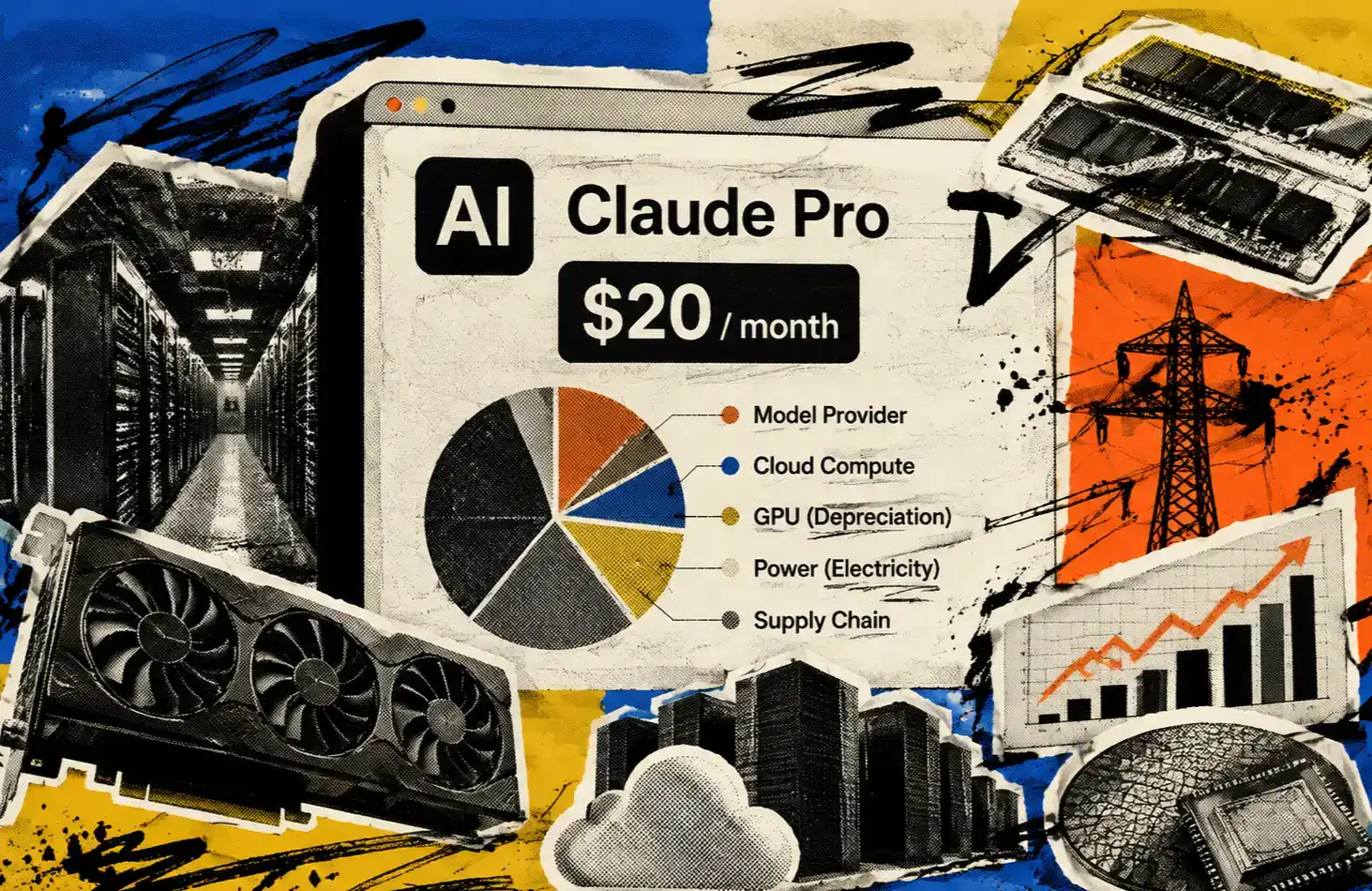
How Much of the Subscription Fee You Pay to Claude Can Optical Module Companies Get?

How much of your $20 Claude Pro subscription actually goes to AI model companies like Anthropic? A viral breakdown image highlights the fundamental valuation challenge for AI applications versus traditional SaaS. Unlike SaaS with high software margins, AI subscriptions face variable "inference costs": every user query consumes GPU time, power, and cloud resources. This creates a tension between fixed subscription fees and usage-driven expenses. While the specific dollar splits are illustrative, the core question is whether AI revenue can achieve SaaS-like margins as usage scales. Currently, infrastructure providers (cloud platforms, GPU makers like Nvidia, HBM suppliers, power/data centers) capture more certain revenue from growing AI usage. Their financials reflect pricing power and faster earnings validation. The bullish case hinges on efficiency improvements: model optimization, caching, smaller models, and custom chips could lower per-token costs over time. The key debate is whether cost declines can outpace increases in user workload complexity and volume. Ultimately, for AI companies to command high SaaS-like valuations, they must demonstrate not just user growth but also improving gross margins after accounting for inference costs. Investors will scrutinize not just subscriber numbers, but usage patterns, enterprise pricing tiers, and real efficiency gains.

marsbitHace 31 min(s)

How Much of the Subscription Fee You Pay to Claude Can Optical Module Companies Get?

marsbitHace 31 min(s)

Trading

Spot
Futuros

Artículos destacados

Qué es ATWO

I. Introducción al ProyectoArena Two es una plataforma interactiva descentralizada que permite a los fanáticos jugar un papel activo y tokenizado en los resultados de eventos en tiempo real. A diferencia de los modelos de transmisión tradicionales que reducen a los fanáticos a espectadores pasivos, Arena Two aprovecha la tecnología blockchain para permitir que los fanáticos voten directamente en tiempo real e influyan en los resultados en el campo.II. Información del TokenNombre del token: ATWO (Arena Two)III. Enlaces RelacionadosSitio web: https://arenatwo.com/Exploradores: https://basescan.org/token/0x499D35eBE6cEe9B2Ac35Fd003fcBbeeB9CFc7B32Twitter: https://x.com/arenatwoXNota: La introducción del proyecto proviene de los materiales publicados o proporcionados por el equipo oficial del proyecto, que es solo para referencia y no constituye asesoramiento de inversión. HTX no se hace responsable de ninguna pérdida directa o indirecta resultante.

183 Vistas totalesPublicado en 2026.05.18Actualizado en 2026.06.02

Qué es ATWO

Cómo comprar ATWO

¡Bienvenido a HTX.com! Hemos hecho que comprar Arena Two (ATWO) sea simple y conveniente. Sigue nuestra guía paso a paso para iniciar tu viaje de criptos.Paso 1: crea tu cuenta HTXUtiliza tu correo electrónico o número de teléfono para registrarte y obtener una cuenta gratuita en HTX. Experimenta un proceso de registro sin complicaciones y desbloquea todas las funciones.Obtener mi cuentaPaso 2: ve a Comprar cripto y elige tu método de pagoTarjeta de crédito/débito: usa tu Visa o Mastercard para comprar Arena Two (ATWO) al instante.Saldo: utiliza fondos del saldo de tu cuenta HTX para tradear sin problemas.Terceros: hemos agregado métodos de pago populares como Google Pay y Apple Pay para mejorar la comodidad.P2P: tradear directamente con otros usuarios en HTX.Over-the-Counter (OTC): ofrecemos servicios personalizados y tipos de cambio competitivos para los traders.Paso 3: guarda tu Arena Two (ATWO)Después de comprar tu Arena Two (ATWO), guárdalo en tu cuenta HTX. Alternativamente, puedes enviarlo a otro lugar mediante transferencia blockchain o utilizarlo para tradear otras criptomonedas.Paso 4: tradear Arena Two (ATWO)Tradear fácilmente con Arena Two (ATWO) en HTX's mercado spot. Simplemente accede a tu cuenta, selecciona tu par de trading, ejecuta tus trades y monitorea en tiempo real. Ofrecemos una experiencia fácil de usar tanto para principiantes como para traders experimentados.

201 Vistas totalesPublicado en 2026.05.18Actualizado en 2026.06.02

Cómo comprar ATWO

Qué es ZEST

I. Introducción al ProyectoEl Protocolo Zest es un protocolo de préstamos en Bitcoin que permite a los proveedores de liquidez de Bitcoin ganar rendimiento en Bitcoin a través de fondos de préstamos gestionados profesionalmente.II. Información del TokenNombre del token: ZEST (Protocolo Zest)III. Enlaces RelacionadosSitio web: https://www.zestprotocol.com/Exploradores: https://bscscan.com/token/0x5506599c722389a60580b5213ea1da60d64754a1Twitter: https://twitter.com/ZestProtocolNota: La introducción al proyecto proviene de los materiales publicados o proporcionados por el equipo oficial del proyecto, que es solo para referencia y no constituye asesoramiento de inversión. HTX no se hace responsable de ninguna pérdida directa o indirecta resultante.

225 Vistas totalesPublicado en 2026.05.19Actualizado en 2026.06.02

Qué es ZEST

Discusiones

Bienvenido a la comunidad de HTX. Aquí puedes mantenerte informado sobre los últimos desarrollos de la plataforma y acceder a análisis profesionales del mercado. A continuación se presentan las opiniones de los usuarios sobre el precio de A (A).

活动图片