DOJ, Europol Freeze $3.5M In Crypto After Dismantling Global Proxy Fraud Network

bitcoinistPublicado a 2026-03-14Actualizado a 2026-03-14

Resumen

US and European authorities dismantled SocksEscort, a global proxy service that used malware (AVrecon) to hijack over 369,000 devices in 163 countries, allowing criminals to hide their locations. The service, operating for years, generated at least $5.7 million from users who paid in cryptocurrency for anonymity. A coordinated law enforcement effort across multiple countries resulted in the seizure of 34 domains, takedown of servers, and freezing of $3.5 million in crypto. The network was linked to various crimes, including a $1 million cryptocurrency theft from a New York resident, bank fraud, and account takeovers.

A New York resident lost close to $1 million in cryptocurrency. That single case became one of the clearest examples of the damage done by SocksEscort — a for-hire proxy service that gave criminals across the globe a way to hide while they stole.

A Network Built On Hijacked Devices

US and European authorities announced Thursday they had shut down SocksEscort after years of operation. The service worked by infecting routers and other internet-connected devices with malware, turning them into cover points that masked the real locations of cybercriminals.

According to the Department of Justice, the network had quietly burrowed into at least 369,000 devices spread across 163 countries. Criminals could then route their attacks through those compromised machines, making them far harder to trace.

The malware at the heart of the operation — known as AVrecon — had been publicly identified by cybersecurity firm Black Lotus Labs as far back as July 2023. The network kept running anyway.
Source: DOJ

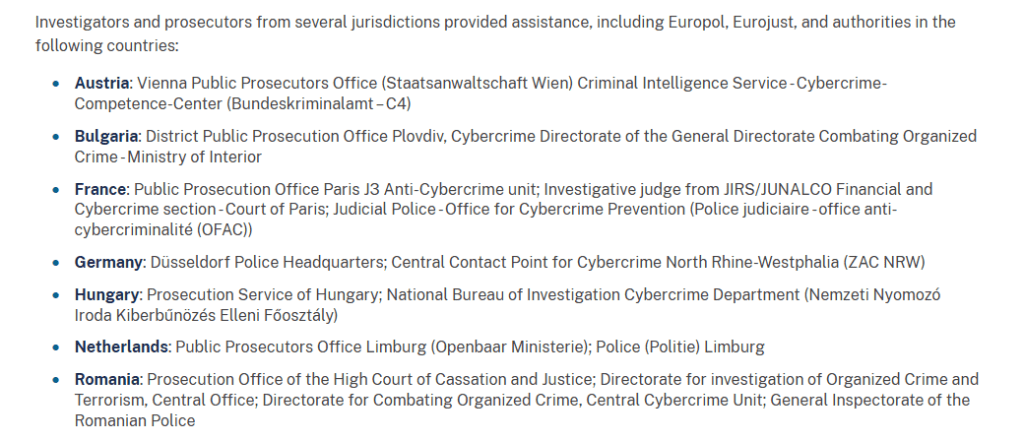
The takedown was not a single agency effort. Law enforcement from Austria, France, Germany, Hungary, the Netherlands, Romania, and the US worked the case together.

On the American side, the FBI’s Sacramento Field Office, the IRS Criminal Investigation Oakland Field Office, and the Department of Defense’s Defense Criminal Investigative Service all had a hand in it.

Europol and Eurojust provided cross-border coordination support. Black Lotus Labs and the nonprofit Shadowserver Foundation supplied technical intelligence that helped investigators connect the dots.

Bitcoin is now trading at $70,541. Chart: TradingView

Criminals Paid In Crypto To Stay Anonymous

SocksEscort did not just attract individual bad actors. It ran like a business. Customers paid to access the service, and they did so anonymously — using cryptocurrency to avoid leaving a financial trail.

Based on reports from Europol, the platform pulled in at least 5 million euros, roughly $5.7 million, from its paying users over the course of its run.

Authorities were ultimately able to seize 34 domains, take down about two dozen servers operating across seven countries, and freeze approximately $3.5 million in crypto tied to the operation.

Europol Executive Director Catherine De Bolle said proxy services of this kind give criminals the cover to carry out attacks, move illegal content, and dodge detection. She credited the international cooperation for exposing the infrastructure behind it.

Fraud Stretched From Bank Accounts To Crypto Wallets

The crimes enabled by SocksEscort went beyond any single method. Officials linked the network to bank fraud and cryptocurrency account takeovers dating back to 2020.

The New York victim’s case stood out for its scale, but reports indicate the damage was spread across multiple countries and target types.

Featured image from Pexels, chart from TradingView

Preguntas relacionadas

QWhat was the name of the proxy service dismantled by US and European authorities?

ASocksEscort

QHow many devices were infected by the malware used in the SocksEscort operation according to the Department of Justice?

AAt least 369,000 devices

QWhat was the name of the malware at the heart of the SocksEscort operation?

AAVrecon

QHow much cryptocurrency was frozen by authorities in connection with the SocksEscort network?

AApproximately $3.5 million

QWhich cybersecurity firm had publicly identified the AVrecon malware as far back as July 2023?

ABlack Lotus Labs

Lecturas Relacionadas

Funding Weekly Report | 14 Public Funding Events, Kalshi Completes $10B New Funding Round at $220B Valuation Led by Coatue Management

Weekly Funding Roundup: 14 Deals and $10.49B+ in Total Funding, Led by Kalshi's $1B Round Last week (5.4-5.10) saw 14 notable funding events in the global blockchain ecosystem, raising over $10.49 billion in total. Key highlights include Kalshi, a prediction market platform, securing a $1 billion round led by Coatue Management, reaching a $22 billion valuation. The platform now boasts ~2 million MAUs and $178B in annualized trading volume. In DeFi, regulated on-chain reinsurer OnRe raised $5 million in Series A funding, and Bitcoin-backed credit protocol Saturn Credit completed a $2 million seed round. For Infrastructure & Tools, OpenTrade raised $17 million to expand its stablecoin yield infrastructure, and RWA platform Balcony secured $12.7 million to deploy its property settlement service in the US. Centralized Finance saw one deal: AI-driven trading platform Stockcoin.ai completed a seed round led by Amber Group. In the prediction market sector alongside Kalshi, AI-powered platform Elastics raised $2 million. Other notable deals include SC Ventures' strategic investment in crypto market maker GSR and Centrifuge securing a "seven-figure" investment from Coinbase to become a core RWA partner for Base. On the investor side, Haun Ventures raised a new $1 billion fund targeting crypto and AI, and Multi Investment raised ~$616 million to focus on blockchain and Web3 investments.

marsbitHace 5 min(s)

Funding Weekly Report | 14 Public Funding Events, Kalshi Completes $10B New Funding Round at $220B Valuation Led by Coatue Management

marsbitHace 5 min(s)

This Week's Key Events Preview | U.S. to Release April CPI Data; U.S. Senate Banking Committee to Review "Digital Asset Market Structure Act of 2025"

Weekly News Preview: Key events for May 12-16 include major economic and crypto industry developments. On Tuesday, May 12, the U.S. will release its April CPI data. Additionally, the gaming blockchain Ronin will begin a 10-hour migration to an Ethereum Layer 2, built on OP Stack with EigenDA for data availability. This aims to leverage Ethereum's security and settle RON's annual inflation below 1%. Base's first independent network upgrade, "Base Azul," is scheduled for mainnet activation on Wednesday, May 13, focusing on security, performance, and developer experience enhancements. Thursday, May 14, sees the U.S. Senate Banking Committee voting on the "Digital Asset Market Structure Act of 2025." In other news, Solana DeFi protocol Carrot will shut down, setting a final withdrawal deadline due to impacts from the Drift exploit. The Moscow Exchange will launch futures trading for Solana, Ripple, and Tron indices (RUB-settled) for qualified investors. Multiple service closures are scheduled for Friday, May 15. Dmail Network will begin winding down due to unsustainable infrastructure costs and failed commercialization. Users must export data before this date. Separately, the Cosmos-based lending blockchain UX Chain will fully shut down. Finally, on Saturday, May 16, gaming infrastructure provider Lattice will wind down operations, with its Redstone Layer 2 network ceasing. Users are urged to withdraw assets, especially from contracts like Uniswap pools, before the shutdown.

链捕手Hace 1 hora(s)

This Week's Key Events Preview | U.S. to Release April CPI Data; U.S. Senate Banking Committee to Review "Digital Asset Market Structure Act of 2025"

链捕手Hace 1 hora(s)

Trading

Spot
Futuros
活动图片





