DOJ Crypto Unit Closure Sparks Scrutiny Of Deputy AG’s Personal Crypto Stakes

bitcoinistPublicado a 2026-01-29Actualizado a 2026-01-29

Resumen

The Justice Department's decision to disband its National Cryptocurrency Enforcement Team (NCET) in April 2025 is under scrutiny from six US senators. They are questioning Deputy Attorney General Todd Blanche about potential conflicts of interest due to his personal cryptocurrency holdings. The senators, including Mazie Hirono and Elizabeth Warren, demand documents and a full explanation for the unit's closure and whether Blanche's finances influenced the decision. Critics argue the timing of his divestment raises ethical concerns, while supporters claim it was approved by ethics officials. The lawmakers are seeking a detailed timeline and records to ensure federal conflict-of-interest laws were followed.

The Justice Department’s move last year to shut a specialized crypto enforcement team is drawing fresh fire after six US senators pressed the deputy attorney general for answers about his personal stakes in digital assets.

The lawmakers say the timing and Deputy Attorney General Todd Blanche’s holdings raise real questions about conflicts that need clear records and a full explanation.

Senators Demand Answers

Reports say the letter, dated January 28, 2026, was sent by Senator Mazie Hirono and joined by Senators Elizabeth Warren, Richard Durbin, Sheldon Whitehouse, Chris Coons, and Richard Blumenthal.

They asked Blanche to provide documents and explain why the National Cryptocurrency Enforcement Team (NCET) was disbanded in April 2025 and whether his own finances played any role in that decision. The lawmakers pointed to federal conflict rules and asked for the timeline and approvals behind the memo.
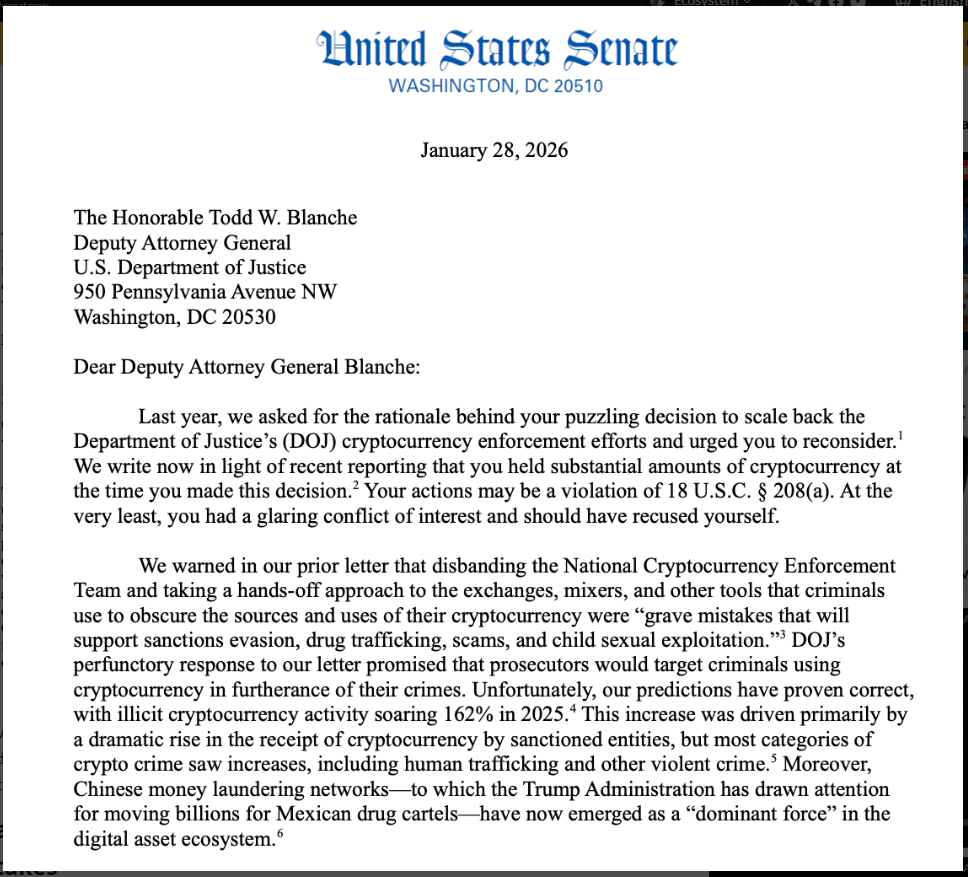
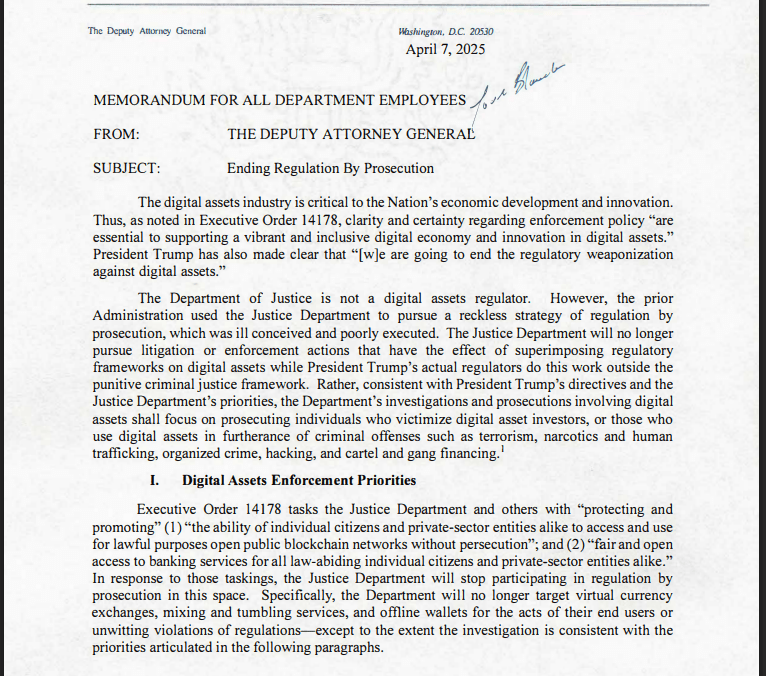
The memo signed by Deputy Attorney General Todd Blanche. Source: DOJ

He agreed to divest, and some sales or transfers happened weeks to months after the memo. Critics say that sequence looks bad and could run afoul of conflict rules; supporters say the matters were cleared by ethics officials.

People On Both Sides Are Talking

Proponents of the policy change argued it would avoid “regulation by prosecution” and let regulators handle oversight instead of criminal cases.

Industry groups welcomed the move as a way to reduce legal uncertainty for exchanges and developers.

Opponents, including the senators, say scaling back a focused enforcement unit risks leaving gaps that bad actors can exploit, especially as illicit activity in crypto has shown sharp swings in recent years.

BTCUSD now trading at $87,783. Chart: TradingView

What Comes Next

Lawmakers are now pushing for documents and sworn answers. They want to see when Blanche learned of the holdings, how fast divestment happened, and who inside DOJ reviewed and approved the memo.

The senators pointed to federal law that bars an official from participating in a matter when they have a financial interest, and they requested a timeline and supporting records to judge whether that law was respected.

Featured image from Getty Images, chart from TradingView

Preguntas relacionadas

QWhat action by the US senators has brought renewed scrutiny to the closure of the DOJ's crypto enforcement team?

ASix US senators, led by Senator Mazie Hirono, sent a letter to Deputy Attorney General Todd Blanche pressing him for answers about his personal cryptocurrency holdings and the decision to disband the National Cryptocurrency Enforcement Team (NCET).

QWhat specific concerns did the senators raise regarding Deputy AG Todd Blanche?

AThe senators raised concerns about a potential conflict of interest, questioning whether Blanche's personal financial stakes in digital assets played a role in the decision to shut down the NCET and if the timing of his divestment complied with federal conflict-of-interest rules.

QWhat was the main argument from proponents who supported the policy change of closing the NCET?

AProponents argued that closing the specialized crypto enforcement team would avoid 'regulation by prosecution' and allow regulators, rather than criminal prosecutors, to handle oversight of the cryptocurrency industry.

QAccording to the article, what is the primary concern of the senators and other opponents of closing the NCET?

AOpponents are concerned that scaling back the focused enforcement unit creates gaps that bad actors can exploit, especially given the volatile nature of illicit activity in the cryptocurrency space in recent years.

QWhat specific information are the lawmakers demanding from Deputy AG Blanche and the DOJ?

AThe lawmakers are demanding documents and sworn answers detailing when Blanche learned of his crypto holdings, the timeline of his divestment, and which DOJ officials reviewed and approved the memo to disband the NCET, to ensure compliance with federal conflict-of-interest laws.

Lecturas Relacionadas

The Era Has Arrived Where Human Writers Must Prove They Are Not Machines

The article describes an era where AI-generated content is flooding the market, forcing human authors to prove they are not machines. It begins with the example of dozens of AI-written, error-ridden biographies of Henry Kissinger appearing on Amazon within hours of his death, a pattern repeated for other deceased celebrities and even living experts who find fraudulent books under their names. This spam content has exploded, with monthly new book releases on platforms like Amazon reaching 300,000 by late 2025. The issue spans genres, from suspiciously high proportions of AI-written teen romance and self-help books to dangerous, AI-generated foraging guides containing lethal advice. The platforms' automated review systems, designed to catch plagiarism and banned words, are ill-equipped to detect AI-generated text that avoids these pitfalls while being nonsensical or fraudulent. The problem has infiltrated traditional publishing. A major publisher, Hachette, had to recall a bestselling horror novel after AI detection tools suggested 78% of its content was machine-generated. An acclaimed European philosophy book was later revealed to be entirely written by AI under a fake author persona. In response, authors are fighting back. At the 2026 London Book Fair, 10,000 writers published a blank book titled "Don't Steal This Book" containing only their signatures—using emptiness as a protest weapon in an age of AI overproduction. Initiatives like the "Human Author Certification" program have emerged, ironically placing the burden on humans to prove their work is not machine-made. The article warns of a vicious cycle: AI-generated low-quality books pollute the data used to train future AI models, leading to "model collapse" and an ever-worsening flood of digital waste, eroding trust in publishing and devaluing human creativity.

marsbitHace 16 min(s)

The Era Has Arrived Where Human Writers Must Prove They Are Not Machines

marsbitHace 16 min(s)

The King of Blind Date Attire in Korea: How SK Hynix Made a Comeback Against Samsung?

In South Korea's dating scene, SK Hynix employees are now highly sought after, a status shift fueled by the company's astronomical profits and employee bonuses, projected to reach up to 6.1 million RMB per person by 2027. This marks a dramatic reversal for the long-time second-place player in memory semiconductors, which has now surpassed its rival Samsung in annual operating profit. The turnaround story began in 2008 when a struggling Hynix, emerging from bankruptcy restructuring, took a risky bet by agreeing to develop High Bandwidth Memory (HBM) with AMD. At the time, HBM had no clear market beyond high-end graphics cards and was a costly, complex technology. Major players like Samsung, pursuing its own HMC technology, declined. For Hynix, with only memory as its core business, it was a gamble born of necessity. The pivotal moment came in 2012 when SK Group Chairman Chey Tae-won acquired Hynix. Defying industry downturns, he invested heavily in R&D and fabrication, sustaining the HBM project through over a decade of commercial uncertainty and internal challenges. A key break occurred around 2016-2017 when Samsung faced production issues supplying HBM2 for Google's TPU, allowing SK Hynix to gain a crucial foothold in the data center market. The AI explosion post-ChatGPT in 2022 was the catalyst, turning HBM into a critical bottleneck for AI accelerators like NVIDIA's GPUs. By 2025, SK Hynix captured 62% of the global HBM market, leaving Samsung at 17%. For the first time, its annual operating profit exceeded Samsung's. Analysts point to the "innovator's dilemma" to explain Samsung's miss: its vast, successful business portfolio made it risk-averse, preventing an all-in bet on the initially niche HBM technology. In contrast, SK Hynix, as a challenger with its back against the wall, had no choice but to commit fully. The story highlights how Korea's chaebol system allows for ultra-long-term bets beyond quarterly pressures. However, SK Hynix's lead isn't guaranteed. Samsung is aggressively catching up on HBM4, and challenges like customer concentration (heavy reliance on NVIDIA) and technical hurdles in advanced packaging remain. The narrative underscores a market truth: the greatest alpha often comes from betting on uncertain, long-term directions others dismiss, much like HBM in 2008.

marsbitHace 56 min(s)

The King of Blind Date Attire in Korea: How SK Hynix Made a Comeback Against Samsung?

marsbitHace 56 min(s)

Trading

Spot
Futuros

Artículos destacados

Cómo comprar MOVE

¡Bienvenido a HTX.com! Hemos hecho que comprar Movement (MOVE) sea simple y conveniente. Sigue nuestra guía paso a paso para iniciar tu viaje de criptos.Paso 1: crea tu cuenta HTXUtiliza tu correo electrónico o número de teléfono para registrarte y obtener una cuenta gratuita en HTX. Experimenta un proceso de registro sin complicaciones y desbloquea todas las funciones.Obtener mi cuentaPaso 2: ve a Comprar cripto y elige tu método de pagoTarjeta de crédito/débito: usa tu Visa o Mastercard para comprar Movement (MOVE) al instante.Saldo: utiliza fondos del saldo de tu cuenta HTX para tradear sin problemas.Terceros: hemos agregado métodos de pago populares como Google Pay y Apple Pay para mejorar la comodidad.P2P: tradear directamente con otros usuarios en HTX.Over-the-Counter (OTC): ofrecemos servicios personalizados y tipos de cambio competitivos para los traders.Paso 3: guarda tu Movement (MOVE)Después de comprar tu Movement (MOVE), guárdalo en tu cuenta HTX. Alternativamente, puedes enviarlo a otro lugar mediante transferencia blockchain o utilizarlo para tradear otras criptomonedas.Paso 4: tradear Movement (MOVE)Tradear fácilmente con Movement (MOVE) en HTX's mercado spot. Simplemente accede a tu cuenta, selecciona tu par de trading, ejecuta tus trades y monitorea en tiempo real. Ofrecemos una experiencia fácil de usar tanto para principiantes como para traders experimentados.

246 Vistas totalesPublicado en 2024.12.13Actualizado en 2025.03.21

Cómo comprar MOVE

Discusiones

Bienvenido a la comunidad de HTX. Aquí puedes mantenerte informado sobre los últimos desarrollos de la plataforma y acceder a análisis profesionales del mercado. A continuación se presentan las opiniones de los usuarios sobre el precio de MOVE (MOVE).

活动图片













