Dogecoin Whales Remain Quiet, What’s Going On And Is DOGE At Risk?

bitcoinistPublicado a 2026-01-09Actualizado a 2026-01-09

Resumen

Dogecoin started 2026 with a significant price surge, briefly reclaiming the $0.15 level after a bearish end to 2025. However, on-chain data reveals that mega whales (holders of 100M-1B DOGE) remained largely inactive during this rally, even reducing their holdings slightly. In contrast, smaller "shark" wallets (10M-100M DOGE) and mid-sized holders (1M-10M DOGE) were the primary accumulators, driving the buying pressure and increased trading volume. Despite the initial jump, DOGE has since pulled back to $0.1424, facing continued resistance at $0.15. The lack of participation from the largest whales introduces uncertainty into the meme coin's near-term outlook.

Dogecoin didn’t ease into 2026 quietly. Following several weeks of drifting and bearish price action at the end of last year, the memecoin suddenly picked up speed, jumping in the first few days of January and briefly reclaiming levels above $0.15. However, on-chain data shows that Dogecoin’s mega whales did not have a hand in the rally. These large Dogecoin holders have mostly stayed on the sidelines, avoiding both heavy buying and selling.

Dogecoin’s Whales Quiet During Recent Price Action

Dogecoin began the week with a quick burst of upside that carried the price from below $0.12 into mid-$0.15. Trading activity picked up during the move, and there was genuine buying interest. During this period, Dogecoin’s trading volume nearly tripled those seen during the last days of December, with notable examples of $3.56 billion trading volume on January 2 and $2.34 billion on January 4.

This intense trading activity briefly placed the Dogecoin price above $0.15 on January 5, a price level that has served as a resistance level that stopped the meme coin’s price action throughout December 2025. However, an interesting detail from recent on-chain analysis is how little large holders reacted to the price rally.

According to data from on-chain analytics platform Santiment, Dogecoin addresses holding 100 million to 1 billion DOGE saw their collective holdings increase into January 4, peaking around 35.8 billion DOGE, before a decline beginning on January 5.

Starting on January 5, this group began trimming exposure, and even as Dogecoin’s price action continued climbing to the $0.15 level, their combined holdings fell to roughly 34.59 billion DOGE by January 6. Since then, balances in this cohort have largely remained flat.
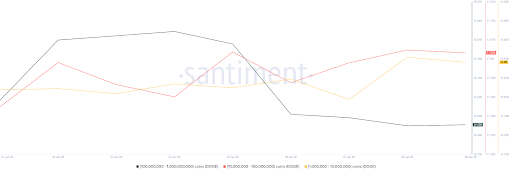
Dogecoin Large Holder Distribution. Source: Santiment

Sharks Doing Most Of The Bullish Work

On the other hand, Dogecoin sharks, i.e., wallets holding between 10 million and 100 million DOGE showed a much stronger appetite. After a brief pullback between January 2 and January 4, this group returned to accumulation during Dogecoin’s push higher. That buying trend has continued through the rest of the week, lifting their collective holdings to about 17.63 billion DOGE at the time of writing.

Smaller large holders in the 1 million to 10 million DOGE range followed a similar pattern, though with more hesitation early on. Activity in this group increased at the start of the week, followed by a dip around January 7. That decline was short-lived, however, as balances rebounded on January 8 and 9, rising to roughly 10.9 billion DOGE at the time of writing.

As it stands, Dogecoin’s price action seems to be taking a pause from the rally and is back to facing resistance at $0.15. The meme coin is now trading at $0.1424, and the lack of clear commitment from large whales is also keeping the outlook uncertain.

DOGE price fails to hold up | Source: DOGEUSDT on Tradingview.com

Preguntas relacionadas

QWhat was the initial price movement of Dogecoin at the beginning of January 2026?

ADogecoin suddenly picked up speed, jumping in the first few days of January and briefly reclaiming levels above $0.15.

QHow did the trading volume of Dogecoin change during the price surge?

ADogecoin's trading volume nearly tripled compared to the last days of December, with notable examples of $3.56 billion on January 2 and $2.34 billion on January 4.

QWhat was the behavior of Dogecoin mega whales (addresses holding 100 million to 1 billion DOGE) during the rally?

AThey mostly stayed on the sidelines, avoiding both heavy buying and selling. Their collective holdings peaked around 35.8 billion DOGE on January 4 before declining to roughly 34.59 billion DOGE by January 6.

QWhich group of Dogecoin holders showed the strongest buying appetite during the price increase?

ADogecoin sharks (wallets holding between 10 million and 100 million DOGE) showed a much stronger appetite and returned to accumulation during Dogecoin's push higher.

QWhat is Dogecoin's current price and key resistance level mentioned in the article?

ADogecoin is trading at $0.1424 and is facing resistance at the $0.15 level.

Lecturas Relacionadas

Michael Saylor: 110 Reasons to Oppose BIP-110

Michael Saylor presents 110 arguments against Bitcoin Improvement Proposal (BIP) 110, a soft fork aimed at restricting certain non-monetary data storage uses (like inscriptions) on the Bitcoin blockchain. He acknowledges the proponents' valid concerns—such as node costs, fee pressure, and preserving Bitcoin's monetary focus—but fundamentally disagrees with the proposed solution. Saylor argues that BIP 110 represents a dangerous precedent of using consensus rules to enforce value judgments on transaction validity, moving away from Bitcoin's core principles of neutrality and permissionless innovation. His key objections are organized into eleven categories: 1) It violates neutrality and hard consensus by banning currently valid transactions. 2) It fails to meet the high burden of proof required for a consensus change, lacking concrete data on the alleged crisis. 3) Its seven bundled technical restrictions are overly broad, targeting generic script functionalities and blocking future upgrade paths. 4) It sacrifices compatibility and future optionality by closing off designed upgrade hooks. 5) Its temporary rules add significant complexity (grandfathering, expiry states) without sufficient justification. 6) The economic and security impacts, particularly on miner revenue and fee markets, are uncertain and unmodeled. 7) Superior, market-based tools (fee markets, relay/mining policies) already exist to manage blockchain load. 8) It stifles innovation by creating a chilling effect for developers. 9) Its modified activation mechanism (55% threshold, forced signaling) is aggressive and risks network splits. 10) The precedent it sets—using consensus to suppress disliked but legal uses—is more dangerous than the problem it aims to solve. 11) A better path exists: improving measurements, refining resource-based policies, and allowing market forces to work. Saylor concludes that Bitcoin's strength lies in its neutral rules, open markets, and hard consensus. Changing these foundational elements to target specific use cases is an unnecessary and risky "iatrogenic" intervention. He advocates for guarding Bitcoin's neutrality rather than acting as its redeemer.

marsbitHace 10 min(s)

Michael Saylor: 110 Reasons to Oppose BIP-110

marsbitHace 10 min(s)

Trading

Spot
活动图片


