Digital asset ETPs post third straight week of net inflows, led by US demand

cointelegraphPublished on 2025-12-15Last updated on 2025-12-15

Abstract

Digital asset exchange-traded products (ETPs) recorded $864 million in net inflows for the third consecutive week, driven primarily by U.S. demand, according to CoinShares. Bitcoin products led with $522 million in inflows, while Ether saw $338 million. Solana and XRP also attracted significant inflows of $65 million and $46.9 million, respectively. The U.S., Germany, and Canada accounted for the majority of regional inflows, while Switzerland posted outflows. Year-to-date, Bitcoin has attracted $27.7 billion, though still below 2024 levels. Multi-asset crypto ETPs and blockchain equity funds saw mixed flows during the period.

Crypto exchange-traded products (ETPs) recorded about $864 million in inflows last week, according to a report on Monday by European digital asset manager CoinShares.

The United States led regional inflows with about $796 million, followed by Germany with roughly $68.6 million and Canada with about $26.8 million. Together, the three countries account for approximately 98.6% of year-to-date (YTD) inflows into digital asset investment products.

Switzerland-listed crypto ETPs recorded about $41.4 million in weekly outflows, while YTD net flows were about $622.4 million, according to the data.
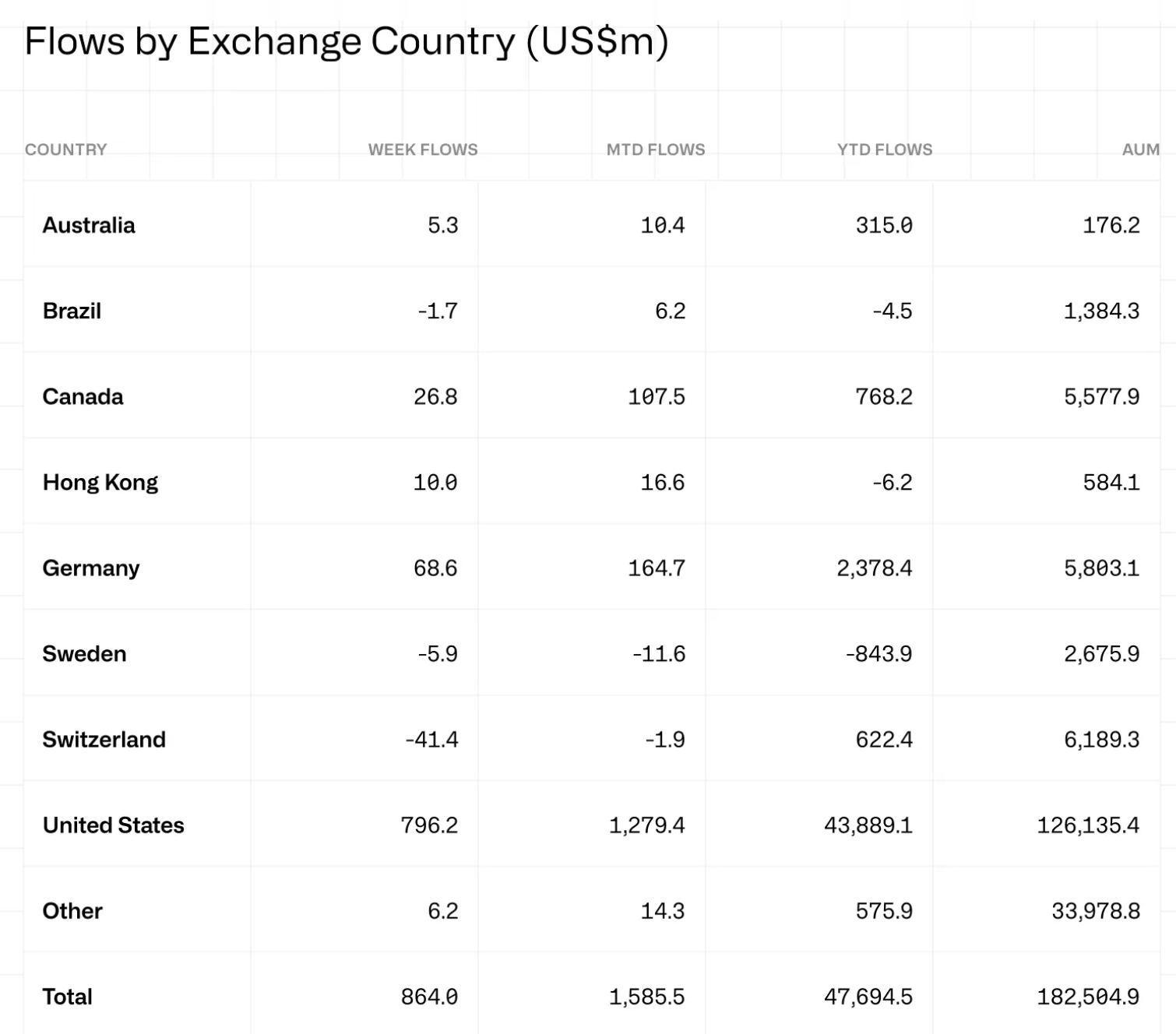
Flows by Exchange Country (US$m). Source: CoinShares’ Report

Bitcoin and Ether dominate inflows, followed by Solana and XRP

Bitcoin (BTC) investment products recorded about $522 million in weekly inflows, while short-Bitcoin products posted roughly $1.8 million in net outflows, “signalling a recovery in sentiment,” according to the report.

Ether (ETH) saw approximately $338 million in inflows during the week, lifting YTD to about $13.3 billion, up 148% from 2024.

Beyond Bitcoin and Ether, Solana (SOL) investment products recorded about $65 million in weekly inflows, bringing YTD inflows to roughly $3.46 billion, a tenfold increase from last year.

XRP (XRP) products also attracted fresh capital, with approximately $46.9 million added during the week and about $3.18 billion in inflows accumulated YTD, according to the data.

Smaller-cap products saw more mixed results, with Aave (AAVE)-linked products recording about $5.9 million in weekly inflows and Chainlink (LINK) adding roughly $4.1 million. Hyperliquid (HYPE) products posted net outflows of around $14.1 million during the period.

This is the third consecutive week of inflows for crypto ETPs, following about $716 million in inflows last week and roughly $1 billion the week before.

Bitcoin has attracted around $27.7 billion YTD, still below the $41 billion it recorded in 2024.

Related: XRP sinks below $2 despite $1B in ETF inflows: How low can price go?

Assets under management and equity ETP flows

By assets under management, Bitcoin investment products hold about $141.8 billion, while Ether-linked products account for roughly $26 billion.

Outside of single-asset products, multi-asset crypto ETPs recorded about $104.9 million in weekly outflows, extending net redemptions to roughly $69.5 million YTD, despite holding approximately $6.8 billion in assets under management, according to the data.
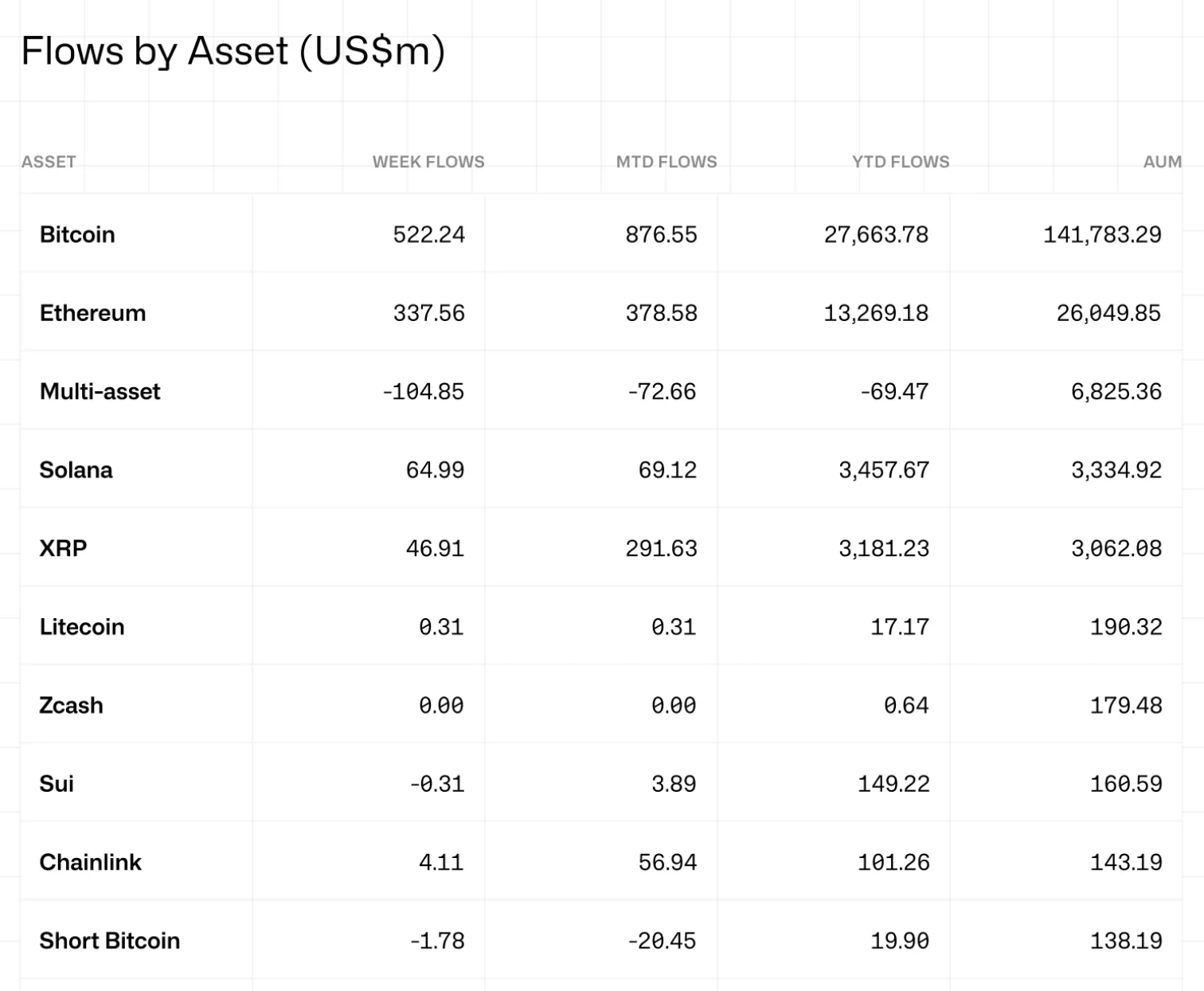
Crypto ETP USD flows by asset. Source: CoinShares

Funds that invest in publicly traded blockchain-related companies saw mixed investor flows during the week. VanEck’s Digital Transformation fund posted the largest weekly inflow at about $45.8 million, followed by VanEck Crypto and Blockchain at roughly $20.5 million and Schwab’s Crypto Thematic ETF at about $7.2 million.

Invesco CoinShares’ Global Blockchain and Bitwise Crypto Industry Innovators ETPs recorded modest net outflows during the week.
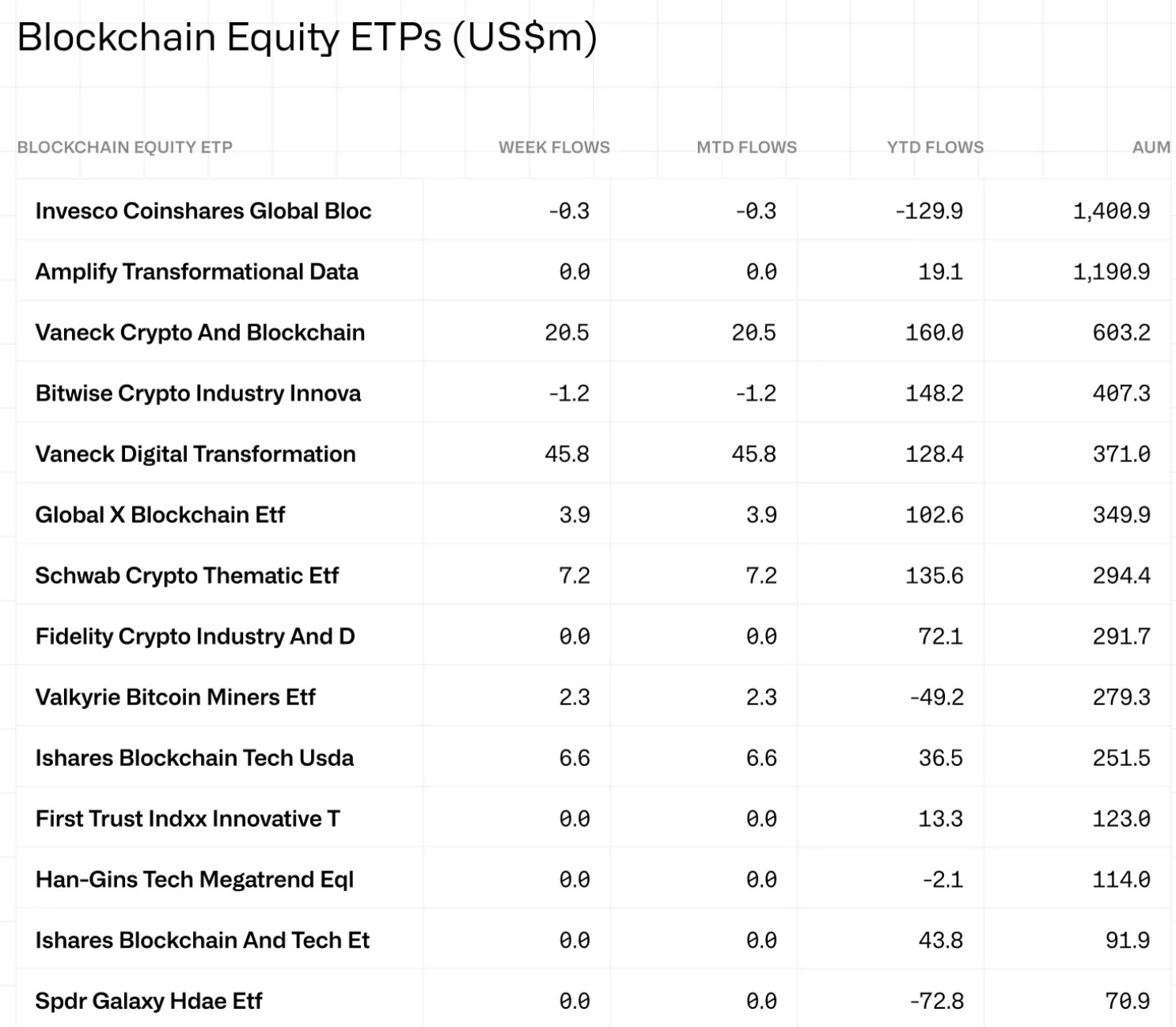
Blockchain Equity ETPs. Source: CoinShares’

Magazine: Big questions: Would Bitcoin survive a 10-year power outage?

Related Reads

2025 Year-End Final Exam: Crypto Asset Allocation Guide After the FOMC Decision

Crypto markets face a critical juncture in late 2025. Bitcoin hovers near $90,000, with the Fear & Greed Index at 25 (Extreme Fear) and short-term holder capitulation at historic highs. The December FOMC meeting delivered an expected 25bps rate cut but adopted a hawkish tone, projecting only one more cut in 2026, causing a brief BTC sell-off. However, the Fed also initiated a $40B/month Reserve Management Purchases (RMP) plan, a form of "stealth QE" injecting liquidity. Key themes emerge: - **Macro Impact**: Hawkish guidance creates short-term pressure, but ending QT and launching RMP set the stage for a 2026 liquidity surge, historically bullish for crypto. - **Institutional Shift**: 2025 marked a pivot to institutional dominance. While BTC remains core, portfolios are diversifying into ETH, Solana, stablecoins, and tokenized real-world assets (RWA). Pension and sovereign wealth funds are increasing exposure. - **Historical Pattern & On-Chain Data**: A potential "Santa Low-Chinese New Year Rally" pattern is anticipated due to seasonal liquidity shifts. On-chain metrics signal a likely bottom: massive STH capitulation, declining exchange reserves, and valuation indicators (MVRV Z-Score, Puell Multiple) in historic buy zones. The confluence of extreme fear, strong underlying accumulation signals, and impending macro liquidity shifts presents a strategic entry point for long-term investors, framing the current pullback as a mid-cycle correction within a broader upward trend.

marsbitHace 16 min(s)

2025 Year-End Final Exam: Crypto Asset Allocation Guide After the FOMC Decision

marsbitHace 16 min(s)

Why Does Hyperliquid Earn Less Than Coinbase?

Hyperliquid, a decentralized exchange, processes near-Nasdaq-level perpetual trading volumes but captures significantly lower fees compared to centralized platforms like Coinbase and Robinhood. While Hyperliquid cleared $205.6 billion in notional volume over 30 days, it generated only $80.3 million in fees—an effective take rate of ~3.9 bps. In contrast, Coinbase and Robinhood achieve take rates of ~35.5 bps and ~33.5 bps, respectively, by operating as retail brokers that monetize multiple layers: distribution, balances, subscriptions, and order flow. This gap stems from a structural difference: Hyperliquid positions itself as a low-fee *market layer* (like Nasdaq), providing high-throughput execution and清算 infrastructure, while brokers like Coinbase control user relationships and extract value through higher-margin activities. Hyperliquid’s model includes permissionless distributor frontends (Builder Codes) and product deployment (HIP-3), which drive ecosystem growth but also create long-term fee compression risks by outsourcing high-value distribution. To defend its economics, Hyperliquid is taking steps to retain distribution control, integrate HIP-3 markets natively, and introduce balance-driven revenue streams like USDH (a native stablecoin with 50% reserve收益 sharing) and portfolio margin (10% interest fee on borrows). These moves aim to shift its model from pure exchange-level execution toward a hybrid approach that captures broker-like profit pools—without sacrificing its core infrastructure advantages. The key challenge remains balancing open ecosystem growth with tighter economic integration to avoid being commoditized as a wholesale execution venue.

marsbitHace 26 min(s)

Why Does Hyperliquid Earn Less Than Coinbase?

marsbitHace 26 min(s)

Trading

Spot
Futures

Discussions

Welcome to the HTX Community. Here, you can stay informed about the latest platform developments and gain access to professional market insights. Users' opinions on the price of US (US) are presented below.

活动图片