Did Vitalik Buterin Just Kill Ethereum Layer-2s? Here’s What He Said

bitcoinistPublicado a 2026-02-05Actualizado a 2026-02-05

Resumen

Vitalik Buterin is reframing the narrative around Ethereum's layer-2s, arguing that the original vision of L2s as "branded shards" primarily for scaling no longer fits current realities. With low L1 fees and an expected gas limit increase in 2026, he states Ethereum is scaling on its own, reducing the need for L2s solely for capacity. Buterin highlights that many L2s are slow to reach "stage 2" decentralization and some may never intend to, due to technical challenges or regulatory requirements that demand ultimate control. He proposes a spectrum model where L2s offer varying levels of security and trust, rather than uniformly claiming to "scale Ethereum." Buterin advises L2 teams to differentiate through features like specialized execution, privacy, or ultra-low latency, rather than scaling alone. He emphasizes the importance of "stage 1" security for handling ETH or Ethereum-based assets and advocates for a native ZK-EVM precompile to simplify trustless interoperability and synchronous composability. Buterin concludes that while some chains will remain trust-dependent, the focus should be on clear user guarantees and base-layer strength, shifting competition from scaling to proving credible offerings.

Vitalik Buterin is signaling a major reframing of Ethereum’s layer-2 narrative: not the death of rollups, but the end of the idea that L2s are shards whose primary job is scaling the network. With L1 fees now low and gas limit projected to rise sharply in 2026, he argues the rollup-centric roadmap’s original premise no longer fits the reality on the ground.

Buterin opened his X post on Feb. 3 by pointing to two pressures that have been building in parallel: L2s have moved to “stage 2” far more slowly than expected, and Ethereum mainnet is scaling in its own right. In his telling, those trends break the old mental model in both directions.

“Ethereum needs to scale,” he wrote, recapping what he framed as the original thesis. “The definition of ‘Ethereum scaling’ is the existence of large quantities of block space that is backed by the full faith and credit of Ethereum... block space where, if you do things (including with ETH) inside that block space, your activities are guaranteed to be valid, uncensored, unreverted, untouched, as long as Ethereum itself functions. If you create a 10000 TPS EVM where its connection to L1 is mediated by a multisig bridge, then you are not scaling Ethereum.”

The punchline is blunt: “This vision no longer makes sense.” Buterin says L1 doesn’t need L2s to serve as “branded shards” if base-layer capacity is expanding, and he’s increasingly skeptical that many L2s either can or want to meet the security and control expectations that label implies. He pointed to at least one L2 that, in his words, “may never want to go beyond stage 1,” citing not only technical concerns around ZK-EVM safety but also customer-driven regulatory requirements that “require them to have ultimate control.”

Ethereum Layer-2’s Need To Change

That’s not presented as an indictment so much as a categorization shift. If an L2 retains ultimate control, it may still be a valid product for its users, Buterin suggested, but it shouldn’t be marketed as “scaling Ethereum” in the strict sense envisioned by the rollup-centric roadmap. In that context, he argues, “we should stop thinking about L2s as literally being ‘branded shards’, with the social status and responsibilities that this entails.”

Instead, he sketches a spectrum model: some L2s can be tightly backed by ETH’s security guarantees, while others can be looser and more optional depending on user needs. That spectrum framing implicitly makes room for app-specific chains, different trust models, and non-EVM environments—without forcing them into a single “rollup as shard” storyline.

For L2 teams, Buterin’s guidance is straightforward: stop anchoring your identity on scaling alone. If you’re handling ETH or Ethereum-issued assets, he argues “stage 1 at the minimum” matters; otherwise, you’re effectively operating as “just a separate L1 with a bridge.” The real differentiator, in his view, should be features and properties that a larger L1 still won’t provide—whether that’s specialized execution environments, privacy, sequencing characteristics like ultra-low latency, or non-financial use cases.

Buterin says he’s become “more convinced of the value of the native rollup precompile,” especially once Ethereum has enshrined the ZK-EVM proof verification it “need[s] anyway to scale L1.” The idea is a protocol-level precompile that verifies ZK-EVM proofs and is treated as part of Ethereum itself, meaning it would “auto-upgrade along with Ethereum,” and if it shipped with a bug, “Ethereum will hard-fork to fix the bug.”

That last point is the subtext: he wants a path where trustless verification and interoperability are easier to achieve without a “security council,” and where rollups can add custom features while still anchoring their EVM correctness directly to Ethereum. He also tied this direction to the prospect of synchronous composability: transactions that can safely span L1 and L2 liquidity with tight coupling, referencing ongoing research on combining preconfirmations with based rollups and real-time proving.

Buterin’s conclusion leaves room for uncomfortable outcomes. A permissionless ecosystem will produce chains with “trust-dependent, or backdoored, or otherwise insecure” elements, he wrote, calling that “unavoidable.” The job, as he frames it, is to make guarantees legible to users while strengthening Ethereum’s base layer, suggesting that the next phase of L2 competition may be less about who “scales Ethereum,” and more about who can credibly define, and prove, what they’re actually offering.

At press time, ETH traded at $2,256.
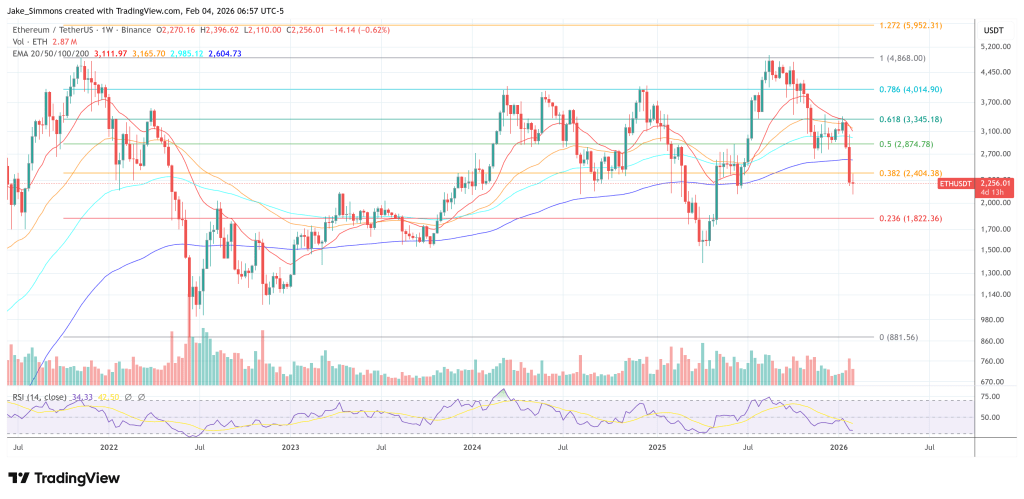
ETH remains below between the 0.382 Fib, 1-week chart | Source: ETHUSDT on TradingView.com

Preguntas relacionadas

QWhat is the main shift in Ethereum's layer-2 narrative that Vitalik Buterin is signaling?

AHe is reframing the narrative away from viewing L2s as 'shards' whose primary purpose is scaling, arguing that this vision no longer makes sense given low L1 fees and Ethereum's own scaling progress.

QAccording to Buterin, what is the original definition of 'Ethereum scaling' that he now says is outdated?

AThe original definition was the existence of large quantities of block space backed by the full faith and credit of Ethereum, guaranteeing activities are valid, uncensored, and unreverted as long as Ethereum functions.

QWhat new model does Buterin propose for categorizing Layer-2 solutions?

AHe proposes a spectrum model where some L2s are tightly backed by Ethereum's security, while others can be looser and more optional, making room for different trust models and use cases without forcing them into a single 'rollup as shard' storyline.

QWhat technical solution does Buterin express increased conviction in for the future of rollups?

AHe is more convinced of the value of a 'native rollup precompile,' a protocol-level feature that would verify ZK-EVM proofs and be treated as part of Ethereum itself, auto-upgrading with the main chain.

QWhat does Buterin suggest should be the real differentiator for L2 teams instead of just scaling?

AHe suggests the real differentiator should be features and properties that a larger L1 won't provide, such as specialized execution environments, privacy, ultra-low latency sequencing, or non-financial use cases.

Lecturas Relacionadas

Why Hasn't the U.S. Seen the Rise of 'Huabei' or 'Jiebei'?

The article explores why the U.S. lacks large-scale consumer credit products like China's "Huabei" and "Jiebei," despite having a developed financial sector. Key reasons include: 1. **Structural Barriers**: A fragmented federal and state regulatory system, reinforced by post-2008 reforms like the Dodd-Frank Act, raises compliance costs and protects traditional banks, stifling fintech innovation. 2. **Credit Card Dominance**: Credit cards, used by 70-80% of adults, form a $1.28 trillion debt market with high APRs (avg. 22.3%). This system cross-subsidizes users who pay in full with those carrying balances, creating a predatory yet entrenched ecosystem. 3. **Data Privacy Laws**: Strict regulations (e.g., FCRA, CCPA) prevent tech giants from leveraging behavioral data for credit scoring, unlike in China where such data fuels fintech models. 4. **Capital Market Disincentives**: Wall Street penalizes tech firms entering finance due to lower valuations associated with heavy regulation and risk, as seen in Apple’s failure with Apple Card. 5. **Banking Oligopoly**: Major banks control consumer lending, leveraging lobbying power and consumer habits to maintain high-cost credit, while alternatives like payday loans (400% APR) or "unbanked" services remain niche or exploitative. Ultimately, regulatory, structural, and corporate interests collectively block the emergence of accessible, low-cost digital lending in the U.S.

Odaily星球日报Hace 8 min(s)

Why Hasn't the U.S. Seen the Rise of 'Huabei' or 'Jiebei'?

Odaily星球日报Hace 8 min(s)

More and More 'Model Supermarkets' Are Opening: ByteDance, Alibaba, and Tencent Compete to Integrate

Chinese tech giants like ByteDance, Alibaba, and Tencent are accelerating the rollout of integrated AI model subscription services—dubbed “model supermarkets”—to provide developers with bundled access to multiple leading domestic large language models (LLMs). ByteDance’s Volcengine recently upgraded its "Coding Plan" by adding newer models like GLM-5.1, Minimax M2.7, and Kimi k2.6, allowing subscribers to use various top models under a single monthly fee starting at ¥40. However, user feedback reveals significant issues, including rapid consumption of usage limits (e.g., hitting caps within hours), frequent server errors (like HTTP 429), and slow response times during peak hours. Complaints about misleading deduction rates—where calls to advanced models consume more quota—are also common. The trend is industry-wide: Alibaba, Tencent, and Baidu have all launched similar multi-model coding plans. While these platforms reduce trial costs for developers, they also expose challenges in balancing affordability with service quality and computational stability. Amid this shift, independent AI companies like Zhipu, MiniMax, and Moonlight Face (Kimi) are developing strategies to avoid becoming mere “pipes” in this ecosystem—focusing on vertical applications, autonomous agents, and long-context models to retain competitiveness. Analysts suggest that, while platform aggregation may pressure model firms in the short term, specialized and vertical AI capabilities will remain differentiated in the long run.

marsbitHace 12 min(s)

More and More 'Model Supermarkets' Are Opening: ByteDance, Alibaba, and Tencent Compete to Integrate

marsbitHace 12 min(s)

Trading

Spot
Futuros

Artículos destacados

Cómo comprar LAYER

¡Bienvenido a HTX.com! Hemos hecho que comprar Solayer (LAYER) sea simple y conveniente. Sigue nuestra guía paso a paso para iniciar tu viaje de criptos.Paso 1: crea tu cuenta HTXUtiliza tu correo electrónico o número de teléfono para registrarte y obtener una cuenta gratuita en HTX. Experimenta un proceso de registro sin complicaciones y desbloquea todas las funciones.Obtener mi cuentaPaso 2: ve a Comprar cripto y elige tu método de pagoTarjeta de crédito/débito: usa tu Visa o Mastercard para comprar Solayer (LAYER) al instante.Saldo: utiliza fondos del saldo de tu cuenta HTX para tradear sin problemas.Terceros: hemos agregado métodos de pago populares como Google Pay y Apple Pay para mejorar la comodidad.P2P: tradear directamente con otros usuarios en HTX.Over-the-Counter (OTC): ofrecemos servicios personalizados y tipos de cambio competitivos para los traders.Paso 3: guarda tu Solayer (LAYER)Después de comprar tu Solayer (LAYER), guárdalo en tu cuenta HTX. Alternativamente, puedes enviarlo a otro lugar mediante transferencia blockchain o utilizarlo para tradear otras criptomonedas.Paso 4: tradear Solayer (LAYER)Tradear fácilmente con Solayer (LAYER) en HTX's mercado spot. Simplemente accede a tu cuenta, selecciona tu par de trading, ejecuta tus trades y monitorea en tiempo real. Ofrecemos una experiencia fácil de usar tanto para principiantes como para traders experimentados.

248 Vistas totalesPublicado en 2025.02.11Actualizado en 2025.03.21

Cómo comprar LAYER

Discusiones

Bienvenido a la comunidad de HTX. Aquí puedes mantenerte informado sobre los últimos desarrollos de la plataforma y acceder a análisis profesionales del mercado. A continuación se presentan las opiniones de los usuarios sobre el precio de LAYER (LAYER).

活动图片