Did Maduro Really Hide $60 Billion in BTC?

marsbitPublicado a 2026-01-06Actualizado a 2026-01-06

Resumen

The article investigates the unverified claim that former Venezuelan President Nicolás Maduro's regime secretly amassed a "shadow reserve" of 600,000 to 660,000 Bitcoins, valued at $60-67 billion, prior to his arrest by US forces in January 2026. This amount would rival the holdings of the largest corporate Bitcoin buyer, MicroStrategy. The report outlines three potential, yet unconfirmed, methods for accumulation: 1. **The failed Petro scheme:** The state-backed cryptocurrency, Petro, was likely a facade but established a regulatory body (Sunacrip) that potentially facilitated money laundering and a strategic pivot to holding Bitcoin. 2. **The PDVSA-Crypto scandal:** An estimated $21 billion in oil export receivables from the state oil company went missing between 2020-2023. Intelligence suggests funds may have been laundered through USDT and converted to Bitcoin via a complex, automated system. 3. **Military mining:** The regime's military commercial arm allegedly confiscated thousands of private mining rigs and operated mining facilities with heavily subsidized electricity, potentially generating tens of thousands of BTC. The article heavily emphasizes that the 600k BTC figure is based on human intelligence (HUMINT) and lacks verifiable on-chain evidence. If the reserve exists, access would likely be controlled via a multi-signature wallet by key figures like financier Alex Saab or Maduro's family. The potential market impact is significant, ranging from neutral (if t...

Author: Cathy, Baihua Blockchain

In the early hours of January 3, 2026, U.S. special forces arrested Venezuelan President Nicolás Maduro in Caracas during a military operation codenamed "Absolute Resolve."

This event sparked a major question in the crypto community: Did the Maduro regime really possess the rumored "shadow reserves"?

According to a report from the investigative agency Whale Hunting and multiple intelligence sources, a staggering rumor has been circulating in the market: the Maduro regime may hold 600,000 to 660,000 Bitcoin. If true, this would be worth a staggering $60-67 billion at market prices in early 2026.

What does this mean?

MicroStrategy (now renamed Strategy), the company known as the "Bitcoin whale," held over 670,000 BTC as of January 2026, worth approximately $61.3 billion. If the Venezuelan rumors are true, its holdings would be comparable to the world's largest corporate buyer, representing about 3% of Bitcoin's total supply (21 million coins).

But the question is: Does this fortune actually exist? And if it does, where is it hidden?

In the crypto world, there is an ironclad rule: "Not your keys, not your coins."

01 How Did the Rumor Originate?

To understand where the rumor of "600,000 BTC" came from, we first need to understand the theoretical avenues through which the Maduro regime could have accumulated Bitcoin. It must be emphasized that the following analysis is based on public reports and intelligence estimates, not proven facts.

Avenue One: The Petro Scam — Paving the Way for Crypto-fication

In February 2018, under heavy pressure from U.S. sanctions, Maduro announced the launch of the world's first "national cryptocurrency" — the Petro. The government claimed to raise $735 million on the first day, with a total fundraising target of $6 billion.

But multiple investigations showed that this ICO had serious problems from the start.

The Petro was first claimed to be based on Ethereum, then on NEM, and finally seemed to run on a private chain that didn't exist. The government claimed the Petro was backed by 5.3 billion barrels of crude oil in the Ayacucho block, but field investigations revealed dilapidated infrastructure with no mining activity whatsoever.

The so-called "financing" was likely just an internal shuffling of regime assets.

But while the Petro failed, it left a crucial byproduct: Sunacrip (National Superintendency of Crypto Assets). This agency was given the power to regulate all crypto activities, issue mining licenses, and even directly operate national mining pools. It wasn't a regulator; it was a national money laundering center.

In January 2024, Maduro officially shut down the Petro. This wasn't a failure, but a strategic pivot — from "issuer" to "holder," fully transitioning to Bitcoin and USDT, which have genuine global liquidity.

Avenue Two: The PDVSA-Crypto Scandal — $21 Billion Unaccounted For

Market rumors suggest the core source of the Maduro regime's Bitcoin reserves may have been the diversion of oil export revenues from the state-owned oil company PDVSA.

In 2019, the U.S. imposed comprehensive sanctions on PDVSA, cutting off its access to the global banking system. To survive, PDVSA initiated an "anti-blockade" strategy:

Dark Fleet: Using tankers with transponders turned off to ship crude oil to "teapot refineries" (small, non-state-owned refineries) in Asia.

Intermediary Network: Masking the origin of crude through shell companies registered in the UAE, Russia, and elsewhere. These intermediaries often had no oil trading experience; their only qualification was personal connections to the regime's core figures.

Crypto Settlements: Unable to receive dollar wire transfers, intermediaries were instructed to pay for oil in USDT (Tether).

In March 2023, Venezuela was rocked by the shocking "PDVSA-Crypto" scandal. An internal government audit revealed that approximately $21 billion in accounts receivable from oil exports between 2020 and 2023 was unaccounted for.

Where did this money go? It remains a mystery to this day.

Some intelligence analysts speculate that a portion of it may have found its way back to regime-controlled wallets via cryptocurrency. Reportedly, Sunacrip established an automated "springboard" mechanism:

  • Receive: Intermediaries send USDT to intermediate wallets controlled by Sunacrip
  • Launder: Obfuscate fund trails through mixers like Tornado Cash
  • Exchange: Convert USDT to Bitcoin at OTC desks in Russia or Eastern Europe
  • Store: Bitcoin transferred to offline-generated cold wallets, with private keys held by the highest echelons of the regime

The architects of this system were Tareck El Aissami (former Oil Minister) and Alex Saab (the regime's "financial diplomat"). El Aissami resigned in March 2023 and was arrested in April 2024 on corruption charges, facing counts of treason, money laundering, and more. The assets he controlled were likely confiscated by the Maduro family.

Saab returned to Venezuela in a prisoner swap with the U.S. in December 2023, with Maduro exchanging 10 American prisoners for this financial architect, highlighting his perceived indispensability — an importance likely stemming from his control over financial lifelines.

Avenue Three: Military Mining — "National Hashrate" from Confiscated Rigs

Beyond oil revenues, another theory suggests the Venezuelan regime may have directly produced Bitcoin by controlling the "means of production."

Venezuela has some of the world's cheapest electricity, primarily from the Guri Dam. This makes Bitcoin mining highly profitable. The Maduro government monopolized this advantage through a military commercial entity — CAMIMPEG (Military Company for Mining, Oil, and Gas).

CAMIMPEG established "Bolivarian Army Digital Asset Production Centers." These military mining farms enjoyed privileges:

  • Guaranteed Power: Priority access to electricity amid nationwide frequent blackouts
  • Security: Heavily guarded by the National Guard
  • Near-Zero Operating Costs: As electricity was effectively free (state-subsidized), marginal costs were near zero

But where did the equipment for these military farms come from? Largely from the confiscation of private miners.

Starting in 2020, Sunacrip, in conjunction with the military, launched a series of raids on private mining operations:

  • 2020: National Guard seizes 315 Antminer S9 units in Bolívar state
  • 2023: Raid on the headquarters of the "Tren de Aragua" gang in Tocorón Prison, seizing numerous miners and weapons
  • 2024: Over 2,300 Antminer S19J Pro units seized in a single operation in Maracay

According to intelligence sources, between 2020 and 2025, the government may have acquired tens of thousands of mining machines through confiscations from private farms and gang facilities. These devices were not destroyed but redeployed to CAMIMPEG-controlled facilities.

Based on the known thousands of high-performance miners, plus output from state-owned farms, this "zombie army" could have produced tens of thousands of Bitcoin over the past several years.

02 Data Sources and Skepticism Regarding the "600,000 BTC" Rumor

Key Question: Is this number credible?

Based on intelligence reports from Chainalysis, TRM Labs, and the investigative agency "Whale Hunting," the estimated figure circulating in the market is 600,000 to 660,000 BTC. But it must be emphasized:

This figure comes solely from intelligence sources, not verifiable on-chain hard data

No public on-chain evidence supports this number

The Whale Hunting report explicitly states: "This estimate is from HUMINT (Human Intelligence), unconfirmed by blockchain analysis"

Nonetheless, the report still provided a hypothetical breakdown:
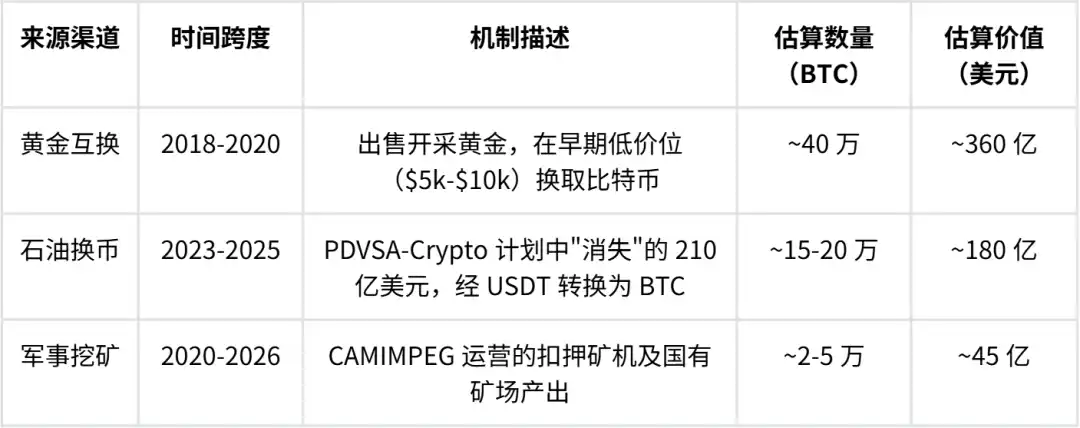
Is this rumor logically plausible?

Supporters' View:

MicroStrategy Comparison: MicroStrategy (now Strategy) held over 670,000 BTC as of January 2026. A sovereign nation theoretically has the capacity to reach a similar scale.

Funding Basis: PDVSA had $21 billion unaccounted for in 2020-2023. If 50% of that was converted to Bitcoin, it could have purchased 300,000-400,000 BTC at average prices of the time.

Skeptics' View:

  • Lack of On-Chain Evidence: If 600,000 BTC truly existed, traces should be found on the blockchain, but no one has been able to point to specific addresses.
  • Suspiciously Round Number: The figure 600,000 seems more like an estimate than an actual count and may be significantly overestimated.
  • Questionable Motive: This rumor might be used for political purposes or market manipulation.

Conclusion: In the absence of concrete blockchain evidence, this remains an unverified rumor.

03 If the Rumor is True: Who Would Hold the Private Keys?

Assuming this "shadow reserve" does exist, even Maduro's arrest does not mean the U.S. can control it.

The FBI's primary challenge would be: How to prove the existence of these Bitcoins, and how to find the private keys?

Who might hold the private keys?

If this asset exists, intelligence analysts speculate it is unlikely managed by a single account. It's more likely to use a multi-signature (Multisig) or private key sharding scheme.

Theoretical key holders might include:

  • Alex Saab: As the regime's financial architect, Saab not only understands the full picture of fund flows but likely holds the crucial seed phrases or knows the physical location of hardware wallets needed to recover the wallets. His return to Venezuela in the December 2023 prisoner swap — 10 American prisoners exchanged for this financial brain — demonstrates his irreplaceability to the regime.
  • Nicolasito (Maduro's Son): Named in indictments, Maduro's son was deeply involved in illegal gold mining and the regime's daily operations, potentially holding a backup of the family's portion of the private keys.
  • Cilia Flores (First Lady): Known as the "First Combatant," she holds a high position within the regime's inner circle. She might control physical access to some cold wallets.
  • Technocrat Layer: Former Sunacrip technicians might be responsible for maintaining the multi-signature technical infrastructure. While they might not know the full keys, their cooperation could be crucial for reconstructing wallet access.

Speculated Crypto Architecture

The most likely architecture is an M-of-N signature scheme (e.g., 3/5 or 5/7). This means signatures from 3 out of 5 core individuals would be required to move the funds.

If Maduro, Flores, and Saab were all under U.S. control, theoretically, the U.S. could compel them to cooperate in unlocking the funds. But reality is far more complex:

  • Geographic Dispersion: Cold wallets could be stored分散ly in bunkers in Caracas, safety deposit boxes in Russia, or safe houses in Cuba.
  • Dead Man's Switch: The system might include an automatic trigger mechanism. If specific actions aren't performed for a prolonged period (e.g., Maduro goes missing), funds could automatically transfer to irrecoverable addresses or be sent to allies.
  • Ideological Resistance: Even facing life imprisonment, key holders might refuse to cooperate. For them, this is not just wealth but the final weapon against "American imperialism."

04 Market Impact: The Rumor Itself is Uncertainty

Even if unverified, this rumor has become a "Sword of Damocles" hanging over the crypto market. 600,000 Bitcoin represents 3% of BTC's total supply. If real, the impact would be massive.

Three Possible Scenarios

Scenario One: Rumor is False

If thorough investigation by the FBI and blockchain analysis firms ultimately proves this "shadow reserve" does not exist or is severely overestimated, the market might breathe a sigh of relief. This means no potential selling pressure, neutral or slightly bullish for price.

Scenario Two: Rumor is True and FBI Gains Control

If the asset exists and the U.S. successfully seizes it, following procedure, these Bitcoin would enter judicial freezing, potentially locked for years. This effectively removes a huge supply from circulation, reducing market float, which is bullish for price.

This is similar to the FBI's seizure of Silk Road Bitcoin in 2013. Around 170,000 BTC were frozen and eventually auctioned in batches. But during the freeze, these coins were effectively out of circulation, objectively reducing selling pressure.

Scenario Three: Rumor is True but Keys are Lost

This is the most dangerous scenario. If the asset exists but the private keys are not controlled by the U.S., remnants of the fleeing regime might attempt to sell Bitcoin on OTC markets for escape funds, triggering panic selling.

The German government's sale of just 50,000 BTC in 2024 caused short-term market volatility. 600,000 would be catastrophic.

05 Summary

Maduro's arrest has revealed a glimpse of the Venezuelan regime's use of cryptocurrency to evade sanctions.

From the failed Petro experiment to the $21 billion PDVSA-Crypto scandal, to militarized mining facilities — these are all confirmed facts. But the rumor of a "600,000 BTC shadow reserve" still lacks concrete evidence.

What we can confirm: Venezuela did use crypto to evade sanctions, PDVSA did have $21 billion unaccounted for, and the regime did confiscate大量 mining equipment.

What we cannot confirm includes: Whether 600,000 BTC were actually accumulated, who holds the private keys (if they exist), and whether these Bitcoin will enter the market.

It does raise a尖锐 question: When decentralized technology is used to evade sanctions, how do we find the balance between freedom and order?

But until more evidence surfaces, the "$60 billion shadow reserve" remains just an unverified rumor.


Preguntas relacionadas

QWhat is the core rumor surrounding Nicolás Maduro's regime and Bitcoin, as discussed in the article?

AThe core rumor is that Nicolás Maduro's regime may have secretly accumulated a 'shadow reserve' of 600,000 to 660,000 Bitcoin, valued at approximately $60-67 billion at early 2026 prices.

QAccording to the article, what were the three main theoretical pathways through which the Maduro regime could have accumulated Bitcoin?

AThe three main theoretical pathways were: 1) Profits and infrastructure from the failed 'Petro' cryptocurrency scheme. 2) Diversion of oil export revenues from the state oil company PDVSA, specifically the $21 billion in unaccounted receivables. 3) Confiscation and operation of mining equipment through military-controlled mining facilities (CAMIMPEG).

QWhat key piece of evidence casts doubt on the credibility of the '600,000 BTC' rumor?

AThe key doubt is the lack of any verifiable on-chain evidence. The number is based on human intelligence (HUMINT) estimates from sources like Whale Hunting and has not been confirmed by blockchain analysis. No specific wallet addresses have been identified to support such a large holding.

QIf the Bitcoin reserve is real, who are the speculated key holders of the private keys, and why?

AThe speculated key holders are: Alex Saab (the regime's financial architect, likely holding critical seed phrases), Nicolasito (Maduro's son, involved in illicit operations), Cilia Flores (the First Lady, with high status), and a layer of technocrats from Sunacrip (who maintained the multisig technical architecture). This suggests a distributed, multisignature wallet structure.

QWhat are the three potential market impact scenarios described if the rumor is true?

A1) The rumor is false: No impact or slightly positive as fear of a massive sell-off is removed. 2) The BTC is real and seized by the FBI: Bullish, as the coins would be frozen, reducing circulating supply. 3) The BTC is real but the private keys are lost/controlled by regime remnants: Bearish, as they could attempt a massive OTC sell-off, causing panic and a price crash.

Lecturas Relacionadas

Why Do You Always Lose Money on Polymarket? Because You're Betting on News, While the Pros Read the Rules

Why do you always lose money on Polymarket? Because you bet on news, while the pros study the rules. This article explains how top traders ("che tou") profit by meticulously analyzing market rules, not just predicting events. Polymarket, a prediction market platform, often sees disputes over event outcomes due to ambiguous rule wording. For instance, a market asking "Who will be the leader of Venezuela by the end of 2026?" was misinterpreted by many who bet on Delcy Rodríguez, assuming she held power. However, the rules specified "officially holds" as the formally appointed, sworn-in individual. Since Nicolás Maduro was still recognized as president officially, he won the market—even being in prison. To resolve such disputes, Polymarket uses a decentralized arbitration system via UMA protocol. The process involves: 1. Proposal: Anyone can propose a market outcome by staking 750 USDC, earning 5 USDC if unchallenged. 2. Dispute: A 2-hour window allows challenges with a 750 USDC stake; successful challengers earn 250 USDC. 3. Discussion: A 48-hour period on UMA Discord for evidence and debate. 4. Voting: UMA token holders vote in two 24-hour phases (blind then public). Outcomes require >65% consensus and 5M tokens voted; otherwise, four re-votes occur before Polymarket intervention. 5. Settlement: Results are final and automatic. Unlike traditional courts, Polymarket’s system lacks separation between arbitrators and stakeholders—voters often hold market positions, creating conflicts of interest. This leads to herd mentality in discussions and non-transparent outcomes without explanatory rulings, preventing precedent formation. Thus, success on Polymarket hinges on deep rule interpretation, not just event prediction, exploiting gaps between reality and contractual wording.

marsbitHace 1 hora(s)

Why Do You Always Lose Money on Polymarket? Because You're Betting on News, While the Pros Read the Rules

marsbitHace 1 hora(s)

DeepSeek Funding: Liang Wenfeng's 'Realist' Pivot

DeepSeek, a leading Chinese AI company, has initiated its first external funding round, aiming to raise at least $300 million at a valuation of no less than $10 billion. This move marks a significant shift from its founder Liang Wenfeng’s previous idealistic stance of rejecting external capital to maintain independence. Despite strong financial backing from its parent company, quantitative trading firm幻方量化 (Huanfang Quant), which provided an estimated $700 million in revenue in 2025 alone, DeepSeek faces mounting challenges. Key issues include a 15-month gap in major model updates, delays in its flagship V4 release, and the loss of several core researchers to competitors offering significantly higher compensation. The company is also undergoing a strategic pivot by migrating its infrastructure from NVIDIA’s CUDA to Huawei’s Ascend platform, a move aligned with China’s push for technological self-reliance amid U.S. export controls. However, DeepSeek lags behind rivals like智谱AI and MiniMax—both now publicly listed—in areas such as product ecosystem, multimodal capabilities, and commercialization. The funding round, though relatively small in scale, is seen as a way to establish a market-validated valuation anchor, making employee stock options more competitive and facilitating talent retention. It also signals DeepSeek’s transition from a pure research-oriented organization to a commercially-driven player in the global AI ecosystem.

marsbitHace 2 hora(s)

DeepSeek Funding: Liang Wenfeng's 'Realist' Pivot

marsbitHace 2 hora(s)

Trading

Spot
Futuros

Artículos destacados

Qué es BITCOIN

Entendiendo HarryPotterObamaSonic10Inu (ERC-20) y Su Posición en el Espacio Cripto En los últimos años, el mercado de criptomonedas ha sido testigo de un aumento en la popularidad de las monedas meme, capturando el interés no solo de los comerciantes, sino también de aquellos que buscan compromiso comunitario y valor de entretenimiento. Entre estos tokens únicos se encuentra HarryPotterObamaSonic10Inu (ERC-20), un proyecto intrigante que mezcla referencias culturales en el tejido de las criptomonedas. Este artículo profundiza en los aspectos clave de HarryPotterObamaSonic10Inu, explorando sus mecanismos, ethos impulsado por la comunidad y su relación con el paisaje cripto más amplio. ¿Qué es HarryPotterObamaSonic10Inu (ERC-20)? Como su nombre sugiere, HarryPotterObamaSonic10Inu es una moneda meme construida sobre la blockchain de Ethereum, clasificada bajo el estándar ERC-20. A diferencia de las criptomonedas tradicionales que pueden enfatizar la utilidad práctica o el potencial de inversión, este token prospera en el valor de entretenimiento y la fuerza de su comunidad. El proyecto tiene como objetivo fomentar un entorno donde los usuarios comprometidos puedan reunirse, compartir ideas y participar en actividades inspiradas por diversos fenómenos culturales. Una característica notable de HarryPotterObamaSonic10Inu es su cero impuestos en las transacciones. Este atractivo elemento tiene como objetivo incentivar el comercio y la participación comunitaria, sin cargos adicionales que puedan disuadir a los comerciantes de pequeña escala. El suministro total de la moneda está establecido en mil millones de tokens, una cifra que marca su intención de mantener una circulación sustancial dentro de la comunidad. Creador de HarryPotterObamaSonic10Inu (ERC-20) Los orígenes de HarryPotterObamaSonic10Inu están algo envueltos en misterio; los detalles sobre el creador siguen siendo desconocidos. El desarrollo de este token carece de un equipo identificable o de un plan explícito, lo cual no es inusual dentro del sector de monedas meme. En cambio, el proyecto ha surgido de manera orgánica, con su progreso muy dependiente del entusiasmo y la participación de su comunidad. Inversores de HarryPotterObamaSonic10Inu (ERC-20) En cuanto a inversiones externas y respaldo, HarryPotterObamaSonic10Inu también sigue siendo ambiguo. El token no lista ninguna fundación de inversión conocida o apoyo organizacional significativo. En cambio, la savia del proyecto es su comunidad de base, que informa su crecimiento y sostenibilidad a través de la acción colectiva y el compromiso en el espacio cripto. ¿Cómo Funciona HarryPotterObamaSonic10Inu (ERC-20)? Como una moneda meme, HarryPotterObamaSonic10Inu opera principalmente fuera de los marcos tradicionales que a menudo rigen el valor de los activos. Hay varios aspectos distintivos que definen cómo funciona el proyecto: Transacciones Sin Impuestos: Sin tarifas impositivas en las transacciones, los usuarios pueden comprar y vender el token libremente sin preocuparse por costos ocultos. Compromiso Comunitario: El proyecto prospera en la interacción comunitaria, aprovechando plataformas de redes sociales para crear entusiasmo y facilitar la participación. Las discusiones, el intercambio de contenido y el compromiso son elementos cruciales que ayudan a expandir su alcance y fomentar la lealtad entre los seguidores. Sin Utilidad Práctica: Cabe señalar que HarryPotterObamaSonic10Inu no ofrece utilidad concreta dentro del ecosistema financiero. Más bien, se clasifica como un token principalmente para actividades de entretenimiento y comunitarias. Referencia Cultural: El token incorpora astutamente elementos de la cultura popular para atraer interés, conectando con entusiastas de los memes y seguidores de las criptomonedas por igual. HarryPotterObamaSonic10Inu ejemplifica cómo las monedas meme operan de manera diferente a los proyectos de criptomonedas más tradicionales, ingresando al mercado como construcciones sociales innovadoras en lugar de activos utilitarios. Cronología de HarryPotterObamaSonic10Inu (ERC-20) La historia de HarryPotterObamaSonic10Inu está marcada por varios hitos notables: Creación: El token surgió de un meme viral, capturando la imaginación de muchos entusiastas de las criptomonedas. Las fechas específicas de creación no están disponibles, subrayando su ascenso orgánico. Listado en Exchanges: HarryPotterObamaSonic10Inu ha llegado a varios exchanges, permitiendo un acceso y comercio más fácil por parte de la comunidad. Iniciativas de Compromiso Comunitario: Actividades continuas destinadas a mejorar la interacción comunitaria, incluyendo concursos, campañas en redes sociales y generación de contenido por parte de fanáticos y defensores. Planes de Expansión Futuros: La hoja de ruta del proyecto incluye el lanzamiento de una colección de NFT, mercancía y un sitio de comercio electrónico relacionado con sus temas culturales, involucrando aún más a la comunidad e intentando añadir más dimensiones a su ecosistema. Puntos Clave Sobre HarryPotterObamaSonic10Inu (ERC-20) Naturaleza Impulsada por la Comunidad: El proyecto prioriza la participación colectiva y la creatividad, asegurando que la involucración de los usuarios esté a la vanguardia de su desarrollo. Clasificación como Moneda Meme: Representa la epítome de las criptomonedas basadas en el entretenimiento, diferenciándose de los vehículos de inversión tradicionales. Sin Afiliación Directa con Bitcoin: A pesar de la similitud en el nombre del ticker, HarryPotterObamaSonic10Inu es distinto y no tiene relación con Bitcoin u otras criptomonedas establecidas. Enfoque en la Colaboración: HarryPotterObamaSonic10Inu está diseñado para crear un espacio para la colaboración y el intercambio de historias entre sus poseedores, proporcionando una vía para la creatividad y el vínculo comunitario. Perspectivas Futuras: La ambición de expandirse más allá de su premisa inicial hacia NFTs y mercancías describe un camino para que el proyecto potencialmente ingrese a avenidas más tradicionales dentro de la cultura digital. A medida que las monedas meme continúan capturando la imaginación de la comunidad de criptomonedas, HarryPotterObamaSonic10Inu (ERC-20) se destaca debido a sus lazos culturales y su enfoque centrado en la comunidad. Si bien puede no encajar en el molde típico de un token impulsado por la utilidad, su esencia radica en la alegría y la camaradería fomentadas entre sus seguidores, destacando la naturaleza en evolución de las criptomonedas en una era cada vez más digital. A medida que el proyecto continúa desarrollándose, será importante observar cómo las dinámicas comunitarias influyen en su trayectoria en el cambiante paisaje de la tecnología blockchain.

1.2k Vistas totalesPublicado en 2024.04.01Actualizado en 2024.12.03

Qué es BITCOIN

Cómo comprar BTC

¡Bienvenido a HTX.com! Hemos hecho que comprar Bitcoin (BTC) sea simple y conveniente. Sigue nuestra guía paso a paso para iniciar tu viaje de criptos.Paso 1: crea tu cuenta HTXUtiliza tu correo electrónico o número de teléfono para registrarte y obtener una cuenta gratuita en HTX. Experimenta un proceso de registro sin complicaciones y desbloquea todas las funciones.Obtener mi cuentaPaso 2: ve a Comprar cripto y elige tu método de pagoTarjeta de crédito/débito: usa tu Visa o Mastercard para comprar Bitcoin (BTC) al instante.Saldo: utiliza fondos del saldo de tu cuenta HTX para tradear sin problemas.Terceros: hemos agregado métodos de pago populares como Google Pay y Apple Pay para mejorar la comodidad.P2P: tradear directamente con otros usuarios en HTX.Over-the-Counter (OTC): ofrecemos servicios personalizados y tipos de cambio competitivos para los traders.Paso 3: guarda tu Bitcoin (BTC)Después de comprar tu Bitcoin (BTC), guárdalo en tu cuenta HTX. Alternativamente, puedes enviarlo a otro lugar mediante transferencia blockchain o utilizarlo para tradear otras criptomonedas.Paso 4: tradear Bitcoin (BTC)Tradear fácilmente con Bitcoin (BTC) en HTX's mercado spot. Simplemente accede a tu cuenta, selecciona tu par de trading, ejecuta tus trades y monitorea en tiempo real. Ofrecemos una experiencia fácil de usar tanto para principiantes como para traders experimentados.

4.6k Vistas totalesPublicado en 2024.12.12Actualizado en 2025.03.21

Cómo comprar BTC

Qué es $BITCOIN

ORO DIGITAL ($BITCOIN): Un Análisis Integral Introducción al ORO DIGITAL ($BITCOIN) ORO DIGITAL ($BITCOIN) es un proyecto basado en blockchain que opera en la red Solana, cuyo objetivo es combinar las características de los metales preciosos tradicionales con la innovación de las tecnologías descentralizadas. Aunque comparte un nombre con Bitcoin, a menudo referido como “oro digital” debido a su percepción como un refugio de valor, ORO DIGITAL es un token separado diseñado para crear un ecosistema único dentro del paisaje Web3. Su meta es posicionarse como un activo digital alternativo viable, aunque los detalles sobre sus aplicaciones y funcionalidades aún están en desarrollo. ¿Qué es ORO DIGITAL ($BITCOIN)? ORO DIGITAL ($BITCOIN) es un token de criptomoneda diseñado explícitamente para su uso en la blockchain de Solana. A diferencia de Bitcoin, que proporciona un papel de almacenamiento de valor ampliamente reconocido, este token parece centrarse en aplicaciones y características más amplias. Aspectos notables incluyen: Infraestructura Blockchain: El token está construido sobre la blockchain de Solana, conocida por su capacidad para manejar transacciones de alta velocidad y bajo costo. Dinámicas de Suministro: ORO DIGITAL tiene un suministro máximo limitado a 100 cuatrillones de tokens (100P $BITCOIN), aunque los detalles sobre su suministro circulante no se han divulgado actualmente. Utilidad: Si bien las funcionalidades precisas no están delineadas explícitamente, hay indicios de que el token podría ser utilizado para diversas aplicaciones, potencialmente involucrando aplicaciones descentralizadas (dApps) o estrategias de tokenización de activos. ¿Quién es el Creador de ORO DIGITAL ($BITCOIN)? En la actualidad, la identidad de los creadores y el equipo de desarrollo detrás de ORO DIGITAL ($BITCOIN) sigue siendo desconocida. Esta situación es típica entre muchos proyectos innovadores dentro del espacio blockchain, particularmente aquellos alineados con las finanzas descentralizadas y fenómenos de monedas meme. Si bien tal anonimato puede fomentar una cultura impulsada por la comunidad, intensifica las preocupaciones sobre la gobernanza y la responsabilidad. ¿Quiénes son los Inversores de ORO DIGITAL ($BITCOIN)? La información disponible indica que ORO DIGITAL ($BITCOIN) no tiene patrocinadores institucionales conocidos ni inversiones destacadas de capital de riesgo. El proyecto parece operar en un modelo de peer-to-peer centrado en el apoyo y la adopción de la comunidad en lugar de rutas de financiamiento tradicionales. Su actividad y liquidez se sitúan principalmente en intercambios descentralizados (DEX), como PumpSwap, en lugar de plataformas de trading centralizadas establecidas, lo que resalta aún más su enfoque de base. Cómo Funciona ORO DIGITAL ($BITCOIN) Los mecanismos operativos de ORO DIGITAL ($BITCOIN) pueden elaborarse en función de su diseño blockchain y atributos de red: Mecanismo de Consenso: Al aprovechar el único proof-of-history (PoH) de Solana combinado con un modelo de proof-of-stake (PoS), el proyecto asegura una validación de transacciones eficiente que contribuye al alto rendimiento de la red. Tokenómica: Si bien los mecanismos deflacionarios específicos no se han detallado extensamente, el vasto suministro máximo de tokens implica que podría atender microtransacciones o casos de uso nicho que aún están por definirse. Interoperabilidad: Existe el potencial de integración con el ecosistema más amplio de Solana, incluyendo varias plataformas de finanzas descentralizadas (DeFi). Sin embargo, los detalles sobre integraciones específicas permanecen no especificados. Cronología de Eventos Clave Aquí hay una cronología que destaca hitos significativos relacionados con ORO DIGITAL ($BITCOIN): 2023: El despliegue inicial del token ocurre en la blockchain de Solana, marcado por su dirección de contrato. 2024: ORO DIGITAL gana visibilidad al estar disponible para trading en intercambios descentralizados como PumpSwap, permitiendo a los usuarios comerciar contra SOL. 2025: El proyecto presencia actividad de trading esporádica y potencial interés en compromisos liderados por la comunidad, aunque no se han documentado asociaciones notables o avances técnicos hasta el momento. Análisis Crítico Fortalezas Escalabilidad: La infraestructura subyacente de Solana soporta altos volúmenes de transacciones, lo que podría mejorar la utilidad de $BITCOIN en varios escenarios de transacción. Accesibilidad: El potencial bajo precio de trading por token podría atraer a inversores minoristas, facilitando una participación más amplia debido a oportunidades de propiedad fraccionada. Riesgos Falta de Transparencia: La ausencia de patrocinadores, desarrolladores o un proceso de auditoría conocidos públicamente puede generar escepticismo sobre la sostenibilidad y confiabilidad del proyecto. Volatilidad del Mercado: La actividad de trading depende en gran medida del comportamiento especulativo, lo que puede resultar en una volatilidad de precios significativa y en incertidumbre para los inversores. Conclusión ORO DIGITAL ($BITCOIN) surge como un proyecto intrigante pero ambiguo dentro del ecosistema de Solana en rápida evolución. Si bien intenta aprovechar la narrativa del “oro digital”, su alejamiento del papel establecido de Bitcoin como refugio de valor subraya la necesidad de una diferenciación más clara de su utilidad y estructura de gobernanza previstas. La aceptación y adopción futura dependerán probablemente de abordar la actual opacidad y de definir sus estrategias operativas y económicas de manera más explícita. Nota: Este informe abarca información sintetizada disponible hasta octubre de 2023, y pueden haber ocurrido desarrollos más allá del período de investigación.

83 Vistas totalesPublicado en 2025.05.13Actualizado en 2025.05.13

Qué es $BITCOIN

Discusiones

Bienvenido a la comunidad de HTX. Aquí puedes mantenerte informado sobre los últimos desarrollos de la plataforma y acceder a análisis profesionales del mercado. A continuación se presentan las opiniones de los usuarios sobre el precio de BTC (BTC).

活动图片