Did Jane Street 'Manipulate' BTC? Deconstructing the AP System and Understanding the Pricing Power Game Behind the ETF Creation and Redemption Mechanism

marsbitPublicado a 2026-02-28Actualizado a 2026-02-28

Resumen

The article investigates allegations that Jane Street Capital manipulated Bitcoin prices by exploiting the ETF creation and redemption mechanism. It clarifies that the issue is not unique to Jane Street but stems from structural features of the Authorized Participant (AP) system common to all Bitcoin ETFs, including those from major firms like JPMorgan, Goldman Sachs, and Citadel. APs hold a unique regulatory exemption under Reg SHO, allowing them to create and redeem ETF shares without typical short-selling constraints like borrowing costs or hard deadlines. This creates a potential conflict: while market inefficiencies (e.g., ETF trading below NAV) should naturally attract arbitrageurs to correct prices, APs—who control the arbitrage pipeline—may delay arbitrage to profit elsewhere, such as in derivatives markets. The shift to in-kind (rather than cash) creations/redemptions further reduced structural buying pressure on Bitcoin spot markets. The core problem is not deliberate price suppression by any single AP but a systemic flaw: the AP framework, designed for traditional finance, may undermine price discovery integrity for Bitcoin. The article concludes by questioning whether existing regulatory frameworks are suitable for an asset class predicated on decentralization.

Author: Eddie Xin, Chief Analyst at OSL Group

"They were fcking us the whole time".

This expletive, circulating on Reddit and CT (Crypto Twitter) following the lawsuit, alongside an epic short squeeze with a liquidation scale exceeding $240 billion, directed the market's fury at the same target: Jane Street Capital.

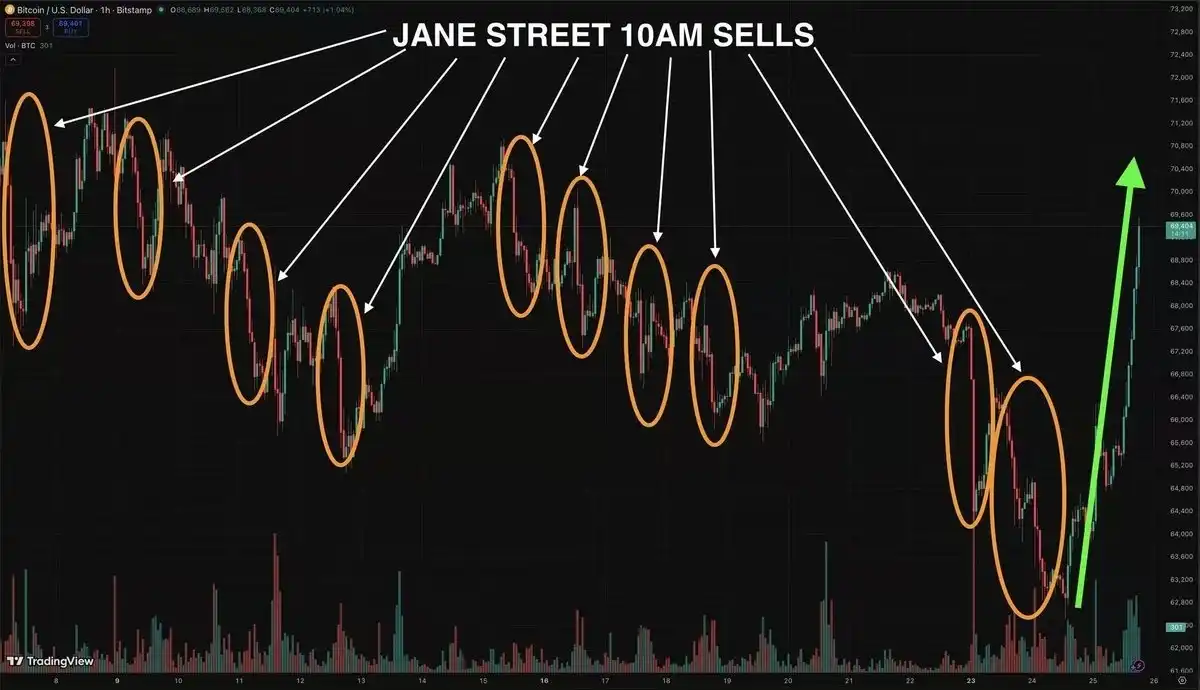
At 10 AM, the liquidity low point in the Asian market for the past few months, the tip of the iceberg was finally revealed with the U.S. Department of Justice's complaint. It all stemmed from Jane Street Capital, a top-tier market maker founded in 2000, which was accused of executing a months-long 'sleight of hand' in the spot and derivative order books by means of targeted ETF arbitrage in the market, utilizing the spot ETF creation and redemption mechanism.

It wasn't until a legal complaint pushed this controversy into the public eye that discussions around the ETF arbitrage mechanism and price discovery structure rapidly heated up, triggering a violent market rebound and an epic short squeeze with a liquidation scale exceeding $240 billion.

But was Jane Street truly the culprit that pressed the suppression button? This is a question worth at least $10 billion.
I. Did Jane Street Really Suppress the BTC Price?

This question deserves an accurate answer. The most important thing to understand first is that this isn't just a question about Jane Street.

It's a question about the structural characteristics of the Bitcoin ETF framework, which applies equally to every Authorized Participant (AP) in the ecosystem. For BlackRock's IBIT alone, this list includes Jane Street Capital, JPMorgan, Macquarie, Virtu Americas, Goldman Sachs, Citadel Securities, Citigroup, UBS, and ABN Amro.

The role of these institutions is deeply misunderstood by the outside world, even among experienced industry veterans, and this misunderstanding deserves to be corrected before drawing any conclusions.

The first thing to understand about APs is that they occupy a marginal exception within the regulatory framework of Reg SHO (the SEC's rule on naked short selling). For instance, Reg SHO requires short sellers to locate shares (locate the stock) before shorting, but APs are exempted due to their contractual right to participate in creations and redemptions.

While this sounds procedural, its practical consequences are significant. It means any AP can create shares at will—no borrowing costs, no capital commitment traditionally associated with short selling, and aside from commercially reasonable timeframes, no hard deadline to close the position.

This is the gray area: a regulatory exemption designed for orderly ETF market making is, structurally, indistinguishable from regulatory arbitrage with an unmatched duration. This exemption is not unique to any single company. It is a prerequisite for membership in the AP club.

II. What Does This AP Exemption Mean?

Normally, if IBIT is trading below its Net Asset Value (NAV), you would expect arbitrage buyers to step in, redeem shares for bitcoin, and close the discount. But any AP *is* that arbitrage buyer; they control the pipeline. This means their incentive to close this discount is different from that of a third-party trading desk without creation/redemption rights.

It sounds complex, but a simple analogy makes it clearer:

First Layer: What is Normal 'Closing the Discount'?

Imagine there's a blind box on the market (this is the IBIT ETF). Everyone knows the blind box contains a real bitcoin voucher worth $100 (this is the NAV). But today, due to market panic, the blind box is priced at $95.

Following normal logic, smart merchants (arbitrage buyers) would frantically buy the blind box for $95, then go to the official source to open it, exchange it for the $100 bitcoin, sell it, and pocket the $5 difference.

And precisely because everyone is buying the blind boxes for arbitrage, the price of the blind box is quickly pushed up by buying pressure, returning to $100. This is called "closing the discount".

Second Layer: The AP with the 'Monopoly Channel'

But in the real world of Bitcoin ETFs, ordinary trading firms and retail investors are not qualified to go to the official source to "open the blind box" (i.e., they lack creation/redemption rights). Only a few privileged Wall Street investment banks (APs) in the entire market can do this. That is, APs monopolize the only channel to exchange ETFs for real bitcoin (they control the pipeline).

Third Layer: Why Don't APs Play by the Arbitrage Rules?

If it were an ordinary third-party merchant, seeing this $5 risk-free spread, they would act immediately. But APs are different; they calculate a more shrewd account: "Since only I can open the blind box, why should I hurry? If I intentionally don't pull the price back to $100, but instead use the current illusion of a low $95 price to go short or long in another casino (like the bitcoin futures market), I might make $20!"

In summary: The market originally has an automatic correction mechanism (if the price falls too much, someone will buy for arbitrage and push the price up). However, because the "only switch" to execute this correction mechanism is held by the APs, and the APs find that "not correcting, maintaining the discount" allows them to make more money elsewhere, they have no incentive to pull the price back to normal levels.

Retail investors suffer waiting for the arbitrage army to save the price, unaware that the only arbitrage army (the APs) is right next door, using this spread to make money in other markets.

III. The Problem Isn't Jane Street, It's the AP Structure

IBIT's short exposure could in principle be hedged by going long bitcoin spot, but this is not mandatory, as long as the chosen instrument maintains a tight correlation.

The obvious alternative is BTC futures, especially given their capital efficiency. This effectively means that if the hedging instrument is futures rather than spot, then the spot is never actually bought. And because the natural arbitrage buyer chooses not to buy spot, this discount cannot be closed through the natural arbitrage mechanism.

It's worth noting that the spot/futures basis is itself the domain of the entire basis trading community, which works to keep this relationship tight. But every separation between the hedging instrument and the underlying asset introduces impure basis risk (dirty basis risk), and this risk compounds throughout the structure—and it is under stress conditions that basis risk is where market dislocation appears.

The final piece of the puzzle involves the recently SEC-approved in-kind creation and redemption. Under the previous cash-only regime, APs were required to deliver cash to the fund, and then the custodian used this cash to buy bitcoin spot. This buying action was a structural regulator—it mechanically forced the purchase of spot as a consequence of creation.

In-kind creation/redemption completely eliminates this. Now any AP can deliver bitcoin directly, and the timing and counterparty for its source can be chosen at its own discretion: OTC desks, negotiated pricing, minimizing market impact.

The broadest interpretation of this flexibility is that an AP could maintain derivative positions aimed at capturing funding rate or volatility profits during the time between establishing a short and completing the in-kind delivery—all while ensuring each individual step still fits the definition of legitimate AP activity.

And this is precisely the crux of the problem. The beginning looks like normal market making, and the end looks like normal market making. It is the middle process that is difficult to clearly categorize. This is not an indictment of any single company. Every AP on the IBIT list, and by extension every AP for every Bitcoin ETF, operates within the same structural framework, enjoys the same exemptions, and therefore possesses the same theoretical capability. Whether any of them exercised this capability in a manner that verges on coordinated activity is a question that falls squarely within the purview of the "surveillance sharing agreements" the SEC required upon ETF approval.

Whether these agreements are sufficient to capture behavior that simultaneously spans spot, futures, and ETF markets (even including cross-border trading venues) remains a truly open question.

In a nutshell, Jane Street is just in the spotlight. The real problem is buried deep in the underlying architecture of the Bitcoin ETF, designed by Wall Street veterans. No specific AP is explicitly suppressing the bitcoin price. What the AP structure can suppress is the integrity of the price discovery mechanism itself, which may have far more profound implications than the former.

Therefore, the question truly worth asking is not whether a specific company is the villain, but whether a regulatory framework built for 20th-century traditional finance is suitable for hosting an emerging 21st-century asset whose "value lies in being free from control by regulatory agencies".

This is perhaps the tuition fee the crypto market must pay to enter the "era of big institutions." After all, while we crave the liquidity irrigation from Wall Street, we do not wish to passively accept the black-box games they construct using regulatory exemptions.

This is not just the answer about Jane Street, but the ultimate question of the Bitcoin ETF era.

Preguntas relacionadas

QWhat is the core allegation against Jane Street Capital in relation to Bitcoin ETFs?

AJane Street Capital is accused of exploiting the creation and redemption mechanism of Bitcoin ETFs to conduct arbitrage between spot and derivative markets, using a regulatory exemption that allows them to potentially suppress price discovery rather than correct market inefficiencies.

QWhat is an Authorized Participant (AP) in the context of Bitcoin ETFs, and what special privilege do they hold?

AAn Authorized Participant (AP) is a large financial institution, like Jane Street or J.P. Morgan, that has the exclusive right to create and redeem ETF shares. They hold a key regulatory exemption from Reg SHO, allowing them to create shares without first locating the stock, which eliminates borrowing costs and hard deadlines associated with traditional short selling.

QWhy might an AP choose not to arbitrage a price discrepancy between an ETF and its Net Asset Value (NAV)?

AAn AP might choose not to arbitrage a discount because they control the only mechanism to correct it. They can profit more by maintaining the discrepancy and using it to execute strategies in derivative markets (like futures) to earn funding rates or volatility profits, rather than simply closing the gap for a smaller, immediate gain.

QHow did the shift from cash-only to in-kind creation and redemption for Bitcoin ETFs change the market dynamics?

AThe shift to in-kind creation removed a structural market stabilizer. Under the cash-only model, APs had to deliver cash to the fund, which forced the custodian to buy Bitcoin spot, supporting its price. With in-kind creation, APs can deliver Bitcoin directly from sources like OTC desks, giving them more flexibility and eliminating the forced spot market purchases.

QAccording to the article, what is the fundamental problem, and is it specific to Jane Street?

AThe fundamental problem is not specific to Jane Street but is a structural issue inherent in the Bitcoin ETF framework. The regulatory exemptions and arbitrage mechanisms granted to all APs can suppress the integrity of the price discovery process itself, raising questions about whether a traditional financial regulatory framework is suitable for a decentralized asset like Bitcoin.

Lecturas Relacionadas

Fed's Internal Doves Flock to Hawkish Stance, Warsh's Debut "Between a Rock and a Hard Place"

U.S. Federal Reserve officials who previously advocated for rate cuts, including Governor Christopher Waller, have recently shifted their stance, with many now not ruling out the possibility of future rate hikes. This sets a challenging stage for new Fed Chair Kevin Warsh's first policy meeting. Appointed by President Trump based on his dovish views, Warsh now faces a committee where the debate has pivoted from "when to cut" to "whether to hike," driven by persistent inflation above 3%, a strong labor market, and supply-side pressures from AI infrastructure demands and geopolitical tensions. Key figures illustrate the shift. Governor Waller, once concerned about employment, now says data has pushed him toward considering rate increases. Even moderate voices like Governor Lisa Cook, while expecting inflation to ease, have indicated readiness to hike if it fails to do so. Long-time hawks such as regional Fed presidents Beth Hammack, Lorie Logan, and Neel Kashkari have grown more vocal, arguing that the real policy rate is effectively falling and that action may soon be needed. The upcoming Fed meeting is expected to keep rates steady but will likely remove the "easing bias" from its statement, signaling a neutral stance between cuts and hikes. The quarterly "dot plot" is anticipated to show most officials projecting no cuts this year, with some potentially indicating hikes. Chair Warsh, a critic of the Fed's reliance on forward guidance like the dot plot, must navigate communicating this pivot using tools he has questioned, all while steering policy in a direction counter to the preferences of the president who appointed him. The consensus suggests the Fed's next move could well be a rate increase.

marsbitHace 4 min(s)

Fed's Internal Doves Flock to Hawkish Stance, Warsh's Debut "Between a Rock and a Hard Place"

marsbitHace 4 min(s)

The Trillion-Yuan Market Cap 'Yi Zhong Tian': Who is the True Value King?

The article analyzes the three leading Chinese optical module companies, collectively nicknamed "Yi Zhong Tian": Xinyisheng, Zhongji Innolight, and TFC Optical Communication. It evaluates their "cost-performance" not by current stock price, but through three lenses: PEG ratio (growth vs. valuation), earnings quality, and premium/discount for certainty. Xinyisheng shows the most attractive PEG ratio and high profitability, but its valuation reflects discounts for risks like high customer concentration and reliance on overseas markets. Zhongji Innolight, the most expensive, commands a premium for its market leadership, dominant share in key products like 800G/1.6T modules, and higher earnings certainty, though it faces geopolitical risks. TFC Optical, as an upstream component supplier ("water seller"), has the highest gross margin and bets on the long-term CPO/NPO architecture trend, but trades at a high valuation with more stable, less explosive growth. The core argument is that while these companies dominate module assembly, the true profit pool and technological moat lie upstream in laser and switch chips, currently controlled by U.S. firms like Lumentum and Coherent. The long-term "cost-performance" for these Chinese leaders hinges on whether the domestic industry, exemplified by companies like Yuanjie Technology, can successfully move up the value chain into high-power laser chips. Otherwise, their high growth may remain confined to the lower-margin assembly segment.

marsbitHace 14 min(s)

The Trillion-Yuan Market Cap 'Yi Zhong Tian': Who is the True Value King?

marsbitHace 14 min(s)

Has the Crypto Market Bottomed? Here's What Institutions Think

The crypto market is in a period of significant debate, with leading institutions offering differing views on whether a bottom has been reached. Three prominent firms have published detailed analyses: * **Galaxy Digital** argues Bitcoin has **not yet bottomed**. Their analysis of 13 historical indicators across six dimensions (valuation, profit-taking, miner pressure, etc.) shows only four are fully met. They project a potential bottom range between $30k and $54k. * **NYDIG** states a bottom is **possible but not likely**. While metrics are close to historic bear market extremes, they note the absence of a classic panic-selling event. They also suggest increased institutional adoption may have structurally altered the market cycle, potentially leading to a shallower downturn. * **Standard Chartered Bank** asserts the **bottom has already occurred** at around $59k. They cite two key factors: potential US-Iran diplomatic progress and the anticipated SpaceX IPO, which they believe absorbed capital and caused ETF selling pressure that is now subsiding. They forecast a year-end price target of $100k. Despite the surface-level disagreement, the reports share critical common ground more valuable for long-term investors: 1. All three believe the market bottom will form **within this year**. 2. All agree the current price is **closer to the bottom than to previous highs**. 3. All maintain a **bullish long-term outlook** for Bitcoin and a new cycle. The core takeaway is that while the exact bottom price ($40k, $50k, or $60k) is debated, the consensus is that a bottom is imminent. For long-term holders, the primary focus should not be pinpointing the absolute low, but on the future potential for prices to reach $100k, $200k, or higher. The fundamental thesis for Bitcoin—sovereign debt accumulation, inflation, declining trust in centralized institutions, global digitization, and improved accessibility—remains intact and is arguably strengthening. The overall landscape is viewed as more favorable than in previous crypto winters.

marsbitHace 24 min(s)

Has the Crypto Market Bottomed? Here's What Institutions Think

marsbitHace 24 min(s)

The 'Chip' Challenge and Breakthroughs in China's Optical Industry Chain

China's Photonics Industry: Bottlenecks and Breakthroughs In the global AI race, computing chips dominate the narrative, but the underlying bottleneck increasingly defining the scale of AI clusters is light—or more specifically, optical connectivity. Optical modules, which translate electrical signals to light and vice versa, are crucial for connecting thousands of GPUs in AI data centers, preventing data congestion and ensuring efficient model training. High-speed modules (800G, 1.6T) are now standard, with performance hinging on advanced DSP (Digital Signal Processor) chips. This is where a critical dependency lies. Two US giants—Marvell and Broadcom—collectively dominate over 90% of the high-end DSP chip market. Chinese optical module leaders like Zhongji Innolight and Eoptolink rely on these chips to manufacture modules for overseas AI customers, primarily in North America. While this creates a supply chain vulnerability, complete decoupling is difficult. Marvell derives over half its revenue from Greater China, and the US firms depend on Chinese partners for chip packaging and optical components. The risk from laser chips (e.g., from Lumentum), another key component, is considered more manageable due to multiple global suppliers and faster progress in domestic alternatives from companies like YOFC and Accelink. To mitigate risks, China's industry is pursuing a multi-pronged strategy: diversifying supply chains and locking in long-term orders; fostering a domestic market ecosystem to adopt homegrown DSPs from firms like Huawei HiSilicon and CETC; accelerating R&D in high-speed DSPs and advanced packaging; and investing in next-gen technologies like silicon photonics and Co-Packaged Optics (CPO) to reduce reliance on discrete DSPs. The ultimate solution lies not in short-term博弈 but in persistent advancement of domestic high-end chip R&D and manufacturing. While challenges remain in performance, certification, and ecosystem building, China's vast domestic market and manufacturing base provide a crucial buffer, buying time for the industry to achieve greater technological independence.

marsbitHace 38 min(s)

The 'Chip' Challenge and Breakthroughs in China's Optical Industry Chain

marsbitHace 38 min(s)

Behind SpaceX's $2 Trillion Market Cap: Why Does Musk Always Have the Next Move Planned?

On June 12th, SpaceX debuted on the Nasdaq, reaching a valuation that briefly touched $2 trillion. This marked the culmination of a 24-year journey from its founding in 2002, driven by Elon Musk's frustration at the high cost of buying rockets. The company's path was defined by early failures, with its first three Falcon 1 launches ending in explosions before a successful 2008 flight opened the era of commercial spaceflight. Key to its model was a fixed-price NASA contract, incentivizing cost reduction. SpaceX mastered rocket reusability, first achieving a Falcon 9 landing in 2015, which drastically cut launch costs. This enabled its profitable Starlink satellite internet constellation, envisioned years before reusability was proven, to create an internal market for frequent launches. Similarly, the next-generation Starship rocket was in development long before its first flight, with its business case evolving from Mars colonization to supporting the emerging concept of in-orbit data centers for AI—a story now central to its valuation. The company's recent IPO, a reversal of its long-standing "no IPO" stance, is funding this ambitious "space-based compute" vision. While major tech players like Google, Blue Origin, and others are investing heavily, significant technical and cost hurdles remain. Ultimately, SpaceX's history is one of creating its own demand: first with Starlink and now with space-based AI compute, betting that its next rocket will enable its next giant market.

marsbitHace 41 min(s)

Behind SpaceX's $2 Trillion Market Cap: Why Does Musk Always Have the Next Move Planned?

marsbitHace 41 min(s)

Trading

Spot
Futuros

Artículos destacados

Qué es BITCOIN

Entendiendo HarryPotterObamaSonic10Inu (ERC-20) y Su Posición en el Espacio Cripto En los últimos años, el mercado de criptomonedas ha sido testigo de un aumento en la popularidad de las monedas meme, capturando el interés no solo de los comerciantes, sino también de aquellos que buscan compromiso comunitario y valor de entretenimiento. Entre estos tokens únicos se encuentra HarryPotterObamaSonic10Inu (ERC-20), un proyecto intrigante que mezcla referencias culturales en el tejido de las criptomonedas. Este artículo profundiza en los aspectos clave de HarryPotterObamaSonic10Inu, explorando sus mecanismos, ethos impulsado por la comunidad y su relación con el paisaje cripto más amplio. ¿Qué es HarryPotterObamaSonic10Inu (ERC-20)? Como su nombre sugiere, HarryPotterObamaSonic10Inu es una moneda meme construida sobre la blockchain de Ethereum, clasificada bajo el estándar ERC-20. A diferencia de las criptomonedas tradicionales que pueden enfatizar la utilidad práctica o el potencial de inversión, este token prospera en el valor de entretenimiento y la fuerza de su comunidad. El proyecto tiene como objetivo fomentar un entorno donde los usuarios comprometidos puedan reunirse, compartir ideas y participar en actividades inspiradas por diversos fenómenos culturales. Una característica notable de HarryPotterObamaSonic10Inu es su cero impuestos en las transacciones. Este atractivo elemento tiene como objetivo incentivar el comercio y la participación comunitaria, sin cargos adicionales que puedan disuadir a los comerciantes de pequeña escala. El suministro total de la moneda está establecido en mil millones de tokens, una cifra que marca su intención de mantener una circulación sustancial dentro de la comunidad. Creador de HarryPotterObamaSonic10Inu (ERC-20) Los orígenes de HarryPotterObamaSonic10Inu están algo envueltos en misterio; los detalles sobre el creador siguen siendo desconocidos. El desarrollo de este token carece de un equipo identificable o de un plan explícito, lo cual no es inusual dentro del sector de monedas meme. En cambio, el proyecto ha surgido de manera orgánica, con su progreso muy dependiente del entusiasmo y la participación de su comunidad. Inversores de HarryPotterObamaSonic10Inu (ERC-20) En cuanto a inversiones externas y respaldo, HarryPotterObamaSonic10Inu también sigue siendo ambiguo. El token no lista ninguna fundación de inversión conocida o apoyo organizacional significativo. En cambio, la savia del proyecto es su comunidad de base, que informa su crecimiento y sostenibilidad a través de la acción colectiva y el compromiso en el espacio cripto. ¿Cómo Funciona HarryPotterObamaSonic10Inu (ERC-20)? Como una moneda meme, HarryPotterObamaSonic10Inu opera principalmente fuera de los marcos tradicionales que a menudo rigen el valor de los activos. Hay varios aspectos distintivos que definen cómo funciona el proyecto: Transacciones Sin Impuestos: Sin tarifas impositivas en las transacciones, los usuarios pueden comprar y vender el token libremente sin preocuparse por costos ocultos. Compromiso Comunitario: El proyecto prospera en la interacción comunitaria, aprovechando plataformas de redes sociales para crear entusiasmo y facilitar la participación. Las discusiones, el intercambio de contenido y el compromiso son elementos cruciales que ayudan a expandir su alcance y fomentar la lealtad entre los seguidores. Sin Utilidad Práctica: Cabe señalar que HarryPotterObamaSonic10Inu no ofrece utilidad concreta dentro del ecosistema financiero. Más bien, se clasifica como un token principalmente para actividades de entretenimiento y comunitarias. Referencia Cultural: El token incorpora astutamente elementos de la cultura popular para atraer interés, conectando con entusiastas de los memes y seguidores de las criptomonedas por igual. HarryPotterObamaSonic10Inu ejemplifica cómo las monedas meme operan de manera diferente a los proyectos de criptomonedas más tradicionales, ingresando al mercado como construcciones sociales innovadoras en lugar de activos utilitarios. Cronología de HarryPotterObamaSonic10Inu (ERC-20) La historia de HarryPotterObamaSonic10Inu está marcada por varios hitos notables: Creación: El token surgió de un meme viral, capturando la imaginación de muchos entusiastas de las criptomonedas. Las fechas específicas de creación no están disponibles, subrayando su ascenso orgánico. Listado en Exchanges: HarryPotterObamaSonic10Inu ha llegado a varios exchanges, permitiendo un acceso y comercio más fácil por parte de la comunidad. Iniciativas de Compromiso Comunitario: Actividades continuas destinadas a mejorar la interacción comunitaria, incluyendo concursos, campañas en redes sociales y generación de contenido por parte de fanáticos y defensores. Planes de Expansión Futuros: La hoja de ruta del proyecto incluye el lanzamiento de una colección de NFT, mercancía y un sitio de comercio electrónico relacionado con sus temas culturales, involucrando aún más a la comunidad e intentando añadir más dimensiones a su ecosistema. Puntos Clave Sobre HarryPotterObamaSonic10Inu (ERC-20) Naturaleza Impulsada por la Comunidad: El proyecto prioriza la participación colectiva y la creatividad, asegurando que la involucración de los usuarios esté a la vanguardia de su desarrollo. Clasificación como Moneda Meme: Representa la epítome de las criptomonedas basadas en el entretenimiento, diferenciándose de los vehículos de inversión tradicionales. Sin Afiliación Directa con Bitcoin: A pesar de la similitud en el nombre del ticker, HarryPotterObamaSonic10Inu es distinto y no tiene relación con Bitcoin u otras criptomonedas establecidas. Enfoque en la Colaboración: HarryPotterObamaSonic10Inu está diseñado para crear un espacio para la colaboración y el intercambio de historias entre sus poseedores, proporcionando una vía para la creatividad y el vínculo comunitario. Perspectivas Futuras: La ambición de expandirse más allá de su premisa inicial hacia NFTs y mercancías describe un camino para que el proyecto potencialmente ingrese a avenidas más tradicionales dentro de la cultura digital. A medida que las monedas meme continúan capturando la imaginación de la comunidad de criptomonedas, HarryPotterObamaSonic10Inu (ERC-20) se destaca debido a sus lazos culturales y su enfoque centrado en la comunidad. Si bien puede no encajar en el molde típico de un token impulsado por la utilidad, su esencia radica en la alegría y la camaradería fomentadas entre sus seguidores, destacando la naturaleza en evolución de las criptomonedas en una era cada vez más digital. A medida que el proyecto continúa desarrollándose, será importante observar cómo las dinámicas comunitarias influyen en su trayectoria en el cambiante paisaje de la tecnología blockchain.

1.8k Vistas totalesPublicado en 2024.04.01Actualizado en 2024.12.03

Qué es BITCOIN

Cómo comprar BTC

¡Bienvenido a HTX.com! Hemos hecho que comprar Bitcoin (BTC) sea simple y conveniente. Sigue nuestra guía paso a paso para iniciar tu viaje de criptos.Paso 1: crea tu cuenta HTXUtiliza tu correo electrónico o número de teléfono para registrarte y obtener una cuenta gratuita en HTX. Experimenta un proceso de registro sin complicaciones y desbloquea todas las funciones.Obtener mi cuentaPaso 2: ve a Comprar cripto y elige tu método de pagoTarjeta de crédito/débito: usa tu Visa o Mastercard para comprar Bitcoin (BTC) al instante.Saldo: utiliza fondos del saldo de tu cuenta HTX para tradear sin problemas.Terceros: hemos agregado métodos de pago populares como Google Pay y Apple Pay para mejorar la comodidad.P2P: tradear directamente con otros usuarios en HTX.Over-the-Counter (OTC): ofrecemos servicios personalizados y tipos de cambio competitivos para los traders.Paso 3: guarda tu Bitcoin (BTC)Después de comprar tu Bitcoin (BTC), guárdalo en tu cuenta HTX. Alternativamente, puedes enviarlo a otro lugar mediante transferencia blockchain o utilizarlo para tradear otras criptomonedas.Paso 4: tradear Bitcoin (BTC)Tradear fácilmente con Bitcoin (BTC) en HTX's mercado spot. Simplemente accede a tu cuenta, selecciona tu par de trading, ejecuta tus trades y monitorea en tiempo real. Ofrecemos una experiencia fácil de usar tanto para principiantes como para traders experimentados.

5.2k Vistas totalesPublicado en 2024.12.12Actualizado en 2026.06.02

Cómo comprar BTC

Qué es $BITCOIN

ORO DIGITAL ($BITCOIN): Un Análisis Integral Introducción al ORO DIGITAL ($BITCOIN) ORO DIGITAL ($BITCOIN) es un proyecto basado en blockchain que opera en la red Solana, cuyo objetivo es combinar las características de los metales preciosos tradicionales con la innovación de las tecnologías descentralizadas. Aunque comparte un nombre con Bitcoin, a menudo referido como “oro digital” debido a su percepción como un refugio de valor, ORO DIGITAL es un token separado diseñado para crear un ecosistema único dentro del paisaje Web3. Su meta es posicionarse como un activo digital alternativo viable, aunque los detalles sobre sus aplicaciones y funcionalidades aún están en desarrollo. ¿Qué es ORO DIGITAL ($BITCOIN)? ORO DIGITAL ($BITCOIN) es un token de criptomoneda diseñado explícitamente para su uso en la blockchain de Solana. A diferencia de Bitcoin, que proporciona un papel de almacenamiento de valor ampliamente reconocido, este token parece centrarse en aplicaciones y características más amplias. Aspectos notables incluyen: Infraestructura Blockchain: El token está construido sobre la blockchain de Solana, conocida por su capacidad para manejar transacciones de alta velocidad y bajo costo. Dinámicas de Suministro: ORO DIGITAL tiene un suministro máximo limitado a 100 cuatrillones de tokens (100P $BITCOIN), aunque los detalles sobre su suministro circulante no se han divulgado actualmente. Utilidad: Si bien las funcionalidades precisas no están delineadas explícitamente, hay indicios de que el token podría ser utilizado para diversas aplicaciones, potencialmente involucrando aplicaciones descentralizadas (dApps) o estrategias de tokenización de activos. ¿Quién es el Creador de ORO DIGITAL ($BITCOIN)? En la actualidad, la identidad de los creadores y el equipo de desarrollo detrás de ORO DIGITAL ($BITCOIN) sigue siendo desconocida. Esta situación es típica entre muchos proyectos innovadores dentro del espacio blockchain, particularmente aquellos alineados con las finanzas descentralizadas y fenómenos de monedas meme. Si bien tal anonimato puede fomentar una cultura impulsada por la comunidad, intensifica las preocupaciones sobre la gobernanza y la responsabilidad. ¿Quiénes son los Inversores de ORO DIGITAL ($BITCOIN)? La información disponible indica que ORO DIGITAL ($BITCOIN) no tiene patrocinadores institucionales conocidos ni inversiones destacadas de capital de riesgo. El proyecto parece operar en un modelo de peer-to-peer centrado en el apoyo y la adopción de la comunidad en lugar de rutas de financiamiento tradicionales. Su actividad y liquidez se sitúan principalmente en intercambios descentralizados (DEX), como PumpSwap, en lugar de plataformas de trading centralizadas establecidas, lo que resalta aún más su enfoque de base. Cómo Funciona ORO DIGITAL ($BITCOIN) Los mecanismos operativos de ORO DIGITAL ($BITCOIN) pueden elaborarse en función de su diseño blockchain y atributos de red: Mecanismo de Consenso: Al aprovechar el único proof-of-history (PoH) de Solana combinado con un modelo de proof-of-stake (PoS), el proyecto asegura una validación de transacciones eficiente que contribuye al alto rendimiento de la red. Tokenómica: Si bien los mecanismos deflacionarios específicos no se han detallado extensamente, el vasto suministro máximo de tokens implica que podría atender microtransacciones o casos de uso nicho que aún están por definirse. Interoperabilidad: Existe el potencial de integración con el ecosistema más amplio de Solana, incluyendo varias plataformas de finanzas descentralizadas (DeFi). Sin embargo, los detalles sobre integraciones específicas permanecen no especificados. Cronología de Eventos Clave Aquí hay una cronología que destaca hitos significativos relacionados con ORO DIGITAL ($BITCOIN): 2023: El despliegue inicial del token ocurre en la blockchain de Solana, marcado por su dirección de contrato. 2024: ORO DIGITAL gana visibilidad al estar disponible para trading en intercambios descentralizados como PumpSwap, permitiendo a los usuarios comerciar contra SOL. 2025: El proyecto presencia actividad de trading esporádica y potencial interés en compromisos liderados por la comunidad, aunque no se han documentado asociaciones notables o avances técnicos hasta el momento. Análisis Crítico Fortalezas Escalabilidad: La infraestructura subyacente de Solana soporta altos volúmenes de transacciones, lo que podría mejorar la utilidad de $BITCOIN en varios escenarios de transacción. Accesibilidad: El potencial bajo precio de trading por token podría atraer a inversores minoristas, facilitando una participación más amplia debido a oportunidades de propiedad fraccionada. Riesgos Falta de Transparencia: La ausencia de patrocinadores, desarrolladores o un proceso de auditoría conocidos públicamente puede generar escepticismo sobre la sostenibilidad y confiabilidad del proyecto. Volatilidad del Mercado: La actividad de trading depende en gran medida del comportamiento especulativo, lo que puede resultar en una volatilidad de precios significativa y en incertidumbre para los inversores. Conclusión ORO DIGITAL ($BITCOIN) surge como un proyecto intrigante pero ambiguo dentro del ecosistema de Solana en rápida evolución. Si bien intenta aprovechar la narrativa del “oro digital”, su alejamiento del papel establecido de Bitcoin como refugio de valor subraya la necesidad de una diferenciación más clara de su utilidad y estructura de gobernanza previstas. La aceptación y adopción futura dependerán probablemente de abordar la actual opacidad y de definir sus estrategias operativas y económicas de manera más explícita. Nota: Este informe abarca información sintetizada disponible hasta octubre de 2023, y pueden haber ocurrido desarrollos más allá del período de investigación.

87 Vistas totalesPublicado en 2025.05.13Actualizado en 2025.05.13

Qué es $BITCOIN

Discusiones

Bienvenido a la comunidad de HTX. Aquí puedes mantenerte informado sobre los últimos desarrollos de la plataforma y acceder a análisis profesionales del mercado. A continuación se presentan las opiniones de los usuarios sobre el precio de BTC (BTC).

活动图片