The incident came to light after approximately 594 $BTC, worth about $38 million at the time, were moved from around 500 single-signature Bitcoin addresses on July 30. When the news first broke, Bitcoin.com News noted that the transfers occurred over roughly 25 minutes and appeared to be targeting wallets sharing a common technical vulnerability.
Later blockchain analysis allowed for an estimation of the potential theft scale. Researchers calculated that between 1,082 and 1,196 addresses might have been compromised over a period of about 41 minutes. Subsequently, a dedicated monitoring dashboard named Coldcard Sweep Watch estimated the total amount at 1,128.4717 $BTC, which, when Bitcoin was trading around $63,044, was approximately $71.1 million.
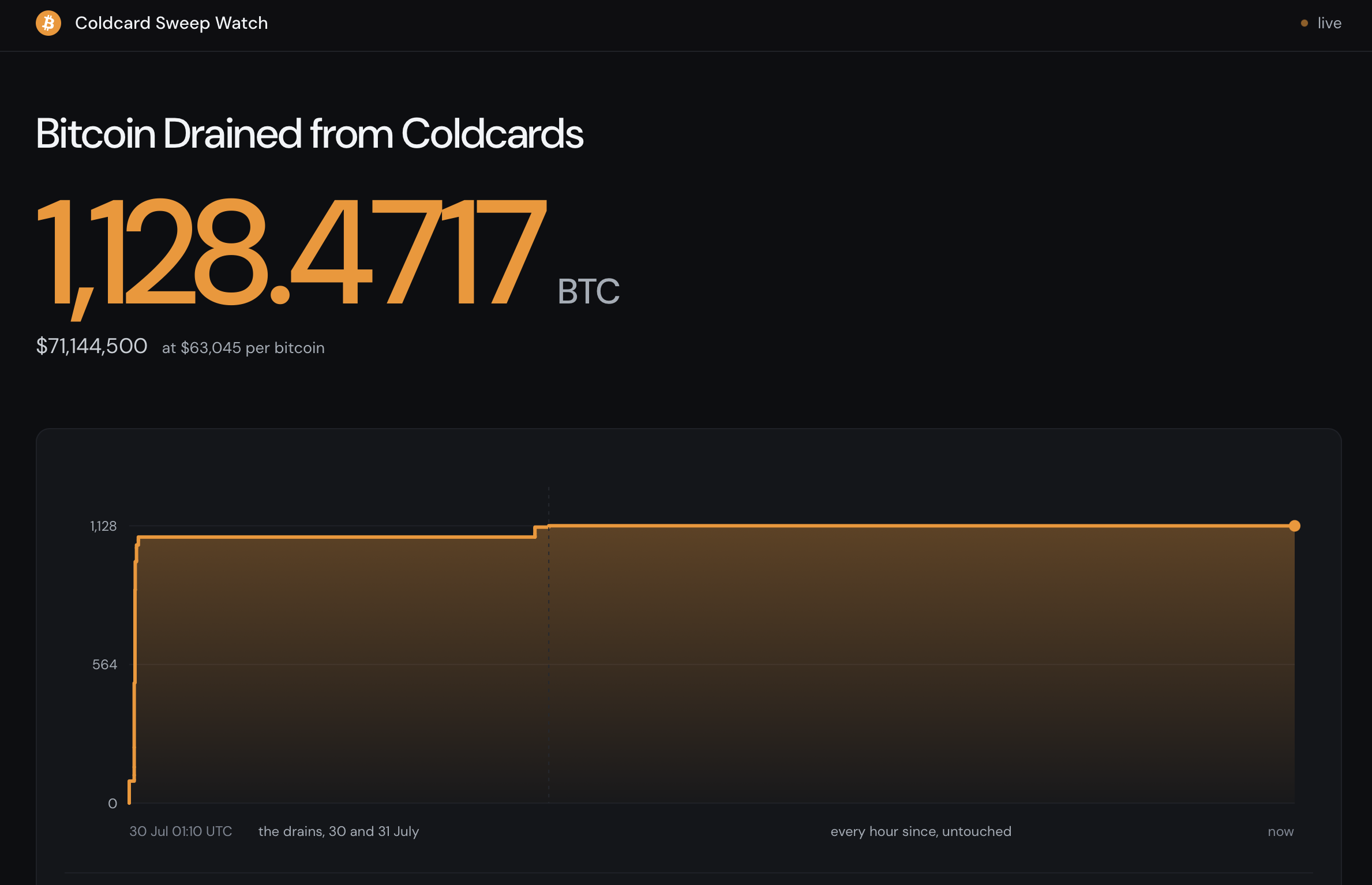
The majority of the funds were concentrated on a single address holding hundreds of bitcoins, with a significant portion of these funds having been largely dormant. The affected addresses shared one crucial detail: their recovery seeds were created on Coldcard hardware wallets manufactured by the Canadian company Coinkite.
A seed phrase is a list of words that controls access to a cryptocurrency wallet. Anyone who can recover or obtain this seed phrase can typically transfer funds from the wallet without possessing the physical device.
Coldcard Discovers Vulnerability in Random Number Generation System
Coinkite issued an urgent warning that some seeds generated on Coldcard devices might be vulnerable. Mk3 devices with firmware version 4.0.1, released around March 2021, and later versions were among those most at risk.
Further analysis expanded concerns to include seeds created on some Mk4, Mk5, and Q devices prior to Coinkite releasing emergency firmware fixes. Reportedly, Tapsigner, Opendime, and Satscard products were not affected by this vulnerability as they use different software.
The vulnerability was related to the random data generation process. Wallet security relies on high-quality randomness so that their recovery seeds cannot be guessed. Researchers estimated that on the most seriously affected Mk3 devices, the seed might have contained only about 40 bits of effective entropy instead of the intended 128 bits.
This difference is critical. A properly generated 128-bit seed is considered virtually impossible to brute-force guess. A 40-bit seed offers significantly fewer possibilities, enabling a malicious actor with sufficient computational power to test potential seeds offline and compare the resulting addresses against the public Bitcoin blockchain.
Some newer devices might have provided around 72 bits of effective entropy, as secure hardware added another layer of unpredictable data. This would have made seed recovery more difficult, though they would still remain far more vulnerable than intended.
One Configuration Error Existed for 5 Years
The problem began with a configuration error at the build stage, related to two software functions performing similar tasks. One function used the device's hardware True Random Number Generator, while the other relied on a weaker software process inherited from MicroPython.
Coinkite intended to disable the MicroPython option. However, a software check only verified the presence of a configuration flag definition, not whether its value was set to zero. Consequently, the finished firmware could silently select the weaker function.
Because both functions had identical formats, the software continued to compile and run without producing obvious errors. The error crept into the code during a software migration in 2021 and remained in the public firmware for over five years.
Updating the device now does not strengthen a seed generated by the faulty software. Affected users must create a completely new seed using the patched firmware or another secure device and then transfer their funds to addresses controlled by this new seed.
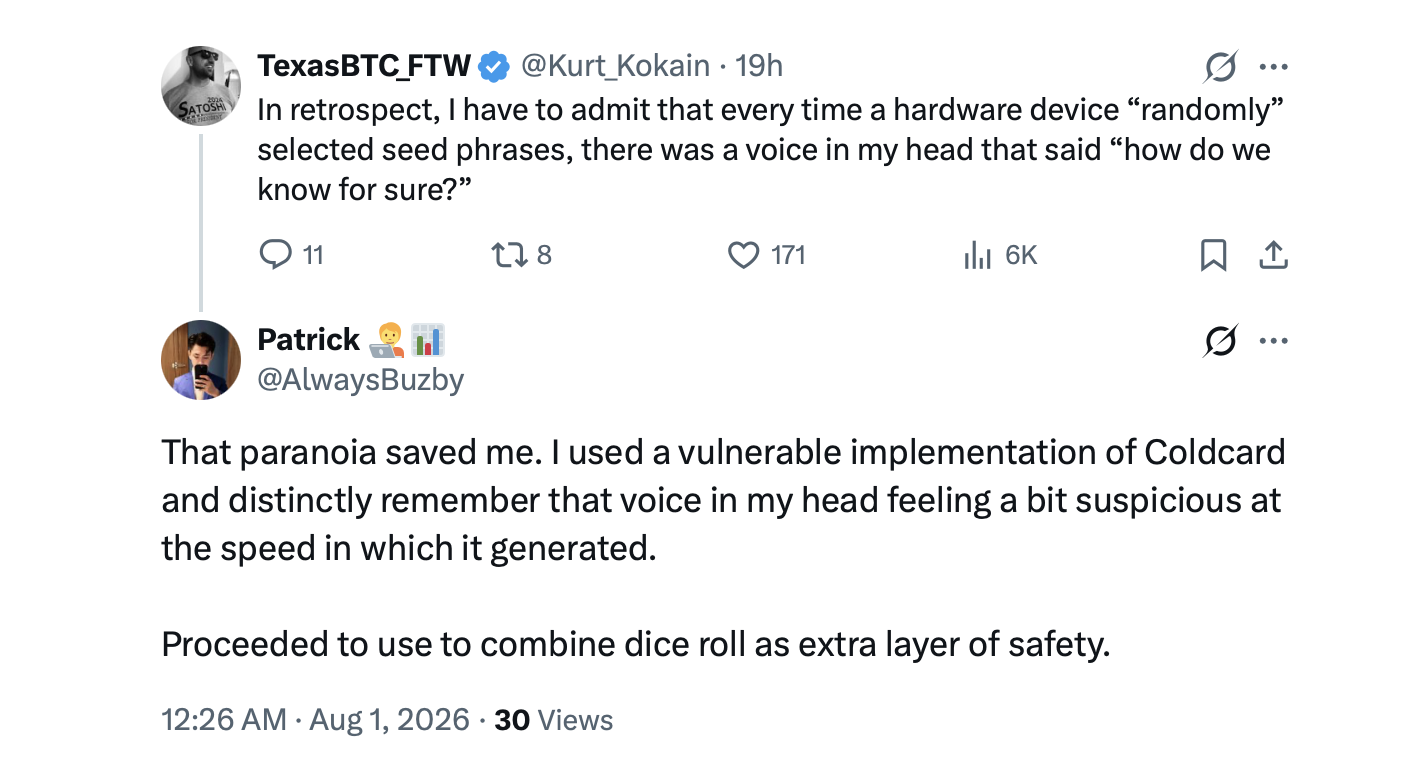
Users who added at least 50 independent dice rolls when creating their seed may have provided sufficient randomness to avoid this vulnerability. A strong BIP-39 passphrase could also have made recovery more difficult, and wallets requiring signatures from multiple independent devices could have prevented fund transfers from a single compromised seed.
Coinkite Points to AI, but Evidence Remains Lacking
Coinkite CEO Rodolfo Novak publicly apologized, stating the company takes full responsibility for the firmware failure. He reported the team is working on patched software, technical reports, and support for affected users.
Coinkite and Novak also proposed a striking theory about how the vulnerability was discovered. Given the company's firmware had been public for years, they stated they believe someone may have used AI to analyze old code versions and discover the vulnerable random number generation path.
"To all other developers: we believe this is the harsh reality of the new AI paradigm. AI code review now allows finding hidden bugs at a speed surpassing even the most seasoned industry experts," Novak wrote in his apology post on X. "If your firmware is open-source or has ever been public, assume it is already being studied by both attackers and security professionals."
Modern AI-based coding systems can process large software repositories and identify suspicious links between configuration settings, functions, and security assumptions. An attacker could instruct such a system to specifically search for weak random number generators, fallback functions, or errors affecting cryptographic keys.
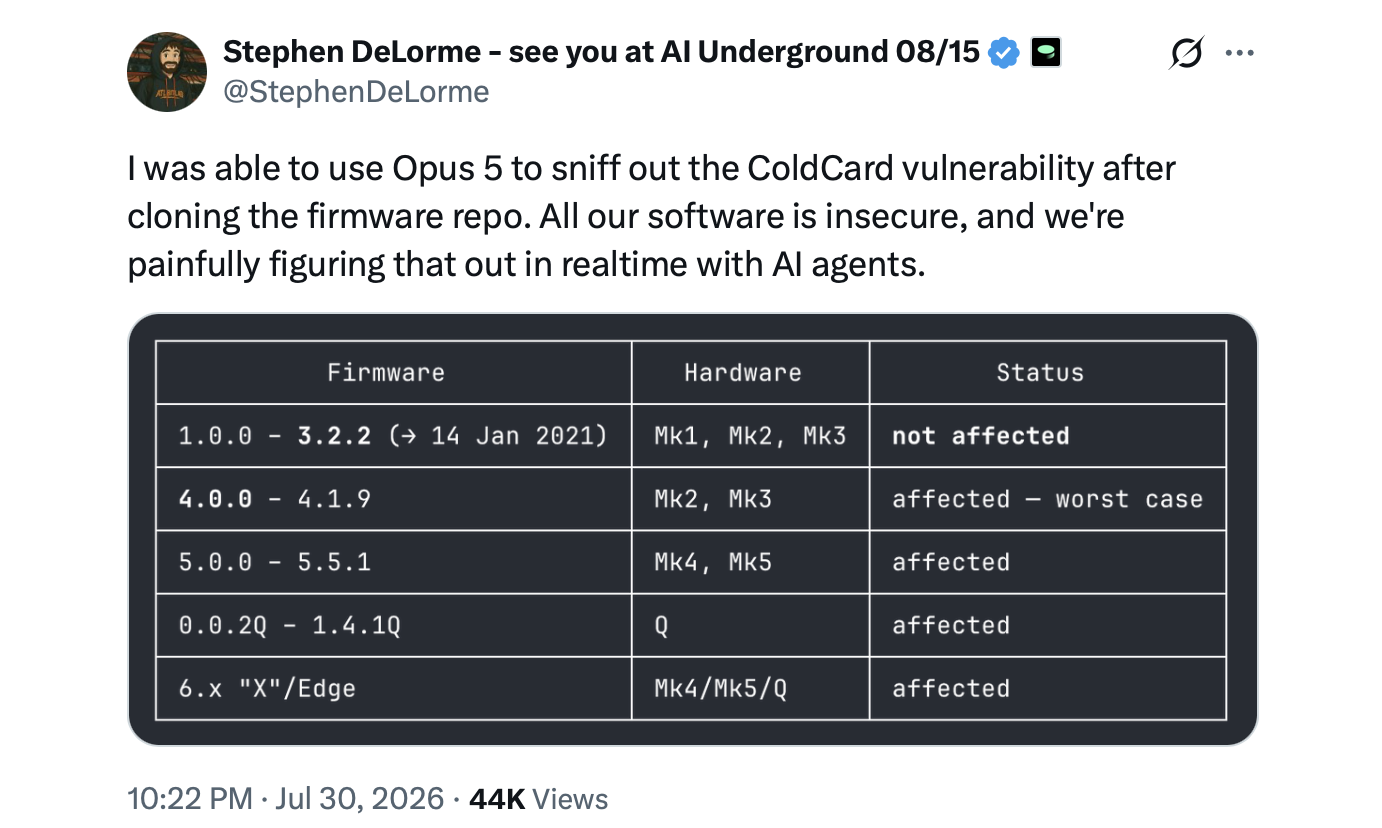
Later, independent researchers reported using AI models to detect or explain the issue after the underlying randomness problem became known. This demonstrated how accessible AI code analysis has become, but did not prove the initial attacker used AI.
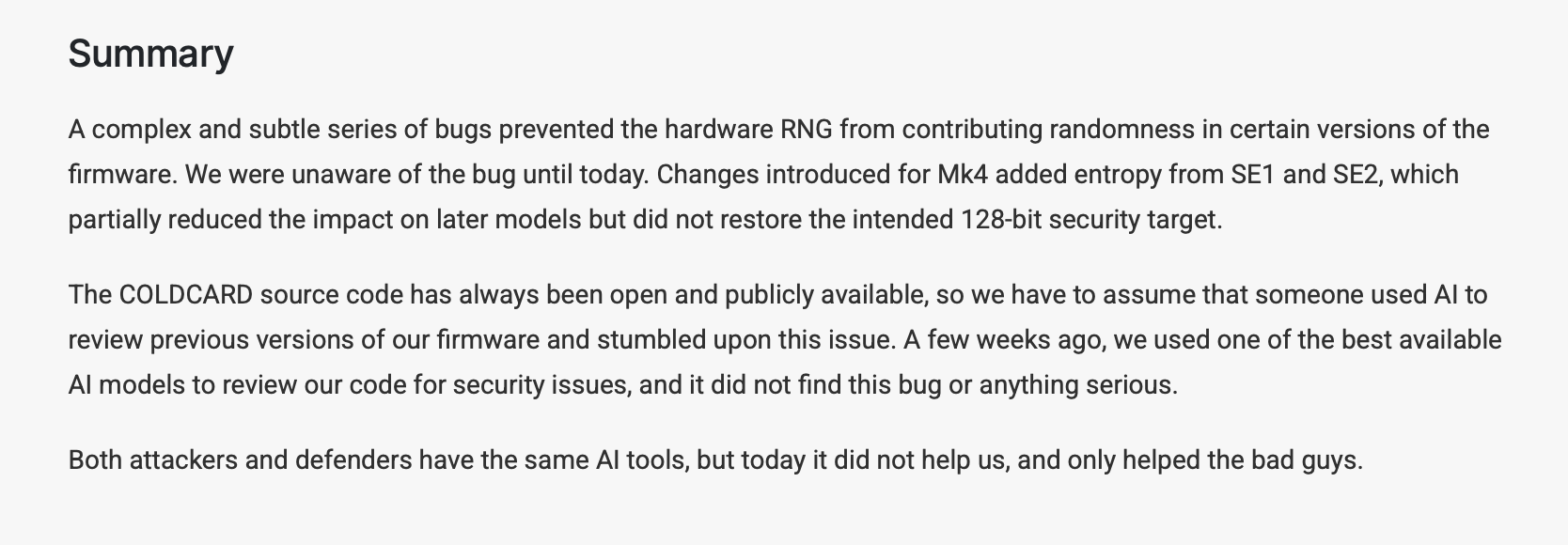
Coinkite acknowledged that its own review using a leading AI model failed to detect the vulnerability before the theft. This outcome shows AI systems do not automatically uncover all serious flaws. Their effectiveness can depend on the instructions given, the volume of code provided, and whether the human conducting the review understands the warning signs.
Critics Argue Human Error Came First
Some security experts argue that overemphasis on AI risks distracting from the underlying engineering mistake. Many believe the configuration error was a known type of software bug, and traditional code reviews, testing procedures, or audits focused on seed generation could have detected it years ago.
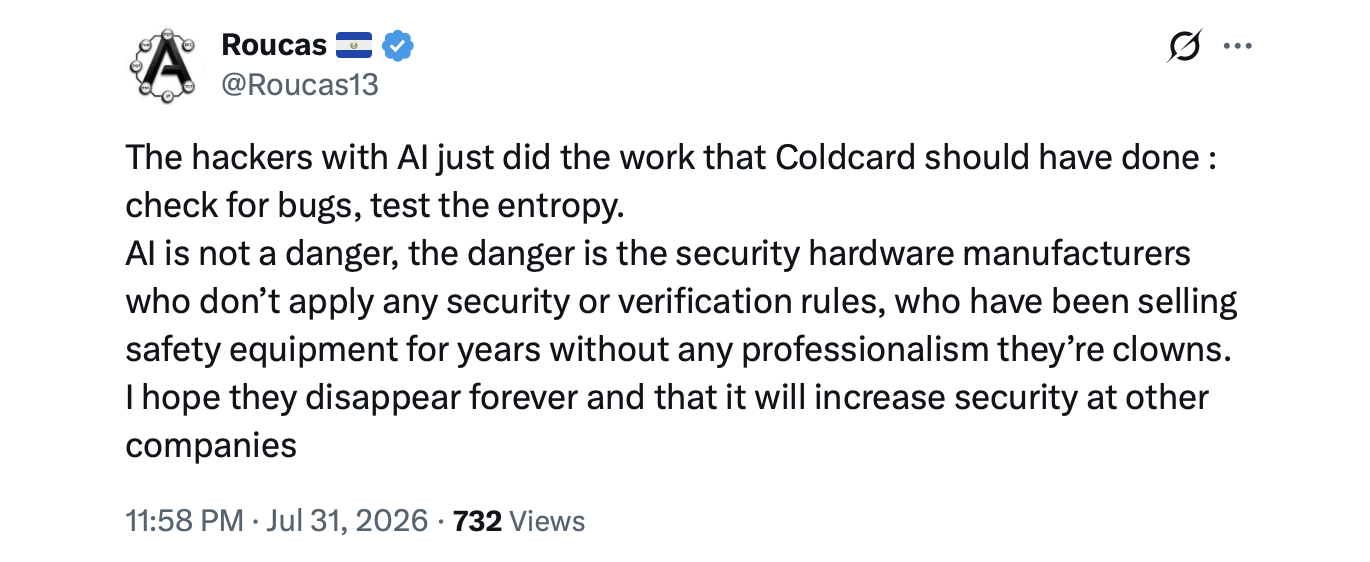
The opposing viewpoints are not necessarily incompatible. Human error created the vulnerability and allowed it to persist, while AI may have lowered the cost of discovering, understanding, or exploiting it. Defenders need to find all dangerous weak spots, whereas an attacker only needs to find one.
This incident also challenges assumptions about open-source security. Open code allows independent experts to audit software, but availability alone does not guarantee someone will analyze the right snippet, detect a subtle defect, and report it before an attacker acts.
For Coldcard users, the immediate priority is determining when and how their seed was generated. Anyone with an affected seed should check instructions via Coinkite's official channels, install patched firmware, generate a new seed, and carefully transfer funds, watching for phishing attempts and fake support messages.
In the long term, the focus will be on how much Bitcoin was stolen, whether investigators can identify the perpetrator, and whether AI played a decisive role in discovering the vulnerability. Hardware wallet manufacturers will also face pressure to strengthen entropy testing, audit build configurations, and continuously examine old code using both human experts and AI tools modeling attacks.
end-content