Dialogue with Bitwise: Institutions See the Current Moment as a Good Entry Point for Bitcoin, Requiring a Clear Roadmap to Address Quantum Attacks

marsbitPublicado a 2026-04-10Actualizado a 2026-04-10

Resumen

Bitwise CIO Matt Hougan and research lead Ryan Rasmussen discuss key catalysts that could drive Bitcoin to $95,000 by 2026. They highlight three main factors: improved macro and geopolitical stability, clearer regulatory frameworks (including the potential passage of the Clarity Act), and strong institutional demand—evidenced by over $1 billion in Bitcoin ETF inflows despite recent market uncertainty. A significant point of discussion is the rising concern around quantum computing threats to Bitcoin. Matt emphasizes the need for a clear mitigation roadmap to reassure long-term investors, particularly the "OG" crypto community, whose confidence has been affected. Both note that institutional investors view current prices as an attractive entry point and are making strategic long-term investments. The conversation also covers structural shifts in crypto, such as the growing institutional adoption of vaults (a more efficient form of asset management than ETFs), tokenization, and stablecoins. They observe a disconnect between crypto-native traders, who are emotionally reactive to price swings, and institutional or AI-focused builders, who are optimistic about blockchain’s foundational technology. Finally, they discuss the emerging importance of prediction markets (e.g., Polymarket and Kalshi), which provide more accurate real-time economic forecasts than traditional sources and offer new tools for portfolio hedging and risk management.

Source: "Milk Road" Podcast

Compiled by: Felix, PANews

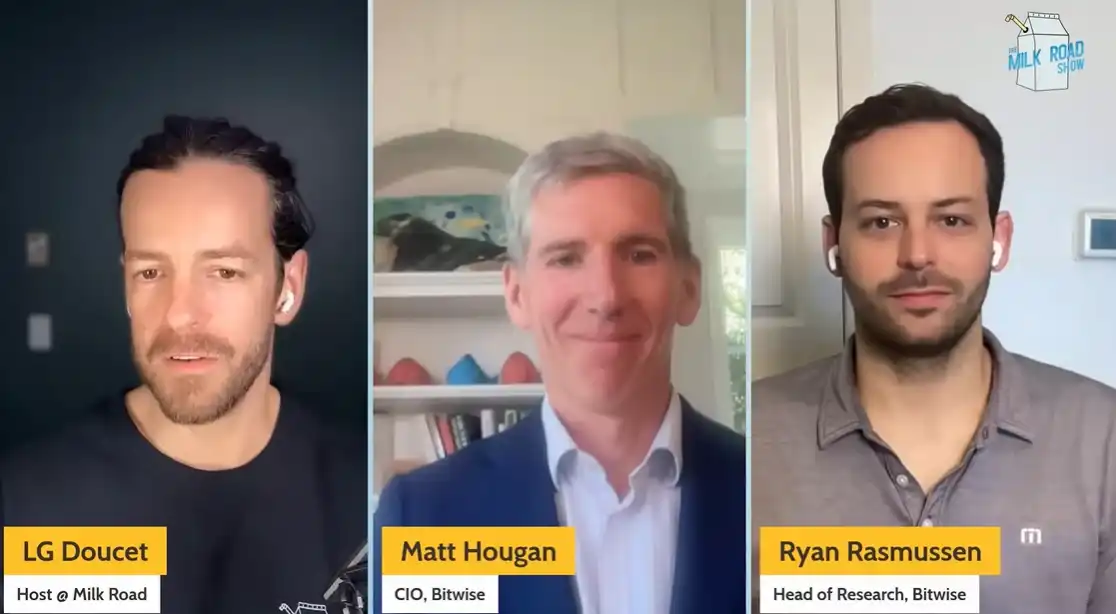
Matt Hougan, Chief Investment Officer of Bitwise, and Ryan Rasmussen, Head of Research, were guests on the "Milk Road Show" program (recorded on April 6th), delving into the true driving forces behind the current crypto market and why institutional demand might be the key to Bitcoin's next move.

They pointed out that despite the overall pessimistic sentiment in the crypto market, institutional investors are still quietly accumulating. From ETF inflows to regulatory dynamics and macroeconomic changes, there are several key signals that could propel Bitcoin to hit the $95,000 mark by 2026. PANews has compiled the highlights of the conversation.
Host: Ryan, I saw an article saying you predicted Bitcoin would reach the $95,000 range by the end of the year. Is that true?

Ryan: That was an interesting conversation because we were talking a lot about the long-term positive factors that could push the market higher. An example I gave at the time was that entering 2026, we see some specific catalysts that could bring the market back to the $95,000 level, which is the position we need to reach to break the four-year cycle. I think this is very likely to happen, and we might even close the year above $95,000. There are several very specific catalysts that will drive us to that target, of course, certain conditions also need to be met. I did say that and I believe it will happen.

Host: What are these catalysts?

Ryan: There are three specific environmental factors that need to turn in favor of Bitcoin to drive the price higher. The first is the macro and geopolitical situation. I strongly believe it will calm down in a relatively short period of time. Many people worry that this long-drawn-out conflict could last for many, many months and have ripple effects on inflation, interest rates, and the US and global economy. I don't believe that will be the case. I think this is just a relatively short-term shock that will fade, and in 6 months we'll be talking about it the same way we talk about the tariff drama or other short-term market shocks triggered by Trump. So I think the macro-geopolitical environment needs to shift from an uncertain, unstable, and persistently chaotic state to a more normalized environment. I think this will happen in the coming months. We will have Kevin Wars taking office, and I think we will see interest rates stabilize or be cut. I don't think there will be rate hikes, and this is positive for Bitcoin's price returns.

Next is regulatory clarity. Bitcoin's regulatory environment has been very uncertain, with the Clarity Act pending, but I believe the Clarity Act will pass before the 2026 window closes. I think this is positive news for Bitcoin and other crypto assets.

And the biggest catalyst (not just for 2026, but a long-term catalyst) is that institutional demand for Bitcoin is very strong. Last month, amidst all this geopolitical macro uncertainty and the regulatory uncertainty I just mentioned, we still saw over $1 billion in inflows into Bitcoin ETFs. So you can imagine what would happen from an institutional demand perspective if these things settle down and become tailwinds for cryptocurrency. I think these factors will push Bitcoin back above $95,000 by the end of the year.

Host: Is it possible that these positive developments do happen, but the conflict also continues, could they cancel each other out?

Ryan: It's possible they could cancel each other out. If we see rate hikes and the conflict lasts for 6 months or even longer, it would be difficult for any financial asset to perform relatively strongly. However, interestingly, the market's reaction to these threats or statements is starting to become less sensitive. For example, Trump issues an ultimatum, Iran responds saying it won't comply, Trump changes the deadline, each time this happens, the market's reaction diminishes. So I think this is just the market gradually desensitizing, and then other forces will take over.

Ultimately, Bitcoin's price is based on supply and demand, so institutional demand will be the strongest driver. From our conversations with investors, they see the current price as a good entry point and are making many long-term allocations in their portfolios. I don't think this long-term demand will be canceled out; whether it arrives next month, in six months, or in nine months remains to be discussed.

Host: Matt, do you sense momentum towards $95,000 by year-end?

Matt: I do think it's conditional on the things Ryan mentioned. I would add one more as another catalyst: We need some kind of resolution or clear roadmap to address the growing concerns about the quantum computing threat to Bitcoin. The only place I might disagree with Ryan is that if all our cards flip positive, I think the price will be well above $95,000; if it's mixed, we might trade sideways; if all factors worsen, we might close at a lower level. My view has greater dispersion. But if we get regulatory clarity, the Iran issue is resolved, and we address the quantum computing issue, I think the year-end will be fantastic. But it requires a series of events to develop favorably.

Host: Is the quantum computing issue really that easy to solve? I recently interviewed some guests, and it sounds a bit complicated; you need to get everyone in the Bitcoin space to re-reach consensus to solve this. And the Ethereum Foundation seems more proactive lately, and the system is very different. Is this a problem that can be solved or prevented quickly in Bitcoin?

Matt: My view is that the things you want to see happening to address the quantum threat are indeed happening. That is, high-credibility people are raising concerns, and more such people are doing so, so the community is paying more serious attention and is willing to weigh the pros and cons. In terms of preparedness, we are in a much better place today than we were 12 months ago. I don't think we need to solve all problems; we need a reliable roadmap to unlock the demand from those "OG" investors, leading us out of winter and into the spring of the four-year cycle. This is not to say that Ethereum has completely solved the problem; they just have a reliable roadmap. If we also have a reliable roadmap and commitment, it should be enough to bring the early OG investors back to the market. I think institutional investors will come regardless because they realize their zero allocation to Bitcoin is a deviation from the market and is no longer a tolerable position. My point is, to break through the upside potential Ryan mentioned of $95,000, we need to get those OG crypto players, retail crypto players involved, and I think they will want a clear roadmap.

Host: You mean these OGs must feel that after Google's and last week's various warnings, the situation is being handled or will soon be under control. So Matt, for those OGs who started selling off their holdings heavily last year, was this concern initially the reason for the loss of demand?

Matt: Yes. I generally think single-cause explanations are wrong, but was it a contributing factor? Yes. Was it as important as the four-year cycle and avoiding a historic 75% drawdown? No. But it was certainly an excuse for people to adjust their exposure emotionally before the four-year cycle arrived. So it's a bit complicated, but it was indeed a factor, and people's attention to it has risen significantly. And I think that's good; it shows the system is self-correcting. But I do think that if well organized, it could become a catalyst at this time.

Host: Ryan, was this quantum issue discussed at the Digital Asset Summit? If not, what were people talking about?

Ryan: Quantum computing was indeed mentioned at the Digital Asset Summit, but not as much as you might think. And Google's article accelerating the quantum risk timeline was actually published after the conference, so it only gained more attention last week. I would say most of the attention at the summit was focused on institutional adoption, regulatory clarity, and things like tokenization, stablecoins, and vaults, with less focus on quantum risk, although it is indeed a concern for investors. Over the past month, many investors have asked about quantum risk for Bitcoin and Ethereum. They see communication about efforts to address these risks, which gives them some comfort, but we really need to see substantive action taken to truly alleviate long-term concerns.

Host: Ryan, you said institutional investors are "curious." Does this mean there is still an information gap, they don't understand these assets, or are they trying to get internal buy-in? What do you mean by "curious"?

Ryan: When you talk to different institutional investors and professional investors about how much attention they pay to the crypto industry and specific developments within the industry, you find it's a wide range. Many professional investors spend very little time thinking about Bitcoin or crypto more broadly. Their information about this space usually comes from Wall Street Journal or CNBC headlines, or hearing people on CNBC talk about potential risks in the market. So when they hear about quantum computing, or Google publishing an important paper that catches their attention, they come to ask us: How big is this risk really? You, as professional asset managers who focus on this space 24/7 and talk to Bitcoin core developers and donate to support them, what is your take? So the information gap is that they rely on us to understand what is real and what is noise.

Host: Matt, at the summit, what else was top of mind for the institutional crowd regarding risks or opportunities? Or what did you learn that was previously underestimated?

Matt: One big takeaway for me is how the attire of people at the summit has changed over the past five years. Five years ago, probably only two or three people wore suits; this year, 80% to 85% of people wore suits, which is remarkable. This shows that there is an unstoppable institutional bull market in the crypto space, reflected in stablecoins, tokenization, and vaults; the very nature of cryptocurrency is undergoing a real evolution. You just have to compare photos of the summit audience from 2020 and now to see a huge shift. Another hot topic was "Vaults." There was tremendous interest in vaults, which I describe as the next ETF. I think the level of institutional interest in vaults even exceeds the current actual assets and growth in that market.

Host: What exactly is the difference between an ETF and a Vault?

Matt: Historically, asset management solved the problem of individuals wanting to invest in markets but not being able to get the diversified allocation and management they needed (because it wasn't their full-time job), so they gave money to asset managers to deploy. 300 years ago (17th century), asset management was very clunky and expensive. By the 1920s, we had open-ended funds; in the 1990s, we had ETFs, making it more efficient. The difference with Vaults compared to ETFs is that they further increase this efficiency. In the traditional world, asset management firms handle custody, auditing, tax reporting, etc., and combine that with the intellectual property (IP) of where the investment goes. Vaults strip away all those "real-world cumbersome tasks" and leave only the IP. Investors put funds into a smart contract, which allocates according to the asset manager's operations. Therefore, it is a more streamlined, efficient, perfect version of asset management, leaving the other cumbersome parts for the individual to manage themselves.

Host: Ryan, I have a question. Are Vaults an area where AI will have a huge impact? Because as Matt described, it sounds like it will involve very advanced strategies. I'm asking you because last week you shared a tweet saying that people working on AI are more excited about cryptocurrency than people working in cryptocurrency.

Ryan: Absolutely. That was a very intriguing tweet. In the past 6 to 9 months, crypto sentiment has been near historical lows, close to the lows of the 2022 FTX crash, prices have fallen sharply, liquidity has dried up. But when you talk to institutional investors, they don't see a price bear market; they see the positive factors that will drive the market higher in the long term: vaults, tokenization, stablecoins, etc. And when you talk to people building AI products, they see many benefits of the underlying technology: AI needs to solve identity proof, which crypto/blockchain does very well; it needs to solve privacy, which crypto does well; it needs a way for AI agents to transact without accessing bank accounts, which stablecoins and blockchain are also very good at. So, AI developers see synergies and are extremely bullish; institutional investors see synergies between traditional finance and crypto technology and are increasingly bullish. And crypto-native investors only see falling prices, dried-up liquidity, constant liquidations, meme coin collapses, and think it's all over. It's a huge disconnect. It's like cryptocurrency holding an umbrella in the rain in a sunny place.

Host: Why is the crypto circle so emotional? Is it because it's more volatile? Can it break free from this emotional roller coaster?

Ryan: I think this is partly a difference in investment time horizons. Many crypto investors entered this space because they wanted to gain a lot of wealth in a relatively short period of time to get ahead of institutions. As the market goes through boom and bust cycles, people become disillusioned and deeply affected. The professional investors we deal with at wealth management firms and platforms are usually long-term oriented. They plan for clients' retirements over 5 or even 45 years, they see the big trends and get excited. Crypto investors, due to over-concentration, exhibit highly emotional behavior when the market fluctuates, which is extremely dangerous in investing. Professional investors are better at systematically investing for long-term returns; they are positioning now because they foresee this technology paying off in 10 years.

Matt: I think that's right. I would also add that certain areas of the crypto market (like meme coins, alt L1s, vaporware apps) are indeed in "winter." Many people hold these assets, and the outlook is indeed bleak. This is completely different from the mindset of making an initial allocation from scratch. If you are entering now and see stablecoins and tokenization poised to boom, and these assets are down 50%, you might think it's an opportunity. But if you hold assets that are down 90% and might fall another 99%, the perspective is of course completely different.

Host: Matt, you published a great memo today answering the five biggest questions about prediction markets. As a professional "Degen," I love betting on all sorts of weird things, but prediction markets currently face a lot of controversy and problems. You hinted in your article that prediction markets are one of the most important tools in finance. Why is that?

Matt: Because they provide the world with new, critical information and are also useful portfolio tools. First is the quality of information. We are all frustrated that the Fed is always looking at lagging data, employment data is often revised significantly, which has a huge impact on economic and investor decisions. If we can improve the quality of economic data, the world will function better.

I mentioned a Fed paper in my article that showed prediction markets like Kalshi (even though they are still small) are already more accurate than Bloomberg's top economists and the Fed's own survey of expectations in predicting Fed rate cuts, GDP, CPI, etc., and it's real-time. From a portfolio perspective, the real world is affected by political and economic events. If you think Elizabeth Warren will become SEC chair after the next election, it will impact crypto, but you currently have no way to cleanly hedge that probability. It's not just crypto; defense stocks, AI stocks will be affected, and our current portfolios cannot express this. Packaging these risks through prediction markets would be a very valuable hedging tool. Are they perfect? No. Do some markets need cleaning up? Absolutely. But overall, I think they are very positive things.

Host: The biggest skepticism prediction markets face is: This is just another form of gambling, especially when tied to cryptocurrency, like meme coins. How do you respond to that?

Matt: Some of it is indeed gambling. If you bet on a football game on a prediction market, it's no different from going to a sportsbook, and that's fine. But if you are predicting the outcome of Fed rates, this is equivalent to the CME's Fed Funds Futures market, where the world's largest financial institutions trade $5 to $15 trillion daily, and we call that investment. Prediction markets can encompass both. We can separate complex financial investment/hedging from sports or pop culture events. They are very powerful tools.

Host: Will these prediction markets bifurcate in the future? For example, going to Polymarket now you see thousands of topics, which is dazzling. Will there be prediction markets in the future that specialize only in financial categories?

Matt: I think that is absolutely possible. When we were considering applying to launch a prediction market ETF, we were certainly looking at financial market indicators, not Taylor Swift's concert revenue. Just like the existing ETF market, there are the simplest S&P 500 ETFs, and there are 3x leveraged single-stock ETFs. Search tools will clearly distinguish between ordinary and special ETFs. So as more financial users embrace these markets, I think they will differentiate, and I wouldn't be surprised to see sports betting separate out, especially since that area has additional legal litigation risks.

Ryan: For investors, I feel prediction markets give investors the ability to express their views on a certain binary outcome, and this ability is very important. In the past, it was difficult to decompose the expectation of someone winning an election and implement it into a complex cross-asset class portfolio of commodities, tech, gold, bonds, etc. Prediction markets greatly simplify the ability of investors to hedge their portfolios or plan. Wrapping financial products like ETFs around specific prediction market events will make the operation very straightforward and easy. Also, as Matt mentioned, the accuracy of prediction markets on macro or economic events (like Kalshi) even exceeds traditional polls and expert consensus; the accuracy of aggregated information is very powerful.

Matt: I very much agree. Another thing not said explicitly is that in the past, the world's largest institutions had their own methods to get these odds directly (e.g., hedge funds paying high-priced lobbyists to go to Washington to get information). What I like about prediction markets is that they surface this information and show it to every investor; it's a more level playing field. This has an egalitarian advantage and is very important for the fairness of the investment ecosystem.

Host: Could there be a day when people no longer watch the news, but instead look directly at the information provided by Polymarket?

Matt: This is my favorite point. I think Polymarket should have won a Pulitzer Prize for its coverage of Trump's election victory. It was the only place that accurately said what was going to happen, better than polls, better than every media outlet. If that's not news, then I don't know what is. That was the most important news story of the year, and it was the only one that got it right. So I think many people will look at Polymarket and Kalshi as much as they look at the New York Times and Wall Street Journal to understand what is happening in the world, and they will probably get better information because of it.

Related reading: Dialogue with Bloomberg ETF Analyst: Why Bitcoin ETF Holders Didn't Sell During the 50% Plunge


Preguntas relacionadas

QWhat are the three key catalysts that Ryan Rasmussen believes could drive Bitcoin to $95,000 by the end of the year?

AThe three key catalysts are: 1) A resolution or stabilization of the current macro and geopolitical tensions, leading to a more normalized environment with stable or lower interest rates. 2) Regulatory clarity, specifically the passage of the Clarity Act. 3) Strong and sustained institutional demand for Bitcoin, as evidenced by significant ETF inflows.

QAccording to Matt Hougan, what additional catalyst does Bitcoin need to reach a significantly higher price, beyond the factors mentioned by Ryan?

AMatt Hougan states that Bitcoin needs a clear resolution or a reliable roadmap to address the growing concerns about the threat of quantum computing to the Bitcoin network.

QHow does Ryan Rasmussen describe the current sentiment disparity between AI builders, institutional investors, and crypto-native investors?

ARyan describes a significant disconnect: AI builders are extremely bullish on crypto because they see the underlying benefits of blockchain for solving identity, privacy, and transaction problems for AI agents. Institutional investors are also increasingly bullish, focusing on long-term positive drivers like vaults, tokenization, and stablecoins. In contrast, crypto-native investors, who are highly concentrated and emotional, are bearish because they only see the current price decline, low liquidity, and meme coin crashes.

QWhat is the fundamental difference between an ETF and a 'Vault' as explained by Matt Hougan?

AMatt Hougan explains that an ETF bundles together the intellectual property (the investment strategy) with the 'real-world plumbing' like custody, auditing, and tax reporting. A Vault, however, is a more efficient and simplified version that strips away all that real-world complexity, leaving only the intellectual property. Investors put funds into a smart contract that allocates them based on the asset manager's strategy.

QWhy does Matt Hougan believe prediction markets are such an important financial tool?

AMatt Hougan believes prediction markets are crucial for two main reasons: 1) They provide higher-quality, real-time information about economic and political events, often outperforming traditional sources like economist surveys. 2) They serve as valuable portfolio tools, allowing investors to hedge against specific event risks (like political elections) that are difficult to hedge with traditional investment vehicles, thereby creating a more level playing field for all investors.

Lecturas Relacionadas

Arbitrum Pretends to Be the Hacker, 'Steals' Back the Money Lost by KelpDAO

Title: Arbitrum Poses as Hacker to Recover Stolen Funds from KelpDAO Last week, KelpDAO suffered a hack resulting in nearly $300 million in losses, marking the largest DeFi security incident this year. Approximately 30,765 ETH (worth over $70 million) remained on an Arbitrum address controlled by the attacker. In an unprecedented move, Arbitrum’s Security Council utilized its emergency authority to upgrade the Inbox bridge contract, adding a function that allowed them to impersonate the hacker’s address and initiate a transfer without access to its private key. The council’s action, approved by 9 of its 12 members, moved the stolen ETH to a frozen address in a single transaction before reverting the contract to its original state. The operation was coordinated with law enforcement, which attributed the attack to North Korea’s Lazarus Group. Community reactions are divided: some praise the recovery of funds, while others question the centralization of power, as the council can upgrade core contracts without governance votes. However, such emergency mechanisms are common among major L2s. Despite the partial recovery, over $292 million was stolen in total, with more than $100 million in bad debt on Aave and remaining funds scattered across other chains. The incident highlights escalating security challenges in DeFi, with state-sponsored hackers employing advanced tactics and L2s responding with elevated countermeasures.

marsbitHace 2 min(s)

Arbitrum Pretends to Be the Hacker, 'Steals' Back the Money Lost by KelpDAO

marsbitHace 2 min(s)

iQiyi Is Too Impatient

The article "iQiyi Is Too Impatient" discusses the controversy surrounding the Chinese streaming platform IQiyi's recent announcement of an "AI Actor Library" during its 2026 World Conference. IQiyi claimed over 100 actors, including well-known names like Zhang Ruoyun and Yu Hewei, had joined the initiative. CEO Gong Yu suggested AI could enable actors to "star in 14 dramas a year instead of 4" and that "live-action filming might become a world cultural heritage." The announcement quickly sparked backlash. Multiple actors named in the list issued urgent statements denying they had signed any AI-related authorization agreements. This forced IQiyi to clarify that inclusion in the library only indicated a willingness to *consider* AI projects, with separate negotiations required for any specific role. The incident, which trended on social media with hashtags like "IQiyi is crazy," is presented as a sign of the company's growing desperation. Facing intense competition from short-video platforms like Douyin and Kuaishou, as well as Bilibili and Xiaohongshu, IQiyi's financial performance has weakened, with revenues declining for two consecutive years. The author argues that IQiyi is "too impatient" to tell a compelling AI story to reassure the market, especially as it pursues a listing on the Hong Kong stock exchange. The piece concludes by outlining three key "AI questions" IQiyi must answer: defining its role as a tool provider versus a content creator, balancing the "coldness" of AI with the human element audiences desire, and properly managing the interests of platforms, actors, and viewers. The core dilemma is that while AI can reduce costs and increase efficiency, it risks creating homogenized, formulaic content and devaluing human performers.

marsbitHace 56 min(s)

iQiyi Is Too Impatient

marsbitHace 56 min(s)

Trading

Spot
Futuros

Artículos destacados

Qué es BITCOIN

Entendiendo HarryPotterObamaSonic10Inu (ERC-20) y Su Posición en el Espacio Cripto En los últimos años, el mercado de criptomonedas ha sido testigo de un aumento en la popularidad de las monedas meme, capturando el interés no solo de los comerciantes, sino también de aquellos que buscan compromiso comunitario y valor de entretenimiento. Entre estos tokens únicos se encuentra HarryPotterObamaSonic10Inu (ERC-20), un proyecto intrigante que mezcla referencias culturales en el tejido de las criptomonedas. Este artículo profundiza en los aspectos clave de HarryPotterObamaSonic10Inu, explorando sus mecanismos, ethos impulsado por la comunidad y su relación con el paisaje cripto más amplio. ¿Qué es HarryPotterObamaSonic10Inu (ERC-20)? Como su nombre sugiere, HarryPotterObamaSonic10Inu es una moneda meme construida sobre la blockchain de Ethereum, clasificada bajo el estándar ERC-20. A diferencia de las criptomonedas tradicionales que pueden enfatizar la utilidad práctica o el potencial de inversión, este token prospera en el valor de entretenimiento y la fuerza de su comunidad. El proyecto tiene como objetivo fomentar un entorno donde los usuarios comprometidos puedan reunirse, compartir ideas y participar en actividades inspiradas por diversos fenómenos culturales. Una característica notable de HarryPotterObamaSonic10Inu es su cero impuestos en las transacciones. Este atractivo elemento tiene como objetivo incentivar el comercio y la participación comunitaria, sin cargos adicionales que puedan disuadir a los comerciantes de pequeña escala. El suministro total de la moneda está establecido en mil millones de tokens, una cifra que marca su intención de mantener una circulación sustancial dentro de la comunidad. Creador de HarryPotterObamaSonic10Inu (ERC-20) Los orígenes de HarryPotterObamaSonic10Inu están algo envueltos en misterio; los detalles sobre el creador siguen siendo desconocidos. El desarrollo de este token carece de un equipo identificable o de un plan explícito, lo cual no es inusual dentro del sector de monedas meme. En cambio, el proyecto ha surgido de manera orgánica, con su progreso muy dependiente del entusiasmo y la participación de su comunidad. Inversores de HarryPotterObamaSonic10Inu (ERC-20) En cuanto a inversiones externas y respaldo, HarryPotterObamaSonic10Inu también sigue siendo ambiguo. El token no lista ninguna fundación de inversión conocida o apoyo organizacional significativo. En cambio, la savia del proyecto es su comunidad de base, que informa su crecimiento y sostenibilidad a través de la acción colectiva y el compromiso en el espacio cripto. ¿Cómo Funciona HarryPotterObamaSonic10Inu (ERC-20)? Como una moneda meme, HarryPotterObamaSonic10Inu opera principalmente fuera de los marcos tradicionales que a menudo rigen el valor de los activos. Hay varios aspectos distintivos que definen cómo funciona el proyecto: Transacciones Sin Impuestos: Sin tarifas impositivas en las transacciones, los usuarios pueden comprar y vender el token libremente sin preocuparse por costos ocultos. Compromiso Comunitario: El proyecto prospera en la interacción comunitaria, aprovechando plataformas de redes sociales para crear entusiasmo y facilitar la participación. Las discusiones, el intercambio de contenido y el compromiso son elementos cruciales que ayudan a expandir su alcance y fomentar la lealtad entre los seguidores. Sin Utilidad Práctica: Cabe señalar que HarryPotterObamaSonic10Inu no ofrece utilidad concreta dentro del ecosistema financiero. Más bien, se clasifica como un token principalmente para actividades de entretenimiento y comunitarias. Referencia Cultural: El token incorpora astutamente elementos de la cultura popular para atraer interés, conectando con entusiastas de los memes y seguidores de las criptomonedas por igual. HarryPotterObamaSonic10Inu ejemplifica cómo las monedas meme operan de manera diferente a los proyectos de criptomonedas más tradicionales, ingresando al mercado como construcciones sociales innovadoras en lugar de activos utilitarios. Cronología de HarryPotterObamaSonic10Inu (ERC-20) La historia de HarryPotterObamaSonic10Inu está marcada por varios hitos notables: Creación: El token surgió de un meme viral, capturando la imaginación de muchos entusiastas de las criptomonedas. Las fechas específicas de creación no están disponibles, subrayando su ascenso orgánico. Listado en Exchanges: HarryPotterObamaSonic10Inu ha llegado a varios exchanges, permitiendo un acceso y comercio más fácil por parte de la comunidad. Iniciativas de Compromiso Comunitario: Actividades continuas destinadas a mejorar la interacción comunitaria, incluyendo concursos, campañas en redes sociales y generación de contenido por parte de fanáticos y defensores. Planes de Expansión Futuros: La hoja de ruta del proyecto incluye el lanzamiento de una colección de NFT, mercancía y un sitio de comercio electrónico relacionado con sus temas culturales, involucrando aún más a la comunidad e intentando añadir más dimensiones a su ecosistema. Puntos Clave Sobre HarryPotterObamaSonic10Inu (ERC-20) Naturaleza Impulsada por la Comunidad: El proyecto prioriza la participación colectiva y la creatividad, asegurando que la involucración de los usuarios esté a la vanguardia de su desarrollo. Clasificación como Moneda Meme: Representa la epítome de las criptomonedas basadas en el entretenimiento, diferenciándose de los vehículos de inversión tradicionales. Sin Afiliación Directa con Bitcoin: A pesar de la similitud en el nombre del ticker, HarryPotterObamaSonic10Inu es distinto y no tiene relación con Bitcoin u otras criptomonedas establecidas. Enfoque en la Colaboración: HarryPotterObamaSonic10Inu está diseñado para crear un espacio para la colaboración y el intercambio de historias entre sus poseedores, proporcionando una vía para la creatividad y el vínculo comunitario. Perspectivas Futuras: La ambición de expandirse más allá de su premisa inicial hacia NFTs y mercancías describe un camino para que el proyecto potencialmente ingrese a avenidas más tradicionales dentro de la cultura digital. A medida que las monedas meme continúan capturando la imaginación de la comunidad de criptomonedas, HarryPotterObamaSonic10Inu (ERC-20) se destaca debido a sus lazos culturales y su enfoque centrado en la comunidad. Si bien puede no encajar en el molde típico de un token impulsado por la utilidad, su esencia radica en la alegría y la camaradería fomentadas entre sus seguidores, destacando la naturaleza en evolución de las criptomonedas en una era cada vez más digital. A medida que el proyecto continúa desarrollándose, será importante observar cómo las dinámicas comunitarias influyen en su trayectoria en el cambiante paisaje de la tecnología blockchain.

1.3k Vistas totalesPublicado en 2024.04.01Actualizado en 2024.12.03

Qué es BITCOIN

Cómo comprar BTC

¡Bienvenido a HTX.com! Hemos hecho que comprar Bitcoin (BTC) sea simple y conveniente. Sigue nuestra guía paso a paso para iniciar tu viaje de criptos.Paso 1: crea tu cuenta HTXUtiliza tu correo electrónico o número de teléfono para registrarte y obtener una cuenta gratuita en HTX. Experimenta un proceso de registro sin complicaciones y desbloquea todas las funciones.Obtener mi cuentaPaso 2: ve a Comprar cripto y elige tu método de pagoTarjeta de crédito/débito: usa tu Visa o Mastercard para comprar Bitcoin (BTC) al instante.Saldo: utiliza fondos del saldo de tu cuenta HTX para tradear sin problemas.Terceros: hemos agregado métodos de pago populares como Google Pay y Apple Pay para mejorar la comodidad.P2P: tradear directamente con otros usuarios en HTX.Over-the-Counter (OTC): ofrecemos servicios personalizados y tipos de cambio competitivos para los traders.Paso 3: guarda tu Bitcoin (BTC)Después de comprar tu Bitcoin (BTC), guárdalo en tu cuenta HTX. Alternativamente, puedes enviarlo a otro lugar mediante transferencia blockchain o utilizarlo para tradear otras criptomonedas.Paso 4: tradear Bitcoin (BTC)Tradear fácilmente con Bitcoin (BTC) en HTX's mercado spot. Simplemente accede a tu cuenta, selecciona tu par de trading, ejecuta tus trades y monitorea en tiempo real. Ofrecemos una experiencia fácil de usar tanto para principiantes como para traders experimentados.

4.6k Vistas totalesPublicado en 2024.12.12Actualizado en 2025.03.21

Cómo comprar BTC

Qué es $BITCOIN

ORO DIGITAL ($BITCOIN): Un Análisis Integral Introducción al ORO DIGITAL ($BITCOIN) ORO DIGITAL ($BITCOIN) es un proyecto basado en blockchain que opera en la red Solana, cuyo objetivo es combinar las características de los metales preciosos tradicionales con la innovación de las tecnologías descentralizadas. Aunque comparte un nombre con Bitcoin, a menudo referido como “oro digital” debido a su percepción como un refugio de valor, ORO DIGITAL es un token separado diseñado para crear un ecosistema único dentro del paisaje Web3. Su meta es posicionarse como un activo digital alternativo viable, aunque los detalles sobre sus aplicaciones y funcionalidades aún están en desarrollo. ¿Qué es ORO DIGITAL ($BITCOIN)? ORO DIGITAL ($BITCOIN) es un token de criptomoneda diseñado explícitamente para su uso en la blockchain de Solana. A diferencia de Bitcoin, que proporciona un papel de almacenamiento de valor ampliamente reconocido, este token parece centrarse en aplicaciones y características más amplias. Aspectos notables incluyen: Infraestructura Blockchain: El token está construido sobre la blockchain de Solana, conocida por su capacidad para manejar transacciones de alta velocidad y bajo costo. Dinámicas de Suministro: ORO DIGITAL tiene un suministro máximo limitado a 100 cuatrillones de tokens (100P $BITCOIN), aunque los detalles sobre su suministro circulante no se han divulgado actualmente. Utilidad: Si bien las funcionalidades precisas no están delineadas explícitamente, hay indicios de que el token podría ser utilizado para diversas aplicaciones, potencialmente involucrando aplicaciones descentralizadas (dApps) o estrategias de tokenización de activos. ¿Quién es el Creador de ORO DIGITAL ($BITCOIN)? En la actualidad, la identidad de los creadores y el equipo de desarrollo detrás de ORO DIGITAL ($BITCOIN) sigue siendo desconocida. Esta situación es típica entre muchos proyectos innovadores dentro del espacio blockchain, particularmente aquellos alineados con las finanzas descentralizadas y fenómenos de monedas meme. Si bien tal anonimato puede fomentar una cultura impulsada por la comunidad, intensifica las preocupaciones sobre la gobernanza y la responsabilidad. ¿Quiénes son los Inversores de ORO DIGITAL ($BITCOIN)? La información disponible indica que ORO DIGITAL ($BITCOIN) no tiene patrocinadores institucionales conocidos ni inversiones destacadas de capital de riesgo. El proyecto parece operar en un modelo de peer-to-peer centrado en el apoyo y la adopción de la comunidad en lugar de rutas de financiamiento tradicionales. Su actividad y liquidez se sitúan principalmente en intercambios descentralizados (DEX), como PumpSwap, en lugar de plataformas de trading centralizadas establecidas, lo que resalta aún más su enfoque de base. Cómo Funciona ORO DIGITAL ($BITCOIN) Los mecanismos operativos de ORO DIGITAL ($BITCOIN) pueden elaborarse en función de su diseño blockchain y atributos de red: Mecanismo de Consenso: Al aprovechar el único proof-of-history (PoH) de Solana combinado con un modelo de proof-of-stake (PoS), el proyecto asegura una validación de transacciones eficiente que contribuye al alto rendimiento de la red. Tokenómica: Si bien los mecanismos deflacionarios específicos no se han detallado extensamente, el vasto suministro máximo de tokens implica que podría atender microtransacciones o casos de uso nicho que aún están por definirse. Interoperabilidad: Existe el potencial de integración con el ecosistema más amplio de Solana, incluyendo varias plataformas de finanzas descentralizadas (DeFi). Sin embargo, los detalles sobre integraciones específicas permanecen no especificados. Cronología de Eventos Clave Aquí hay una cronología que destaca hitos significativos relacionados con ORO DIGITAL ($BITCOIN): 2023: El despliegue inicial del token ocurre en la blockchain de Solana, marcado por su dirección de contrato. 2024: ORO DIGITAL gana visibilidad al estar disponible para trading en intercambios descentralizados como PumpSwap, permitiendo a los usuarios comerciar contra SOL. 2025: El proyecto presencia actividad de trading esporádica y potencial interés en compromisos liderados por la comunidad, aunque no se han documentado asociaciones notables o avances técnicos hasta el momento. Análisis Crítico Fortalezas Escalabilidad: La infraestructura subyacente de Solana soporta altos volúmenes de transacciones, lo que podría mejorar la utilidad de $BITCOIN en varios escenarios de transacción. Accesibilidad: El potencial bajo precio de trading por token podría atraer a inversores minoristas, facilitando una participación más amplia debido a oportunidades de propiedad fraccionada. Riesgos Falta de Transparencia: La ausencia de patrocinadores, desarrolladores o un proceso de auditoría conocidos públicamente puede generar escepticismo sobre la sostenibilidad y confiabilidad del proyecto. Volatilidad del Mercado: La actividad de trading depende en gran medida del comportamiento especulativo, lo que puede resultar en una volatilidad de precios significativa y en incertidumbre para los inversores. Conclusión ORO DIGITAL ($BITCOIN) surge como un proyecto intrigante pero ambiguo dentro del ecosistema de Solana en rápida evolución. Si bien intenta aprovechar la narrativa del “oro digital”, su alejamiento del papel establecido de Bitcoin como refugio de valor subraya la necesidad de una diferenciación más clara de su utilidad y estructura de gobernanza previstas. La aceptación y adopción futura dependerán probablemente de abordar la actual opacidad y de definir sus estrategias operativas y económicas de manera más explícita. Nota: Este informe abarca información sintetizada disponible hasta octubre de 2023, y pueden haber ocurrido desarrollos más allá del período de investigación.

83 Vistas totalesPublicado en 2025.05.13Actualizado en 2025.05.13

Qué es $BITCOIN

Discusiones

Bienvenido a la comunidad de HTX. Aquí puedes mantenerte informado sobre los últimos desarrollos de la plataforma y acceder a análisis profesionales del mercado. A continuación se presentan las opiniones de los usuarios sobre el precio de BTC (BTC).

活动图片










