Written by: Lockridge Okoth, BeInCrypto
Compiled by: Chopper, Foresight News
ARK Invest founder Cathie Wood (known as "Cathie Wood") has continued to accumulate shares of Circle despite the stock plunging 42% over the past year. On Sunday, she explained the rationale behind her move. She believes a large swath of Wall Street analysts, whose careers are rooted in understanding Visa and Mastercard, simply cannot grasp a company like Circle.
Circle is the issuer of the stablecoin USDC, a digital dollar backed by reserves of cash and U.S. short-term Treasury bonds. Wood, who runs the investment firm ARK Invest, has now made Circle one of the largest crypto-related bets in her flagship fund.
Wood Counters Wall Street Analysts
Wood made these remarks in response to a chart based on Artemis data. Analyst Alex Obchakevich posted the chart, which indicates a shift in market sentiment regarding which players are profiting in the stablecoin business.
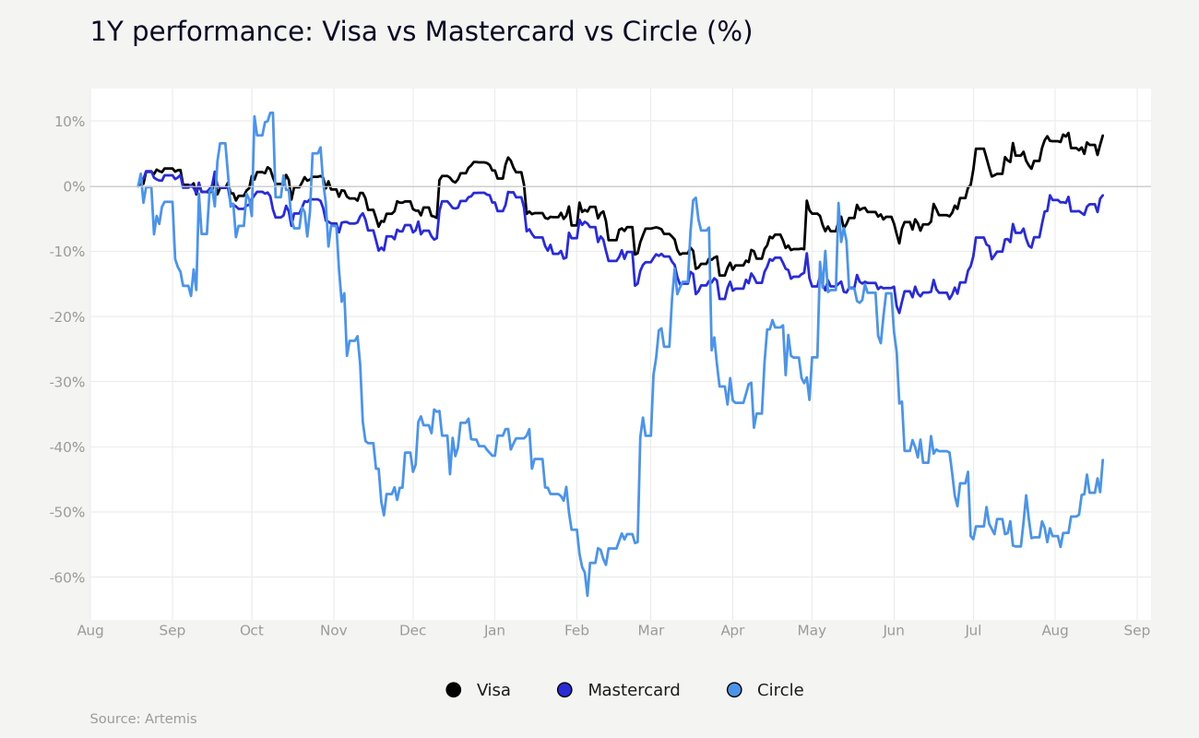
The chart shows the one-year stock performance of three payment companies: Visa up approximately 5%, Mastercard up around 1%, and Circle down sharply by 42%.
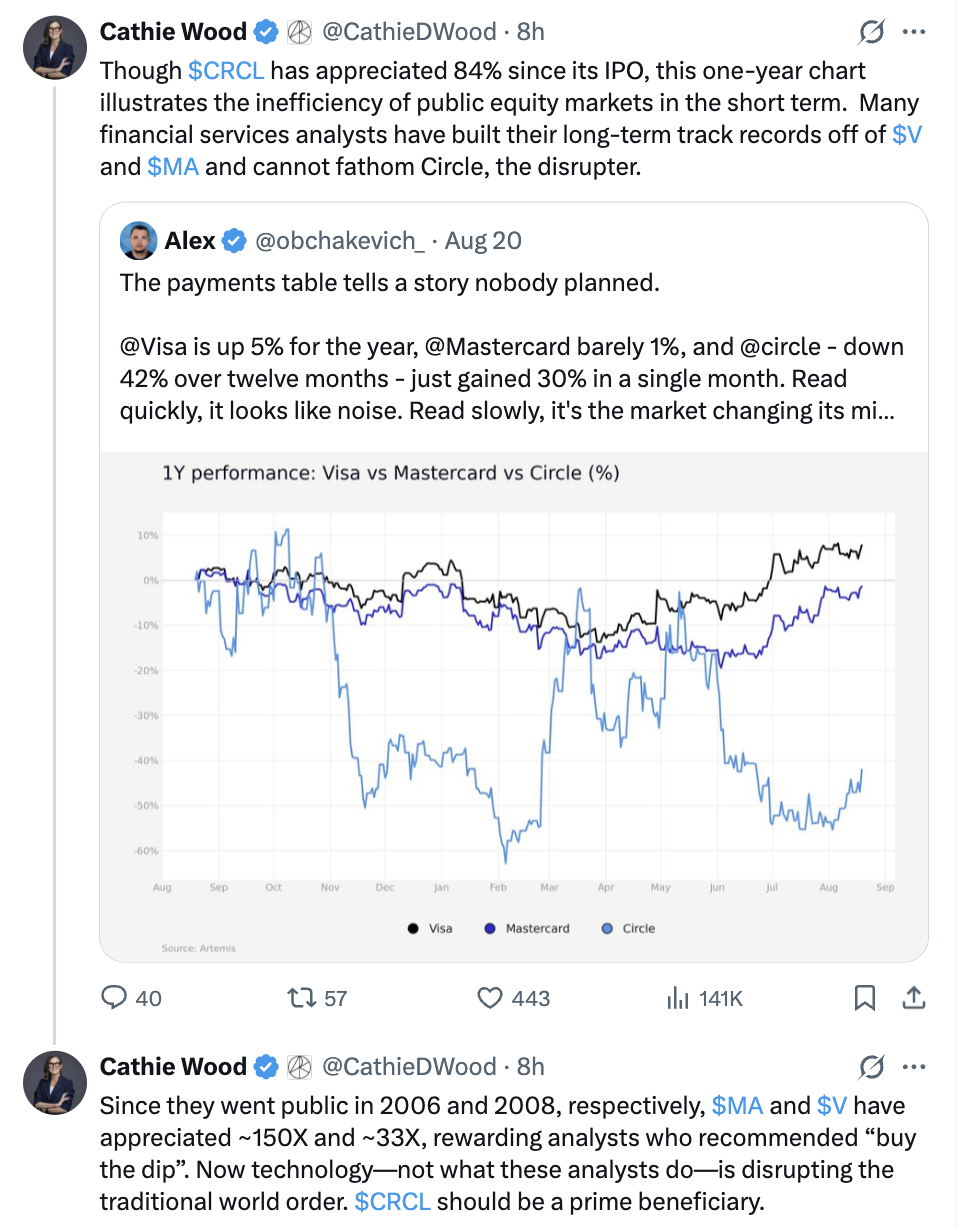
Wood stated in a post on platform X, "Despite CRCL (Circle stock ticker) rising 184% since its IPO, this one-year chart perfectly illustrates the short-term inefficiency of public equity markets. Many financial services analysts have built their long-term performance on studying Visa and Mastercard; they don't understand a disruptor like Circle."
She then cited historical examples, noting that Mastercard stock has risen approximately 150-fold since its IPO, while Visa has gained about 33-fold.
"Analysts who advised clients to buy these stocks on dips looked prescient in hindsight. But now, it's technology, not analyst expertise, reshaping the payments industry. Circle deserves growth."
Historical Analogy Holds, But One Data Point is Off
Wood's cited multiples for the traditional payment giants check out as essentially accurate.
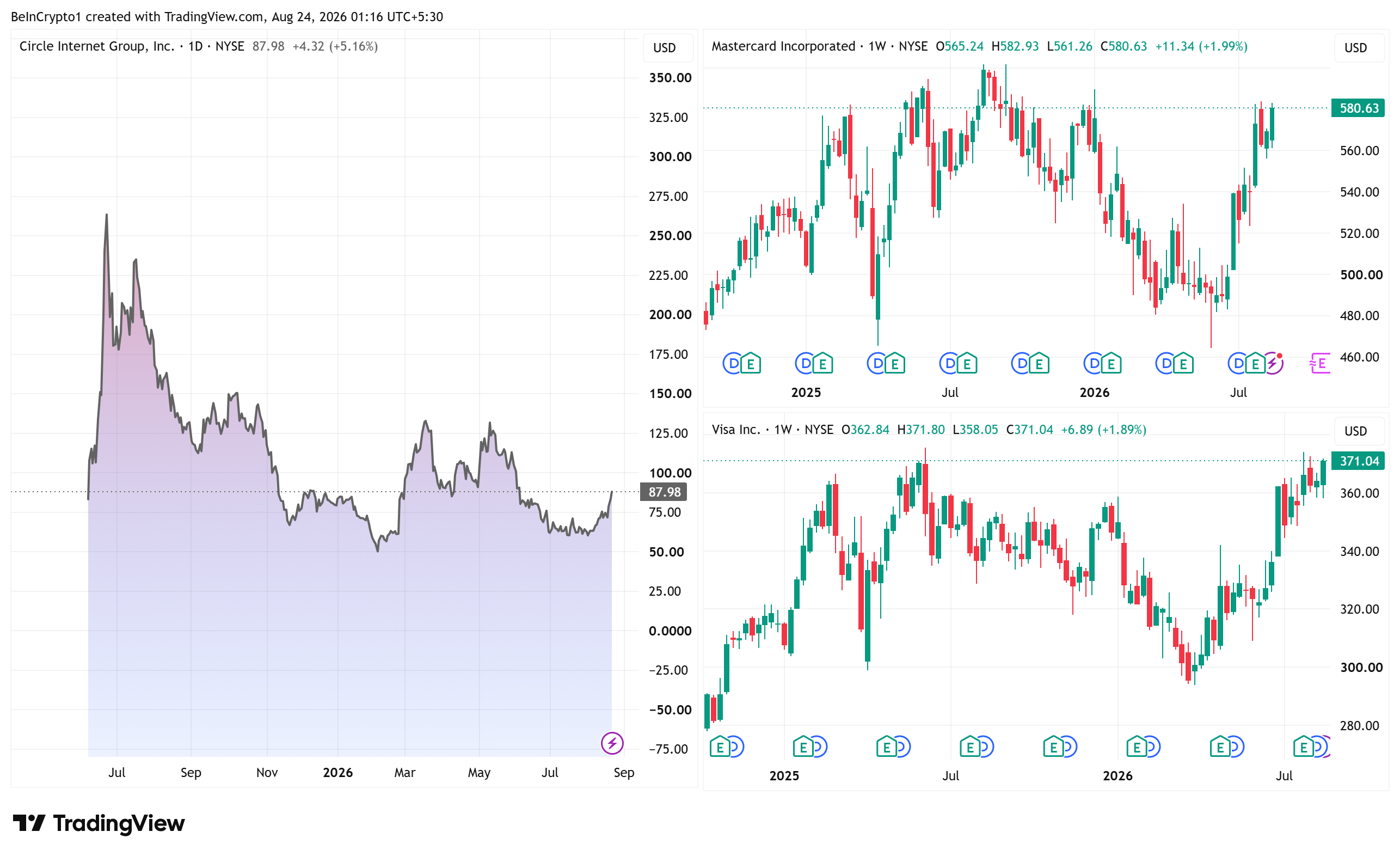
Mastercard IPO'd in 2006 at $39 per share and later executed a 10-for-1 stock split, adjusting the IPO price to $3.90. Compared to last Friday's closing price of $580.63, that's a gain of roughly 149 times.
Visa IPO'd in March 2008 at $44 per share, underwent a 4-for-1 split in 2015, adjusting the price to $11. Last Friday's close of $371.04 represents an increase of about 34 times. Wood's calculation on this part is correct.
However, her data point for Circle was incorrect. Circle IPO'd in June 2025 at $31 per share. Last Friday's closing price was $87.98, representing an actual gain of approximately 184%, not the 84% she stated.
Wall Street Deeply Divided on Circle's Valuation
Wall Street analysts are not ignoring Circle, which undercuts part of Wood's argument. Among the 21 analysts covering the stock, 11 rate it a Strong Buy, 2 a Buy, 5 a Hold, and 3 a Sell.
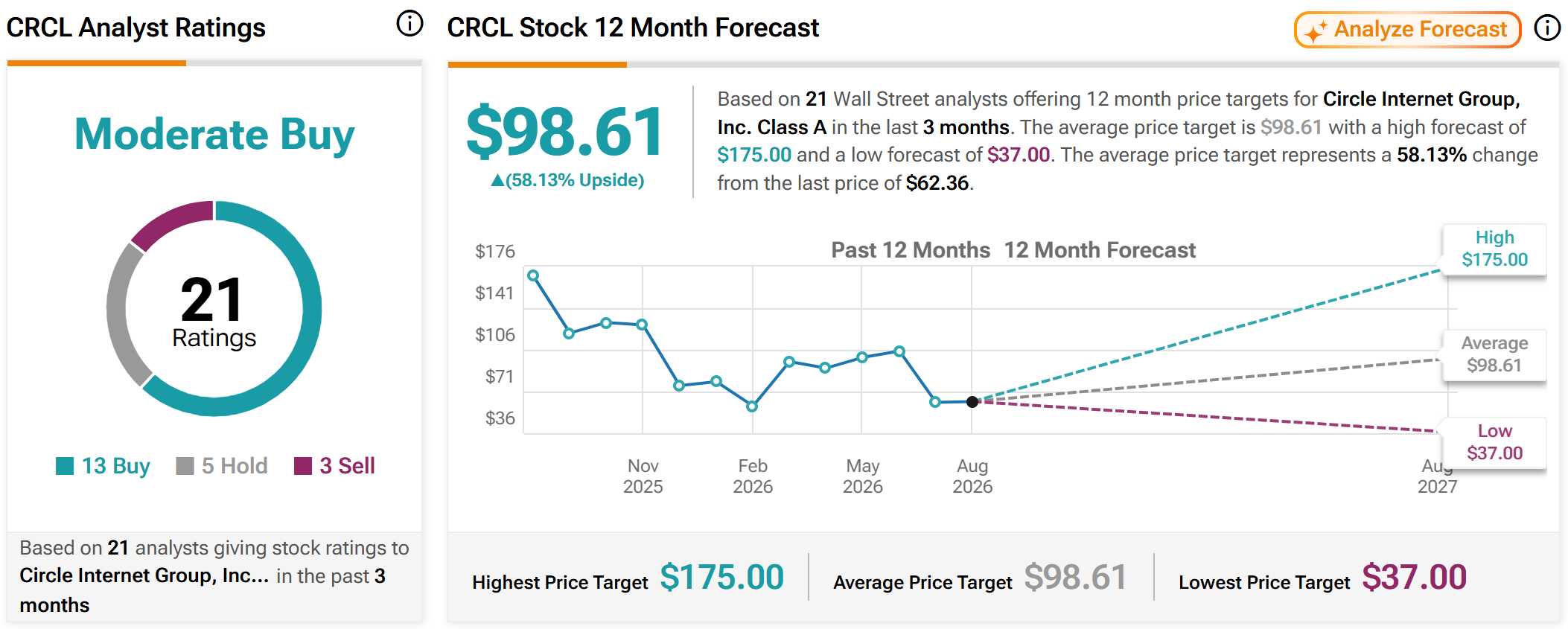
The disparity in price targets for CRCL is even more staggering, ranging from an optimistic $173 to a pessimistic $37—a 4.7x difference for the same company on the same day. The average analyst target price is $98.61.
For mature payment networks, analysts would never show such wide dispersion. For Circle, there is no unified valuation framework in the industry. A significant portion of Circle's revenue comes from interest on reserves, which would shrink if rates fall; the rest heavily depends on the adoption speed of its stablecoin.
Circle's financials underscore this contradiction. Its Q2 2026 earnings report, released in early August, showed revenue growing about 37% year-over-year and the company turning a profit, yet its market cap still retreated by 30%.
The competitive landscape adds further uncertainty. Circle is building a technology stack based on its proprietary Arc blockchain; meanwhile, the OpenUSD Alliance, composed of over 140 institutions, aims to compete for the same underlying payment infrastructure.
Wood is not hedging her bet. As of last Friday, her ARK flagship fund held 3,931,968 shares of Circle, worth $329 million, constituting 5.14% of the fund's portfolio—a larger position than its holding in Coinbase. The future may prove Wood right. But for now, the chasm between a $37 and a $173 price target illustrates one thing clearly: the market has not reached a consensus on Circle's true value.