Delphi Digital: Three Major Trends in Prediction Markets

链捕手Publicado a 2026-01-19Actualizado a 2026-01-19

Resumen

Delphi Digital outlines three key trends shaping the future of prediction markets, now a $600M+ sector. Major players like CME Group, Coinbase, and Robinhood are entering, while incumbents Polymarket and Kalshi aggressively expand. Polymarket focuses on CFTC-compliant crypto-native infrastructure, U.S. re-entry, and Web2 partnerships. Kalshi leverages regulatory advantages and orderbook liquidity for global growth. Layer 1 and Layer 2 networks now have economic incentives to capture prediction market activity. Verticalized markets for specific user groups will outperform generic platforms. Three predictions are highlighted: 1. **Perpetual-ized Options**: Prediction markets simplify options into binary, expiry-free formats (e.g., “Will BTC close above $150K on June 30?”), boosting accessibility. 2. **Native On-Chain Risk Markets**: These will provide DeFi-native insurance (e.g., short-term markets to hedge stETH depegging risks). 3. **Unbundling**: The stack will split to serve different users—professional tools (aggregators, advanced analytics) and social-first interfaces for mass adoption. AI agents may soon dominate arbitrage, pushing innovation toward new mechanisms like impact markets, sentiment prediction, virtual sports, futarchy, and coordination markets. Prediction markets are evolving into foundational infrastructure for options, insurance, and governance.

Compiled by: Ken, Chaincatcher

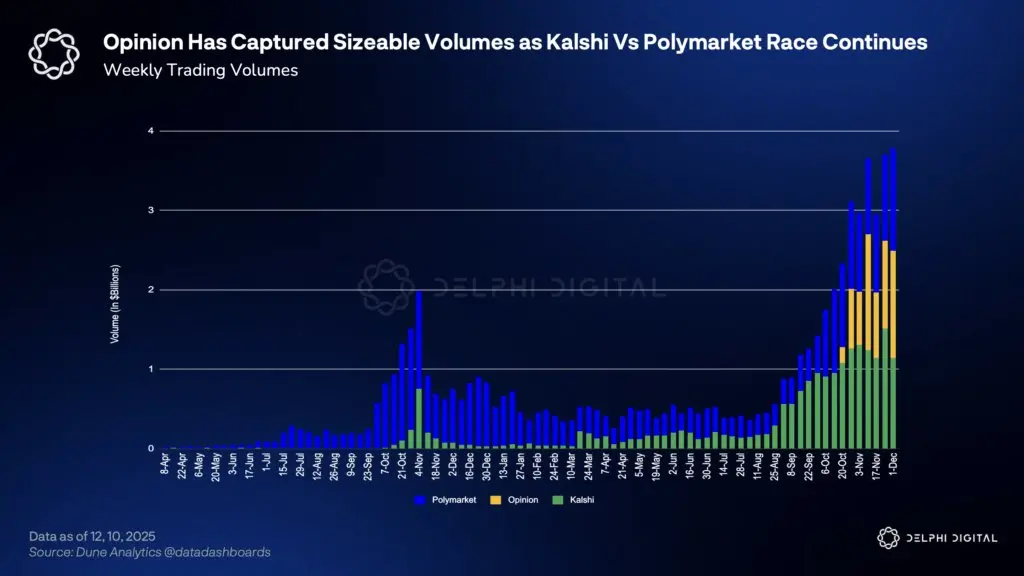
Prediction markets have leaped from a niche field to a sector with a scale exceeding $600 million. What are the development trends for the next phase?

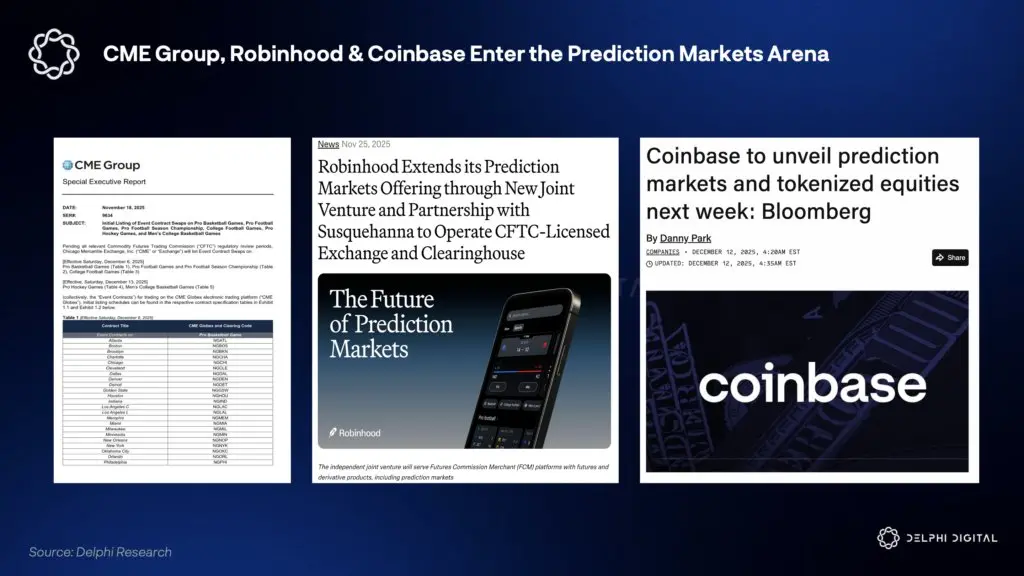
Giants are entering the arena: CME Group plans to launch sports markets, Coinbase is launching prediction markets, Robinhood acquired MIAXdx to offer in-house markets, thereby reducing reliance on Kalshi. Meanwhile, Polymarket and Kalshi are aggressively expanding to compete for market share.
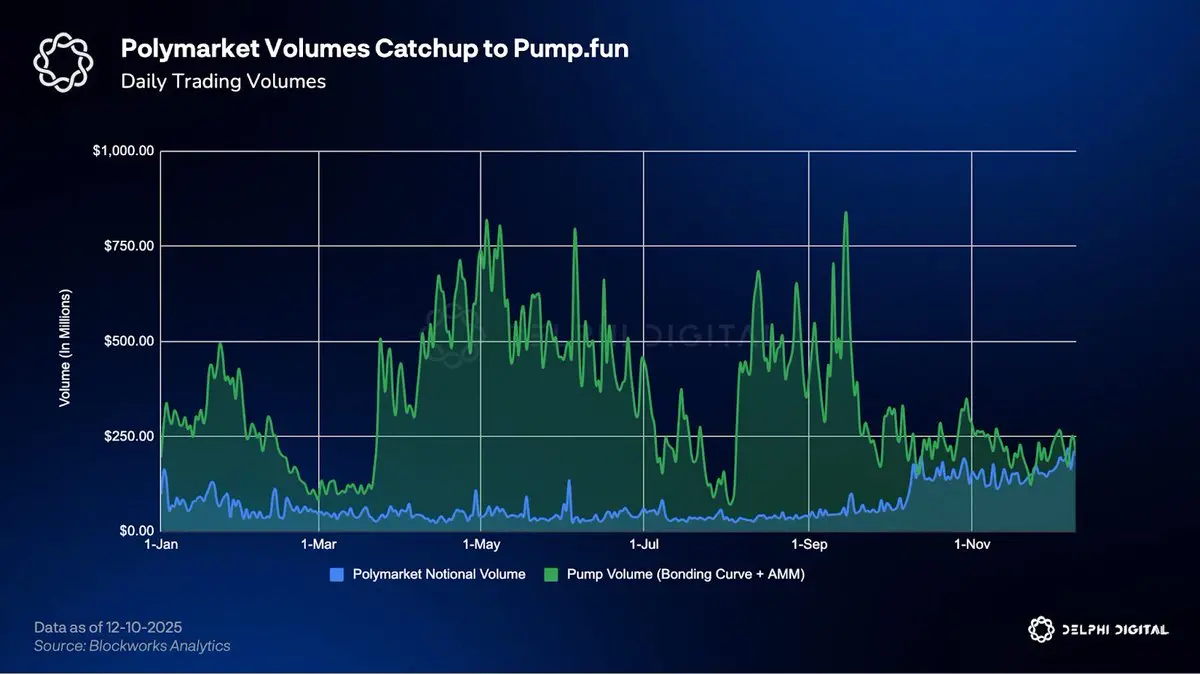
Polymarket's Strategy: Build a crypto-native foundation with a CFTC-compliant architecture to aggregate the largest liquidity.

  • Return to the US Market: Through its acquired licensed exchange, it is about to regain CFTC approval and go live.

  • Web2 Expansion: Reaching entirely new audiences through partnerships with UFC, NFL, and Yahoo Finance.

  • On-Chain Moat: Consolidating dominance and improving user retention through potential airdrop expectations and wallet integrations.

Kalshi's Strategy: Leverage compliance moat and order book liquidity to expand into global and on-chain markets.

  • Global Expansion: With $300 million in funding, Kalshi is expanding to 140 countries, challenging Polymarket's international advantage.

  • On-Chain Integration: Kalshi chooses not to compete directly with DeFi but instead provides liquidity to Jupiter and gains additional volume through high-traffic on-chain hubs like Phantom.

Kingmaker Effect

Layer 1 and Layer 2 now have real economic incentives to compete for prediction market share. Ecosystem grant programs targeting prediction market projects and their trading volume are expected to emerge.
General-purpose prediction market platforms will struggle to compete with existing liquidity giants. The real opportunity lies in verticalized markets built for specific user groups.

Prediction 1: The "Perpetual-ization" of Options

Perpetual contracts simplified derivatives trading by removing expiration dates. Prediction markets can apply the same logic to options.

A market asking "Will Bitcoin close above $150,000 on June 30th?" is essentially a cash-settled binary option. There are no Greeks, no strike chains, no complex pricing models. Just a simple 0-100 probability that anyone can understand. Repackaging volatility into an easily digestible form through prediction markets will drive new demand for on-chain options.
Protocols like @Euphoria_fi are pushing this concept further with "click-to-trade" interfaces designed to feel more like gaming than operating a complex trading terminal.

Prediction 2: On-Chain Native Risk Markets

Prediction markets are poised to become core infrastructure by filling the gap for native insurance. Markets need tools to hedge DeFi risk exposures. To scale, DeFi needs native, trustless ways to规避 these risks.

Short-term (15/30 day rolling) markets like "Will stETH trade below 0.98 ETH for more than 1 hour in January?" allow users to precisely hedge specific risks.

Finding counterparties for these markets is very difficult. LPs can earn small premiums but face tail risk of being wiped out. Nonetheless, platforms that crack this nut will immediately gain favor with players who have massive sums locked in DeFi.

Prediction 3: Unbundling

The real opportunity is not to compete directly with Polymarket, but to unbundle the tech stack to serve different user types.

Professional users need tools to gain an edge and discover new opportunities in an expanding universe of markets.

  • Aggregators: Unified dashboards for trading across multiple platforms. Examples: @ConvergeMarkets, @KairosTradeX, @fireplacegg terminals.

  • Advanced Analytics: Risk modeling, alternative data sources, and wallet tracking. Examples: @hash_dive, @Polysights.

Financial speculation is a large market, but social娱乐 is even larger. Betting with friends is human nature,极其 natural. Today's interfaces are designed primarily for traders, not the broader mass market. An interface aimed at broad adoption should optimize for "social signaling," not just profit maximization.

The "super users" running these tools at scale may not be human. Funds managed by AI Agents will monitor data streams in real-time, discover mispriced markets, and execute arbitrage at speeds far exceeding humans. As these players enter, the easy arbitrage edges in binary markets are expected to disappear.

As the easy edges in prediction markets are arbitraged away, capital and users will shift to new mechanisms:

  • Impact Markets: Price the consequence (impact) of an outcome rather than its likelihood of happening. (e.g., @lightconexyz)

  • Sentiment Markets: Markets where participants predict group sentiment rather than real-world outcomes. (e.g., @meleemarkets)

  • Virtual Sports: Crypto-native versions (e.g., @footballdotfun) turn player cards into tradable liquid assets.

  • Futarchy: Governance decisions driven by market predictions on whether proposals will meet target metrics. (e.g., @MetaDAOProject)

  • Coordination Markets: A protocol sets a goal, participants buy tokens and take action to achieve it. If the goal is met, everyone profits through yields and token appreciation. (e.g., @hyperstiti0ns)

Prediction markets are becoming more than just speculation; they are evolving into infrastructure for options, insurance, and governance.

Recommended Reading:

RootData 2025 Web3 Industry Annual Report

Binance Power Shift: The Dilemma of a 300 Million User Empire

Beyond Stablecoins: Circle Releases 2026 Strategy Report, Internet Financial System Has Fully Emerged

InfoFi Narrative Collapses, Kaito, Cookie and Others Shut Down Related Products

Preguntas relacionadas

QWhat are the three major trends in prediction markets identified by Delphi Digital?

AThe three major trends are: 1) The 'perpetualization' of options, which simplifies derivatives trading by removing expiration dates. 2) The rise of on-chain native risk markets to provide native, trustless ways to hedge DeFi risk exposure. 3) The unbundling of the tech stack to serve different user types, such as professional traders and the broader social entertainment market.

QHow is Polymarket strategizing to compete in the prediction market space?

APolymarket's strategy is to build a crypto-native base with a CFTC-compliant architecture to aggregate the largest liquidity. Its key moves include re-entering the US market through its acquired licensed exchange, expanding to Web2 audiences via partnerships with organizations like the NFL and Yahoo Finance, and solidifying its dominance through potential airdrop expectations and wallet integrations to improve user retention.

QWhat is Kalshi's approach to global expansion and its relationship with DeFi?

AKalshi is leveraging its compliance moat and order book liquidity to expand globally. With $300 million in funding, it is expanding into 140 countries to challenge Polymarket's international advantage. Instead of competing directly with DeFi, Kalshi is providing liquidity to platforms like Jupiter and acquiring additional trading volume through high-traffic on-chain hubs like Phantom.

QWhat new market mechanisms are expected to emerge as simple arbitrage opportunities in binary markets diminish?

AAs simple arbitrage advantages in binary markets are exhausted, new mechanisms are expected to gain traction. These include impact markets (pricing the consequence of an outcome), sentiment markets (predicting group sentiment rather than real-world outcomes), virtual sports (crypto-native versions that turn player cards into tradable assets), futarchy (governance decisions driven by market predictions), and coordination markets (where participants buy tokens and take actions to achieve a protocol-set goal for collective profit).

QHow are prediction markets evolving beyond mere speculation according to the article?

APrediction markets are evolving to become core infrastructure for options, insurance, and governance. They are being used to create simplified, easy-to-understand derivatives, provide native hedging tools for DeFi risks, and drive governance decisions through futarchy and other novel coordination mechanisms.

Lecturas Relacionadas

The "Impossible Triad" Is Fundamentally a Pseudo-Problem

The article argues that blockchain's fundamental limitation is not the scalability trilemma (decentralization, scalability, security), which has been largely solved, but the lack of **privacy** and, until recently, clear **legitimacy**. Blockchain is described as a slow, expensive, globally shared computer whose core value is censorship resistance and verifiability. While ideal for native digital assets like money (e.g., stablecoins), its default transparency acts as a **tax**, exposing all transactions and enabling MEV extraction, which deters serious institutional capital. Simultaneously, its permissionless nature created regulatory ambiguity. The piece contends that **privacy** is the missing critical feature. It rejects the false choice between total transparency and complete anonymity. Modern cryptography (like zero-knowledge proofs) enables **compliant privacy**: users can prove facts (solvency, KYC status, compliance) without revealing the underlying sensitive data (specific holdings, identities). This preserves auditability for regulators and eliminates the leak of financial information. With recent regulatory progress (e.g., the GENIUS Act) addressing legitimacy, adding default, provably compliant privacy becomes a pure upgrade. It transforms blockchain from a costly, public ledger into a confidential settlement layer, finally bridging the gap to mainstream institutional and individual adoption of on-chain finance.

链捕手Hace 6 hora(s)

The "Impossible Triad" Is Fundamentally a Pseudo-Problem

链捕手Hace 6 hora(s)

Optical Chips: Collective Capacity Expansion

The global optical chip industry is experiencing a massive wave of expansion driven by surging AI data center demand. Major players across the US, Japan, Europe, and China are aggressively investing to ramp up production capacity. In the US, Coherent is expanding its 6-inch Indium Phosphide (InP) semiconductor fab in Texas, supported by CHIPS Act funding and a $2 billion strategic investment from NVIDIA. Lumentum is building a new factory for InP optical devices, and Nokia is scaling its advanced photonic chip packaging and testing capabilities. NVIDIA's investments aim to secure future supply of critical lasers and optical interconnect products for AI infrastructure. Japan's JX Advanced Metals, a leading InP substrate supplier, plans a multi-billion yen investment to increase its capacity 7-10 times, strengthening its grip on the crucial upstream materials market. In Europe, IQE and Tower Semiconductor settled a patent dispute and signed a multi-year InP epitaxial wafer supply agreement, highlighting that next-generation silicon photonics platforms will integrate high-performance InP components. STMicroelectronics and Sivers Semiconductors are also expanding silicon photonics production and partnerships. China is rapidly building out its domestic supply chain. Dongshan Precision's subsidiary, Source Photonics, announced a $12 billion project to expand optical chip and module production. Companies like Sanan Optoelectronics and Yunnan Germanium are scaling up InP chip manufacturing and substrate production, moving towards vertical integration from materials to modules. While debate continues around the exact future architecture—whether CPO (Co-Packaged Optics), NPO, or pluggables will dominate—analysts like Morgan Stanley argue the underlying driver is unchangeable: the explosive growth in bandwidth demand. This will inevitably increase the volume of optical engines, lasers, and related content per GPU, regardless of the final technical path. The competition for "more light" in the AI era has intensified into a global, full-chain capacity race.

marsbitHace 9 hora(s)

Optical Chips: Collective Capacity Expansion

marsbitHace 9 hora(s)

Stablecoins Finally Find Real Yield: An In-Depth Look at On-Chain Reinsurance Re | A Conversation with Re Founder Karan Saroya

Stablecoin Real Yield Found: A Deep Dive into On-Chain Reinsurance with Re's Karan Saroya As stablecoin supply exceeds $170 billion, the search for sustainable, non-speculative yield intensifies. Re, an on-chain reinsurance platform, provides an answer: connecting stablecoin capital to the trillion-dollar traditional reinsurance market. Re operates as a regulated reinsurer, accepting stablecoin deposits as collateral to back US insurance companies. These insurers pay premiums, generating yield that flows back to on-chain depositors. Currently supporting 35 insurers and underwriting $500 million, Re projects scaling to over $1 billion soon. Key insights from a Bankless podcast with founder Karan Saroya and investor Avichal of Electric Capital: 1. **Uncorrelated, Real-World Yield:** Re offers stablecoin holders access to reinsurance returns (targeting 12-14%+), an asset class entirely separate from crypto or equity markets. 2. **Operational Efficiency via Smart Contracts:** Re replaces traditional, labor-intensive capital fundraising with smart contracts, allowing a ~12-person team to compete with industry giants. 3. **Regulatory Leverage:** For every $1 of collateral, regulations allow backing $5-7 in written premiums. This leverage amplifies returns from the underlying risk-free rate. 4. **DeFi Integration:** Depositors receive receipt tokens, which can be used in protocols like Morpho for "looping," potentially pushing yields to 18-20%+. 5. **The "DeFi Mullet" Model:** A compliant front-end (regulated reinsurer) paired with a decentralized back-end (smart contracts, DeFi capital markets). 6. **RE Governance Token:** Modeled on Lloyd's of London, the token governs the central capital pool's allocation, counterparty acceptance, and parameters. 7. **Real Economic Impact:** Capital funds real-world productivity (factories, clinics, businesses) via insurance, moving beyond crypto's internal loops. The discussion highlights a pivotal moment: DeFi's supply-side infrastructure is now met by real demand for productive yield, potentially kickstarting a flywheel where vast on-chain stablecoin capital seeks these real-world returns.

链捕手Hace 10 hora(s)

Stablecoins Finally Find Real Yield: An In-Depth Look at On-Chain Reinsurance Re | A Conversation with Re Founder Karan Saroya

链捕手Hace 10 hora(s)

1996 or 1999? Walsh's First Test is 'How to View AI'

"1996 or 1999? Wall's First Big Test Is 'How to View AI'" Federal Reserve Chairman Wall's initial challenge is not whether to raise or cut rates, but a more fundamental judgment: what kind of boom is the current AI boom? This will determine the Fed's policy path and define his legacy. Economics is split between two opposing views, according to reporter Nick Timiraos. One sees imminent productivity gains that will increase supply and cool inflation, allowing the Fed to hold steady. The other argues that while productivity benefits are distant, demand shocks are here now, and waiting for data confirmation risks missing the intervention window, forcing sharper rate hikes later. Wall has signaled a leaning toward the first view, echoing 1996-era Alan Greenspan, who embraced strong, productivity-driven growth without fear of inflation. However, Wall faces a different macro environment than Greenspan did, with tariff pressures, expanding fiscal deficits, and diminishing globalization benefits, which could force more significant inflation pressures even if AI benefits materialize. Wall's logic, expressed before taking office, is that AI-driven productivity gains won't show in official data for years. If the Fed waits for confirmation, it might mistakenly tighten policy and choke off the very growth that could suppress inflation. This argues for using forward-looking narratives over lagging data. Chicago Fed President Austan Goolsbee presents a key counter-argument. He distinguishes between expected and unexpected productivity booms. A widely anticipated boom, like the current AI wave, can cause people to spend future wealth gains in advance, overheating the economy before productivity actually rises, thus requiring preemptive rate hikes. He cites rising costs for AI data centers as evidence of such overheating. Fed Governor Christopher Waller offers a rebuttal to Goolsbee, noting the "expected spending" mechanism only works if people can borrow against future income, which many households cannot do due to borrowing constraints. Wall also faces a paradox related to his desire to reduce the Fed's use of "forward guidance" (pre-announcing policy moves). This practice was established in 1999 when Greenspan began signaling hikes to avoid market shocks. If the economy follows a less optimistic path, Wall may be forced to choose between using the guidance he wants to abolish or risking market volatility by staying silent. The ultimate question defining Wall's first major test remains: Is this 1996 or 1999?

marsbitHace 11 hora(s)

1996 or 1999? Walsh's First Test is 'How to View AI'

marsbitHace 11 hora(s)

Trading

Spot
Futuros
活动图片