
DeFi's Yield Winter: Liquidity Glut, Shrinking Leverage, and No Arbitrage Opportunities

marsbitPublicado a 2026-03-12Actualizado a 2026-03-12

Resumen

The DeFi market is experiencing a "yield winter," with average stablecoin deposit rates on major lending protocols like Aave V3 falling below 2%—the lowest since mid-2023. This decline is driven by a structural imbalance: stablecoin supply has surged, with total market cap growing over 130% since early 2024, while on-chain demand has stagnated. Over 60% of deposited assets on Aave are idle, causing severe liquidity congestion and suppressed yields. Key factors include reduced leverage demand due to low perpetual funding rates, which disincentivizes arbitrage strategies, and diminished cyclical borrowing activity following the contraction of yield assets like sUSDe. Additionally, declining risk appetite in crypto has shifted capital toward safer, traditional alternatives like U.S. Treasuries (yielding ~4.24%), further draining DeFi liquidity. Amid the downturn, protocols like Sky (formerly MakerDAO) have differentiated themselves by integrating real-world assets (RWA), such as Treasuries and corporate debt, to offer stable yields above 3.75%. This shift highlights a broader trend: DeFi must evolve from speculative yield chasing to sustainable, diversified收益 models. The yield crunch may represent a necessary correction, setting the stage for future growth.

Author: Jae, PANews

The end of a cycle often begins with the most subtle indicators.

Since September 2025, the DeFi (Decentralized Finance) market has entered a "yield winter." The average annualized deposit yield (APY) for major stablecoins on leading lending protocols has hit its lowest level since June 2023.

On Aave V3 on the Ethereum mainnet, USDC and USDT deposit rates have fallen below 2%. Meanwhile, the yield on the U.S. 10-year Treasury note has rebounded to 4.24%. For DeFi players who experienced DeFi Summer and are accustomed to high APYs, this is not just a numerical decline but more like a death knell for the end of a cycle.

Is this merely a cyclical fluctuation, or is the market undergoing a structural reshaping?

Supply-Demand Mismatch: Excess Liquidity Triggers Interest Rate Collapse

Over the past six months, the interest rate curves of major lending protocols have shown a consistent downward trend, as their interest rate models experience a yield collapse caused by "oversupply."
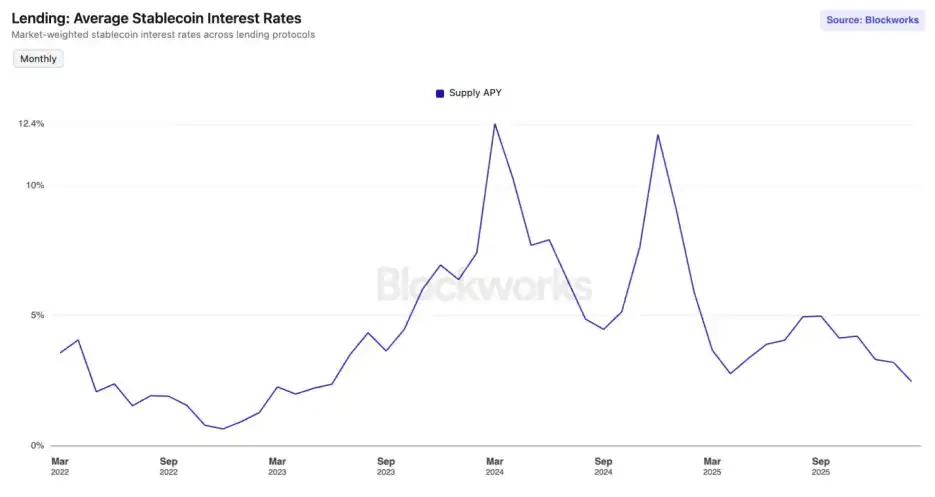
Interest rates are the price of capital. The physical basis determining this price is the supply of capital.

Since 2024, the stablecoin sector has undergone an unprecedented "expansion wave," with its total market capitalization surging from less than $1.3 trillion to over $3.1 trillion, representing a compound annual growth rate of approximately 55%.
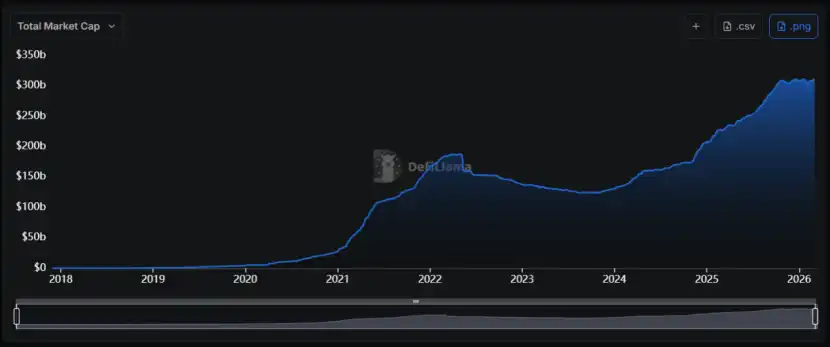
The problem is that the surge in supply has not been accompanied by a proportional expansion of on-chain demand.

When the supply of a certain commodity (stablecoin liquidity) in the market increases significantly while demand remains sluggish, its price (interest rate) will inevitably fall. This is a basic principle of economics, and DeFi is no exception.

Taking the lending sector leader Aave as an example, its stablecoin utilization rate is declining significantly. As of March 12, Aave's total value locked (TVL) has reached as high as $42.5 billion.

A closer look at the capital structure reveals a concerning figure: active loans amount to only $16.3 billion. Over 60% of deposited assets are idle. This supply-demand imbalance has directly led to a rapid decline in interest rates.

This means that funds are being deposited but not borrowed, leading to severe liquidity congestion. Protocol algorithms are forced to automatically lower the interest rate curve in an attempt to attract more borrowers.
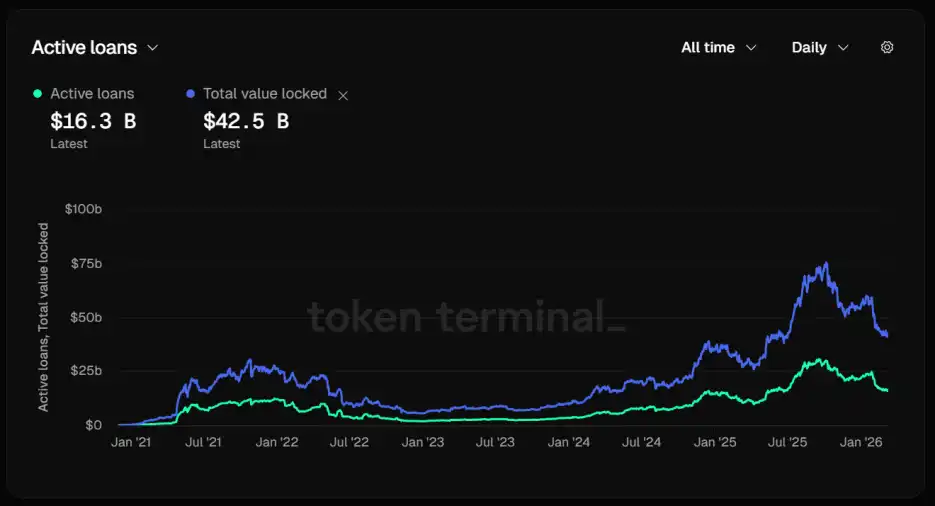
However, these efforts have had little effect. The base rates for USDC and USDT on Aave V3 on the Ethereum mainnet have already fallen below 2%, forming a stark contrast to the double-digit returns common during bull markets.

The stablecoin market has fallen into a "liquidity trap." When the market is flooded with low-cost capital but lacks high-return investment opportunities, these funds pile up in the pools of lending protocols.

Funding Rate Collapse and Cooling Circular Borrowing Lead to Leverage Slowdown

The prosperity of DeFi stablecoin interest rates is essentially driven by "leverage." When arbitrage activity in the perpetual futures market cools down, the borrowing demand for stablecoins shrinks rapidly, causing interest rates to plummet.

In a bull market, high bullish sentiment leads to positive and high funding rates. Arbitrageurs employ delta-neutral strategies like "borrowing stablecoins to buy spot + selling perpetual contracts" for risk-free hedging to earn the funding rate. In this process, stablecoins are the fuel.

However, the derivatives market has recently been sluggish. On major centralized exchanges (CEX), the funding rates for BTC and ETH have repeatedly been negative or at very low positive values. This reflects that bearish forces dominate the market or that bulls are extremely cautious.

Either explanation points to the same result: a lack of motivation for arbitrageurs.

When the annualized funding rate drops significantly, considering borrowing costs and transaction fees, the net profit for arbitrageurs is drastically reduced. Their demand for stablecoin borrowing subsequently plummets.

Another major source of stablecoin borrowing demand is circular borrowing. A typical path for this yield-enhancing strategy is: depositing yield-bearing assets like sUSDe into Aave, borrowing out stablecoins like USDC, and then converting the borrowed USDC into more sUSDe to deposit again.

This strategy was once widely used because the USDe yield was as high as 30%, while the borrowing cost was only around 10%, leaving an arbitrage spread of about 20 percentage points.

However, after the "1011" event, the spread narrowed catastrophically, and USDe also hit a "scalability" ceiling, its size dropping from nearly $15 billion to the current $6 billion.
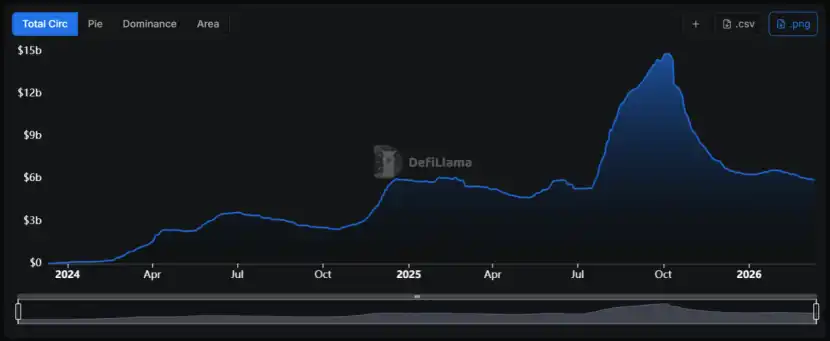
The yield of USDe is highly dependent on the size of short positions in the market. Since the total open interest in the perpetual futures market is limited, when the size of USDe expands to a certain point, the short positions required for hedging themselves will lower the overall market funding rate, thereby suppressing the sUSDe yield.

For ordinary traders, a decrease in sUSDe yield reduces the strategy's spread. Their reduced demand for leveraged positions will further decrease their demand for stablecoin collateral.

This is a self-reinforcing negative cycle: demand shrinks → interest rates fall → demand shrinks further.

Shift in Crypto Market Risk Appetite, Capital Seeks Certainty

The overall decline in risk appetite in the crypto market is another important factor leading to lower stablecoin interest rates.

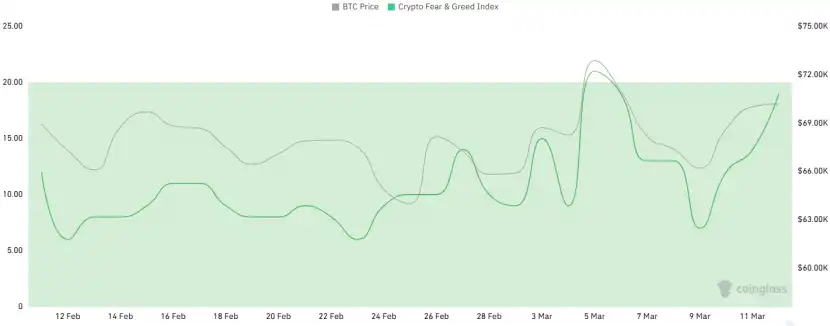
Over the past month, the Crypto Fear & Greed Index has frequently touched the "Extreme Fear" zone, and even with BTC prices holding around $70,000, sentiment has not shown sustained improvement.
CoinDesk Data also shows that total CEX trading volume fell by 2.41% in February to $5.61 trillion, the lowest trading volume since October 2024.
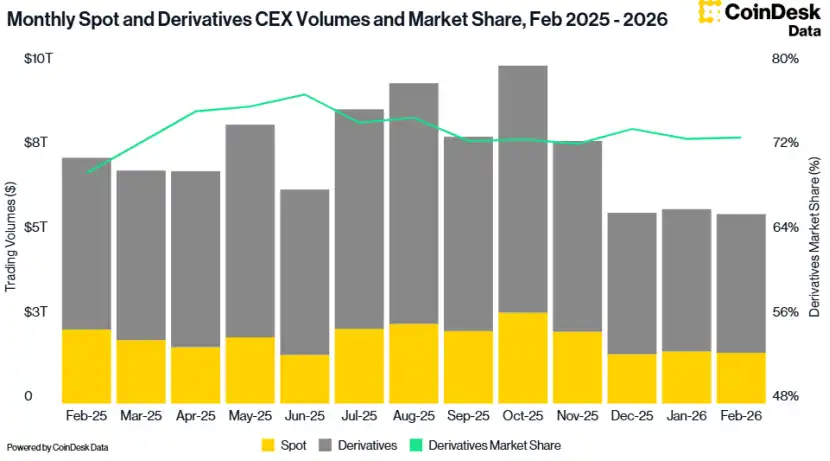
Decreased risk appetite is driving investors towards market segments with higher certainty.

Since January 2024, the U.S. Federal Reserve's effective federal funds rate has remained above 3.6%. Although the market expects a moderate path of future rate cuts, the current real interest rate remains relatively high.
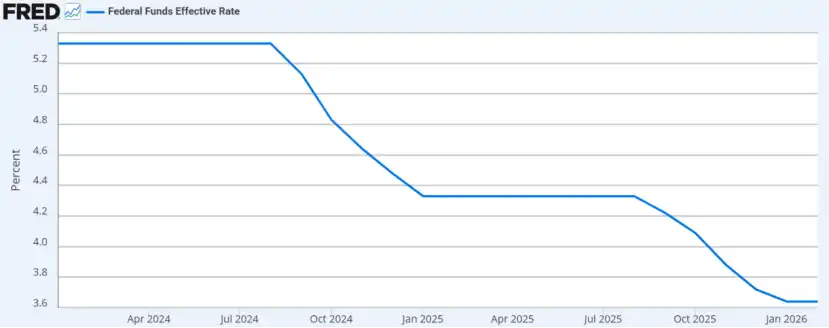
This macroeconomic environment has also exerted a profound suppressive effect on DeFi stablecoin interest rates. When the risk-free Treasury yield is higher than the DeFi deposit rate, rational investors, in the absence of risk premium compensation, will choose to withdraw funds from on-chain protocols or invest them into protocols backed by RWA (Real World Assets).

In this yield winter, not all protocols are shrinking. Sky (formerly MakerDAO) has built a unique "yield moat."

Compared to Aave, which relies more on on-chain borrowing demand, Sky's yield also comes from $1.5 billion in mature RWA assets. These assets include U.S. Treasuries, AAA-rated corporate debt, etc., which are unaffected by crypto market fluctuations and provide stable underlying cash flow.

This model of converting RWA into underlying collateral has driven a 68% month-over-month growth in USDS supply, with a market capitalization approaching $8 billion.
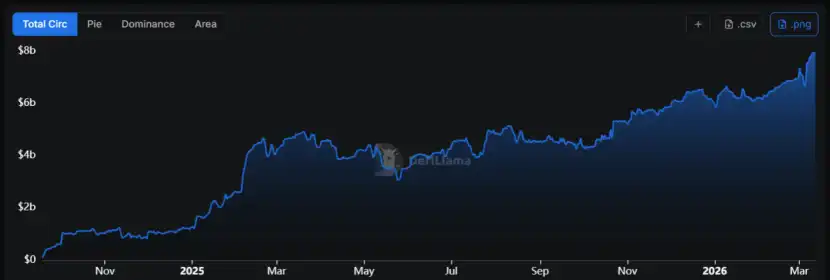
As of now, the sUSDS rate remains around 3.75%, becoming the "de facto floor" for on-chain yields. In vaults related to USDC and USDT, its deposit rate can reach over 5%.

This allows Sky to assume a role similar to a "benchmark rate platform." In comparison, the rates for similar assets on Aave are almost non-competitive.

Thus, it is evident that Sky is transforming from a mere stablecoin protocol into a "fixed-income asset management" protocol, utilizing its massive RWA portfolio to hedge against downside risks in the crypto market. When internal DeFi demand is lacking, it can seek yield externally (from traditional financial markets).

For investors, learning to scrutinize the underlying logic of yields—whether they come from Treasury dividends or volatility premiums from futures markets—will be a required course this cycle. Strategies also need to shift from "chasing APY" to "seeking differentiated risk exposure."

The "yield winter" is not only the result of cyclical fluctuations but also a necessary growing pain for DeFi's "de-bubbling."

Perhaps, just as the trough of 2023 nurtured the prosperity of 2024, this interest rate bottoming may also be DeFi accumulating energy for the next leap forward.


Preguntas relacionadas

QWhat is the main reason for the decline in DeFi stablecoin deposit APY according to the article?

AThe primary reason is a severe supply-demand imbalance, where the supply of stablecoins has surged (with total market cap growing from under $1.3 trillion to over $3.1 trillion) without a proportional expansion in on-chain borrowing demand, leading to a liquidity glut and a collapse in interest yields.

QHow did the negative or low funding rates on perpetual contracts impact DeFi stablecoin interest rates?

ALow or negative funding rates on CEX perpetual contracts eliminated the profitability of the delta-neutral arbitrage strategy (borrowing stablecoins to buy spot and sell perpetuals), which drastically reduced the demand for borrowing stablecoins and contributed to the decline in their lending rates.

QWhat role did the '1011 event' and the subsequent change in USDe's scalability play in the DeFi yield winter?

AThe '1011 event' caused a catastrophic narrowing of the yield spread for USDe-based looped borrowing strategies. USDe's scalability hit a ceiling, with its size dropping from nearly $15 billion to about $6 billion, reducing leverage demand and further decreasing stablecoin borrowing needs.

QWhy is Sky (formerly MakerDAO) able to maintain a higher stablecoin yield compared to protocols like Aave during this period?

ASky maintains a higher yield because it incorporates Real World Assets (RWA), such as U.S. Treasuries and corporate debt, which provide a stable underlying cash flow unaffected by crypto market volatility, allowing it to offer a competitive yield (e.g., ~3.75% for sUSDS) even when on-chain demand is low.

QHow has the overall risk appetite in the crypto market influenced the DeFi yield environment?

AA decline in overall crypto market risk appetite, indicated by the Fear & Greed Index frequently hitting 'extreme fear' and reduced CEX trading volume, has driven investors toward higher certainty investments. This shift, combined with attractive traditional risk-free rates (e.g., U.S. 10-year Treasury at 4.24%), has reduced capital allocation to volatile DeFi yields, further depressing on-chain interest rates.

Lecturas Relacionadas

Within Strategy's Framework, STRC's Dividend Yield Remains at 12% as Share Price Stays Below Par Value

Michael Saylor, Executive Chairman of Strategy (MSTR), confirmed that the dividend rate for its STRC perpetual preferred shares will remain at 12.00% through August 2026. The rate has increased from 9% at its July 2025 launch to the current high via a "ratchet" mechanism, which permanently raises the rate by 0.5% whenever the share price falls below $95. This mechanism is intended to push the price back toward its $100 par value and support Strategy's "at-the-market" (ATM) program for issuing new shares to fund Bitcoin purchases. However, the mechanism has not worked as intended. STRC shares closed at $89.46 on July 31, remaining about 10-11% below par value despite the record-high dividend. Competition from rival Strive's higher-yielding SATA securities has pressured demand. The persistent discount has forced Strategy to suspend new STRC issuances via its ATM program, limiting this funding channel for Bitcoin acquisitions. STRC's struggles reflect Bitcoin's own volatility, as the preferred shares historically move in tandem. Analysts have warned the ratchet structure carries long-term, one-way risk. A law firm is investigating Strategy's ability to maintain dividend payments if Bitcoin's price stays low. Retail investors own roughly 83% of outstanding STRC shares, a group seen as prone to panic selling during downturns. In response, Strategy has established financial reserves, including a liquidity cushion covering about 26 months of dividend/interest obligations, and a $2 billion share buyback program alongside a Bitcoin monetization framework, though the company emphasized it is not obligated to sell any Bitcoin.

cryptonews.ruHace 20 min(s)

Within Strategy's Framework, STRC's Dividend Yield Remains at 12% as Share Price Stays Below Par Value

cryptonews.ruHace 20 min(s)

Analyst: Bitcoin's Price Will Drop to $60k in August, Then Rebound to $70k

Financial analyst Andrey Poroshin has provided a new forecast for Bitcoin's price dynamics in August. Poroshin, an analyst at the Bitbanker exchange, expects the cryptocurrency market to experience a downturn this month, with prices retesting the $60,000 level due to a lack of supportive macroeconomic catalysts. He noted that the recent US Federal Reserve decision to hold interest rates did not significantly impact the market, while inflation remains above the 2% target. Poroshin stated that Bitcoin is ending July under pressure from moderate volatility and a lack of new macroeconomic stimuli, leading to continued market caution. According to his base scenario, Bitcoin will drop to a range of $60,000 to $62,000 before recovering to $70,000. He pointed out that even $70,000 remains below the cost of mining in the US, which has prompted some miners to shift towards AI data center operations. Poroshin cited the winding down of BitMEX's operations as a potential catalyst for a price rebound, suggesting the exit of weaker players often coincides with market reversals and reduced short-term selling pressure. He believes Bitcoin is currently less susceptible to geopolitical shocks, such as the Iran-US conflict, and does not expect significant market changes in August related to the pending CLARITY Act. Looking ahead, Poroshin forecasts that September will bring more active price fluctuations driven by potential Fed rate decisions and possible discussions or approval of the CLARITY Act.

cryptonews.ruHace 20 min(s)

Analyst: Bitcoin's Price Will Drop to $60k in August, Then Rebound to $70k

cryptonews.ruHace 20 min(s)

Trading

Spot
活动图片




