DeepSeek Announces Permanent Price Cut, But Liang Wenfeng Is Not Trying to Be a "Cyber Bodhisattva"

marsbitPublicado a 2026-05-24Actualizado a 2026-05-24

Resumen

DeepSeek has announced a permanent 75% discount on its V4-Pro API, significantly reducing its token prices. This move stands out as a major industry-wide price cut while competitors like Anthropic, OpenAI, and Google have been quietly raising theirs. The article contrasts this strategy with the broader trend of AI becoming more expensive, citing examples of companies like Microsoft and Uber struggling with high token costs as usage soars. While CEO Liang Wenfeng is hailed by some as a "Cyber Bodhisattva" for this普惠 approach, the article argues this is a strategic business choice, not mere altruism. DeepSeek's ability to maintain low prices is attributed to several structural advantages: lower-cost AI talent in China, the impending use of domestic昇腾 hardware for further cost reductions, and, most critically, access to China's cheaper and more abundant energy infrastructure, which drastically reduces the electricity costs dominating AI operations. The analysis suggests that for many commercial applications, a "good enough" model that is radically cheaper (e.g., 1% to 11% of GPT-5.5's cost) is more valuable than the absolute top-tier model. This allows for vastly more experimentation and iteration within a budget. Therefore, as AI generally becomes more expensive, DeepSeek's cost-competitiveness—rooted in China's energy and talent advantages—becomes its core strategic value and differentiator in the global market.

By | Luo Chao Channel

DeepSeek has announced it will make the 75% discount on its V4-Pro API "permanent," effective globally.

The final pricing structure: the base input price has been reduced from $1.74 / million tokens to $0.435 / million tokens, and the output price from $3.48 / million tokens to $0.87 / million tokens. For input cache hits across the entire API product line, DeepSeek has implemented even greater concessions: $0.003625 / million tokens, all following a Pinduoduo-style rock-bottom pricing model.
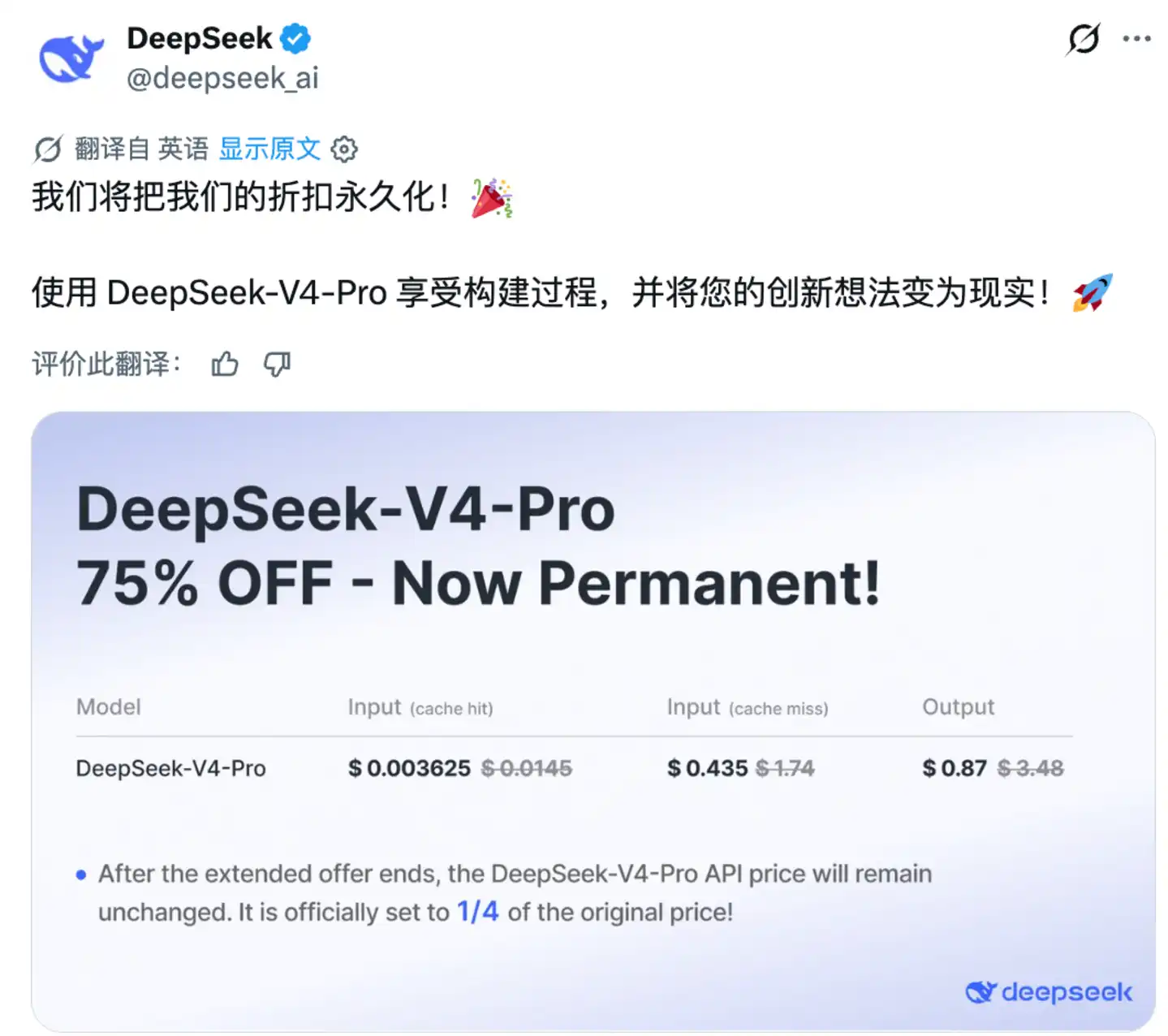
A wave of voices immediately emerged on social media, including X, hailing Liang Wenfeng as the Cyber Bodhisattva, the "Feng God," or "Saint Liang" of the AI circle. The sentiment doesn't just come from the cheapness itself — DeepSeek has long been called the "Pinduoduo of AI," free for C-end users and affordable for B-end, and the world is used to its low prices. The difficulty of this round of price cuts lies in the fact that AI prices are rising globally.

Reports indicate that in DeepSeek's ongoing record-breaking Series A financing, Liang Wenfeng will personally contribute up to 20 billion RMB, accounting for 40% of the total funding. For most companies, the first thing after financing is to strengthen cash flow and make performance look better, but Liang Wenfeng does not plan to use commercialization promises to attract investors, instead insisting on open-source and pursuing AGI. This price cut truly follows through on his word. The last time someone bravely expressed a lack of desire to make money was Pinduoduo, whose co-founder explicitly told investors in a 2024 earnings call: "Starting from Q3, our profits will gradually decline and won't rebound in the short term. In the long run, the decline in profitability is inevitable." The stock price plummeted.

Sam Altman talks about democratizing AI, but OpenAI is rapidly moving towards the opposite of its name: CloseAI. Liang Wenfeng, however, is personally ensuring that everyone, every enterprise, can use AI as affordably as possible. But is Liang Wenfeng truly a living bodhisattva? Not at all. He is an entrepreneur. Open-source and affordability are merely choices of business model, which is exceptionally commendable now and will become increasingly rare in the future.

Because: AI is getting more expensive.

This week, Microsoft canceled internal Claude Code licenses because the token-based billing was too high to bear. Microsoft heavily invested in OpenAI and also provides Azure cloud services to Anthropic, possessing computing resources envied by all enterprises, yet the token costs still hurt. Coincidentally, Uber's CTO reported an embarrassing situation to management in April: the company's AI budget prepared for the entire year of 2026 was exhausted within four months, with 95% of engineers using AI programming tools monthly and 70% of submitted code generated by AI. The exact quote was: "I'm back to the drawing board because the budget I thought I would need is blown away already."

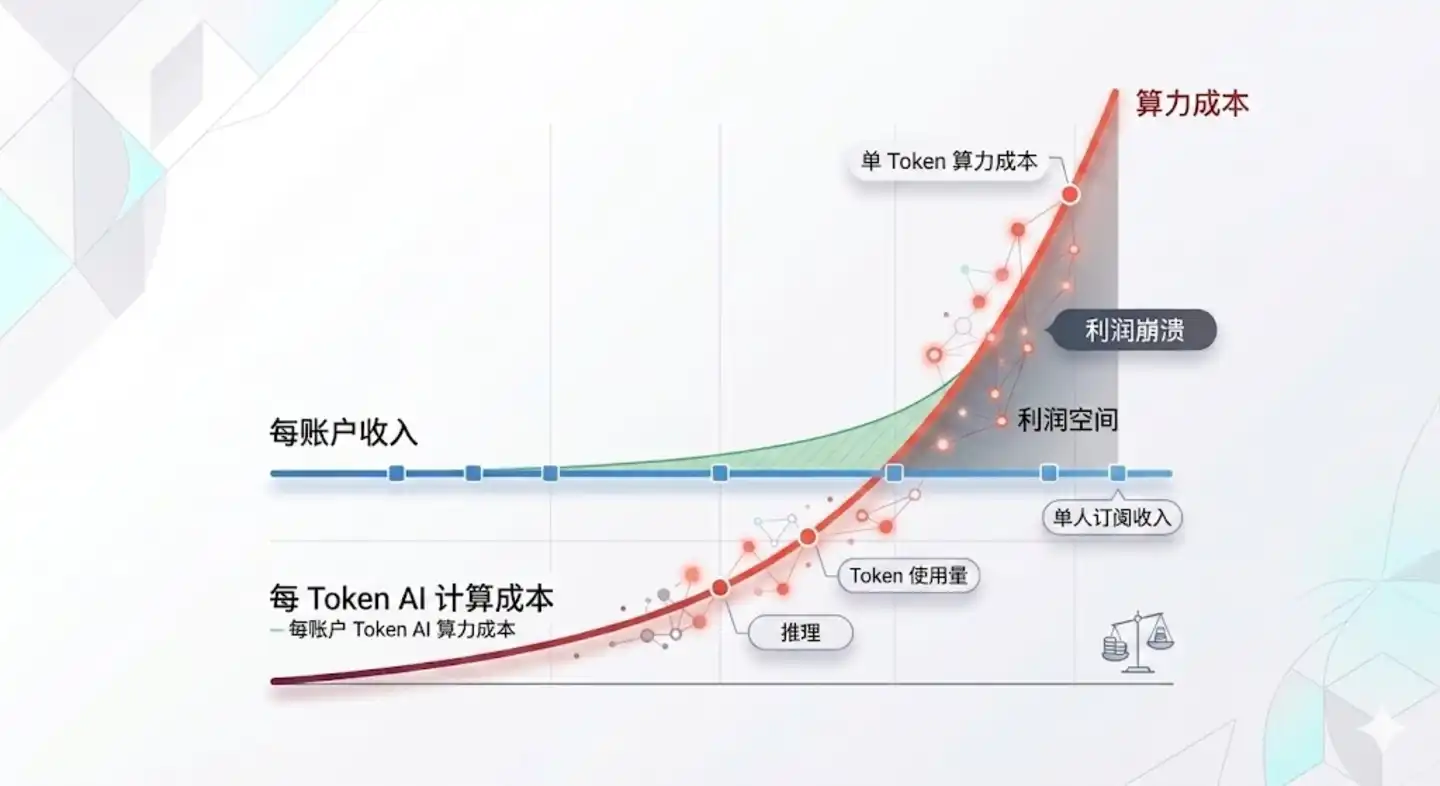
The fact that big companies' token budgets are burning through much faster than expected certainly has to do with employees "not treating beans as rations" and burning tokens recklessly, but the root cause of token budget tension is that AI is getting more expensive. US AI software prices have risen by 20% to 37% over the past year. The "Big Three" — Anthropic, OpenAI, and Google — have all quietly increased the effective price for the same AI output over the past six months.
(Source: X)

The prevailing narrative used to be: "The larger the scale of AI application, the higher the level of industrialization, the lower the cost, and the happier enterprises will be." How naive.

And this trend will not reverse. Price is determined by supply and demand, not cost, but the supply-demand relationship for AI has completely reversed in 2026. Before, big companies begged people to use AI, needing to educate the market and promote the technology. AI was always subsidized — how many free "Thousand Questions" cups of milk tea have you had? Now? People are increasingly actively using it, "can't live without it after the first puff." AI programming, AI documentation, AIGC, even AI search are becoming more widespread. The era of AI subsidies is completely over.

The more people use it, the greater the demand, the tighter token resources become, so the computing power shortage has spilled over from GPUs to CPUs, storage, and even bandwidth. Intel, Micron, SK Hynix, Samsung Electronics, SanDisk, and domestic companies like Jiangbolong and the two "Longs" are feasting alongside Nvidia. Where does the doubling revenue growth of semiconductor giants in 2026 come from? It certainly isn't from the OpenAI-Oracle-Microsoft triangular closed-loop investment, right? Enterprises' pain is just beginning. And AI products like ChatGPT, Claude, Gemini, and Doubao emphasizing strict hierarchies between free and paid tiers will also make individual users increasingly conflicted.

It's like ride-hailing: during the craze, you could take premium cars to and from work for free, with capital footing the bill. After user habits were established, subsidies ended, prices returned to normal levels, and those who needed to take the subway still did. AI is the same. Therefore, against the backdrop of rising token prices across the industry, DeepSeek's insistence on cutting prices is no longer just a display of personal courage as a "Cyber Bodhisattva," but demonstrates a kind of reverse pricing power: we can be this cheap, still operate normally, and quality doesn't drop.

If Liang Wenfeng wanted, DeepSeek wouldn't need to be this cheap at all. So people are starting to worry: Will DeepSeek become the Linux of the AI era? Huge influence, but not making big money. Linux's contribution to the IT industry is far greater than Windows or Android (which itself is based on the Linux kernel), but it's open-source and commercially hasn't spawned giants like Microsoft or Google. DeepSeek currently has huge influence, but its commercial capabilities are far inferior to the Silicon Valley Big Three, and even cannot compete with the three domestic players: Kimi, MiniMax, and Zhipu. 2025 revenue ranking of the "Four Little Dragons": Zhipu (2025 revenue 724 million RMB) > MiniMax (2025 revenue approx. 560 million RMB) > Moonshot AI (approx. 200 million) > DeepSeek (unknown but lower).

Liang Wenfeng made money through AI quantitative trading and can personally invest 20 billion in DeepSeek, but the story of "running on love" cannot last forever.

Furthermore, under the open-source model, others can also distill, deploy, and fine-tune, so DeepSeek's technological moat will become thinner. So you always see news like this: "After Zhipu GLM-5.1 was open-sourced, it refreshed global scores on the SWE-bench Pro benchmark," "Xiaomi's MiMo-V2.5-Pro tops the global open-source large model leaderboard..." A joint report from MIT and Hugging Face shows that in the past year, open-source models developed in China accounted for 17.1% of global downloads, surpassing the US's 15.8%, ranking first globally.

No wonder there are increasing voices in Silicon Valley saying: There must be a US version of DeepSeek; we cannot sit back and watch the AI industry replay the stories of Shein, Temu, or TikTok. "If an open-source champion does not rise in the United States, the world will run on open-source models and software from whichever country can produce the strongest, most stable, cheapest, customizable, scalable models that meet personal and commercial needs." Topics involving great power competition often sound grand, but the competition behind them is real.

Behind DeepSeek's rise lies the narrative of indigenous substitution. V4's support for Ascend brought joy, and driven by domestic computing power, the price competitiveness DeepSeek currently displays is just the appetizer. In the technical report, DeepSeek indicated that after the batch release of Ascend 950 super nodes in the second half of the year, the price of V4-Pro will be significantly reduced further. The best is yet to come.

There's also the advantage of high-level AI talent. AI talent is expensive to a "luxury" level, but China's is relatively cheaper. Lei Jun making headlines for poaching Luo Fuli from DeepSeek with a ten-million-yuan salary, while Zuckerberg was offering $1 billion to poach people, including via acqui-hires. But the difference between what a $1 billion person and a ten-million-yuan person produces is clearly not 700 times. The price gap in AI talent will actually translate into a systemic price gap in the token production system.

The bigger competitive advantage lies in the energy system, which is the first layer of Jensen Huang's AI five-layer cake.

The end of AI is computing power, and the end of computing power is electricity. In April 2026, DeepSeek posted job listings for Senior Data Center Operations Engineers and Senior Delivery Managers in Ulanqab, Inner Mongolia, indicating its move to build token factories in the west, pushing cost advantages from the software layer down to the physical layer. The last time I wrote about Ulanqab in an article was when Kuaishou was building a data center there: close to power plants, suitable climate for cooling. Moreover, green electricity prices in western China are about 0.2-0.3 RMB/kWh, only 1/5 to 1/4 of those in Europe and the US.

It's not just that western green electricity is competitive. According to 2025 data from the International Energy Agency, China's total installed power generation capacity has exceeded 2,300 GW, accounting for about 22% of the global total, ranking first; the US has about 1,300 GW. More crucially, China has the world's most complete power structure: thermal, hydro, wind, nuclear, and photovoltaic all included. Data shows that China's industrial electricity prices have long been maintained at $0.06 to $0.08/kWh, while California's industrial electricity prices are close to $0.18/kWh, and even exceed $0.25/kWh in parts of Germany. This means that training a ten-thousand-card cluster in China is naturally dozens of percentage points cheaper than in Europe and the US.

In the operating costs of AI large models, electricity costs account for 60%-70% of total operating costs. It's not just running the model that uses electricity; cooling is a major part. The "infrastructure maniac" even builds data centers directly on the seabed, with offshore wind power input nearby and seawater circulation for free cooling. Then there are large-scale projects like "West-East Electricity Transmission" and "East Data West Computing." The ability to regionally dispatch power and computing is extremely strong. Guizhou, Inner Mongolia, Ningxia were already core nodes of "East Data West Computing." The pathway for moving AI computing power centers west was prepared long ago.

Using Chinese AI essentially means using AI trained by a more competitive energy system — more economical, more affordable AI. This is one reason why the overseas revenue of Kimi, MiniMax, etc., exploded after the Spring Festival. It's not just that the algorithms are stronger; it's that they have an electricity price cheat.

Nvidia can define the price of high-end computing power, but DeepSeek and others are grasping the pricing power of tokens. You might say cheap AI is no good. AI is indeed you get what you pay for. DeepSeek V4 only narrowed the gap between open-source and closed-source to a historical minimum. The company candidly acknowledges the objective gap with top models like GPT, and it's not multimodal — it can recognize images but not generate them.

But this hasn't stopped the community from flocking to DeepSeek. The reason: most real business scenarios don't require calling the world's strongest model every time. Consulting, customer service, summarization, translation, code completion, enterprise knowledge bases, automated workflows — these don't require the highest intelligence, but "barely usable + cheap enough + stable enough." When DeepSeek V4's inference cost is only about 1% (Flash) to 11% (Pro) of GPT-5.5's, an enterprise with the same budget can call tens of times more tokens, try more prompt chains, iterate more agent workflows, and the final output might even be better. After all, AI itself is a "probability" game. If it's cheap enough, getting results by making do is perfectly acceptable.

Therefore, the more expensive AI gets, the more valuable DeepSeek's cheapness becomes, and the more valuable the company DeepSeek becomes. Liang Wenfeng and his investors understand this better than anyone.


Preguntas relacionadas

QWhat is the main reason for the recent wave of social media calling Liang Wenfeng a 'Cyber Bodhisattva'?

AThe main reason is DeepSeek's announcement to make the 75% discount on its V4-Pro API pricing permanent, lowering input and output token costs significantly. This action stands in stark contrast to the global trend of major AI companies raising their prices, earning Liang praise for making AI more accessible and affordable.

QAccording to the article, what is the fundamental factor making AI increasingly expensive?

AThe fundamental factor is the reversal of the supply-demand relationship for AI in 2026. The era of AI subsidies has ended as usage has become widespread and indispensable. Increased demand leads to greater strain on token resources, causing shortages across the compute stack (GPU, CPU, storage, bandwidth), which in turn drives up costs.

QWhat competitive advantages does China possess, according to the article, that contribute to the lower cost of AI models like DeepSeek?

AChina possesses several competitive advantages: 1) A more affordable and abundant talent pool for AI engineers. 2) A highly competitive energy system with significantly lower industrial electricity prices (as low as 1/5 to 1/4 of Western rates), which is crucial as power can constitute 60-70% of AI operational costs. 3) Strong regional power and compute调度 capabilities through initiatives like 'West-East Power Transmission' and 'East Data West Computing'.

QWhy might DeepSeek's low-cost strategy be commercially viable even as it forgoes higher profits in the short term?

ADeepSeek's strategy is viable because its extreme cost efficiency grants it反向定价权 (reverse pricing power). In a market where AI is getting universally more expensive, DeepSeek's ability to operate profitably at drastically lower prices demonstrates superior operational efficiency. Furthermore, for many real-world business applications (customer service, summarization, code completion), 'good enough' performance at a fraction of the cost allows businesses to experiment and scale more, potentially delivering better overall results.

QWhat concern does the article raise regarding the long-term sustainability of DeepSeek's open-source and low-cost model?

AThe article raises the concern that DeepSeek could become the 'Linux of the AI era'—immensely influential and foundational but not a major commercial powerhouse itself. The open-source model allows others to distill, deploy, and fine-tune its models, potentially eroding its technical moat. While impactful, its current commercial revenue lags behind competitors like智谱, MiniMax, and月之暗面, raising questions about the long-term sustainability of a model heavily reliant on founder investment and '发电' (generating power with love, i.e., idealistic drive).

Lecturas Relacionadas

After Three Consecutive Quarters of Decline, Can the Crypto Market Find a Window for Stabilization in Q3?

The cryptocurrency market has just concluded its worst-performing quarter since 2022, with total capitalization dropping 12.6% to $2.1 trillion. All core metrics indicate capital is leaving the sector, not just rotating within it. Bitcoin fell 14.2% and Ethereum dropped 25.4% in Q2, breaking their previous correlation with US tech stocks. A key driver is the reversal in US spot Bitcoin ETF flows, which saw a net outflow of approximately $4.67 billion in Q2, including a record monthly outflow near $4.5 billion in June. While recent data suggests long-term holders are accumulating again, sustained ETF outflows mean continued selling pressure. Market focus is now singularly on the Federal Reserve. The upcoming July FOMC meeting is seen as the most critical event for Q3. A dovish signal could support Bitcoin reclaiming a $68,000-$84,000 range, while a hawkish stance might establish a new trading band around $50,000-$56,000. Additionally, regulatory uncertainty persists, with the progress of the crucial *CLARITY Act* stalling in the Senate, reducing its perceived 2026 passage probability to 40-45%. Despite the broad downturn, a few sectors showed growth. Prediction markets saw nominal volume surge 48.7% year-over-year to $113.8 billion, and tokenized collectibles transaction volume rose 143% quarterly to $1.4 billion. The Real-World Asset (RWA) tokenization sector also continued steady growth, now representing ~$28.1 billion in on-chain value. The market's foundation for an extreme crash appears limited, with Bitcoin price hovering near its 200-week moving average. However, the trading paradigm has shifted from narrative-driven speculation to decisions based on price action, policy developments, and interest rate expectations, making a broad sentiment-driven rally unlikely in the near term.

marsbitHace 4 hora(s)

After Three Consecutive Quarters of Decline, Can the Crypto Market Find a Window for Stabilization in Q3?

marsbitHace 4 hora(s)

BIT Trading Moment: BTC Still Suppressed by Weekly 200 EMA, Rejection May Restart Decline; Storage and Semiconductors that Surged Last Night Begin Falling in Evening Trading

**Crypto & Stock Market Wrap: Bitcoin Tests Resistance, Stocks Retreat After AI Surge** Bitcoin consolidates around $66,000, facing key resistance near $68,000—an area seen as a major psychological and technical hurdle where previous rallies have failed. Analysts note the cryptocurrency is caught between its 200-week moving average (~$63,333) and 200-week EMA (~$68,328). A clear break above $68k is needed to signal a stronger bullish trend, while a rejection could lead to a retest of $63k support. Market sentiment remains cautious, with low futures open interest pointing to a low-liquidity rebound rather than a full bull market. Bitcoin spot ETFs saw another $203 million inflow. US stock futures pointed lower after a strong Tuesday session led by a massive rebound in semiconductors and memory stocks. The rally was fueled by renewed optimism about AI-driven hardware demand, with Micron, SanDisk, and SK Hynix surging. However, those gains reversed in pre-market trading. Super Micro Computer (SMCI) soared over 20% after hours on strong guidance and a record backlog. Other standouts included Rocket Lab and nuclear energy plays Oklo and X-Energy. Rising oil prices (Brent above $91) and climbing Treasury yields (10-year near 4.64%), however, are reigniting inflation concerns and acting as a headwind for equities. In Asia, markets were mixed. South Korea's KOSPI pared early gains to close slightly higher as semiconductor stocks like SK Hynix gave back initial surges. Japan's Nikkei edged lower as the yen hit a fresh 38-year low against the dollar, raising fears of potential market intervention. Key events to watch include the Samsung Galaxy launch, AMD's AI event, and a slew of major tech earnings from Alphabet, Tesla, and IBM after the close on Wednesday, followed by the ECB meeting and Intel's earnings on Thursday.

marsbitHace 5 hora(s)

BIT Trading Moment: BTC Still Suppressed by Weekly 200 EMA, Rejection May Restart Decline; Storage and Semiconductors that Surged Last Night Begin Falling in Evening Trading

marsbitHace 5 hora(s)

Former CFTC Chairman, Circle President Tarbert: Preaching Long-Termism While Cashing Out $30 Million Himself

Former CFTC Chairman and Circle President Heath Tarbert has consistently advocated for a long-term vision in public, urging patience from investors as Circle’s stock price has fallen significantly from its peak. However, it has been revealed that since Circle’s IPO, Tarbert has continuously sold his CRCL shares through pre-arranged trading plans, cashing out approximately $30 million, without making any public market purchases. This contrast between his public messaging and personal actions has drawn criticism. Tarbert joined Circle in July 2023 as Chief Legal Officer, leveraging his regulatory experience to help guide the company through its IPO and expansion. Despite promoting stablecoins as long-term infrastructure, he established a 10b5-1 trading plan just before Circle went public, leading to substantial stock sales over the following year. In March 2026, he initiated another plan to sell more shares. His career trajectory highlights a pattern of moving between high-level regulatory roles and influential positions in the financial sector. After resigning as CFTC Chairman in early 2021, he joined Citadel Securities as Chief Legal Officer just 27 days later, during a period of intense regulatory scrutiny for the firm. He later joined Circle, aiding its efforts to navigate regulatory challenges for its public listing. While Tarbert's expertise in policy and compliance is valuable to companies like Circle, his actions—advocating long-term confidence while personally divesting—raise questions about the alignment between his public statements and his private financial decisions, leaving investors who followed his advice to bear the market risks.

marsbitHace 5 hora(s)

Former CFTC Chairman, Circle President Tarbert: Preaching Long-Termism While Cashing Out $30 Million Himself

marsbitHace 5 hora(s)

Gate Research Institute: The 'Wall Street-ization' Wave of Crypto Financial Products – Competition or Integration?

The article titled "Gate Research Institute: Are Crypto Financial Products Sparking a 'Wall Street' Wave—Competition or Convergence?" explores the evolving relationship between the crypto ecosystem and traditional finance (TradFi). The piece begins by reflecting on Bitcoin's original 2009 vision of decentralization, disintermediation, and moving away from banks. It then contrasts this with the 2024 landscape, where key crypto assets like Bitcoin are increasingly held through Wall Street products like ETFs issued by giants like BlackRock. The article questions whether this signifies that TradFi is systematically taking over the rights to issue, price, custody, and distribute crypto financial assets. The core argument is that this is not a zero-sum takeover but rather a bidirectional convergence where each side addresses the other's weaknesses. Crypto offers 24/7 global markets, programmable settlement, and open access but lacks compliant channels, institutional-grade custody, deep fiat liquidity, and mainstream distribution. TradFi possesses these but is constrained by legacy systems, limited operating hours, and slow settlement. Two primary convergence paths are highlighted: * **Path A (CEX to TradFi):** Exemplified by Gate, which has progressed from offering tokenized stocks and CFDs to providing direct, real stock trading (US, Hong Kong, South Korea) within its platform, using USDT. * **Path B (TradFi to Crypto):** Exemplified by Robinhood, which has integrated crypto trading, acquired exchanges like Bitstamp, and is moving traditional assets like stocks onto the blockchain via tokenization and its own Layer 2. Both paths are ultimately competing to become the next-generation, unified financial account—a "super account" where users can seamlessly trade cryptocurrencies, stocks, ETFs, RWA (Real World Assets), and tokenized treasury products in one interface. The growth of RWA and tokenized treasuries (e.g., BlackRock's BUIDL) is presented as the asset-layer fusion, providing stable, yield-bearing assets on-chain and acting as a bridge between the two worlds. In conclusion, the "Wall Street-ization" of crypto is framed as a mutual transformation. Decentralized ideals persist in the protocol layer, while at the application layer, a more efficient, global, and accessible unified capital market is emerging from this convergence. The future competition lies not between crypto exchanges and stockbrokers, but between platforms vying to offer the most comprehensive asset coverage, liquidity, and user experience within a single account.

marsbitHace 5 hora(s)

Gate Research Institute: The 'Wall Street-ization' Wave of Crypto Financial Products – Competition or Integration?

marsbitHace 5 hora(s)

Trading

Spot
活动图片




