Deconstructing Smart-Cashtags: How X Is Entering Web3 Financial Infrastructure?

marsbitPublicado a 2026-01-14Actualizado a 2026-01-14

Resumen

X, formerly Twitter, is launching "Smart-Cashtags," a feature that integrates real-time financial data directly into its platform, marking a significant step in its evolution into an "Everything App." This update aims to eliminate the friction users face when switching between X for market information, charting tools like TradingView, and exchanges to execute trades. The core innovation is the binding of a cashtag (e.g., $SOL) to a specific on-chain smart contract address, combating the widespread issue of scam tokens with identical names. This provides a layer of verification and security for users. Beyond fraud prevention, Smart-Cashtags will display a financial dashboard with real-time price, volume, and on-chain data when a user clicks a tag. This transforms X into a "Bloomberg Terminal for retail," enabling near-instant decision-making without leaving the app and accelerating the platform's influence on asset pricing. This move is also a strategic play in the "Web3 traffic入口" war against Telegram, which has captured mobile trading demand via its trading bots. With the recent acquisition of payment licenses and an in-app wallet in development, X is positioned to eventually integrate "Buy/Sell" buttons, potentially becoming the world's largest social trading platform. Scheduled for a global rollout, Smart-Cashtags represent X's ambition to move beyond being a source of information to becoming the central hub for social finance (Social-Fi), capturing value directly with...

Author: BlockWeeks

In the world of crypto, attention is currency, and X (formerly Twitter) has long been the world's largest wholesale market for attention.

For a long time, users here have been accustomed to a fragmented existence: searching for "Alpha" (excess return information) on X, quickly switching to TradingView to check charts, and then jumping to an exchange to place an order. This "friction cost" caused by app switching is often the key factor determining the profit or loss of a high-frequency trade.

However, with the official preview of Smart-Cashtags by X's product lead Nikita Bier in early 2026, this fragmented state may become history. This is more than just a UI component update; it marks the placement of the most critical piece in Musk's puzzle of building the "Everything App"—the closed loop of financial information flow.
Farewell to "Fakes": On-Chain Authentication of Token Identity

For any investor who has lived through a "shitcoin season," the first, and most painful, point that Smart-Cashtags addresses is "identity verification."

In the old system, a Cashtag (like $ABC) was merely a blue hyperlink for search. But in the decentralized world, anyone can issue a token named $ABC. This meant that when a big influencer shilled a coin, scammers could often deploy a token with the same name within minutes and manipulate search results through volume manipulation, causing many retail investors to buy the wrong contract address.

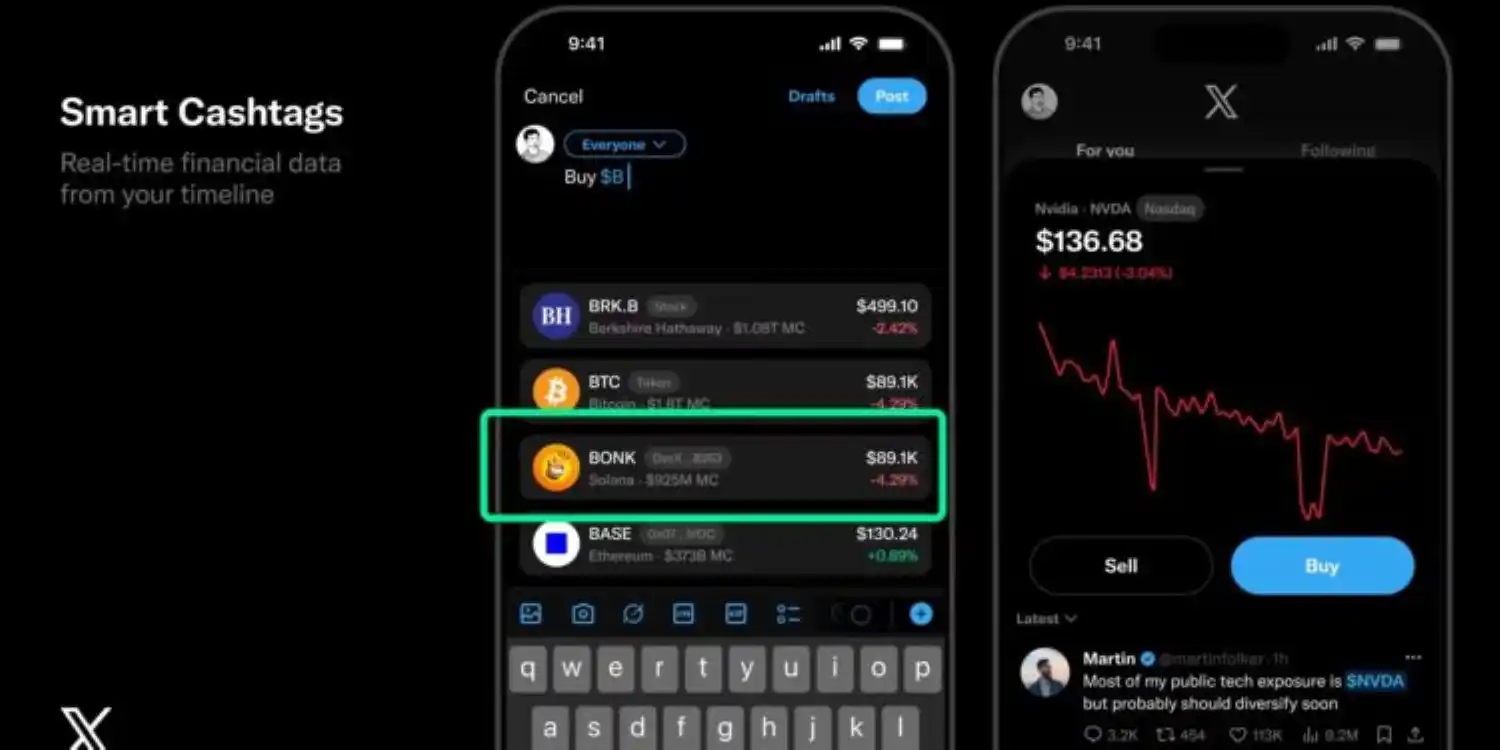
The core change with Smart-Cashtags is its introduction of a "hard binding of semantics and contract." Based on currently disclosed information, the new feature will allow posters or communities to directly associate a specific smart contract address when typing the $ symbol.

This means that in the future, $SOL will no longer be an ambiguous tag; it will directly point to the native asset on the Solana chain. For those highly liquid, short-lived Meme coins, this is equivalent to introducing an "anti-counterfeiting watermark" at the social layer. X is attempting to use technical means to cleanse the rampant scam noise on its platform, paving the way for subsequent compliant finance.

The "Bloomberg-ization" of the Social Interface: When the Information Flow Becomes the Trading Flow

If "anti-counterfeiting" is the foundation, then shaping X into the "Bloomberg Terminal for retail" is its true ambition.

In traditional finance, the Bloomberg Terminal is expensive because it integrates news, data, and trading on one screen. Smart-Cashtags is doing the same thing for retail. Once the feature goes live, clicking a tag will no longer redirect to a tweet search stream but will instead directly summon a floating financial dashboard.
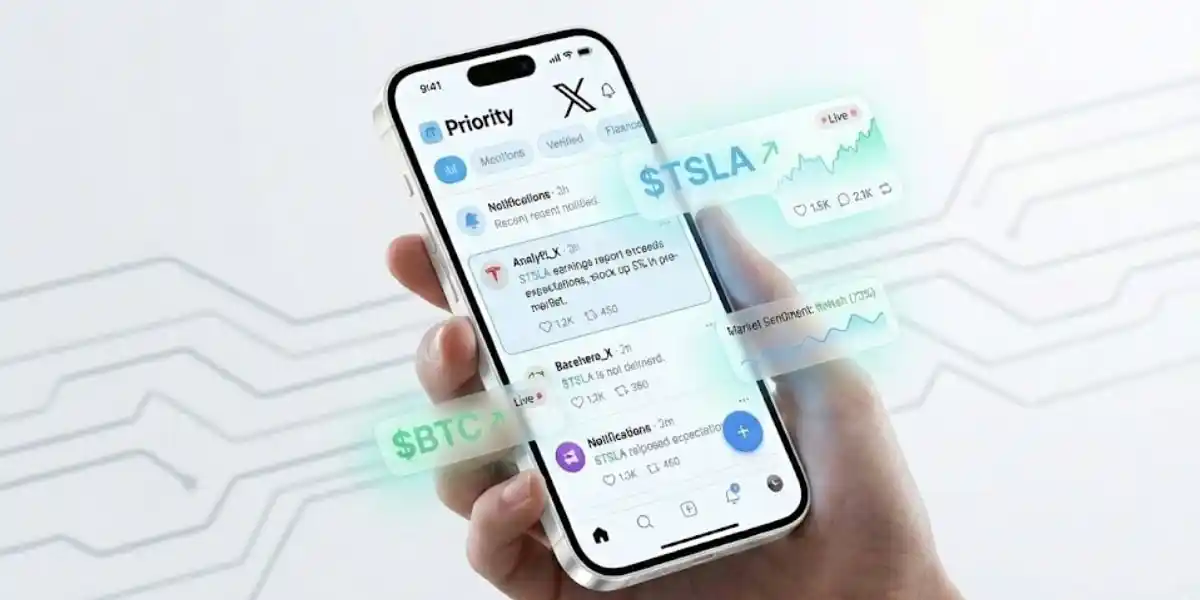
Imagine this scenario: You come across breaking news about a DeFi protocol being hacked. In the past, you would need to exit X, open a charting app to confirm the price drop, and then decide whether to buy the dip or cut losses. In the future, you simply click the tag in the tweet, and real-time price, trading volume changes, and on-chain fund flows will be instantly displayed on the current page.

This "zero-redirect" experience will drastically shorten the time window from "acquiring information" to "making a decision." For the market, this means the speed of sentiment transmission will further accelerate, and X's immediate influence on asset pricing will reach an unprecedented height.

The Endgame of Social-Fi: A Direct Challenge to Telegram

We cannot view this update in isolation. Behind Smart-Cashtags lies the invisible war between X and Telegram for the "Web3 traffic gateway."

Over the past two years, Telegram,凭借 Unibot, Banana Gun, and other trading bots, has successfully captured a significant portion of mobile trading demand. Users see a message in a Telegram group and buy directly with one click via a bot—an experience that once could only be envied by X.

Smart-Cashtags is X's powerful counterattack. Although the initial functionality focuses on market display,结合 Musk's acquisition of payment licenses in multiple US states and X's testing of an "in-app wallet" feature, it is reasonable to speculate that integrating "Buy/Sell" buttons directly on the tag page is only a matter of time.

Once the payment layer is connected, X will instantly升级 from a "square for arguments" to the world's largest "social exchange." It boasts a more public arena for discourse, more sophisticated algorithm recommendations, and a larger user base of institutions compared to Telegram.

Conclusion

2026 is destined to be a year where Social-Fi (Social Finance) separates the wheat from the chaff.

The emergence of Smart-Cashtags means X is no longer content with just being a traffic "referral"; it wants to become the "checkout counter" itself. For the average investor, this may mean more convenient tools; but for professional crypto practitioners, this heralds a new battlefield: those who can first leverage this new tool to capture emotional value will occupy the high ground in the new traffic distribution mechanism.

It is reported that the feature is expected to be rolled out to global users in February. When that happens, every time we click the $ symbol, we might be participating in a tiny rewrite of financial history.


Preguntas relacionadas

QWhat is the core innovation of X's Smart-Cashtags feature, and what key problem does it solve?

AThe core innovation of Smart-Cashtags is the 'hard binding of semantics and contracts.' It solves the critical problem of token identity confirmation by allowing a cashtag (e.g., $ABC) to be directly linked to a specific on-chain smart contract address, preventing users from being scammed by fake, identically named tokens.

QHow does the Smart-Cashtags feature transform the user experience on X into a 'Bloomberg Terminal for retail'?

AIt transforms the experience by displaying a financial dashboard directly within the X interface when a user clicks a cashtag. This provides real-time price, trading volume, and on-chain data without requiring the user to switch to another app, drastically shortening the time between receiving information and making a trading decision.

QWhich competing platform has been a leader in capturing mobile Web3 trading flow, and how is X's Smart-Cashtags a response to it?

ATelegram has been the leading platform, capturing mobile Web3 trading flow through integrated trading bots like Unibot and Banana Gun. Smart-Cashtags is X's direct response, aiming to compete by integrating financial data and, in the future, potentially direct buy/sell functionality within its social feed.

QBeyond just displaying data, what is the article's prediction for the future evolution of the Smart-Cashtags feature?

AThe article predicts that the feature will eventually integrate direct 'Buy/Sell' buttons, leveraging the payment licenses acquired by Elon Musk. This would turn X from a social platform into a massive 'social exchange,' directly competing with Telegram's bot-based trading model.

QWhat broader shift in X's strategy does the introduction of Smart-Cashtags represent according to the article?

AIt represents a strategic shift where X is no longer content with just being a source of traffic and information (a 'lead generator') but is moving to become the complete financial infrastructure itself, acting as the 'cash register' by closing the loop between social discourse and financial action.

Lecturas Relacionadas

Near Returns to the AI Stage: Transformation into a Public Chain Due to 'Payroll Difficulties,' Agent and Privacy Emerge as New Growth Narratives

NEAR Returns to AI Origins: From Payroll Struggles to Blockchain, Now Focusing on AI Agents and Privacy NEAR Protocol's journey began not with grand blockchain ambitions, but from a practical hurdle: its AI startup founders, including Transformer paper co-author Illia Polosukhin, couldn't efficiently pay international developers in 2017. This led them to pivot and build a high-performance, scalable blockchain. After years navigating various crypto narratives like sharding and cross-chain interoperability, NEAR is now leveraging its AI roots to re-enter the AI arena. A key driver is its "NEAR Intents" layer, which abstracts complex cross-chain transactions. Users simply state their goal (e.g., swap BTC for ETH), and a solver network finds the optimal route. This system has processed over $20B in cross-chain volume, generating significant fee revenue. A major growth area is private transactions via "Confidential Intents/Swaps," which hide trade details until settlement to protect against MEV and front-running. Remarkably, private swaps recently accounted for over 40% of NEAR's transaction volume, highlighting strong demand but also potential regulatory scrutiny. With its AI-founder pedigree, NEAR is positioning itself at the intersection of blockchain, AI agents, and privacy, aiming to become infrastructure for the emerging agent economy while navigating the challenges of its rapid adoption.

marsbitHace 1 hora(s)

Near Returns to the AI Stage: Transformation into a Public Chain Due to 'Payroll Difficulties,' Agent and Privacy Emerge as New Growth Narratives

marsbitHace 1 hora(s)

From Ethereum to AI's 'CROPS': What Exactly is This Set of 'Slow Variables' That Vitalik Repeatedly Emphasizes?

In recent discussions, Vitalik Buterin has frequently emphasized the concept of "CROPS," a framework defining core values for Ethereum's development. CROPS stands for Censorship Resistance, Capture Resistance, Open Source, Privacy, and Security. Initially outlined in the Ethereum Foundation's "EF Mandate," it represents a commitment to user sovereignty, ensuring that the network resists external control, remains open, protects privacy, and prioritizes security. The relevance of CROPS extends beyond Ethereum's foundational principles, becoming crucial in the context of AI integration. As AI agents begin handling wallet operations and automated transactions, the risk increases that users may cede control over their digital assets, privacy, and intentions to centralized AI service providers. A "CROPS AI" would therefore emphasize local execution where possible, privacy-preserving remote model calls (e.g., using zero-knowledge proofs), and transparent, verifiable processes to maintain user agency. Vitalik highlights a significant convergence between "CROPS Ethereum access layer" and "CROPS AI." Both address the same fundamental challenge: how users can access powerful services—be it blockchain data via RPCs or AI models—without exposing sensitive information or relinquishing ultimate control. This intersection points toward a future digital entry point that is more private, secure, and user-controlled. Ultimately, CROPS is not merely an abstract ideal but a practical guidepost. It steers development—from protocol resilience and wallet design to AI agent safety—towards a future where users retain self-sovereignty even as digital systems grow more complex and powerful. In an era of accelerating AI adoption, these "slow variables" of censorship resistance, openness, privacy, and security may define Ethereum's enduring value.

marsbitHace 1 hora(s)

From Ethereum to AI's 'CROPS': What Exactly is This Set of 'Slow Variables' That Vitalik Repeatedly Emphasizes?

marsbitHace 1 hora(s)

Silicon Valley 'Startup Guru' Steve Hoffman: Web3 + AI Could Be a Trap

Silicon Valley investor and "Godfather of Startups" Steve Hoffman warns that combining Web3 with AI is likely a trap, not a promising venture. In an interview, Hoffman argues that while AI is a foundational technology touching all industries, Web3 adds complexity, friction, and regulatory risk without solving mainstream consumer or business needs. He advises founders to focus on deep, specialized applications where startups can out-iterate giants, rather than on generic features easily replicated by large tech companies. Hoffman observes that Silicon Valley will lead foundational AI research, while China excels at rapid, large-scale application and commercialization, particularly in robotics. He stresses that AI-driven autonomous agents capable of collaborative, multi-step tasks are 2-4 years away, which will cause significant job displacement. The solution is not to slow AI but to redesign business models around human-AI collaboration and reform social systems like education and retraining. For startups, Hoffman recommends focusing on vertical, expertise-heavy domains to build defensibility. He sees major opportunities in AI fraud detection and cybersecurity. Key founder mindsets include systemic thinking over feature-focus, relentless customer centricity, building adaptive teams, and deeply understanding AI's capabilities and limits. Hoffman is also leading a non-profit initiative to establish university centers aimed at training future leaders in responsible, human-value-aligned AI innovation.

marsbitHace 3 hora(s)

Silicon Valley 'Startup Guru' Steve Hoffman: Web3 + AI Could Be a Trap

marsbitHace 3 hora(s)

Token Inefficient, Economy Tokenless

The article "Tokens Aren't Economical, Economics Aren't Tokenized" analyzes a pivotal shift in the AI industry from a technology-driven narrative to one dominated by capital efficiency. It highlights two concurrent trends: a severe capital shortage due to the exorbitant and recurring costs of compute (e.g., OpenAI's high burn rate) and a wave of corporate spin-offs where major tech companies are separating their AI units (like Kuaishou's Kling and Baidu's Kunlunxin). The core argument is that AI's "anti-internet" business model, where user growth increases costs rather than profits, has created a disconnect between high valuations and actual cash flow. Spin-offs address this by allowing AI assets to be valued independently. Within a parent company, they are seen as cost centers, but as standalone entities, they are priced based on their growth potential and scarcity in the primary market, leading to massive valuation premiums (e.g., Kling's estimated value tripling post-spin-off). The industry is at an inflection point, moving from "model worship" to "value realization." The competition is evolving from a pure compute (GPU) race to a broader focus on systemic efficiency and full-stack engineering (involving CPUs and orchestration) to achieve viable commercialization. The year 2026 is framed as a critical moment where the industry must definitively answer how to economically translate AI capability into tangible business value, reshaping the sector's future power structure.

marsbitHace 3 hora(s)

Token Inefficient, Economy Tokenless

marsbitHace 3 hora(s)

Trading

Spot
Futuros
活动图片