DDC Enterprise Increases Bitcoin Holdings by 200, Advancing Steadiness in Treasury Strategy

marsbitPublicado a 2026-01-22Actualizado a 2026-01-22

Resumen

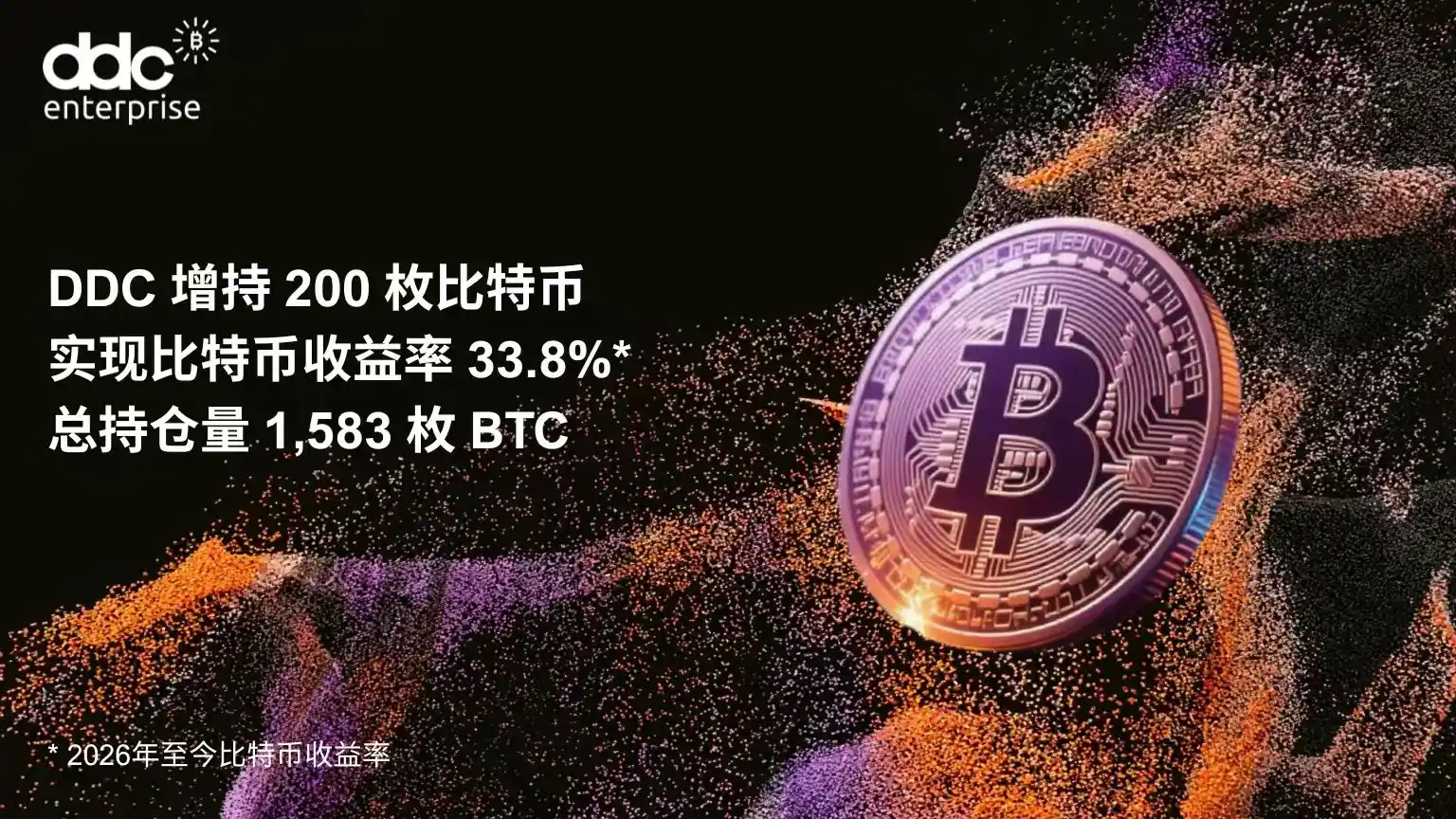
DDC Enterprise Limited (NYSEAMERICAN: DDC), a global Asian food platform and digital asset management company, announced on January 22, 2026, that it has purchased an additional 200 Bitcoin as part of its established Bitcoin reserve strategy. This acquisition brings the company’s total Bitcoin holdings to 1,583. The move reflects DDC’s disciplined capital allocation approach, emphasizing steady accumulation across market cycles with strong governance and risk controls. The purchase was made during a market correction, underscoring the company’s long-term value focus rather than short-term volatility. Key highlights include: - Total Bitcoin held: 1,583 - Average purchase price: $88,085 per Bitcoin - Year-to-date return on Bitcoin holdings: 33.8% - Bitcoin per 1,000 shares: 0.053203 Norma Chu, Founder, Chairwoman, and CEO, stated in the 2026 Shareholder Letter that companies prepared for the long term can identify opportunities amid volatility. DDC continues to strengthen its Bitcoin reserve under a clear governance framework as part of its treasury strategy.

NEW YORK, January 22, 2026 – DDC Enterprise Limited (NYSEAMERICAN: DDC, hereinafter referred to as "DDC" or the "Company"), a global Asian food platform and digital asset treasury management company, today announced that, as part of its established Bitcoin reserve plan, it has completed a new round of accumulation, purchasing an additional 200 Bitcoin.

Following this transaction, DDC's total Bitcoin holdings have increased to 1,583.

The Company stated that this acquisition continues its consistent principle of prudent capital allocation, emphasizing the orderly advancement of its treasury strategy under a clear governance framework and risk control mechanisms. This purchase was timed with a phase of correction in the crypto asset market, reflecting the Company's strategic judgment based on long-term value rather than being overly influenced by short-term market fluctuations.

DDC pointed out that the core philosophy of its treasury management includes: maintaining a steady pace of gradual accumulation across different market cycles, strictly controlling capital costs, and managing risks throughout the entire process.

Key Highlights of This Acquisition

• Reserve Growth: Bitcoin holdings increased by 200

• Holding Milestone: Total Bitcoin holdings reach 1,583

• Average Holding Cost: $88,085 per Bitcoin

• Year-to-Date Return on Bitcoin Holdings: 33.8%

• Holdings per Share: 0.053203 Bitcoin per 1,000 shares of DDC stock

Norma Chu, Founder, Chairperson of the Board, and Chief Executive Officer of DDC, stated in the "2026 Letter to Shareholders": "Market volatility is inevitable in the early stages of institutional participation. However, we believe that companies truly prepared for the long term can identify and seize opportunities within this volatility. The Company's core direction remains steadily advancing reserve expansion, continuously building a competitive Bitcoin treasury with long-term potential, supported by a robust governance system."

The Company indicated that more details regarding its long-term capital allocation strategy and Bitcoin reserve management framework are provided in the newly released "2026 Letter to Shareholders".

About DDC Enterprise Limited

DDC Enterprise Limited (NYSEAMERICAN: DDC), while maintaining its position as a leading global Asian food platform, is methodically advancing its corporate Bitcoin treasury strategy. The Company has strategically established Bitcoin as a core reserve asset and continues to expand its portfolio of restaurant concepts. DDC is at the forefront of exploration among public companies integrating Bitcoin into their financial architecture.

Lecturas Relacionadas

Agents Take Over Traffic Distribution Power: What Are Tencent, ByteDance, and Alibaba Competing For?

In the race to dominate the AI era's entry point, China's tech giants—Tencent, ByteDance, and Alibaba—are aggressively deploying AI Agents to control the future of traffic distribution. Alibaba is pursuing a dual-track "closed loop + openness" strategy. Its Qianwen app is evolving into a super-Agent integrated across its ecosystem (Taobao, Alipay, etc.) to handle complex tasks like travel planning. Concurrently, it is opening its platform to external brands (Luckin Coffee, KFC) and has launched a B2B Agent platform, "Wukong," targeting enterprise automation. Its other flagship, Quark, aims to be an "AI super search box" for information and tasks. ByteDance is executing an omnipresent "sprawl strategy." Its Doubao app boasts over 300 million monthly active users and is evolving into a default AI entry point for daily life, with plans for paid versions and e-commerce integration. Its core weapon is the Kouzi platform, a visual "AI assembly factory" for developers to build custom Agents. ByteDance is also pushing hardware integration, collaborating on AI phones and developing smart glasses to embed Doubao everywhere. Tencent is playing its long-held "ultimate card" by quietly embedding an AI Agent directly into WeChat. This Agent, accessible via a swipe, can understand user commands and automatically execute tasks by calling upon WeChat's millions of mini-programs (e.g., finding and ordering coffee). This leverages WeChat's unparalleled 1.4-billion-user ecosystem to position the app as an AI-powered "service operating system," a move that could dramatically reshape the competitive landscape. The core battleground is shifting from competing for "user screen time" to competing to be the "default execution layer" for user intent. The business model is evolving from an "attention economy" to an "intent economy," where the Agent that can most efficiently fulfill a user's need gains control over service access and token flow. This represents a fundamental change in how users connect with digital services, making the fight for the Agent入口 (entry point) a pivotal moment for redefining industry leadership in the AI age.

marsbitHace 1 hora(s)

Agents Take Over Traffic Distribution Power: What Are Tencent, ByteDance, and Alibaba Competing For?

marsbitHace 1 hora(s)

From Banning Doubao to Embracing Honor: Why Did WeChat Suddenly 'Change Its Face'?

The article explores the sudden shift in WeChat's strategy towards AI assistants from mobile phone manufacturers, transitioning from strict opposition to active collaboration. For over a year, WeChat fiercely resisted attempts by phone AI assistants (like ByteDance's Doubao in late 2025) to control its features via GUI automation ("simulated clicking"), citing security and data control concerns. This stance created a significant barrier for system-level AI integration. Now, Tencent has initiated A2A (Agent-to-Agent) partnerships with major phone brands like Honor, Xiaomi, OPPO, and vivo. This model allows a phone's system AI (e.g., Honor's YOYO) to parse a user's voice command and send a structured request directly to WeChat's own internal AI agent via secure APIs. WeChat then executes the action (e.g., sending a message) and returns the result. The article attributes Tencent's "change of face" to strategic pressure. While leading in social app usage, Tencent trails rivals like ByteDance and Alibaba in standalone AI app popularity. WeChat, with its vast mini-program ecosystem, is Tencent's key asset for an AI comeback. The upcoming WeChat AI agent aims to handle tasks like booking and payments within the app. However, phone system assistants remain the primary AI entry point for most users. The A2A collaboration allows Tencent to extend WeChat's AI reach to this crucial system layer while maintaining control over its core functions and data. For phone manufacturers, embracing A2A is a pragmatic move. The GUI route proved unviable due to WeChat's blocks. A2A offers a compliant path to integrate a vital service, enhancing their AI assistants' usefulness. It allows them to focus on developing their own AI ecosystems for other services while cooperating on WeChat access. The collaboration is framed as a mutual, strategic necessity: Tencent gains a distribution channel, and manufacturers gain a key functionality. The partnership relies on a "dual authorization" mechanism for security, requiring both user and app consent for each action. While questions about long-term data privacy practices remain, experts note A2A is more secure and compliant than GUI automation. Ultimately, this cooperation is seen as a tentative, calculated truce. Tencent's long-term goal is to make WeChat an AI-powered "service OS." Phone manufacturers aim to make their system AI the central user interface. Their paths may converge or clash in the future, but for now, the A2A deal represents the opening chapter in the battle for the AI-era user入口, driven by necessity and strategic calculus on both sides.

marsbitHace 3 hora(s)

From Banning Doubao to Embracing Honor: Why Did WeChat Suddenly 'Change Its Face'?

marsbitHace 3 hora(s)

Trading

Spot
Futuros
活动图片