Data Suggest Bitcoin May Be Entering A New Bear Phase, Warns CryptoQuant

bitcoinistPublicado a 2025-12-25Actualizado a 2025-12-25

Resumen

Bitcoin may be transitioning into a new bear market phase, according to a CryptoQuant analysis by Woominkyu. The Bitcoin Cycle Momentum Indicator (BCMI) has declined to between 0.4 and 0.5, signaling a cooling period rather than a temporary pullback. Historically, cycle bottoms occur when BCMI falls to 0.25–0.35, suggesting further downside potential. Demand has sharply declined since early October, with institutional demand contracting. US spot Bitcoin ETFs became net sellers in Q4 2025, selling approximately 24,000 BTC. Perpetual futures funding rates dropped to their lowest since December 2023, indicating reduced risk appetite. Bitcoin's price has fallen below its 365-day moving average, a key bull-bear market indicator. If a bear market is confirmed, the realized price could be around $56,000, representing a 55% drawdown from recent all-time highs. Intermediate support is seen near $70,000. Bitcoin was trading at $87,635 at the time of writing, down 10% year-to-date and 30.5% from its peak above $126,000.

As Bitcoin (BTC) continues to trade below the pivotal $90,000 mark with no signs of recovery, the prospect of a bear market is becoming increasingly relevant. Analyst Woominkyu from CryptoQuant has shared insights suggesting that the current market dynamics indicate a transition rather than just a temporary pullback.

Could Bitcoin Be Shifting Into A Bear Phase?

In a report released recently, Woominkyu examined the Bitcoin Cycle Momentum Indicator (BCMI), noting that its return to the 0.5 zone on October 21 was interpreted as a cooling phase, rather than indicative of a market peak.

In the weeks following this observation, Bitcoin’s price has seen a noticeable decline alongside a similar drop in BCMI, suggesting that the market is not only experiencing a cooling period but has also reset in terms of price and on-chain momentum.
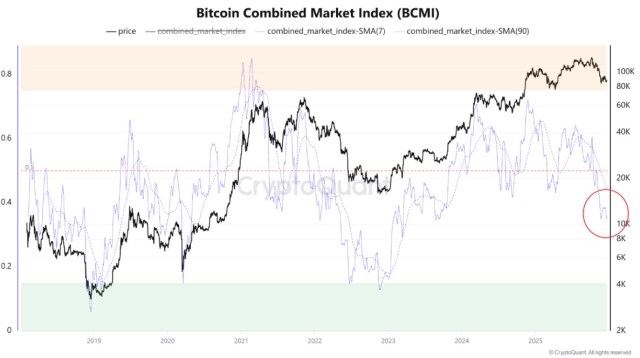
The BCMI index hovering between 0.4 and 0.5 levels. Source: CryptoQuant

Historically, significant cycle bottoms for Bitcoin in 2019 and 2023 occurred when BCMI levels fell between the 0.25 and 0.35 range. These levels are often associated with full sentiment compression and a structural reset within the market.

Currently, while BCMI remains below equilibrium as seen in the chart above, and it is still above the historical bottom zones. This data suggests that Bitcoin may be shifting into a bear phase rather than recovering from a simple pullback.

According to Woominkyu, a more stable bottom may only materialize if BCMI revisits levels seen during the previous cycles from 2019 to 2023.

Bear Market Conditions

In a separate analysis, CryptoQuant indicated that demand for Bitcoin has sharply declined, reinforcing the idea of a bear market. The report pointed to the significant drop in Bitcoin demand growth that has occurred since early October 2025.

Moreover, the report highlights that institutional and large-holder demand is contracting instead of expanding. US spot Bitcoin exchange-traded funds (ETFs) have converted into net sellers during the fourth quarter of 2025, offloading approximately 24,000 BTC.

Additionally, the number of addresses holding between 100 and 1,000 BTC, which typically represent ETFs and treasury firms, is also increasing at a rate below the trend, reflecting the demand deterioration that preceded the bear market of 2022.

The condition of the derivatives markets further corroborates the weakening appetite for risk. Funding rates in perpetual futures have dropped to their lowest levels since December 2023.

Historically, such declines in funding rates indicate a reduced willingness to maintain long positions, a phenomenon commonly associated with bear market conditions rather than bullish trends.

Technical analysis also reveals the deterioration of Bitcoin’s price structure, with the cryptocurrency falling below its 365-day moving average—a crucial long-term support level that has historically delineated bull and bear markets.

Looking ahead, historical data suggests that Bitcoin’s bear market bottoms typically align with its realized price, currently estimated around $56,000. This implies a potential drawdown of approximately 55% from the recent all-time high.

Intermediate support is anticipated around the $70,000 level, suggesting a relatively shallow bear market compared to previous cycles.

The daily chart shows BTC’s price trending downwards since October highs. Source: BTCUSDT on TradingView.com

At the time of writing, BTC was trading at $87,635. This represents year-to-date losses of 10%, as well as a 30.5% gap compared to all-time highs of just above $126,000.

Featured image from DALL-E, chart from TradingView.com

Preguntas relacionadas

QWhat does the CryptoQuant analyst suggest about the current Bitcoin market phase based on the BCMI indicator?

AThe analyst suggests that Bitcoin may be shifting into a bear phase rather than recovering from a simple pullback, as the BCMI has returned to the 0.5 zone and then declined alongside the price, indicating a market reset in terms of price and on-chain momentum.

QAccording to the article, what historical BCMI levels are associated with significant cycle bottoms for Bitcoin?

AHistorically, significant cycle bottoms for Bitcoin in 2019 and 2023 occurred when BCMI levels fell between the 0.25 and 0.35 range, which are associated with full sentiment compression and a structural reset within the market.

QWhat evidence does the article provide to show that Bitcoin demand has declined?

AThe article states that demand for Bitcoin has sharply declined since early October 2025, with US spot Bitcoin ETFs becoming net sellers in Q4 2025 (offloading ~24,000 BTC) and the number of addresses holding 100-1,000 BTC increasing below trend, reflecting demand deterioration similar to the 2022 bear market.

QHow does the condition of the derivatives markets support the bear market argument?

AFunding rates in perpetual futures have dropped to their lowest levels since December 2023, indicating a reduced willingness to maintain long positions, which is commonly associated with bear market conditions rather than bullish trends.

QWhat key technical level has Bitcoin fallen below, and what is the potential bottom price mentioned in the article?

ABitcoin has fallen below its 365-day moving average, a crucial long-term support level. The article suggests bear market bottoms typically align with the realized price, currently estimated around $56,000, representing a potential 55% drawdown from the all-time high, with intermediate support around $70,000.

Lecturas Relacionadas

Blockchain Has Finally Started to Sail into the Mainstream After 18 Years

Blockchain Finds Its True Path After 18 Years: Becoming the Financial Backbone for AI Agents and Autonomy This analysis explores a pivotal shift in the blockchain and crypto investment landscape, driven by the dominance of AI. Major venture capital firms, including Variant, Paradigm, Haun Ventures, and YZi Labs, are moving beyond pure "crypto" investment theses. They are expanding their focus to AI, robotics, and frontier tech, signaling that blockchain is no longer seen as a standalone sector but as an underlying infrastructure layer. The core argument is that blockchain's killer application may not be user-facing apps, but rather providing the economic rails for the coming wave of AI agents, autonomous robots, and automated systems. Key capabilities like self-custody wallets, programmable stablecoins for micropayments, on-chain identity, and verifiable smart contracts are positioned as essential for a future where machines conduct economic activity. The recent $1.4 billion investment by Tether (via its venture arm) in German robotics company NEURA Robotics exemplifies this, aiming to embed Tether's wallet tools directly into robots for autonomous transactions. While many "AI + Crypto" projects remain superficial, the article concludes that true value lies where crypto is a necessary component—enabling machine-to-machine payments, agent autonomy, verifiable data provenance, and open financial settlement for the AI era. For crypto venture capital, this convergence with AI represents both an adaptation to shifting capital flows and a potential path to unlocking the large-scale, non-speculative utility the industry has long sought.

marsbitHace 21 min(s)

Blockchain Has Finally Started to Sail into the Mainstream After 18 Years

marsbitHace 21 min(s)

Blockchain has finally begun sailing toward the main channel after 18 years

After 18 years of development, blockchain technology is beginning to move from a specialized niche into mainstream adoption, according to a recent industry analysis. The shift is reflected in the changing strategies of major crypto venture capital firms, which are expanding their focus beyond pure "digital ownership" towards broader themes like "autonomy." The report highlights that leading VC firms like Variant, Paradigm, Haun Ventures, and YZi Labs are broadening their investment mandates to include not only crypto but also artificial intelligence (AI), robotics, biotech, and other frontier technologies. This reflects a recognition that the isolated "crypto investment" narrative is losing appeal to limited partners (LPs) as capital and attention increasingly flow toward AI and other high-growth tech sectors. A key emerging thesis is that blockchain's most significant future application may not be as a consumer-facing product, but as the underlying economic and settlement infrastructure for the AI era. As AI agents and autonomous systems become more prevalent, they will require programmable, global, and low-cost payment networks (like stablecoins), verifiable digital identities, and secure wallets to manage transactions and assets on behalf of users. The investment by stablecoin issuer Tether into robotics company NEURA, with plans to integrate its wallet technology, is cited as a prime example of this convergence. However, the article cautions that simply labeling projects as "AI + Crypto" is insufficient. True value lies in integrations where blockchain technology is essential—such as enabling machine-to-machine micropayments, verifiable data provenance for AI, or transparent governance for autonomous organizations—rather than being a superficial marketing add-on. In conclusion, while AI currently dominates the tech narrative and capital flows, it may ultimately create the real-world, high-frequency demand that the crypto industry has long sought. For crypto VCs and projects, the path forward is to position blockchain not as a competing sector, but as a critical foundational layer powering autonomy and economic activity in an AI-driven future.

链捕手Hace 27 min(s)

Blockchain has finally begun sailing toward the main channel after 18 years

链捕手Hace 27 min(s)

Y Combinator Co-founder: How to Make a Billion Dollars?

The Y Combinator co-founder argues that becoming a billionaire by founding a successful startup is not only possible but demonstrably achievable without unfair or unethical practices. He disputes a politician's claim to the contrary, using the example of a founder whose company grew at 93% monthly solely through creating a product users loved and recommended. The core mechanism is exponential growth. A conservative 15% monthly growth rate compounds to a 4384x increase over five years, which can easily lead to billion-dollar valuations and founder wealth. The process depends on two key variables: the growth rate and the duration it can be sustained. A high growth rate stems from a great product that users naturally promote, while a long duration requires a large enough market. For aspiring founders, especially young ones, the simplest path is to build something they and their friends genuinely need. Young people's current needs often predict future mass-market trends. He advises against actively "searching" for ideas, as this tends to filter out unconventional but promising ones. Instead, inspiration should come from working on interesting projects with friends, as many iconic companies (e.g., Apple, Facebook) started this way. Ultimately, building a massively valuable startup is not about exploitation but empathy: deeply understanding a user group and building a product that significantly improves their lives. This, powered by exponential growth in a large market, is the legitimate path to immense wealth creation.

Foresight NewsHace 29 min(s)

Y Combinator Co-founder: How to Make a Billion Dollars?

Foresight NewsHace 29 min(s)

The 800V Voltage Standard Championed by Nvidia: Which Infrastructure Providers Stand to Benefit?

NVIDIA is actively promoting the 800VDC architecture as a key direction for its next-generation AI factories and high-power racks, particularly for the upcoming Rubin and Kyber platforms. The primary driver is the rapidly increasing power density of AI racks, with designs like GB200/GB300 NVL72 reaching 120-140kW and future systems potentially hitting 180-220kW. At such high power levels, traditional low-voltage power delivery becomes inefficient due to massive current, leading to significant copper use, cable bulk, heat, and power loss. The 800VDC standard aims to increase efficiency by transmitting power at higher voltage and lower current to the rack before stepping it down locally for GPUs. NVIDIA claims this can improve efficiency by up to 5%, reduce total cost of ownership (TCO) by up to 30%, and cut copper usage by approximately 45%. This shift redefines infrastructure roles, pushing power engineering to the forefront alongside GPU performance. Key beneficiaries and ecosystem partners highlighted include: 1. **Power Infrastructure Providers:** Companies like Vertiv, Schneider Electric, Delta Electronics (台达电), and Korean firms LS Electric and HD Hyundai Electric are involved in designing next-gen AI factory power distribution, rack power supplies, and backup systems. 2. **Power Semiconductors:** Suppliers of SiC/GaN devices, such as Infineon and STMicroelectronics, are better suited for high-voltage, high-efficiency conversion in this new architecture. 3. **Connectivity & Structure:** The focus shifts to high-reliability components like busbars, high-voltage connectors, and advanced PCBs that meet stricter insulation and safety requirements. 4. **Liquid Cooling & Rack ODM:** As power and heat density rise, liquid cooling becomes critical. Full-rack system integrators (e.g., Dell, Wiwynn, Wistron) must now demonstrate robust pre-delivery testing capabilities, including burn-in testing under full load, requiring significant power and cooling infrastructure in their factories. The transition is not immediate for all data centers but is targeted at high-density AI factories. NVIDIA’s 800VDC ecosystem is in a preparatory phase, with full-scale production expected to align with the 2027 launch of Kyber rack-scale systems. The investment thesis revolves around which companies can demonstrate proven product integration, customer validation, and reliable delivery of complete, high-power AI rack systems, making power, cooling, and testing capabilities new critical variables in the AI infrastructure value chain alongside GPUs.

marsbitHace 50 min(s)

The 800V Voltage Standard Championed by Nvidia: Which Infrastructure Providers Stand to Benefit?

marsbitHace 50 min(s)

Trading

Spot
Futuros

Artículos destacados

Cómo comprar BILL

¡Bienvenido a HTX.com! Hemos hecho que comprar Billions Network (BILL) sea simple y conveniente. Sigue nuestra guía paso a paso para iniciar tu viaje de criptos.Paso 1: crea tu cuenta HTXUtiliza tu correo electrónico o número de teléfono para registrarte y obtener una cuenta gratuita en HTX. Experimenta un proceso de registro sin complicaciones y desbloquea todas las funciones.Obtener mi cuentaPaso 2: ve a Comprar cripto y elige tu método de pagoTarjeta de crédito/débito: usa tu Visa o Mastercard para comprar Billions Network (BILL) al instante.Saldo: utiliza fondos del saldo de tu cuenta HTX para tradear sin problemas.Terceros: hemos agregado métodos de pago populares como Google Pay y Apple Pay para mejorar la comodidad.P2P: tradear directamente con otros usuarios en HTX.Over-the-Counter (OTC): ofrecemos servicios personalizados y tipos de cambio competitivos para los traders.Paso 3: guarda tu Billions Network (BILL)Después de comprar tu Billions Network (BILL), guárdalo en tu cuenta HTX. Alternativamente, puedes enviarlo a otro lugar mediante transferencia blockchain o utilizarlo para tradear otras criptomonedas.Paso 4: tradear Billions Network (BILL)Tradear fácilmente con Billions Network (BILL) en HTX's mercado spot. Simplemente accede a tu cuenta, selecciona tu par de trading, ejecuta tus trades y monitorea en tiempo real. Ofrecemos una experiencia fácil de usar tanto para principiantes como para traders experimentados.

267 Vistas totalesPublicado en 2026.05.07Actualizado en 2026.06.02

Cómo comprar BILL

Qué es ATWO

I. Introducción al ProyectoArena Two es una plataforma interactiva descentralizada que permite a los fanáticos jugar un papel activo y tokenizado en los resultados de eventos en tiempo real. A diferencia de los modelos de transmisión tradicionales que reducen a los fanáticos a espectadores pasivos, Arena Two aprovecha la tecnología blockchain para permitir que los fanáticos voten directamente en tiempo real e influyan en los resultados en el campo.II. Información del TokenNombre del token: ATWO (Arena Two)III. Enlaces RelacionadosSitio web: https://arenatwo.com/Exploradores: https://basescan.org/token/0x499D35eBE6cEe9B2Ac35Fd003fcBbeeB9CFc7B32Twitter: https://x.com/arenatwoXNota: La introducción del proyecto proviene de los materiales publicados o proporcionados por el equipo oficial del proyecto, que es solo para referencia y no constituye asesoramiento de inversión. HTX no se hace responsable de ninguna pérdida directa o indirecta resultante.

179 Vistas totalesPublicado en 2026.05.18Actualizado en 2026.06.02

Qué es ATWO

Cómo comprar ATWO

¡Bienvenido a HTX.com! Hemos hecho que comprar Arena Two (ATWO) sea simple y conveniente. Sigue nuestra guía paso a paso para iniciar tu viaje de criptos.Paso 1: crea tu cuenta HTXUtiliza tu correo electrónico o número de teléfono para registrarte y obtener una cuenta gratuita en HTX. Experimenta un proceso de registro sin complicaciones y desbloquea todas las funciones.Obtener mi cuentaPaso 2: ve a Comprar cripto y elige tu método de pagoTarjeta de crédito/débito: usa tu Visa o Mastercard para comprar Arena Two (ATWO) al instante.Saldo: utiliza fondos del saldo de tu cuenta HTX para tradear sin problemas.Terceros: hemos agregado métodos de pago populares como Google Pay y Apple Pay para mejorar la comodidad.P2P: tradear directamente con otros usuarios en HTX.Over-the-Counter (OTC): ofrecemos servicios personalizados y tipos de cambio competitivos para los traders.Paso 3: guarda tu Arena Two (ATWO)Después de comprar tu Arena Two (ATWO), guárdalo en tu cuenta HTX. Alternativamente, puedes enviarlo a otro lugar mediante transferencia blockchain o utilizarlo para tradear otras criptomonedas.Paso 4: tradear Arena Two (ATWO)Tradear fácilmente con Arena Two (ATWO) en HTX's mercado spot. Simplemente accede a tu cuenta, selecciona tu par de trading, ejecuta tus trades y monitorea en tiempo real. Ofrecemos una experiencia fácil de usar tanto para principiantes como para traders experimentados.

196 Vistas totalesPublicado en 2026.05.18Actualizado en 2026.06.02

Cómo comprar ATWO

Discusiones

Bienvenido a la comunidad de HTX. Aquí puedes mantenerte informado sobre los últimos desarrollos de la plataforma y acceder a análisis profesionales del mercado. A continuación se presentan las opiniones de los usuarios sobre el precio de A (A).

活动图片