Original | Odaily Planet Daily (@OdailyChina)
Author | Golem (@web3_golem)

The winds in the crypto world come fast and go fast.
DAT once stirred up huge waves in 2025, with a large number of speculators teaming up with shell companies listed on the US stock market to fabricate a false prosperity of "crypto assets invading US stocks." By the time FOMO investors came to their senses, their accounts had already been cleaned out. If you were one of them, the following news might make you feel a bit better: Even CZ fell into the hands of the same group.
At that time, more than 30 listed companies were competing to deploy BNB treasuries, and CZ stated he would "carefully select." He ultimately chose CEA Industries, founded by Galaxy Digital co-founder David Namdar. In July 2025, CEA Industries (NASDAQ: BNC) completed a $500 million private financing round led by YZi Labs and officially began implementing the BNB reserve plan.
CZ's choice of David Namdar seemed impeccable—a stellar resume, close personal ties, someone he considered within his "circle of trust." Unfortunately, CZ's investment acumen has always been "questionable," and this time, he misjudged again.
In November 2025, the conflict between YZi Labs and CEA Industries erupted completely. YZi Labs accused BNC of issues like continuously declining stock prices and board inaction, and also demanded the election of new directors. At the time, Odaily Planet Daily analyzed that YZi Labs would most likely take over BNC, David Namdar would be ousted, and the matter would end there. (Related reading:BNB Treasury Leader Heavily Criticized, "CZ's Confidant" May Be Ousted?)
No one expected that the real show had just begun.
The Person Who Rugged CZ Has Fled
On March 24, YZi Labs published an article condemning CEA Industries for paying nearly $1.98 million in severance compensation to the departing CEO to ensure a soft landing, demanding the board publicly justify the reasonableness of the severance payment.
Simultaneously, YZi Labs accused the CEA Industries board of having funneled millions of dollars to related parties, having paid a total of $3.8 million to 10X Capital since June 7, 2025; and previously, the CEO and CFO roles were held by the same person (Odaily Note: CEA Industries appointed a new CFO on March 9), with the company lacking adequate verification controls in key areas such as revenue, taxation, and equity compensation.
YZi Labs investment partner Alex Odagiu finally stated what should have been realized a year ago—"CEA Industries' board has turned a Nasdaq-listed company into a private ATM."
Who is this departing CEO? And who is 10X Capital?
This CEO is still David Namdar. That's right, he wasn't kicked out by YZi Labs last November; instead, he has now hollowed out CEA Industries before leisurely resigning. Furthermore, he is also the CEO of 10X Capital. 10X Capital is the asset manager for CEA Industries and was the biggest promoter behind turning CEA Industries into a BNB treasury company last year.
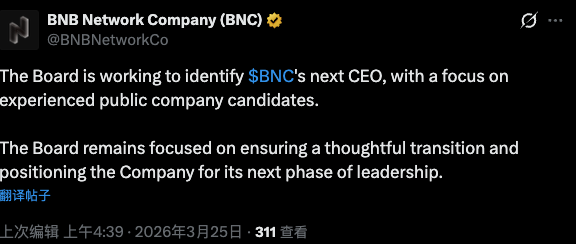
According to the information in the 8-K form filed with the SEC by CEA Industries on March 16, David Namdar, from his appointment as CEO on August 5, 2025, until signing the transition agreement on March 16, 2026, did not receive any cash or equity compensation, so it is being paid now; legally, it seems fine. David Namdar has successfully executed a golden cicada shedding its shell. On March 25, the pinned post on the official CEA Industries X account was changed to indicate they are looking for a new CEO.
According to external media reports, in early March this year, a BNC investor visited the CEA Industries office in Nevada, USA, and found that CEA Industries was an empty shell, with no management or operations. On the business front, official information shows that CEA Industries currently holds 515,544 BNB with a cost basis of $855, but its last public purchase of BNB was in November 2025.
After being criticized by YZi Labs, CEA Industries immediately recruited a new director as demanded by YZi Labs—Annemarie Tierney, founder of Liquid Advisors. Tierney also has an excellent resume, but she is not from the YZi Labs camp. CEA Industries responds to every demand from YZi Labs, but nothing ever gets properly resolved.
Speaking of which, why wasn't David Namdar ousted by YZi Labs last November? Did CZ protect him? The answer is certainly not. YZi Labs had the intention but lacked the capability.
The Battle Between David Namdar's Camp and YZi Labs' Camp
In fact, since last November, David Namdar's camp and YZi Labs' camp have been engaged in an ongoing battle for control of CEA Industries.
David Namdar's camp includes his established 10X Capital and the entire board of CEA Industries, and these two organizations have a high degree of personnel overlap. They effectively control CEA Industries.
YZi Labs is a major shareholder of CEA Industries. According to a filing YZi Labs submitted to the US SEC on January 8, YZi Labs collectively holds 4,255,043 shares of CEA Industries common stock, representing approximately 9.4% of the issued common shares.
The core purpose of YZi Labs' struggle is to expand the CEA Industries board from 6 members to 13 members, with all 7 new members coming from YZi Labs. CZ is also among the candidates. If successful, YZi Labs would control the majority of the new board.
Although YZi Labs is already a major shareholder of CEA Industries, it still doesn't have enough votes to directly place people on the board. Therefore, YZi Labs must unite with other shareholders to initiate a written consent solicitation to implement the overhaul it has wanted since November. This is also why YZi Labs is so keen on publicizing that David Namdar's actions are an infringement on all shareholders' rights.
But David Namdar's board, of course, would not let YZi Labs' plan succeed easily. First, David Namdar postponed the CEA Industries 2025 Annual General Meeting by 16 months, cutting off a crucial opportunity for shareholders to vote on board members. Second, and most ruthlessly, David Namdar launched a "poison pill" plan and amended the company's bylaws on December 26.
The formal name of this plan is an amended Stockholder Rights Plan. CEA Industries stated plainly in its filing with the US SEC that because YZi Labs had formed a shareholder group (YZi Labs Group) intending to control the company, the board decided to amend the Stockholder Rights Plan and the company's bylaws—the last time these bylaws were amended was in 2018.
At this point in the story, David Namdar has completely stopped pretending. "Easy to invite the god, hard to send him away." He set a dead end for CZ: If you want to replace me, not only will it be costly, but you also need my approval first.</p
First, the new Stockholder Rights Plan stipulates that if any group or individual beneficially owns 15% or more of the shares without board approval, the rights held by other shareholders will activate, allowing them to purchase additional shares at a 50% discount. This means if YZi Labs continues to increase its shareholding percentage, other shareholders may get the chance to "buy in cheaply," diluting YZi Labs' ownership and drastically increasing the cost of its fight for control of CEA Industries; Furthermore, warrants are also counted towards beneficial ownership, and if these are included, YZi Labs' ownership percentage actually exceeds 19.99%.
Second, the new company bylaws stipulate that any shareholder seeking to take action via written consent must first request the company to set a record date, and also impose more stringent disclosure requirements. This means YZi Labs' consent solicitation to add new company directors first needs approval from the board led by David Namdar, procedurally obstructing and delaying YZi Labs' actions.
On March 24, after YZi Labs condemned David Namdar and his board for lining their own pockets, the CEA Industries board counterattacked. It stated that the consent solicitation application letter YZi Labs proposed in January for adding new company directors did not comply with the company's bylaws and would not be registered. The specific reason given by CEA Industries was that YZi Labs did not disclose the amount of BNB held by its related parties and their agents, nor did it disclose the financial relationships between YZi Labs and its agents; if YZi Labs controlled the board, it could cause harm to other shareholders' interests.
The ginger is still spicier when old. From the current perspective, in this battle for control, David Namdar had already won long ago. All YZi Labs, which invested heavily, can do now is condemn, condemn, and condemn again.
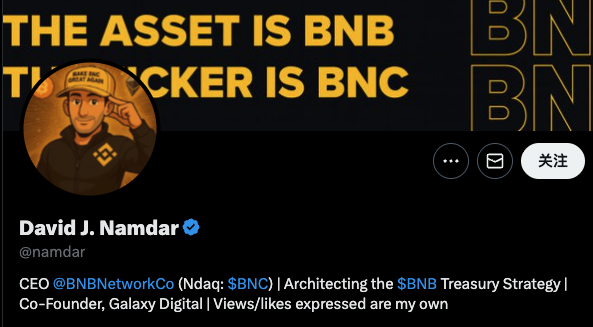
Although David Namdar has already squeezed CEA Industries dry, if you click on his X account, you'll find his avatar wearing a shirt with the Binance logo and a hat that says "MAKE BNC GREAT AGAIN." His pinned post is still congratulating CZ on being pardoned by the US government. Perhaps from the very beginning, David Namdar saw CZ as nothing more than an ATM.
On March 20, David Namdar's important partner, 10X Capital co-founder Hans Thomas, also resigned from the CEA Industries board. But YZi Labs is not willing to just let them get away with it scot-free. YZi Labs investment partner Alex Odagiu posted on X platform, "Hans Thomas is out, but we are not done yet"......