Cypherpunk values are dying, but they’re not dead yet

cointelegraphPublicado a 2025-12-18Actualizado a 2025-12-18

Resumen

The author reflects on their grandfather's distrust of banks and preference for hiding cash, which initially seemed paranoid but later revealed deeper wisdom about privacy and financial sovereignty. Growing up in wartime London, his generation valued privacy as a fundamental right, contrasting sharply with today’s pervasive surveillance and data exploitation. The article critiques modern attitudes that equate privacy with secrecy, citing examples like Vitalik Buterin’s criticized use of a mixer and the erosion of self-sovereignty. It emphasizes that privacy is normal and essential for an open society, echoing Eric Hughes' "Cypherpunk Manifesto." Despite the decline of cypherpunk values—privacy, self-sovereignty, and decentralization—the piece argues they are not yet dead, calling for renewed focus on these principles.

Not long before he died, Grandad said something that I thought was a little silly, a little old-fashioned.

He declared that he didn’t trust the banks, and he didn’t want them to know what he did with his money. I scoffed at the time, paranoid old fella! But of course, it turns out I owe him an apology.

As we were walking around his house, he motioned toward an off-white wall with an off-comfortable sofa in front of it. This piece of singularly ugly furniture hadn’t left its spot in more than a decade.

The wall had a small square door that, when pushed in, revealed a crawl space. Inside was packaging from the 1970s, partially gnawed board games and unimportant documents, squirreled as if they would one day stave off a harsh winter.

My Grandad guided my flashlight to a brown padded envelope hidden near what I was truly hoping wasn’t exposed asbestos. I retrieved the envelope and handed it over. He took the opportunity to deliver a short speech. He was proud I was doing my Master’s, and he knew it was a financial burden, so he wanted to help. Inside the envelope was a musty wad of cash fastened with a mostly decayed rubber band.

His speech was meaningful, but what came after was wisdom that took more than 10 years to land. I asked why he hid cash in the wall, and he explained that most of his savings were hidden around the house; in books, in wardrobes, under mattresses. In fact, he joked that when he died, I must tear the house apart before it’s sold.

Well, he did die, and we did examine every crack and cavity, and we did indeed find most of his savings. Some of the cash was so old that we worried the bank may not even agree to exchange it for modern legal tender, though inflation had robbed the piles of most of their purchasing power anyway, two scams of fiat that I’ll save for another article.

My Grandad grew up poor in wartime London, and it meant a fierce caution with currency was woven into his DNA; money was scarce. Still, his philosophy was sound, and it has played on my mind for years now.

The people of my grandparents’ era were highly protective of their privacy, back when it was a basic human right. I know, how quaint.

In 1950, a motorist named Harry Willcock was stopped in London, and the police officer demanded to see his identity card, an unfortunate requirement introduced at the outbreak of World War II.

Harry refused to brandish his papers and was arrested. According to the lord chief justice in charge of the subsequent legal battle, the ID cards were now being used for purposes beyond their original scope. And so, they were scrapped.

Back in the 1950s, privacy was the baseline for most, and it led to suspicion of anything like surveillance, despite there not being much of it. Just 70 years ago, surveillance was rare, labor-intensive and expensive, typically involving someone physically following you, possibly in a trench coat.

Conversations, cash payments and public transport; no permanent record was left. Any records created were mainly on paper and, importantly, siloed. You couldn’t easily cross-reference records; it’s what lawyers call “practical obscurity.”

Today, our data is farmed, sold and cross-referenced en masse as surveillance has become the new baseline.

My Grandad would have loathed the modern way. He was unknowingly a cypherpunk, and those values are eroding with increasing speed.
Source: Cointelegraph

Privacy, self-sovereignty, decentralization: Before it’s too late

The privacy narrative that has arisen of late could be chalked up to numerous causes, but it feels like a desperate and inevitable last stand.

Society is somehow so downtrodden that tools to assist with privacy are demonized. Vitalik Buterin used a mixer to donate money and was criticized with winks and nods, suggesting he was shady for doing so. Buterin replied with the simple yet iconic, “Privacy is normal.”

There is a sense that a desire for privacy must mean you have something to hide, but as Susie Violet Ward, CEO of Bitcoin Policy UK, once replied: “You have curtains in your house, don’t you?”

Eric Hughes wrote in “A Cypherpunk Manifesto” in 1993 that “privacy is necessary for an open society in the electronic age. Privacy is not secrecy. A private matter is something one doesn’t want the whole world to know, but a secret matter is something one doesn’t want anybody to know. Privacy is the power to selectively reveal oneself to the world.”

Self-sovereignty has followed the downward trajectory of privacy. Control over one’s identity, data and even property has been steadily stripped away, year after year. We must offer up identification, in nearly a “papers, please” kind of way, to most centralized authorities with which we wish to interact.

With data, extensive legal battles have carved us a sliver of control with the “right to be forgotten,” but even that still requires each person to manually request the erasure of their data from each holder.

Likewise, with property, the “right to repair” was necessary as manufacturers of everything from cars to phones raised the walls of their gardens.

These issues are not the concern of the unscrupulous, and we need not whisper. Privacy is normal, as is agency over the many threads of our lives and the right to a fair, pragmatically decentralized playing field.

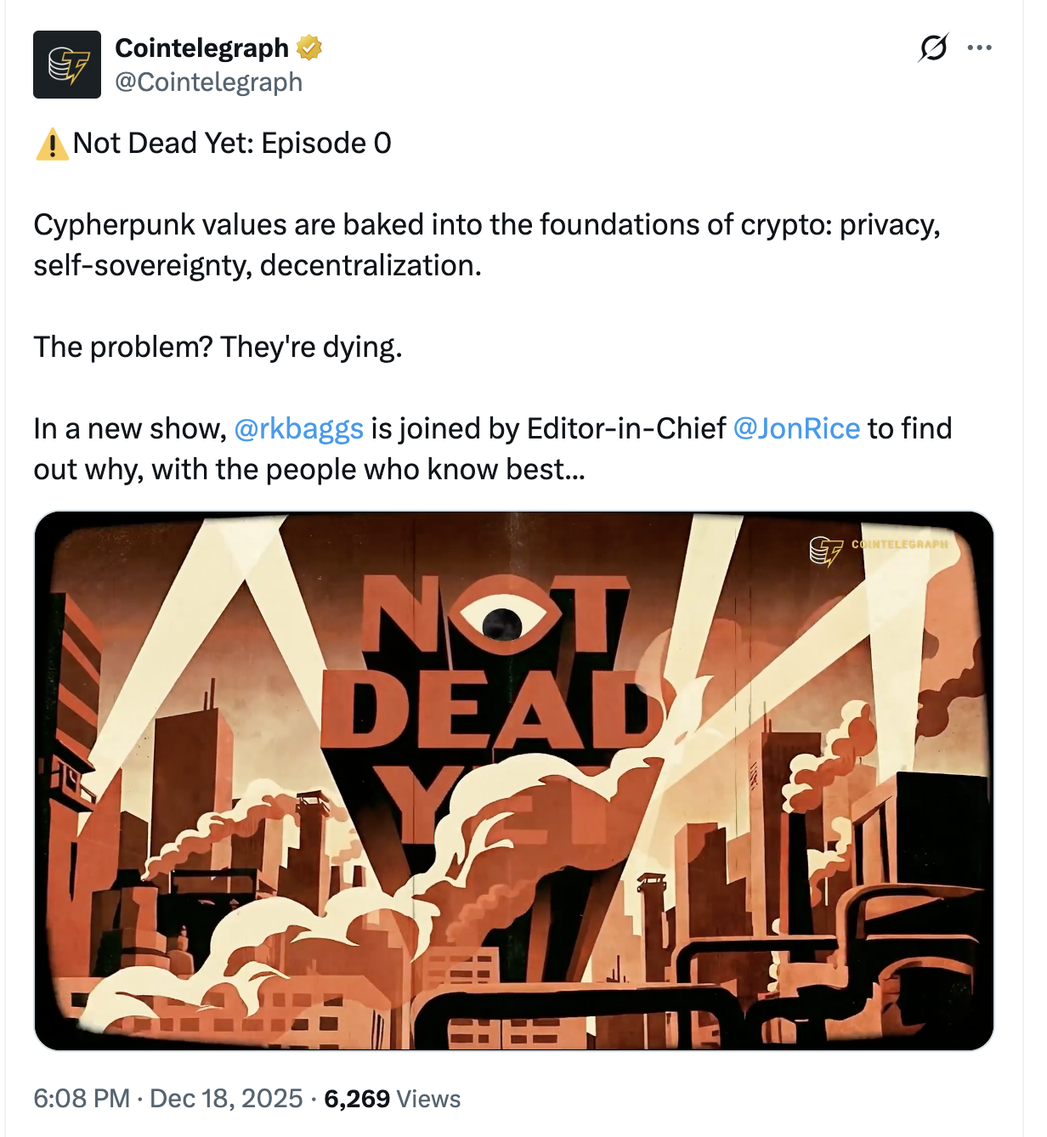
That is why Cointelegraph is launching a show dedicated to conversations on the erosion of these basic human rights, with bona fide experts, visionaries and those building the tools of a free and private future. It is a show for the digital dissidents who believe in civil liberties.

Because cypherpunk values are dying.

But they’re Not Dead Yet.


Preguntas relacionadas

QWhat core values does the article associate with the cypherpunk movement?

AThe article associates privacy, self-sovereignty, and decentralization as the core values of the cypherpunk movement.

QWhy did the author's grandfather hide cash around his house?

AHe didn't trust the banks and wanted to keep his financial transactions private, a philosophy born from growing up poor in wartime London where money was scarce.

QAccording to the article, how has the public perception of privacy changed from the last century to today?

AIn the past, privacy was considered a baseline human right and the public was suspicious of surveillance. Today, mass surveillance and data farming have become the new baseline, and the desire for privacy is often wrongly equated with having something to hide.

QWhat historical example is given to illustrate the public's past defense of privacy?

AThe case of Harry Willcock in 1950s London, who was arrested for refusing to show his identity card to a police officer, leading to the eventual scrapping of the ID card system as it was being used beyond its original purpose.

QWhat is the main argument the article makes against the notion that wanting privacy means you have something to hide?

AThe article argues that privacy is not secrecy. It quotes Eric Hughes's 'A Cypherpunk Manifesto,' stating that 'privacy is the power to selectively reveal oneself to the world,' and uses the analogy of having curtains in one's house to show that the desire for privacy is normal and not nefarious.

Lecturas Relacionadas

Warsh's First Day in Office, Markets Deliver a 'Wake-up Call': Rate Hike Expected This Year

On his first day in office, newly inaugurated Federal Reserve Chairman Warsh received a stark market warning, with expectations now fully pricing in a 25-basis-point interest rate hike this year. The shift was triggered by hawkish remarks from Fed Governor Waller, who stated that inflation is now the key policy "driver" and that the odds of a hike or cut are evenly split. This sent short-term Treasury yields higher. Waller signaled a significant pivot in his stance, citing disappointing inflation and labor data. He suggested removing "easing bias" language from Fed statements and did not rule out future rate increases if inflation fails to recede, though he noted immediate action isn't warranted without signs of unanchored inflation expectations. Chairman Warsh faces immediate pressure at his first FOMC meeting in June. With the preferred inflation gauge at a three-year high, analysts warn that failing to hike could be interpreted as an implicit easing of policy. The geopolitical situation in the Middle East is adding to existing price pressures. The market's expectation for a hike contrasts sharply with earlier forecasts for multiple cuts. While long-term Treasury yields have been contained by lower energy prices recently, analysts note they remain under structural upward pressure. Warsh's swearing-in at the White House highlights political scrutiny over Fed independence. However, the market has made it clear that inflation is the most urgent challenge, leaving the new chairman little time to settle in.

marsbitHace 12 hora(s)

Warsh's First Day in Office, Markets Deliver a 'Wake-up Call': Rate Hike Expected This Year

marsbitHace 12 hora(s)

Trading

Spot
Futuros

Artículos destacados

Qué es GENIUS

I. Introducción al Proyecto1. ¿Qué es Genius?Genius (GENIUS) se posiciona como el “terminal en cadena definitivo”, una plataforma de trading descentralizada enfocada en la privacidad y la velocidad. Al integrar tecnología de privacidad de primer nivel, busca construir una infraestructura de trading privado de próxima generación en redes como BNB Chain, permitiendo a los usuarios interactuar en cadena con una experiencia fluida comparable a los intercambios centralizados.2. ¿Cómo Funciona Genius?La arquitectura técnica central de Genius está estructurada de la siguiente manera:(1) Invisible en la cadena: Los usuarios no necesitan manejar manualmente aprobaciones de múltiples pasos para operaciones entre cadenas, envoltura de activos o gestión compleja de gas.(2) Trading sin firma: A través de integraciones como Turnkey, Genius permite el trading instantáneo sin confirmaciones emergentes o autorización por transacción.(3) Agregador de Agregadores: Genius está impulsado por una pila de agregación de clase mundial integrada con más de 150 DEXs, reclamando una eficiencia de cotización superior en comparación con productos competidores.(4) Gestión de Cuentas: La plataforma adopta una arquitectura no custodial y aprovecha Turnkey y Lit Protocol para la gestión de claves, permitiendo a los usuarios acceder de manera segura a sus cuentas a través de claves de acceso.3. ¿Quién Creó Genius?Según sus Términos de Servicio oficiales, Genius fue desarrollado por Shuttle Labs, Inc. Basado en la cuenta oficial de X del proyecto, Ryan Myher es uno de los contribuyentes clave que impulsa la iteración del producto, incluyendo desarrollos como el lanzamiento del protocolo Ghost, así como un mayor compromiso con la comunidad.El fundador de Binance, CZ, se ha unido oficialmente al proyecto como asesor, con el objetivo de ayudar al equipo a construir una experiencia de trading en cadena más rápida y que preserve la privacidad.Además, el proyecto ha recibido un fuerte respaldo de YZi Labs, que ha invertido en Genius y trabaja junto a la Fundación Genius, responsable de mantener el Protocolo Genius Bridge (GBP).4. Tokenómica de GeniusGENIUS es el token nativo del ecosistema Genius. Hasta ahora, el proyecto no ha publicado un documento completo de tokenómica.Según las últimas divulgaciones oficiales, Genius incorpora un mecanismo deflacionario, y el 4.6% del suministro total de tokens ya había sido quemado durante la fase de lanzamiento inicial.Sistema de Puntos Genius (GP):(1) Comercio para Ganar: La plataforma ha establecido un fondo de recompensas de 200 millones de Puntos Genius, y los usuarios ganan GP por cada comercio ejecutado a través del terminal.(2) Clasificación y Insignias: Genius cuenta con un sistema de insignias basado en progresión que va desde Inteligente hasta Dios, con niveles más altos desbloqueando beneficios y ventajas adicionales.(3) Rendimiento Nativo: Los usuarios que posean activos designados como usdGG en el panel pueden ganar rendimiento nativo directamente sin pasar por un staking complejo.(4) Incentivos por Referidos: Los referidores pueden ganar reembolsos de tarifas de más del 45% pagados en USDC, junto con GP adicionales.5. Cronograma & Hitos ClaveMarzo 2020: Se creó la cuenta oficial de X del proyecto, marcando el inicio de su fase de preparación temprana.13 de enero de 2026: Genius anunció una inversión de varios millones de dólares de YZi Labs y simultáneamente confirmó a CZ como asesor para acelerar la construcción de su infraestructura de trading privado.18 de abril de 2026: El proyecto anunció que el protocolo de privacidad Ghost se lanzaría pronto.29 de abril de 2026: El protocolo Ghost se abrió oficialmente a sus primeros 50 testers, marcando el comienzo de una nueva era para el trading privado en BNB Chain. Al mismo tiempo, el equipo confirmó que el 4.6% de los tokens han sido quemados.​II. Información del Token1) Información BásicaNombre del token: GENIUS (Genius)III. Enlaces RelacionadosSitio web:https://www.tradegenius.com/homeExploradores:https://bscscan.com/address/0x1f12b85aac097e43aa1555b2881e98a51090e9a6Redes Sociales:https://x.com/GeniusTerminalNota: La introducción del proyecto proviene de los materiales publicados o proporcionados por el equipo oficial del proyecto, que es solo para referencia y no constituye asesoramiento de inversión. HTX no se hace responsable de ninguna pérdida directa o indirecta resultante.

260 Vistas totalesPublicado en 2026.04.29Actualizado en 2026.05.12

Qué es GENIUS

Cómo comprar GENIUS

¡Bienvenido a HTX.com! Hemos hecho que comprar Genius (GENIUS) sea simple y conveniente. Sigue nuestra guía paso a paso para iniciar tu viaje de criptos.Paso 1: crea tu cuenta HTXUtiliza tu correo electrónico o número de teléfono para registrarte y obtener una cuenta gratuita en HTX. Experimenta un proceso de registro sin complicaciones y desbloquea todas las funciones.Obtener mi cuentaPaso 2: ve a Comprar cripto y elige tu método de pagoTarjeta de crédito/débito: usa tu Visa o Mastercard para comprar Genius (GENIUS) al instante.Saldo: utiliza fondos del saldo de tu cuenta HTX para tradear sin problemas.Terceros: hemos agregado métodos de pago populares como Google Pay y Apple Pay para mejorar la comodidad.P2P: tradear directamente con otros usuarios en HTX.Over-the-Counter (OTC): ofrecemos servicios personalizados y tipos de cambio competitivos para los traders.Paso 3: guarda tu Genius (GENIUS)Después de comprar tu Genius (GENIUS), guárdalo en tu cuenta HTX. Alternativamente, puedes enviarlo a otro lugar mediante transferencia blockchain o utilizarlo para tradear otras criptomonedas.Paso 4: tradear Genius (GENIUS)Tradear fácilmente con Genius (GENIUS) en HTX's mercado spot. Simplemente accede a tu cuenta, selecciona tu par de trading, ejecuta tus trades y monitorea en tiempo real. Ofrecemos una experiencia fácil de usar tanto para principiantes como para traders experimentados.

186 Vistas totalesPublicado en 2026.04.29Actualizado en 2026.05.12

Cómo comprar GENIUS

Cómo comprar MEGA

¡Bienvenido a HTX.com! Hemos hecho que comprar MegaETH (MEGA) sea simple y conveniente. Sigue nuestra guía paso a paso para iniciar tu viaje de criptos.Paso 1: crea tu cuenta HTXUtiliza tu correo electrónico o número de teléfono para registrarte y obtener una cuenta gratuita en HTX. Experimenta un proceso de registro sin complicaciones y desbloquea todas las funciones.Obtener mi cuentaPaso 2: ve a Comprar cripto y elige tu método de pagoTarjeta de crédito/débito: usa tu Visa o Mastercard para comprar MegaETH (MEGA) al instante.Saldo: utiliza fondos del saldo de tu cuenta HTX para tradear sin problemas.Terceros: hemos agregado métodos de pago populares como Google Pay y Apple Pay para mejorar la comodidad.P2P: tradear directamente con otros usuarios en HTX.Over-the-Counter (OTC): ofrecemos servicios personalizados y tipos de cambio competitivos para los traders.Paso 3: guarda tu MegaETH (MEGA)Después de comprar tu MegaETH (MEGA), guárdalo en tu cuenta HTX. Alternativamente, puedes enviarlo a otro lugar mediante transferencia blockchain o utilizarlo para tradear otras criptomonedas.Paso 4: tradear MegaETH (MEGA)Tradear fácilmente con MegaETH (MEGA) en HTX's mercado spot. Simplemente accede a tu cuenta, selecciona tu par de trading, ejecuta tus trades y monitorea en tiempo real. Ofrecemos una experiencia fácil de usar tanto para principiantes como para traders experimentados.

187 Vistas totalesPublicado en 2026.04.30Actualizado en 2026.04.30

Cómo comprar MEGA

Discusiones

Bienvenido a la comunidad de HTX. Aquí puedes mantenerte informado sobre los últimos desarrollos de la plataforma y acceder a análisis profesionales del mercado. A continuación se presentan las opiniones de los usuarios sobre el precio de A (A).

活动图片