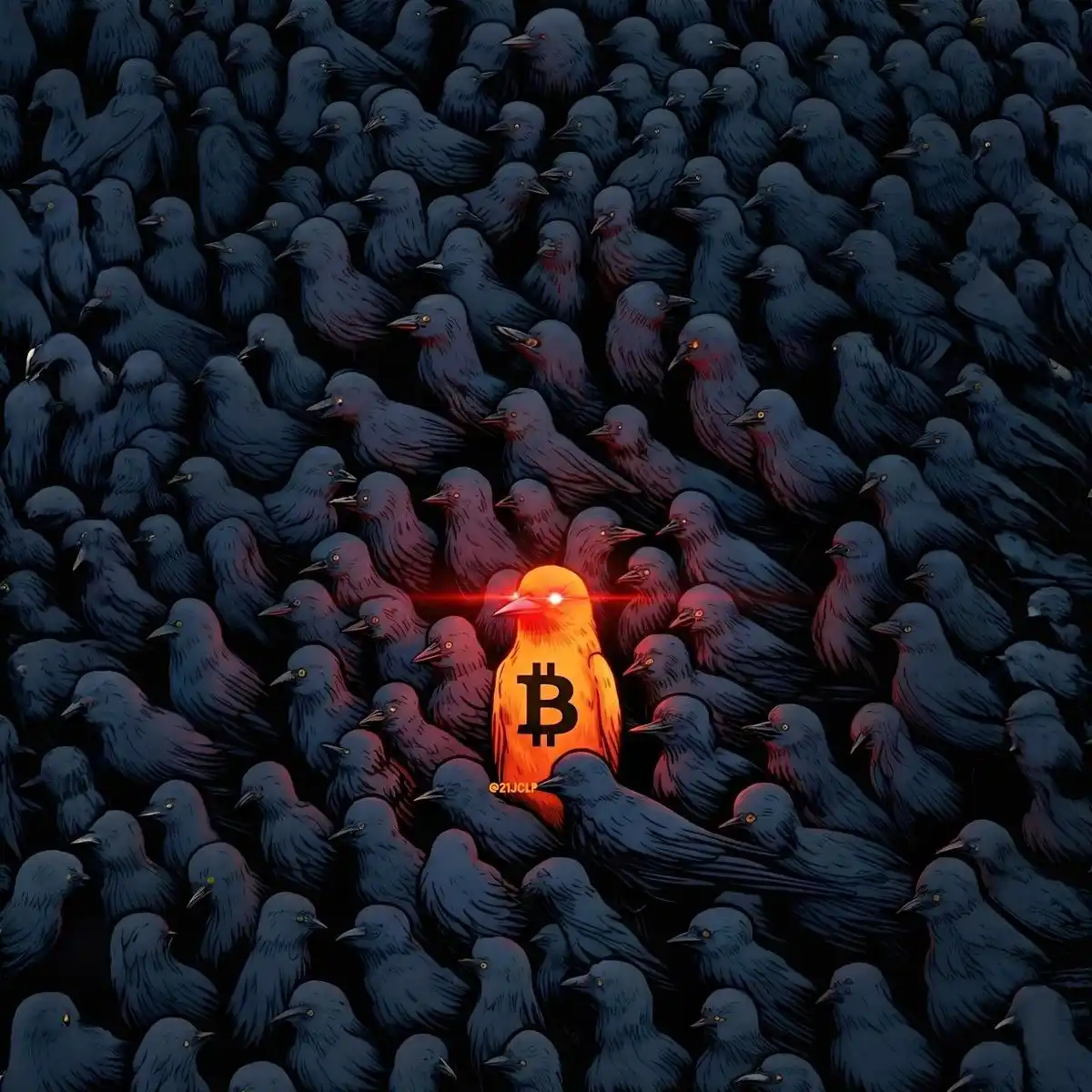
Cypherpunk values are dying, but they’re not dead yet

cointelegraphPublicado a 2025-12-18Actualizado a 2025-12-18

Resumen

The author reflects on their grandfather's distrust of banks and preference for hiding cash, which initially seemed paranoid but later revealed deeper wisdom about privacy and financial sovereignty. Growing up in wartime London, his generation valued privacy as a fundamental right, contrasting sharply with today’s pervasive surveillance and data exploitation. The article critiques modern attitudes that equate privacy with secrecy, citing examples like Vitalik Buterin’s criticized use of a mixer and the erosion of self-sovereignty. It emphasizes that privacy is normal and essential for an open society, echoing Eric Hughes' "Cypherpunk Manifesto." Despite the decline of cypherpunk values—privacy, self-sovereignty, and decentralization—the piece argues they are not yet dead, calling for renewed focus on these principles.

Not long before he died, Grandad said something that I thought was a little silly, a little old-fashioned.

He declared that he didn’t trust the banks, and he didn’t want them to know what he did with his money. I scoffed at the time, paranoid old fella! But of course, it turns out I owe him an apology.

As we were walking around his house, he motioned toward an off-white wall with an off-comfortable sofa in front of it. This piece of singularly ugly furniture hadn’t left its spot in more than a decade.

The wall had a small square door that, when pushed in, revealed a crawl space. Inside was packaging from the 1970s, partially gnawed board games and unimportant documents, squirreled as if they would one day stave off a harsh winter.

My Grandad guided my flashlight to a brown padded envelope hidden near what I was truly hoping wasn’t exposed asbestos. I retrieved the envelope and handed it over. He took the opportunity to deliver a short speech. He was proud I was doing my Master’s, and he knew it was a financial burden, so he wanted to help. Inside the envelope was a musty wad of cash fastened with a mostly decayed rubber band.

His speech was meaningful, but what came after was wisdom that took more than 10 years to land. I asked why he hid cash in the wall, and he explained that most of his savings were hidden around the house; in books, in wardrobes, under mattresses. In fact, he joked that when he died, I must tear the house apart before it’s sold.

Well, he did die, and we did examine every crack and cavity, and we did indeed find most of his savings. Some of the cash was so old that we worried the bank may not even agree to exchange it for modern legal tender, though inflation had robbed the piles of most of their purchasing power anyway, two scams of fiat that I’ll save for another article.

My Grandad grew up poor in wartime London, and it meant a fierce caution with currency was woven into his DNA; money was scarce. Still, his philosophy was sound, and it has played on my mind for years now.

The people of my grandparents’ era were highly protective of their privacy, back when it was a basic human right. I know, how quaint.

In 1950, a motorist named Harry Willcock was stopped in London, and the police officer demanded to see his identity card, an unfortunate requirement introduced at the outbreak of World War II.

Harry refused to brandish his papers and was arrested. According to the lord chief justice in charge of the subsequent legal battle, the ID cards were now being used for purposes beyond their original scope. And so, they were scrapped.

Back in the 1950s, privacy was the baseline for most, and it led to suspicion of anything like surveillance, despite there not being much of it. Just 70 years ago, surveillance was rare, labor-intensive and expensive, typically involving someone physically following you, possibly in a trench coat.

Conversations, cash payments and public transport; no permanent record was left. Any records created were mainly on paper and, importantly, siloed. You couldn’t easily cross-reference records; it’s what lawyers call “practical obscurity.”

Today, our data is farmed, sold and cross-referenced en masse as surveillance has become the new baseline.

My Grandad would have loathed the modern way. He was unknowingly a cypherpunk, and those values are eroding with increasing speed.
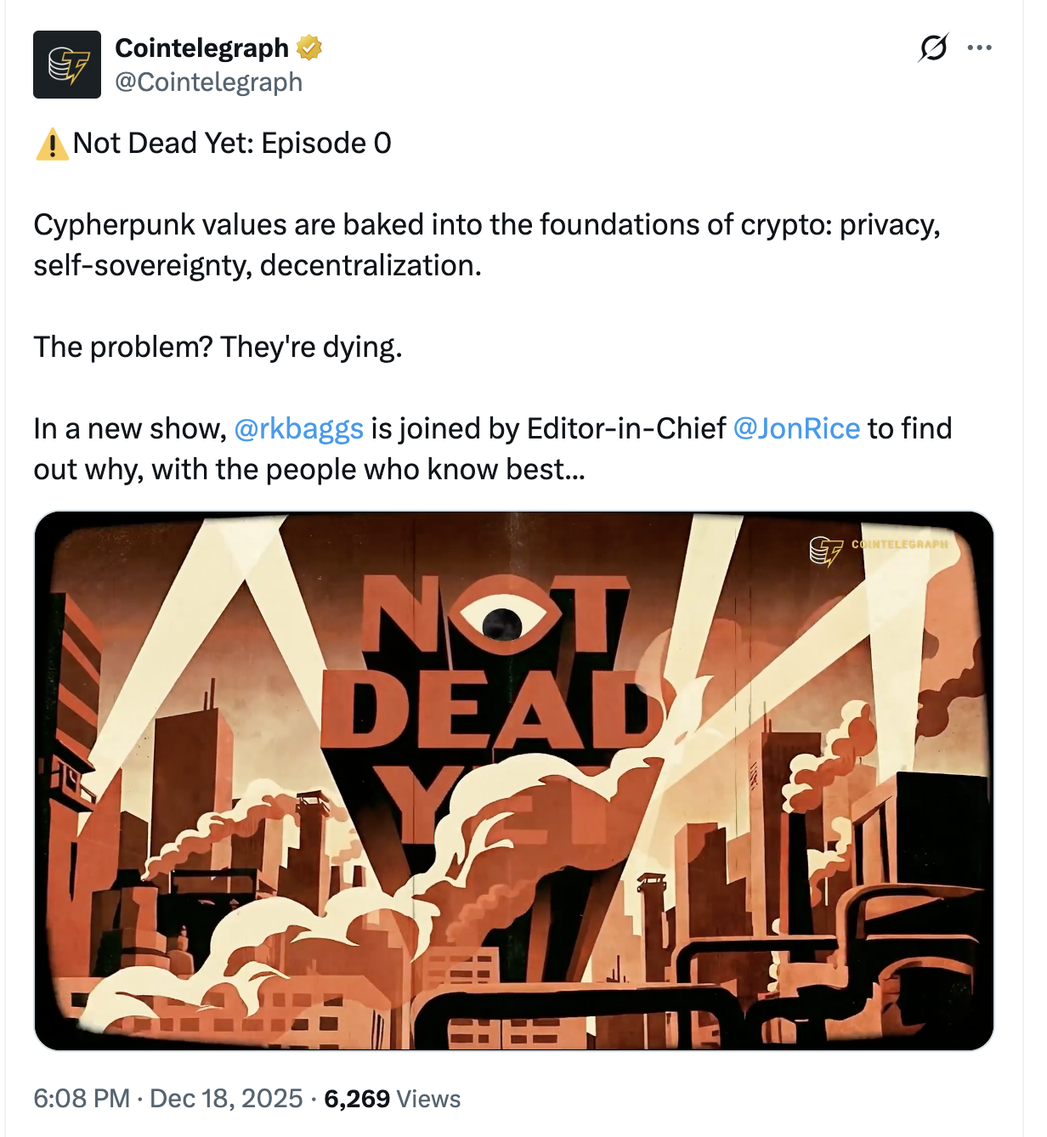
Source: Cointelegraph

Privacy, self-sovereignty, decentralization: Before it’s too late

The privacy narrative that has arisen of late could be chalked up to numerous causes, but it feels like a desperate and inevitable last stand.

Society is somehow so downtrodden that tools to assist with privacy are demonized. Vitalik Buterin used a mixer to donate money and was criticized with winks and nods, suggesting he was shady for doing so. Buterin replied with the simple yet iconic, “Privacy is normal.”

There is a sense that a desire for privacy must mean you have something to hide, but as Susie Violet Ward, CEO of Bitcoin Policy UK, once replied: “You have curtains in your house, don’t you?”

Eric Hughes wrote in “A Cypherpunk Manifesto” in 1993 that “privacy is necessary for an open society in the electronic age. Privacy is not secrecy. A private matter is something one doesn’t want the whole world to know, but a secret matter is something one doesn’t want anybody to know. Privacy is the power to selectively reveal oneself to the world.”

Self-sovereignty has followed the downward trajectory of privacy. Control over one’s identity, data and even property has been steadily stripped away, year after year. We must offer up identification, in nearly a “papers, please” kind of way, to most centralized authorities with which we wish to interact.

With data, extensive legal battles have carved us a sliver of control with the “right to be forgotten,” but even that still requires each person to manually request the erasure of their data from each holder.

Likewise, with property, the “right to repair” was necessary as manufacturers of everything from cars to phones raised the walls of their gardens.

These issues are not the concern of the unscrupulous, and we need not whisper. Privacy is normal, as is agency over the many threads of our lives and the right to a fair, pragmatically decentralized playing field.

That is why Cointelegraph is launching a show dedicated to conversations on the erosion of these basic human rights, with bona fide experts, visionaries and those building the tools of a free and private future. It is a show for the digital dissidents who believe in civil liberties.

Because cypherpunk values are dying.

But they’re Not Dead Yet.


Criptos en tendencia

Preguntas relacionadas

QWhat core values does the article associate with the cypherpunk movement?

AThe article associates privacy, self-sovereignty, and decentralization as the core values of the cypherpunk movement.

QWhy did the author's grandfather hide cash around his house?

AHe didn't trust the banks and wanted to keep his financial transactions private, a philosophy born from growing up poor in wartime London where money was scarce.

QAccording to the article, how has the public perception of privacy changed from the last century to today?

AIn the past, privacy was considered a baseline human right and the public was suspicious of surveillance. Today, mass surveillance and data farming have become the new baseline, and the desire for privacy is often wrongly equated with having something to hide.

QWhat historical example is given to illustrate the public's past defense of privacy?

AThe case of Harry Willcock in 1950s London, who was arrested for refusing to show his identity card to a police officer, leading to the eventual scrapping of the ID card system as it was being used beyond its original purpose.

QWhat is the main argument the article makes against the notion that wanting privacy means you have something to hide?

AThe article argues that privacy is not secrecy. It quotes Eric Hughes's 'A Cypherpunk Manifesto,' stating that 'privacy is the power to selectively reveal oneself to the world,' and uses the analogy of having curtains in one's house to show that the desire for privacy is normal and not nefarious.

Lecturas Relacionadas

From Gold to Bitcoin: Fixed Supply + Institutional Frenzy, Might It Repeat the 'Explosive' Price Trend?

"From Gold to Bitcoin: Fixed Supply and Institutional Frenzy May Lead to 'Explosive' Price Rally Analysts suggest Bitcoin's price action could mirror gold's over the past two decades, following the launch of spot Bitcoin ETFs. Gold ETFs, introduced in 2004, drove gold's price surge to a current market cap near $28 trillion. Both gold and Bitcoin are non-yielding stores of value, with prices driven purely by investor sentiment rather than cash flows or credit. Gold ETFs experienced dramatic cycles: explosive growth, painful drawdowns, and slow recoveries, with each cycle reaching higher peaks. Bitcoin ETFs, approved in early 2024, saw rapid institutional adoption but are now facing similar volatility. Recent warnings highlight the risk of significant ETF outflows disrupting the current rebound. BlackRock's IBIT, a leading Bitcoin ETF, has sold nearly 100,000 BTC to meet redemptions while still holding over 733,000. The core parallel is fixed supply: when demand surges, prices explode, but demand is often volatile and wave-like, not steady. Institutional interest, through ETFs and corporate adoption, remains a key support pillar, helping to cushion sell-offs. If Bitcoin captures even a fraction of gold's role as a store of value, its upside potential is immense, though the path will be marked by high volatility. For investors, focusing on long-term trends and managing risk is crucial as this 'price explosion' narrative unfolds."

Foresight NewsHace 35 min(s)

From Gold to Bitcoin: Fixed Supply + Institutional Frenzy, Might It Repeat the 'Explosive' Price Trend?

Foresight NewsHace 35 min(s)

Why Is AI Agent Shopping Hard to Popularize?

The article argues that the popular narrative of "AI agent shopping" – equipping AI with a wallet to autonomously handle purchases – is fundamentally flawed and oversimplifies the complexity of shopping. It deconstructs shopping into two core actions: **information retrieval** (standardized, easily automated) and **value judgment** (deeply subjective and human-centric). The narrative mistakenly assumes AI can fully handle both. Value judgment itself has two layers: **evaluation** (assessing options against criteria) and **demand definition** (setting the criteria, weights, and values). The latter is inherently human and dynamic, as preferences are not fixed but constructed during the decision-making process ("constructive preferences"). The real dividing line for automation is not product standardization, but whether the **act of choosing** itself holds experiential value. For mundane purchases (e.g., printer paper), full AI delegation works. For experiential goods (e.g., wine, furniture), the joy of selection is core to consumption, so AI should act as an assistant that narrows options, leaving the final choice to humans. The "AI wallet" concept confuses three separate elements: decision-making, execution, and fund custody. Current payment industry solutions (e.g., from Stripe, Mastercard, Google, Visa) show that limited, scoped payment authorization tokens are sufficient for most consumer scenarios, not full fund custody. The true use case for autonomous AI wallets is in **B2B procurement** and **machine-to-machine (M2M) settlements** for standardized, high-frequency, low-value transactions. The real bottlenecks for AI shopping are not payment technology, but **1) the lack of trusted data sources** (e.g., fake reviews, counterfeit goods) and **2) the impossibility of automating human demand definition**. The conclusion is that the focus should be on safely automating the assessment and filtering process while reserving for humans the rights to define their criteria and enjoy the final act of choice. For experiential goods, the platform's competitive advantage shifts to providing a superior selection experience.

Foresight NewsHace 1 hora(s)

Why Is AI Agent Shopping Hard to Popularize?

Foresight NewsHace 1 hora(s)

After Nine Months of Shorting, a Full Turn to Long: Renowned Trader Opens Bitcoin Positions Around 64K, Crypto Market Long-Short Divergence Intensifies

After nine months of being short, prominent crypto trader Doctor Profit has closed all his bearish positions and started buying Bitcoin near $64,000, signaling a complete bullish reversal. He argues that structural market changes—such as impending U.S. regulation (CLARITY Act) and institutional adoption via securities tokenization—are rewriting the traditional four-year cycle script, potentially bringing the market bottom forward from the widely expected September/October timeframe. This view finds some technical support from on-chain analyst gumsays, who notes a bullish divergence on Bitcoin's weekly chart has persisted for 147 days, nearing the 161-day duration seen before the 2022 cycle low. However, cycle researcher Jake Pahor presents a counter-argument based on historical data. Analyzing patterns since 2014, he identifies three common features of past bear market bottoms: a ~12-month duration from peak to trough, a sustained period of extreme fear (with a proprietary risk score below 20), and the price falling below Bitcoin's realized price (~$53,000 currently). The current cycle, only nine months from its October 2025 peak, meets none of these conditions. The debate highlights a market torn between "front-running" a potential early bottom driven by new fundamentals and waiting for confirmation through traditional on-chain and sentiment metrics. While Doctor Profit opts for aggressive buying, Pahor maintains a disciplined, tiered accumulation strategy, continuing weekly buys at current risk levels but reserving larger orders for if more extreme fear emerges.

marsbitHace 1 hora(s)

After Nine Months of Shorting, a Full Turn to Long: Renowned Trader Opens Bitcoin Positions Around 64K, Crypto Market Long-Short Divergence Intensifies

marsbitHace 1 hora(s)

Trading

Spot

Artículos destacados

Cómo comprar O

¡Bienvenido a HTX.com! Hemos hecho que comprar O1 exchange (O) sea simple y conveniente. Sigue nuestra guía paso a paso para iniciar tu viaje de criptos.Paso 1: crea tu cuenta HTXUtiliza tu correo electrónico o número de teléfono para registrarte y obtener una cuenta gratuita en HTX. Experimenta un proceso de registro sin complicaciones y desbloquea todas las funciones.Obtener mi cuentaPaso 2: ve a Comprar cripto y elige tu método de pagoTarjeta de crédito/débito: usa tu Visa o Mastercard para comprar O1 exchange (O) al instante.Saldo: utiliza fondos del saldo de tu cuenta HTX para tradear sin problemas.Terceros: hemos agregado métodos de pago populares como Google Pay y Apple Pay para mejorar la comodidad.P2P: tradear directamente con otros usuarios en HTX.Over-the-Counter (OTC): ofrecemos servicios personalizados y tipos de cambio competitivos para los traders.Paso 3: guarda tu O1 exchange (O)Después de comprar tu O1 exchange (O), guárdalo en tu cuenta HTX. Alternativamente, puedes enviarlo a otro lugar mediante transferencia blockchain o utilizarlo para tradear otras criptomonedas.Paso 4: tradear O1 exchange (O)Tradear fácilmente con O1 exchange (O) en HTX's mercado spot. Simplemente accede a tu cuenta, selecciona tu par de trading, ejecuta tus trades y monitorea en tiempo real. Ofrecemos una experiencia fácil de usar tanto para principiantes como para traders experimentados.

125 Vistas totalesPublicado en 2026.06.19Actualizado en 2026.06.29

Cómo comprar O

Cómo comprar PROS

¡Bienvenido a HTX.com! Hemos hecho que comprar Pharos (PROS) sea simple y conveniente. Sigue nuestra guía paso a paso para iniciar tu viaje de criptos.Paso 1: crea tu cuenta HTXUtiliza tu correo electrónico o número de teléfono para registrarte y obtener una cuenta gratuita en HTX. Experimenta un proceso de registro sin complicaciones y desbloquea todas las funciones.Obtener mi cuentaPaso 2: ve a Comprar cripto y elige tu método de pagoTarjeta de crédito/débito: usa tu Visa o Mastercard para comprar Pharos (PROS) al instante.Saldo: utiliza fondos del saldo de tu cuenta HTX para tradear sin problemas.Terceros: hemos agregado métodos de pago populares como Google Pay y Apple Pay para mejorar la comodidad.P2P: tradear directamente con otros usuarios en HTX.Over-the-Counter (OTC): ofrecemos servicios personalizados y tipos de cambio competitivos para los traders.Paso 3: guarda tu Pharos (PROS)Después de comprar tu Pharos (PROS), guárdalo en tu cuenta HTX. Alternativamente, puedes enviarlo a otro lugar mediante transferencia blockchain o utilizarlo para tradear otras criptomonedas.Paso 4: tradear Pharos (PROS)Tradear fácilmente con Pharos (PROS) en HTX's mercado spot. Simplemente accede a tu cuenta, selecciona tu par de trading, ejecuta tus trades y monitorea en tiempo real. Ofrecemos una experiencia fácil de usar tanto para principiantes como para traders experimentados.

144 Vistas totalesPublicado en 2026.06.22Actualizado en 2026.06.29

Cómo comprar PROS

Qué es VERONA

I. Introducción al Proyecto VERONA es una blockchain construida para todos, en todas partes a través de la abstracción de cadenas. Utilizando su capa de Abstracción Generalizada, VERONA se distingue por integrar funcionalidades complejas de blockchain, como cuentas, firmas e interoperabilidad, directamente a nivel de protocolo. Este enfoque permite interactuar con aplicaciones de blockchain sin necesidad de entender las tecnologías subyacentes.1) Información Básica Nombre: VERONA (VERONA)III. Enlaces Relacionados Enlace al sitio web oficial: https://xion.burnt.com/ Libro Blanco: https://xion.burnt.com/whitepaper.pdf Exploradores: https://explorer.burnt.com/ Redes Sociales: https://x.com/burnt_xion Nota: La introducción del proyecto proviene de los materiales publicados o proporcionados por el equipo oficial del proyecto, que es solo para referencia y no constituye asesoramiento de inversión. HTX no se hace responsable de ninguna pérdida directa o indirecta resultante.

168 Vistas totalesPublicado en 2026.06.22Actualizado en 2026.06.22

Qué es VERONA

Discusiones

Bienvenido a la comunidad de HTX. Aquí puedes mantenerte informado sobre los últimos desarrollos de la plataforma y acceder a análisis profesionales del mercado. A continuación se presentan las opiniones de los usuarios sobre el precio de A (A).

活动图片