Cursor 3 replaces the traditional code editor with an agent management console, marking a significant shift in both AI-assisted development tools and developer workflows.
As the fastest-growing AI code editor in terms of revenue, Cursor has released its first non-code editor product.
Cursor 3 (codenamed Glass) is built from the ground up, featuring an agent management console as the main interface, relegating the traditional IDE to a secondary position for the first time. Engineers can still write code in it, but the core design philosophy of this product has shifted to "users will spend most of their time scheduling agents, reviewing outputs, and deciding which tasks to release." The space where the file tree was once displayed has now been replaced by a prompt input box.
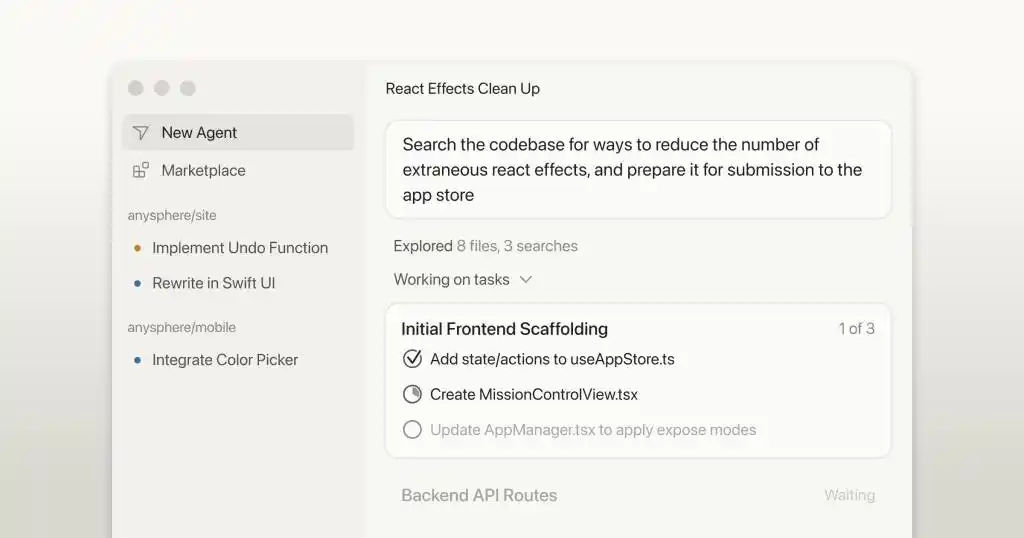
For months, the status of coding tools has been increasingly overshadowed by AI models. The emergence of Cursor 3 is a direct result of this $2 billion annual revenue company accepting this reality and betting its entire product line on it. This shift mirrors the experiences of infrastructure engineers in the past.
Cloud control panels replaced SSH terminals. Kubernetes controllers replaced manual server configuration. Today, the orchestration layer is replacing the code editor as the primary interface. Although the trend is the same, the stakes of this wave of change are higher because the abstraction layer being downgraded is the underlying architecture that developers have used for 40 years.
What Cursor 3 Brings
Cursor was born in 2022 as a fork of VS Code and has now evolved into a sibling version built entirely around agents. Cursor states that the new interface is "built from the ground up, agent-centric," and treats the traditional IDE as an alternative that can be switched to at any time.
The workspace natively supports multiple repositories, allowing agents and users to operate simultaneously across different repositories, while all local and cloud agents are displayed in a unified sidebar. This sidebar pulls agents from all of Cursor's interfaces, including sessions launched from mobile devices, web clients, Slack, GitHub, and even Linear. Cloud agents generate demos and work screenshots, allowing engineers to quickly understand changes without pulling the code locally.
The most prominent feature in the new version is Cloud Handoff. Users can move running agent sessions from their laptop to the Cursor cloud, ensuring they continue to run when the computer is shut down, and pull them back locally for editing and testing on the desktop when ready, and vice versa. Users can start tasks in the cloud and pull them back when they need to take control. This ability to port sessions between local and cloud environments has been a major weakness of most competing products.
One can view the emergence of Cursor 3 as a significant shift from managing a single server to managing a cluster of servers through a control plane. While users can still SSH into a server when necessary, the control plane has become the hub for decision-making, workload allocation, and viewing system status. Cursor 3's approach to agents represents a similar major shift, where the IDE is analogous to SSH, and Glass is analogous to the control plane.
Transformation Driven by Pressure
The release of Cursor 3 is no accident. Over the past six weeks, Cursor has launched what I call an "accelerated product offensive." In late March, Fortune published a feature describing Cursor's situation as a classic case of the "innovator's dilemma," which quickly sparked strong reactions. Prior to this, Bloomberg had just pointed out that Cursor's annualized revenue officially surpassed $2 billion in February 2026, doubling in just three months.
However, Fortune found that Anthropic's terminal-first programming agent, Claude Code, had grown its annualized revenue to $2.5 billion in just over a year, winning favor with over 300,000 enterprise customers. Developers publicly expressed their intention to abandon Cursor and switch to Claude Code. A Cursor investor told Fortune that several startups in his portfolio were considering terminating their contracts with Cursor. In March, reports indicated that although Cursor was seeking a new round of funding with a valuation of approximately $50 billion, market confidence in its future development was crumbling.
In response, Cursor quickly took three major steps to address these challenges. On March 5, the company released the Automations system, which triggers agents based on GitHub events, Slack messages, and timers without human intervention.
On March 19, Cursor released Composer 2, its first self-developed model based on MoonDarkSide's open-source Kimi K2.5.
Cursor claims that Composer 2 scored 61.3 on its proprietary CursorBench test, higher than Claude Opus 4.6's 58.2, with lower cost per unit token. It is important to note that CursorBench is Cursor's own evaluation suite.
Also in March, Cursor enabled self-hosted cloud agents, allowing Fortune 500 companies to run Cursor agents on their internal infrastructure.
Then came the official release of Cursor 3. Three products in one month, with a complete interface overhaul. This pace is clear evidence of the company's conviction that its business domain is being redefined.
Structural Shift
The significance of Cursor's transformation lies in its suggestion of a paradigm shift far beyond a single company. All major players in the AI-assisted development space have now reached a consensus that agents need their own dedicated orchestration interface. The disagreement among vendors lies in where this interface should reside, creating interesting differences in developer tool architecture.
Anthropic's Claude Code adopts a terminal-first model, completely abandoning the Integrated Development Environment (IDE). The command-line interface (CLI) is the orchestration layer, where developers work via natural language commands in the shell. Anthropic later added a browser-based interface and a desktop application at claude.ai/code, but still considers the terminal the core, meaning the orchestration layer is completely separate from the editor.
OpenAI has chosen a different path. Codex now encompasses a standalone desktop application, a command-line interface, IDE extensions for VS Code and its forks, plus a cloud interface at chatgpt.com/codex. Among these, the desktop application becomes the "command center" for managing parallel agents, viewing diffs, and running work across projects. OpenAI's philosophy is that the orchestration layer should be ubiquitous, accessible from any interface developers use.
"For the past four decades, the software development paradigm has been defined by the code editor. Cursor 3 bets everything on the belief that supervising agents will become more important than editing files."
Google's approach is closest to Cursor's. After paying Windsurf a $2.4 billion licensing fee and bringing its CEO and core engineers into DeepMind, Google launched Antigravity—an agent-centric IDE offering two distinct modes. The editor view contains the traditional programming environment, while the manager interface allows developers to generate, orchestrate, and observe multiple agents in parallel within the workspace. Agent orchestration and code editing coexist within the same application but are presented in different views.
Cursor 3 also adopts this internal IDE model but takes it a step further. Glass sets the agent console as the default view, with the editor becoming an alternative view. Google's Antigravity considers both views equally important, reflecting a difference in emphasis. In other words, the two companies have different judgments about where developers will ultimately spend their time.
We can draw an analogy to the evolution of cloud infrastructure. When AWS introduced its management console, users did not stop using SSH. But SSH was no longer the place for making infrastructure decisions; the console became the control plane, and SSH became an occasional debugging tool.
Anthropic and OpenAI believe the orchestration layer can operate as a standalone application, separate from the IDE. Cursor and Google believe the orchestration layer needs to coexist with the editor so developers can directly view the code when agents make mistakes. The industry generally agrees that agent orchestration will become the new main interface, but consensus on the specific architectural design has not been reached.
What This Means for Developers
Currently, the practical impact of this change is mainly reflected in the following three aspects:
1. Model Selection Becomes Infrastructure
Cursor sets Composer 2 as the default model but still allows developers to switch to Claude, GPT-5.4, and Gemini based on the conversation. The model driving the agents is now an infrastructure-level decision, similar to choosing a database or cloud region, and token economics will form as scale increases.
Cursor's published pricing for Composer 2 Standard is $0.50 per million input tokens and $2.50 per million output tokens (prices as of March 2026), significantly lower than the pricing of frontier models from Anthropic and OpenAI.
For teams running dozens of parallel agents, such pricing is undoubtedly more attractive than feature sets or UI preferences.
2. VS Code's Moat is Drying Up
Cursor forked from VS Code, inheriting its extension ecosystem and enabling instant distribution. Cursor 3, however, charts a new course, aiming to create differentiated advantages. If agent-centric interface design ultimately wins, the importance of VS Code extensions will decline significantly. Microsoft clearly needs to keep a close eye on this trend.
The assumption of VS Code as the center of the developer tool universe has held for nearly a decade but is now gradually unraveling.
JetBrains faces similar pressure. As the primary interaction shifts from editing files to managing agents, the competitive advantages of traditional IDEs in programming intelligence and refactoring tools will also evaporate.
3. Workflows Change First, Development Roles Transform Later
Cursor 3 posits that engineers will spend significant time reviewing diffs generated by agents, validating screenshots generated by cloud agents, deciding which tasks to push to the cloud and which to keep local, and managing PR workflows.
This is fundamentally different from previous code writing methods and skill requirements, meaning programming is shifting more towards engineering manager or platform operations roles rather than traditional software developers. In other words, the role of the software engineer is merging with that of an application-layer systems operator.
"The role of the software engineer is merging with that of an application-layer systems operator."
Cursor's own development trajectory reflects this shift. The company acquired the code review platform Graphite in December 2025. As CEO Michael Truell stated, as AI accelerates code generation, code review is becoming the new bottleneck.
Cursor 3 extends this logic further: agents write the code, Graphite reviews it, and the engineer's job is to coordinate the two. The importance of the Integrated Development Environment (IDE) takes a back seat.
Future Outlook
The orchestration layer for AI programming agents is now a new product category. All major manufacturers have launched related products. The unresolved question is at the architectural level. Should the orchestration layer exist within the IDE, outside it, or simultaneously across all interfaces?
Anthropic and OpenAI are betting on standalone tools. Cursor and Google are betting on integrated consoles that include an IDE. Whose choice aligns more closely with the real trend will win the support of developers in the next decade, just as the cloud control plane debate in the early 2010s determined today's infrastructure giants.
For the past forty years, the way software is built has been defined by the code editor. Cursor 3 bets on the idea that supervising agents is more important than editing files. Cursor is not killing the IDE; it is demoting it.
If this assessment is accurate, what we are seeing might be the last code editor in human memory. The future remains to be seen.
Original Article Link
https://thenewstack.io/cursor-3-demotes-ide/
This article is from the WeChat public account "AI前线" (AI Frontline), author: Janakiram MSV, translator: Nuclear Cola