Currency and Stock Market Barometer: Strategy Invested Over $2 Billion to Buy Over 24,800 BTC Last Week; Bitmine's ETH Holdings Increase to 4.37% of Total Supply (May 19)

marsbitPublicado a 2026-05-19Actualizado a 2026-05-19

Resumen

Crypto & Stock Market Watch: Institutional BTC Buying Surges, ETH Holdings Grow Major listed companies aggressively accumulated Bitcoin last week, with net purchases skyrocketing over 44x to $2.03 billion. Strategy (formerly MicroStrategy) led the charge, spending approximately $2.01 billion to buy 24,869 BTC, bringing its total holdings to 843,738 BTC. Overall, listed firms (excluding miners) now hold 1,113,841 BTC, valued at ~$86.16 billion. On the Ethereum front, Bitmine purchased 71,672 ETH in the past week. It now holds 5,278,462 ETH, worth $11.56 billion and representing 4.37% of ETH's total supply. A significant portion (4,712,917 ETH) is staked, generating an annualized yield of $289 million. Industry leaders note a divergence from the MicroStrategy model, with ETH treasury firms increasingly focusing on staking yields and simpler balance sheets. In traditional markets, Morgan Stanley warns of a potential significant U.S. stock market correction if bond yields and volatility continue rising. Investment giants like Berkshire Hathaway and Bridgewater adjusted portfolios in Q1, with Bridgewater notably increasing its stakes in chipmakers like Nvidia, Broadcom, and Micron while shedding software stocks. Among other crypto-focused public companies, Solana treasury firm Upexi reported a widened net loss of $109 million for its fiscal Q3, driven by a decline in its crypto holdings' value. Meanwhile, Hyperion DeFi, a HYPE token treasury company, reported a Q1 net profit o...

Editor's Note: After a brief strong rebound, the overall crypto market has fallen back to the $76,000-$79,000 range. Affected by this, crypto-related stocks have declined across the board, with leading DAT stocks like Strategy and Bitmine nearly wiping out gains made over the past month. Additionally, influenced by various events and news such as potential Federal Reserve interest rate hikes, South Korea's financial and U.S. stock markets have recently experienced minor corrections. Compared to the optimistic information mentioned in last week's "Currency and Stock Market Barometer," recent negative news including the U.S.-Iran situation and the Wash administration coming to power has arrived one after another. In the short term, the crypto and stock sector may still require stimuli from events like SpaceX's IPO or Anthropic's financing news. On the policy front, noteworthy news is that the U.S. SEC may launch a tokenized stock regulatory framework as early as this week, potentially ushering in another explosive period for on-chain securities.

For more information on the currency and stock market, please visit MSX.com.

U.S. Stock Correction Risk Increases Sharply, Financial Titans Bet on Chip Sector

Morgan Stanley: Risk of Significant U.S. Stock Correction Increases Sharply, 10-Year Treasury Yield Breaks Above 4.5%

The "warning line" for U.S. stocks set by Morgan Stanley has been breached. The bank's Chief Investment Officer and Wall Street's well-known bull, Michael Wilson, warns that if U.S. Treasury yields continue to rise and volatility climbs, the U.S. stock market will face "its first significant correction since late March." Michael Wilson stated: "If the rise in long-term yields is accompanied by an increase in bond volatility, we expect a significant correction in stocks for the first time since the bottom in late March." Previously, Morgan Stanley marked the 10-year Treasury yield reaching 4.5% as a "critical point where yields may pose a more obvious obstacle to stock valuations."

Warren Buffett and Ray Dalio Q1 Portfolio Dynamics: Betting on Chip Infrastructure, Reducing Software Stocks, Concentration Increases

Berkshire Q1 Significantly Increased Alphabet Holdings, Initiated Delta Air Lines, Exited Amazon

According to Berkshire Hathaway's disclosed first-quarter holdings report (13F), Berkshire increased its holdings in stocks like Alphabet (GOOGL.O) and The New York Times in Q1. Alphabet received over 36 million additional shares, raising its portfolio weight from 2.04% to 5.93%; it exited positions in Amazon (AMZN.O), Visa (V.N), Mastercard (MA.N), UnitedHealth (UNH.N), and others; reduced holdings in stocks like Chevron (CVX.N) and Bank of America (BAC.N); and initiated a position in Delta Air Lines (DAL.N), buying 39.8 million shares valued at approximately $2.65 billion. Overall, Berkshire's U.S. stock portfolio value at the end of Q1 was $26.3 billion, compared to $27.4 billion in the previous quarter. The company bought about $16 billion worth of stocks and sold about $24 billion worth in the quarter, resulting in net sales of about $8.15 billion. The number of holdings dropped sharply from 42 to 29, indicating significantly increased concentration.

Bridgewater's Q1 U.S. Stock Portfolio Value $22.4 Billion, Increased Chip Stocks and Reduced Software Stocks

The world's largest hedge fund, Bridgewater Associates, disclosed its Q1 U.S. stock holdings report (13F) as of the end of March this year. The report shows Bridgewater initiated positions in 214 stocks, increased holdings in 292 stocks, exited positions in 261 stocks, and reduced holdings in 487 stocks in Q1. It significantly increased holdings in chip stocks like Nvidia, Broadcom, and Micron Technology; exited enterprise software stocks like Salesforce and ServiceNow; and reduced its position in Adobe. As of the end of Q1, Bridgewater's U.S. stock portfolio value was $22.4 billion, compared to $27.4 billion in the previous quarter. Specifically, Bridgewater increased its Nvidia holding by 827,800 shares, raising its portfolio weight from 2.63% at year-end to 3.65%; increased Broadcom by 670,000 shares, raising its weight from 1.47% to 2.54%; and increased Micron Technology by 586,000 shares, raising its weight from 0.93% to 2.23%. Additionally, Bridgewater initiated a position in Taiwan Semiconductor Manufacturing Company (TSMC) with 1.077 million shares. As of the end of Q1, this stock accounted for 1.62% of the portfolio.

Weekly Update on Crypto-Related Public Company Dynamics

BTC Treasury Representative Public Companies

Public Company Weekly Net BTC Purchases Rebound Strongly to $2.03 Billion, Surging Over 44 Times from Last Week

According to SoSoValue data, as of 8 AM ET on May 18, 2026, the total weekly net Bitcoin purchases by global public companies (excluding mining companies) last week amounted to $2.03 billion, an increase of 4,403.11% compared to the previous week.

Strategy (formerly MicroStrategy) announced an investment of $2.01 billion (an increase of 4,574.4% compared to last week) to purchase 24,869 Bitcoins at an average price of $80,985, bringing its total holdings to 843,738 Bitcoins.

Japanese public company Metaplanet did not purchase Bitcoin last week.

Additionally, 4 other companies purchased Bitcoin last week. Asset management company Strive announced the purchase of 9 Bitcoins on May 12, without disclosing the specific amount spent, bringing its total holdings to 15,009 Bitcoins; UK Bitcoin company The Smarter Web Company announced on May 12 and May 15 an investment of $2.84 million to purchase 25 Bitcoins at $81,592.67 and 10 Bitcoins at $79,662, bringing its total holdings to 2,840 Bitcoins; French Bitcoin company Capital B announced on May 18 an investment of $15.02 million to purchase 192 Bitcoins at $78,205.4, bringing its total holdings to 3,135 Bitcoins; Brazilian Bitcoin company OrangeBTC announced on May 18 an investment of $390,900 to purchase 5 Bitcoins at $78,180, bringing its total holdings to 3,737 Bitcoins.

As of publication, the total Bitcoin held by the tracked global public companies (excluding mining companies) is 1,113,841 coins, an increase of 2.37% from last week. The current market value is approximately $86.16 billion, accounting for 5.6% of Bitcoin's circulating market cap.

Strive Q1 Increased Bitcoin Holdings by 6,001 Coins, Net Loss of $265.9 Million

Bitcoin treasury company Strive released its 2026 Q1 financial results and announced that starting June 16, 2026, its SATA preferred stock dividends will be paid daily on business days, maintaining an annualized dividend yield of 13%. As of May 12, 2026, Strive's Bitcoin reserve reached 15,009 coins, including approximately 5,048 Bitcoins acquired through the acquisition of Semler Scientific; the company added 6,001 Bitcoins in Q1 2026 and purchased an additional 1,381 Bitcoins in Q2 up to May 12. The financial report shows Strive's Q1 GAAP net loss was $265.9 million, with approximately $295.8 million of the loss related to the decrease in the fair value of its Bitcoin holdings.

ETH Treasury Representative Public Companies

Bitmine Bought 71,672 ETH in the Past Week

Over the past week, Bitmine purchased a total of 71,672 ETH. Currently, Bitmine holds 5,278,462 ETH, valued at $11.56 billion, accounting for 4.37% of ETH's total supply. Its holdings also include 202 Bitcoins, $200 million worth of Beast Industries shares, $83 million worth of Eightco Holdings shares, and $685 million in cash.

Additionally, Bitmine has staked 4,712,917 ETH, valued at $1.03 billion, generating annualized staking revenue of $289 million.

Sharplink CEO: Ethereum Treasury Companies Diverge from Strategy Model, Focusing More on Staking Yield

Sharplink CEO Joseph Chalom stated that Ethereum treasury companies are gradually diverging from the Strategy and Michael Saylor model, focusing more on staking yield and a clean balance sheet rather than relying on complex financing structures.

Chalom believes Ethereum treasury companies can directly earn yield by holding ETH, thus avoiding the need for excessive leverage. He also stated that only a few Ethereum treasury companies will survive market downturns.

Furthermore, citing BlackRock CEO Larry Fink's previous view, he described Ethereum as a "tokenized toll road" and pointed out that events like the NYSE and Nasdaq advancing 24/7 trading plans, DTCC exploring tokenized collateral, and Bullish's acquisition of Equiniti will all push tokenized assets further into the traditional financial system.

Chalom expects that with the continued expansion of stablecoins, tokenized assets, DeFi, and AI applications, Ethereum will gradually chart a different development path from Bitcoin in the future.

SOL Treasury Representative Public Companies

Solana Treasury Company Upexi Stock Falls 8% After Reporting Q3 Net Loss Widened to $109 Million

The stock of Solana treasury company Upexi fell 8.16% on Tuesday after the company reported its third fiscal quarter net loss widened to $109 million, primarily due to a decrease in the value of its cryptocurrency holdings. The company's filing on Tuesday showed an unrealized loss on digital assets of $92.3 million. Despite total revenue growing 46% year-over-year to $4.6 million, driven by cryptocurrency staking income, it still reported a loss.

Upexi's results show that as of March 31, the company held 2.5 million Solana tokens, valued at over $238 million, making it the second-largest corporate treasury holder of Solana after Forward Industries, which holds over 7 million tokens.

DeFi Development Q1 Net Loss $83.4 Million, SOL Holdings Per Share Grew 108% in One Year

Solana treasury company DeFi Development Corp reported that despite a widening loss in Q1, SOL holdings per share grew 108% over the past year, from 0.0322 to 0.0670 tokens. As of May 13, the company holds approximately 2.2946 million SOL and equivalents. CEO Joseph Onorati stated the company achieved growth through strategies like internal staking, operating a joint validator node with Bonk, deploying over 25% of its treasury on-chain, and believes Strategy's approach is a starting point, not the ceiling. The company's Q1 revenue was $2.66 million, up 827% year-over-year; net loss was $83.4 million, compared to $778,000 in the same period last year, primarily affected by SOL price decline.

SOL Strategies Appoints Jon Matonis as Board Chairman

On May 12, Nasdaq-listed Solana ecosystem treasury company SOL Strategies announced the appointment of Jon Matonis as Chairman of the Board. Jon Matonis is a founding director of the Bitcoin Foundation, a long-time activist advocating for financial privacy, and has decades of industry experience.

Altcoin Treasury Representative Public Companies

Hyperion DeFi Discloses HYPE Token Holdings Exceed 2 Million Coins, Q1 Net Profit Reaches $8.8 Million

Nasdaq-listed HYPE treasury company Hyperion DeFi released its Q1 financial report, disclosing a Q1 net profit of $8.8 million, an improvement from the Q4 2025 net loss of $39.8 million. Since the end of Q1, it has added approximately 60,000 HYPE tokens, and its current HYPE token holdings have exceeded 2 million coins. Its validator node has received delegation of 10.2 million HYPE, ranking among the top six validator nodes, second only to the Hyperliquid Foundation.

Additionally, the company holds 1.92 million KNTQ tokens and 10 million HPL tokens.

Bitwise to Use Part of Hyperliquid ETF Management Fees to Accumulate HYPE Tokens

Bitwise Asset Management announced that it will allocate 10% of the management fee income from its BHYP Hyperliquid ETF to holding the Hyperliquid native token HYPE on its corporate balance sheet. The related HYPE holdings will also be staked.

Bitwise stated that Hyperliquid adopts a "community-first" model where approximately 99% of on-chain revenue is used to buy back and burn HYPE tokens, hence the company's decision to hold HYPE in sync. Bitwise's Hyperliquid ETF (ticker: BHYP) was listed on the New York Stock Exchange last Friday, providing investors with exposure to Hyperliquid and staking yield.


Preguntas relacionadas

QAccording to the article, what was the total net purchase amount of Bitcoin by listed companies (excluding mining companies) in the week ending May 18, 2026, and how much did Strategy specifically invest?

AAccording to the article, the total weekly net purchase of Bitcoin by listed companies (excluding mining companies) for the week ending May 18, 2026, was $2.03 billion. Specifically, Strategy (formerly MicroStrategy) announced an investment of $2.01 billion to purchase 24,869 Bitcoin at an average price of $80,985.

QHow many ETH did Bitmine purchase in the past week, and what percentage of the total ETH supply does its current holding represent?

AAccording to the article, Bitmine purchased 71,672 ETH in the past week. Its current holding of 5,278,462 ETH represents 4.37% of the total ETH supply.

QWhat was the main reason cited for Upexi's net loss widening to $109 million in its third fiscal quarter?

AUpexi's net loss widened to $109 million in its third fiscal quarter mainly due to a decrease in the value of its cryptocurrency holdings, which resulted in an unrealized loss of $92.3 million on its digital assets.

QWhat did Sharplink CEO Joseph Chalom say is the key difference between Ethereum treasury companies and the model of Strategy/Michael Saylor?

ASharplink CEO Joseph Chalom stated that Ethereum treasury companies are diverging from the Strategy/Michael Saylor model by focusing more on staking yield and maintaining simple balance sheets, rather than relying on complex financing structures. He noted that the ability to earn yield directly from holding ETH reduces the need for excessive leverage.

QWhat action did Bitwise Asset Management announce regarding the management fee income from its BHYP Hyperliquid ETF?

ABitwise Asset Management announced that it will use 10% of the management fee income from its BHYP Hyperliquid ETF to acquire and hold the Hyperliquid native token, HYPE, on its corporate balance sheet. This acquired HYPE will also be staked.

Lecturas Relacionadas

Samsung Bets on Mobile HBM: AI Moves from Cloud to Palm, a New Frontier in Semiconductor Investment?

Samsung is betting on bringing high-bandwidth memory (HBM) technology from servers to mobile devices, aiming to enable powerful on-device AI features in smartphones and tablets. This move is driven by the booming AI market, where HBM demand from data centers has fueled Samsung's record profits, with HBM4 already in mass production. By integrating mobile HBM, Samsung seeks to transform user AI experiences—making tasks like image generation and real-time translation faster, seamless, and more private by processing data locally. Strategically, this allows Samsung to leverage its vertical integration in memory, advanced packaging, and Exynos processors to differentiate its Galaxy devices against competitors like Apple and Qualcomm. It also opens a new consumer growth avenue, reducing reliance on volatile server HBM demand alone. The initiative is expected to benefit the broader supply chain, boosting demand for advanced packaging materials, thermal solutions, and other components. While promising, risks include potential delays in mobile HBM mass production beyond 2027, high initial costs, and the cyclical nature of the memory market. Nonetheless, Samsung's push signals a broader industry shift toward hybrid cloud-edge AI computing, positioning it as a key player in defining the future of AI-powered devices and presenting a potential long-term investment theme in semiconductors.

marsbitHace 11 min(s)

Samsung Bets on Mobile HBM: AI Moves from Cloud to Palm, a New Frontier in Semiconductor Investment?

marsbitHace 11 min(s)

Trillion-Dollar Banking Giant Adjusts Portfolio: Buys XRP Heavily, Clears Out Solana

In a significant portfolio rebalancing move, Italian banking giant Intesa Sanpaolo, with $1.1 trillion in assets, has made a notable shift in its cryptocurrency holdings. According to disclosures from Q4 2025 to Q1 2026, the bank's total crypto exposure surged from $100 million to approximately $235 million. The most striking action was its first-time establishment of an XRP position, investing around $18 million through the Grayscale XRP Trust. This marks a milestone as one of the first major European banks to adopt XRP via a regulated investment vehicle. This move is part of a broader, systematic digital asset strategy. The bank also substantially increased its Bitcoin exposure via ETFs and initiated its first Ethereum investment through a staking trust. In a contrasting strategic pivot, Intesa Sanpaolo drastically reduced its Solana holdings by over 99%, nearly exiting its position in a Bitwise Solana staking ETF. This shift is interpreted as reflecting a institutional preference for assets perceived with lower regulatory and operational risk, especially following Solana's network stability issues and improved clarity for XRP after its legal settlements. The bank's actions highlight key drivers for institutional adoption: clearer regulations, the availability of compliant ETF products, and the search for portfolio diversification. This trend signifies crypto's evolving status from a niche experiment to a recognized component of mainstream asset allocation, with institutions favoring gradual, regulated entry points over direct token ownership.

marsbitHace 1 hora(s)

Trillion-Dollar Banking Giant Adjusts Portfolio: Buys XRP Heavily, Clears Out Solana

marsbitHace 1 hora(s)

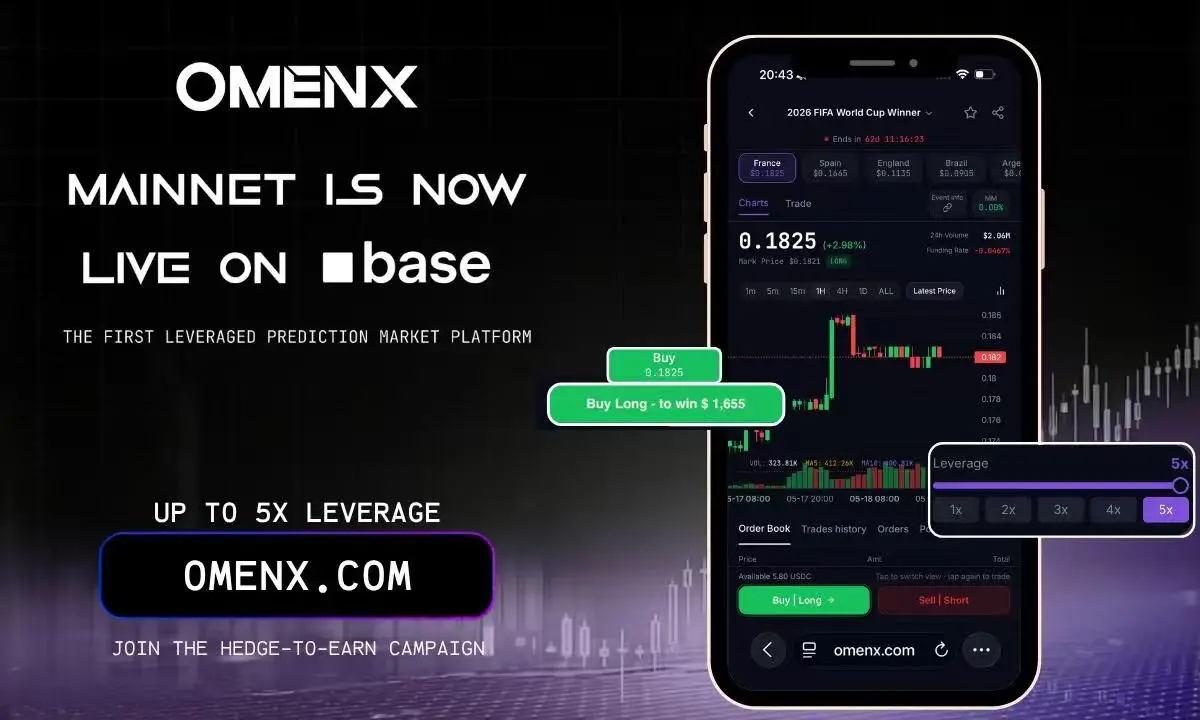
Base Native Leveraged Prediction Market OmenX Officially Launches on Mainnet

Base-native leveraged prediction market platform OmenX has officially launched on mainnet. It currently supports up to 5x leverage, with plans to increase to 10x based on platform liquidity and market conditions. Unlike traditional prediction markets where users fully collateralize YES/NO positions and wait for settlement, OmenX aims to create a trading platform-like experience. Users can open leveraged positions on event outcomes, and actively trade, adjust, or hedge these positions before the event concludes for greater capital efficiency. Alongside the mainnet launch, OmenX introduced a "Hedge-to-Earn" campaign targeting existing users of other prediction markets (initially Polymarket). This initiative allows users to claim incentives or hedging benefits on OmenX based on their existing positions, aiming to introduce them to leveraged trading and active risk management. OmenX positions itself as a derivatives trading platform for prediction market assets. The team believes that as platforms like Polymarket mainstream prediction markets, event outcomes are becoming a new tradable asset class. The next phase of demand will focus on leverage, liquidity, and advanced trading tools. Post-launch, OmenX plans to expand supported market types, optimize liquidity, and develop APIs and additional trading tools. The team is also in discussions with investors and partners to secure resources for further development.

链捕手Hace 1 hora(s)

Base Native Leveraged Prediction Market OmenX Officially Launches on Mainnet

链捕手Hace 1 hora(s)

Trading

Spot
Futuros

Artículos destacados

Qué es BITCOIN

Entendiendo HarryPotterObamaSonic10Inu (ERC-20) y Su Posición en el Espacio Cripto En los últimos años, el mercado de criptomonedas ha sido testigo de un aumento en la popularidad de las monedas meme, capturando el interés no solo de los comerciantes, sino también de aquellos que buscan compromiso comunitario y valor de entretenimiento. Entre estos tokens únicos se encuentra HarryPotterObamaSonic10Inu (ERC-20), un proyecto intrigante que mezcla referencias culturales en el tejido de las criptomonedas. Este artículo profundiza en los aspectos clave de HarryPotterObamaSonic10Inu, explorando sus mecanismos, ethos impulsado por la comunidad y su relación con el paisaje cripto más amplio. ¿Qué es HarryPotterObamaSonic10Inu (ERC-20)? Como su nombre sugiere, HarryPotterObamaSonic10Inu es una moneda meme construida sobre la blockchain de Ethereum, clasificada bajo el estándar ERC-20. A diferencia de las criptomonedas tradicionales que pueden enfatizar la utilidad práctica o el potencial de inversión, este token prospera en el valor de entretenimiento y la fuerza de su comunidad. El proyecto tiene como objetivo fomentar un entorno donde los usuarios comprometidos puedan reunirse, compartir ideas y participar en actividades inspiradas por diversos fenómenos culturales. Una característica notable de HarryPotterObamaSonic10Inu es su cero impuestos en las transacciones. Este atractivo elemento tiene como objetivo incentivar el comercio y la participación comunitaria, sin cargos adicionales que puedan disuadir a los comerciantes de pequeña escala. El suministro total de la moneda está establecido en mil millones de tokens, una cifra que marca su intención de mantener una circulación sustancial dentro de la comunidad. Creador de HarryPotterObamaSonic10Inu (ERC-20) Los orígenes de HarryPotterObamaSonic10Inu están algo envueltos en misterio; los detalles sobre el creador siguen siendo desconocidos. El desarrollo de este token carece de un equipo identificable o de un plan explícito, lo cual no es inusual dentro del sector de monedas meme. En cambio, el proyecto ha surgido de manera orgánica, con su progreso muy dependiente del entusiasmo y la participación de su comunidad. Inversores de HarryPotterObamaSonic10Inu (ERC-20) En cuanto a inversiones externas y respaldo, HarryPotterObamaSonic10Inu también sigue siendo ambiguo. El token no lista ninguna fundación de inversión conocida o apoyo organizacional significativo. En cambio, la savia del proyecto es su comunidad de base, que informa su crecimiento y sostenibilidad a través de la acción colectiva y el compromiso en el espacio cripto. ¿Cómo Funciona HarryPotterObamaSonic10Inu (ERC-20)? Como una moneda meme, HarryPotterObamaSonic10Inu opera principalmente fuera de los marcos tradicionales que a menudo rigen el valor de los activos. Hay varios aspectos distintivos que definen cómo funciona el proyecto: Transacciones Sin Impuestos: Sin tarifas impositivas en las transacciones, los usuarios pueden comprar y vender el token libremente sin preocuparse por costos ocultos. Compromiso Comunitario: El proyecto prospera en la interacción comunitaria, aprovechando plataformas de redes sociales para crear entusiasmo y facilitar la participación. Las discusiones, el intercambio de contenido y el compromiso son elementos cruciales que ayudan a expandir su alcance y fomentar la lealtad entre los seguidores. Sin Utilidad Práctica: Cabe señalar que HarryPotterObamaSonic10Inu no ofrece utilidad concreta dentro del ecosistema financiero. Más bien, se clasifica como un token principalmente para actividades de entretenimiento y comunitarias. Referencia Cultural: El token incorpora astutamente elementos de la cultura popular para atraer interés, conectando con entusiastas de los memes y seguidores de las criptomonedas por igual. HarryPotterObamaSonic10Inu ejemplifica cómo las monedas meme operan de manera diferente a los proyectos de criptomonedas más tradicionales, ingresando al mercado como construcciones sociales innovadoras en lugar de activos utilitarios. Cronología de HarryPotterObamaSonic10Inu (ERC-20) La historia de HarryPotterObamaSonic10Inu está marcada por varios hitos notables: Creación: El token surgió de un meme viral, capturando la imaginación de muchos entusiastas de las criptomonedas. Las fechas específicas de creación no están disponibles, subrayando su ascenso orgánico. Listado en Exchanges: HarryPotterObamaSonic10Inu ha llegado a varios exchanges, permitiendo un acceso y comercio más fácil por parte de la comunidad. Iniciativas de Compromiso Comunitario: Actividades continuas destinadas a mejorar la interacción comunitaria, incluyendo concursos, campañas en redes sociales y generación de contenido por parte de fanáticos y defensores. Planes de Expansión Futuros: La hoja de ruta del proyecto incluye el lanzamiento de una colección de NFT, mercancía y un sitio de comercio electrónico relacionado con sus temas culturales, involucrando aún más a la comunidad e intentando añadir más dimensiones a su ecosistema. Puntos Clave Sobre HarryPotterObamaSonic10Inu (ERC-20) Naturaleza Impulsada por la Comunidad: El proyecto prioriza la participación colectiva y la creatividad, asegurando que la involucración de los usuarios esté a la vanguardia de su desarrollo. Clasificación como Moneda Meme: Representa la epítome de las criptomonedas basadas en el entretenimiento, diferenciándose de los vehículos de inversión tradicionales. Sin Afiliación Directa con Bitcoin: A pesar de la similitud en el nombre del ticker, HarryPotterObamaSonic10Inu es distinto y no tiene relación con Bitcoin u otras criptomonedas establecidas. Enfoque en la Colaboración: HarryPotterObamaSonic10Inu está diseñado para crear un espacio para la colaboración y el intercambio de historias entre sus poseedores, proporcionando una vía para la creatividad y el vínculo comunitario. Perspectivas Futuras: La ambición de expandirse más allá de su premisa inicial hacia NFTs y mercancías describe un camino para que el proyecto potencialmente ingrese a avenidas más tradicionales dentro de la cultura digital. A medida que las monedas meme continúan capturando la imaginación de la comunidad de criptomonedas, HarryPotterObamaSonic10Inu (ERC-20) se destaca debido a sus lazos culturales y su enfoque centrado en la comunidad. Si bien puede no encajar en el molde típico de un token impulsado por la utilidad, su esencia radica en la alegría y la camaradería fomentadas entre sus seguidores, destacando la naturaleza en evolución de las criptomonedas en una era cada vez más digital. A medida que el proyecto continúa desarrollándose, será importante observar cómo las dinámicas comunitarias influyen en su trayectoria en el cambiante paisaje de la tecnología blockchain.

1.5k Vistas totalesPublicado en 2024.04.01Actualizado en 2024.12.03

Qué es BITCOIN

Cómo comprar BTC

¡Bienvenido a HTX.com! Hemos hecho que comprar Bitcoin (BTC) sea simple y conveniente. Sigue nuestra guía paso a paso para iniciar tu viaje de criptos.Paso 1: crea tu cuenta HTXUtiliza tu correo electrónico o número de teléfono para registrarte y obtener una cuenta gratuita en HTX. Experimenta un proceso de registro sin complicaciones y desbloquea todas las funciones.Obtener mi cuentaPaso 2: ve a Comprar cripto y elige tu método de pagoTarjeta de crédito/débito: usa tu Visa o Mastercard para comprar Bitcoin (BTC) al instante.Saldo: utiliza fondos del saldo de tu cuenta HTX para tradear sin problemas.Terceros: hemos agregado métodos de pago populares como Google Pay y Apple Pay para mejorar la comodidad.P2P: tradear directamente con otros usuarios en HTX.Over-the-Counter (OTC): ofrecemos servicios personalizados y tipos de cambio competitivos para los traders.Paso 3: guarda tu Bitcoin (BTC)Después de comprar tu Bitcoin (BTC), guárdalo en tu cuenta HTX. Alternativamente, puedes enviarlo a otro lugar mediante transferencia blockchain o utilizarlo para tradear otras criptomonedas.Paso 4: tradear Bitcoin (BTC)Tradear fácilmente con Bitcoin (BTC) en HTX's mercado spot. Simplemente accede a tu cuenta, selecciona tu par de trading, ejecuta tus trades y monitorea en tiempo real. Ofrecemos una experiencia fácil de usar tanto para principiantes como para traders experimentados.

4.9k Vistas totalesPublicado en 2024.12.12Actualizado en 2025.03.21

Cómo comprar BTC

Qué es $BITCOIN

ORO DIGITAL ($BITCOIN): Un Análisis Integral Introducción al ORO DIGITAL ($BITCOIN) ORO DIGITAL ($BITCOIN) es un proyecto basado en blockchain que opera en la red Solana, cuyo objetivo es combinar las características de los metales preciosos tradicionales con la innovación de las tecnologías descentralizadas. Aunque comparte un nombre con Bitcoin, a menudo referido como “oro digital” debido a su percepción como un refugio de valor, ORO DIGITAL es un token separado diseñado para crear un ecosistema único dentro del paisaje Web3. Su meta es posicionarse como un activo digital alternativo viable, aunque los detalles sobre sus aplicaciones y funcionalidades aún están en desarrollo. ¿Qué es ORO DIGITAL ($BITCOIN)? ORO DIGITAL ($BITCOIN) es un token de criptomoneda diseñado explícitamente para su uso en la blockchain de Solana. A diferencia de Bitcoin, que proporciona un papel de almacenamiento de valor ampliamente reconocido, este token parece centrarse en aplicaciones y características más amplias. Aspectos notables incluyen: Infraestructura Blockchain: El token está construido sobre la blockchain de Solana, conocida por su capacidad para manejar transacciones de alta velocidad y bajo costo. Dinámicas de Suministro: ORO DIGITAL tiene un suministro máximo limitado a 100 cuatrillones de tokens (100P $BITCOIN), aunque los detalles sobre su suministro circulante no se han divulgado actualmente. Utilidad: Si bien las funcionalidades precisas no están delineadas explícitamente, hay indicios de que el token podría ser utilizado para diversas aplicaciones, potencialmente involucrando aplicaciones descentralizadas (dApps) o estrategias de tokenización de activos. ¿Quién es el Creador de ORO DIGITAL ($BITCOIN)? En la actualidad, la identidad de los creadores y el equipo de desarrollo detrás de ORO DIGITAL ($BITCOIN) sigue siendo desconocida. Esta situación es típica entre muchos proyectos innovadores dentro del espacio blockchain, particularmente aquellos alineados con las finanzas descentralizadas y fenómenos de monedas meme. Si bien tal anonimato puede fomentar una cultura impulsada por la comunidad, intensifica las preocupaciones sobre la gobernanza y la responsabilidad. ¿Quiénes son los Inversores de ORO DIGITAL ($BITCOIN)? La información disponible indica que ORO DIGITAL ($BITCOIN) no tiene patrocinadores institucionales conocidos ni inversiones destacadas de capital de riesgo. El proyecto parece operar en un modelo de peer-to-peer centrado en el apoyo y la adopción de la comunidad en lugar de rutas de financiamiento tradicionales. Su actividad y liquidez se sitúan principalmente en intercambios descentralizados (DEX), como PumpSwap, en lugar de plataformas de trading centralizadas establecidas, lo que resalta aún más su enfoque de base. Cómo Funciona ORO DIGITAL ($BITCOIN) Los mecanismos operativos de ORO DIGITAL ($BITCOIN) pueden elaborarse en función de su diseño blockchain y atributos de red: Mecanismo de Consenso: Al aprovechar el único proof-of-history (PoH) de Solana combinado con un modelo de proof-of-stake (PoS), el proyecto asegura una validación de transacciones eficiente que contribuye al alto rendimiento de la red. Tokenómica: Si bien los mecanismos deflacionarios específicos no se han detallado extensamente, el vasto suministro máximo de tokens implica que podría atender microtransacciones o casos de uso nicho que aún están por definirse. Interoperabilidad: Existe el potencial de integración con el ecosistema más amplio de Solana, incluyendo varias plataformas de finanzas descentralizadas (DeFi). Sin embargo, los detalles sobre integraciones específicas permanecen no especificados. Cronología de Eventos Clave Aquí hay una cronología que destaca hitos significativos relacionados con ORO DIGITAL ($BITCOIN): 2023: El despliegue inicial del token ocurre en la blockchain de Solana, marcado por su dirección de contrato. 2024: ORO DIGITAL gana visibilidad al estar disponible para trading en intercambios descentralizados como PumpSwap, permitiendo a los usuarios comerciar contra SOL. 2025: El proyecto presencia actividad de trading esporádica y potencial interés en compromisos liderados por la comunidad, aunque no se han documentado asociaciones notables o avances técnicos hasta el momento. Análisis Crítico Fortalezas Escalabilidad: La infraestructura subyacente de Solana soporta altos volúmenes de transacciones, lo que podría mejorar la utilidad de $BITCOIN en varios escenarios de transacción. Accesibilidad: El potencial bajo precio de trading por token podría atraer a inversores minoristas, facilitando una participación más amplia debido a oportunidades de propiedad fraccionada. Riesgos Falta de Transparencia: La ausencia de patrocinadores, desarrolladores o un proceso de auditoría conocidos públicamente puede generar escepticismo sobre la sostenibilidad y confiabilidad del proyecto. Volatilidad del Mercado: La actividad de trading depende en gran medida del comportamiento especulativo, lo que puede resultar en una volatilidad de precios significativa y en incertidumbre para los inversores. Conclusión ORO DIGITAL ($BITCOIN) surge como un proyecto intrigante pero ambiguo dentro del ecosistema de Solana en rápida evolución. Si bien intenta aprovechar la narrativa del “oro digital”, su alejamiento del papel establecido de Bitcoin como refugio de valor subraya la necesidad de una diferenciación más clara de su utilidad y estructura de gobernanza previstas. La aceptación y adopción futura dependerán probablemente de abordar la actual opacidad y de definir sus estrategias operativas y económicas de manera más explícita. Nota: Este informe abarca información sintetizada disponible hasta octubre de 2023, y pueden haber ocurrido desarrollos más allá del período de investigación.

83 Vistas totalesPublicado en 2025.05.13Actualizado en 2025.05.13

Qué es $BITCOIN

Discusiones

Bienvenido a la comunidad de HTX. Aquí puedes mantenerte informado sobre los últimos desarrollos de la plataforma y acceder a análisis profesionales del mercado. A continuación se presentan las opiniones de los usuarios sobre el precio de BTC (BTC).

活动图片