Crypto Watchlist: 5 Things To Monitor This Week

bitcoinistPublicado a 2026-03-02Actualizado a 2026-03-02

Resumen

Crypto markets face a mix of geopolitical and product catalysts this week. Bitcoin remains the key macro watch, rebounding after an initial dip from U.S.-Iran tensions, with traders assess whether the conflict will escalate or fade. Oil price movements are being monitored for inflation and rate implications. On the product side, Starknet is launching strkBTC, a privacy-optional wrapped Bitcoin. Polygon’s March 4 upgrade will recycle gas fees to subsidize machine-to-machine payments. Avalanche begins its Retro9000 incentive round on March 2, shifting focus to rewarding most-used projects. The week concludes with the U.S. jobs report on March 6, which could reset interest rate expectations. Overall, macro factors like geopolitical risk and economic data may drive sharp market swings. The total crypto market cap stood at $2.25 trillion.

Crypto heads into the week of March 2 with five clear catalysts on deck: a worsening US-Iran conflict under President Donald Trump, a privacy-focused Bitcoin wrapper from Starknet, Polygon’s March 4 agentic-payments gas upgrade, Avalanche’s new incentive round, and Friday’s US jobs report.

Crypto Watchlist For This Week

Bitcoin is still the biggest macro watch this week, but the setup has already changed. The initial war shock over the weekend pushed BTC down toward $63,000, yet that move did not hold. The token rebounded as high as $68,196 on Sunday and was back around $65,807 by European Monday morning, while broader reporting showed traders were already reassessing whether the conflict would become a lasting macro shock or a violent but temporary headline event.

Oil followed a similar pattern: Brent briefly surged to $82.37 before giving back part of the move and easing back into the upper-$70s, which matters because crypto traders are now watching inflation risk and rate expectations more than the initial geopolitical headline itself.

What matters now is not simply that Washington and Tehran are in open conflict, but that the political signals are mixed. Trump has said he is willing to talk to Iran’s “new leadership,” while the White House has also made clear that military operations are continuing.

At the same time, AP’s live coverage says Iranian leaders are publicly rejecting negotiations. For markets, that creates a more nuanced watch item than a straight risk-off story: if diplomacy starts to look credible and oil keeps fading from its highs, Bitcoin’s rebound may hold; if the war widens and energy markets tighten again, crypto is likely to trade under macro pressure first and narrative second.

On the product side, Starknet is preparing to roll out strkBTC, a wrapped Bitcoin asset issued on Starknet and redeemable for native BTC, with optional shielding for balances and transfers. The design matters because Starknet is not pitching privacy as mandatory. In its own words, “Privacy is available when needed. Transparency remains available when required for compliance.”

Polygon’s catalyst lands on March 4, when the Lisovo/LisovoPro hardfork is scheduled around block 83,756,500, with implementation of PIP-82 included in the release. The proposal would recycle up to $1 million in gas base fees spent on agentic-commerce transactions, a direct subsidy aimed at machine-to-machine payments. Polygon’s own proposal says the chain has attracted 20.3% of x402 transactions and 10.4% of total volume since the start of the year.

Avalanche’s watch item is the Retro9000 C-Chain Round, which starts on March 2 and draws from the Foundation’s $40 million Retro9000 funding pool. The key shift is methodological. Avalanche says the program is moving from rewarding who built to rewarding what gets used, with projects ranked by AVAX burned through smart-contract activity and the top 40 becoming eligible for rewards.

The cleanest scheduled macro event arrives on Friday, March 6, when the Bureau of Labor Statistics releases the February US employment report at 8:30 a.m. ET. Reuters expects payroll growth of 60,000 after January’s 130,000 gain, making the release an important test of whether the prior month was a false signal or the start of a firmer labor backdrop. For crypto, that report matters because it can quickly reset rate-cut expectations just as markets are trying to price geopolitical stress.

This leaves crypto focused mainly on macro. If Middle East risk keeps oil, the dollar and broader risk sentiment in motion, Bitcoin and the wider altcoin market could remain exposed to sharp headline-driven swings. But if US-Iran tensions cool, Friday’s jobs report may become the next major trigger, with markets likely to judge it through one question above all: whether it strengthens or weakens the case for Fed easing.

At press time, the total crypto market cap stood at $2.25 trillion.
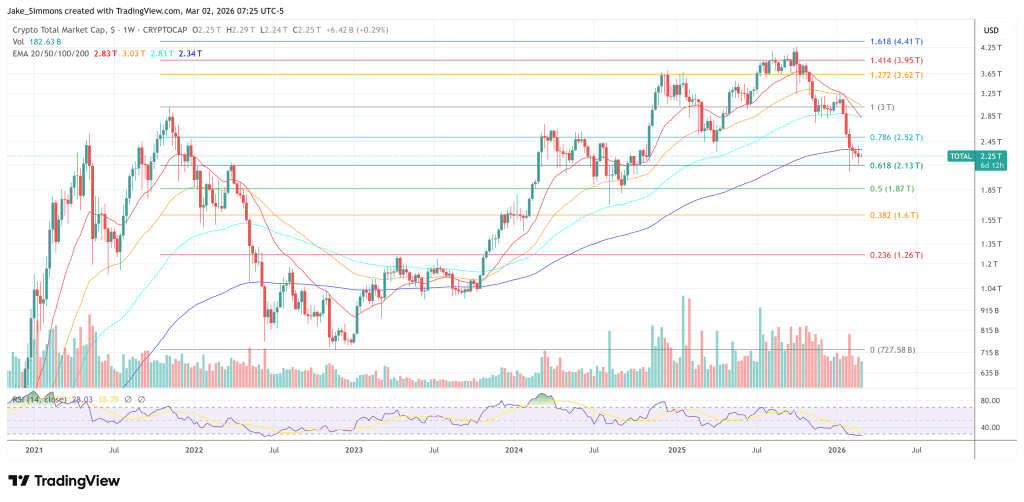
Total crypto market cap remains above the 0.618 Fib, 1-week chart | Source: TOTAL on TradingView.com

Preguntas relacionadas

QWhat are the five key catalysts for the crypto market this week as mentioned in the article?

AThe five catalysts are: a worsening US-Iran conflict, the launch of Starknet's strkBTC, Polygon's gas upgrade on March 4, Avalanche's new incentive round, and the US jobs report on Friday.

QHow did Bitcoin initially react to the US-Iran conflict over the weekend, and what was its price by European Monday morning?

AThe initial war shock pushed Bitcoin down toward $63,000, but it rebounded to as high as $68,196 on Sunday and was trading around $65,807 by European Monday morning.

QWhat is the key feature of Starknet's new strkBTC product?

AstrkBTC is a wrapped Bitcoin asset issued on Starknet that is redeemable for native BTC, with optional privacy shielding for balances and transfers, meaning privacy is available when needed but transparency remains for compliance.

QWhat is the purpose of Polygon's March 4 upgrade, and what specific feature does it implement?

AThe purpose of the upgrade is to implement agentic-payments through the Lisovo hardfork, which includes PIP-82. This proposal recycles up to $1 million in gas base fees spent on agentic-commerce transactions to directly subsidize machine-to-machine payments.

QHow does the Avalanche Retro9000 C-Chain Round differ from previous incentive programs?

AThe key methodological shift is that it moves from rewarding 'who built' to rewarding 'what gets used.' Projects are ranked by the amount of AVAX burned through smart-contract activity, with the top 40 becoming eligible for rewards from the $40 million funding pool.

Lecturas Relacionadas

Participants in XRP Fraud Scheme That Stole $9 Million from 71 Investors Arrested

South Korean police have arrested three individuals accused of operating a fraudulent investment platform that stole approximately 3.4 million XRP (worth about $9 million) from 71 investors between October 16 and 23. The suspects promoted the site Fxrpntwork.com through blogs, online articles, and YouTube videos, promising guaranteed principal and monthly returns of 1.5% to 1.8%. Investors were instructed to transfer XRP from Korean exchanges to overseas platforms and then to wallets controlled by the group before the site was shut down. The scammers copied the branding of legitimate projects Flare Network and FXRP to appear credible. Authorities warn that such impersonation frauds, which use familiar branding and urgent promises of guaranteed profits, are a common red flag. Legitimate companies do not solicit cryptocurrency transfers through unsolicited promotions. Seoul police have issued an Interpol Red Notice for a fourth suspect abroad and are investigating others involved in creating and promoting the fraudulent website. While investigators froze 17.3 billion won in assets, approximately 10 billion won was moved during the probe, with wallet analysis revealing transfers totaling 27.3 billion won, suggesting there may be additional unidentified victims and accomplices. The case underscores the organized, cross-border nature of crypto investment fraud.

cryptonews.ruHace 4 min(s)

Participants in XRP Fraud Scheme That Stole $9 Million from 71 Investors Arrested

cryptonews.ruHace 4 min(s)

Within Strategy's Framework, STRC's Dividend Yield Remains at 12% as Share Price Stays Below Par Value

Michael Saylor, Executive Chairman of Strategy (MSTR), confirmed that the dividend rate for its STRC perpetual preferred shares will remain at 12.00% through August 2026. The rate has increased from 9% at its July 2025 launch to the current high via a "ratchet" mechanism, which permanently raises the rate by 0.5% whenever the share price falls below $95. This mechanism is intended to push the price back toward its $100 par value and support Strategy's "at-the-market" (ATM) program for issuing new shares to fund Bitcoin purchases. However, the mechanism has not worked as intended. STRC shares closed at $89.46 on July 31, remaining about 10-11% below par value despite the record-high dividend. Competition from rival Strive's higher-yielding SATA securities has pressured demand. The persistent discount has forced Strategy to suspend new STRC issuances via its ATM program, limiting this funding channel for Bitcoin acquisitions. STRC's struggles reflect Bitcoin's own volatility, as the preferred shares historically move in tandem. Analysts have warned the ratchet structure carries long-term, one-way risk. A law firm is investigating Strategy's ability to maintain dividend payments if Bitcoin's price stays low. Retail investors own roughly 83% of outstanding STRC shares, a group seen as prone to panic selling during downturns. In response, Strategy has established financial reserves, including a liquidity cushion covering about 26 months of dividend/interest obligations, and a $2 billion share buyback program alongside a Bitcoin monetization framework, though the company emphasized it is not obligated to sell any Bitcoin.

cryptonews.ruHace 43 min(s)

Within Strategy's Framework, STRC's Dividend Yield Remains at 12% as Share Price Stays Below Par Value

cryptonews.ruHace 43 min(s)

Trading

Spot
活动图片