Crypto Treasury Firms Face $15B Selling Pressure From MSCI Decision

bitcoinistPublicado a 2025-12-19Actualizado a 2025-12-19

Resumen

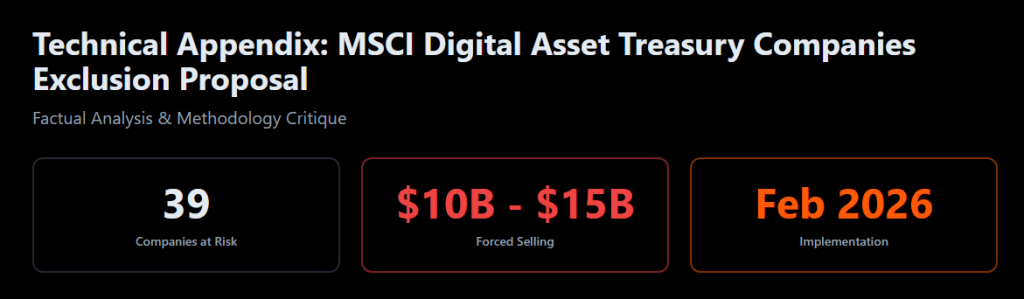
Analysts estimate that passive funds could pull between $10 billion and $15 billion from companies holding significant crypto assets if MSCI proceeds with a proposed rule change. The index provider is reviewing a policy to exclude firms holding over 50% of their assets in digital currencies from its benchmarks, a decision expected by January 2026. If enacted, index-tracking funds would be forced to sell shares of affected companies. JPMorgan analysis singles out MicroStrategy as the most impacted, potentially facing $2.8 billion in outflows. Beyond stock sales, there is a risk the companies themselves might liquidate crypto holdings, adding direct selling pressure to both equity and crypto markets. Industry groups are pushing back against the proposal, arguing for an operations-based classification instead.

Analysts have calculated that passive funds could pull as much as $11.6 billion from companies that treat large crypto holdings as corporate treasuries if MSCI removes them from its indexes, a move that would force index-tracking vehicles to sell shares.

Reports say that number comes from adding direct MSCI-tracked outflows to possible follow-on selling by other index providers.

Estimated Outflows Range

The figure sits inside a wider band of estimates. Some analysts and press pieces put the possible damage anywhere between $10 billion and $15 billion, depending on whether other major index providers copy MSCI’s decision and how much passive money is forced to move.

The analysis that produced these numbers looked at roughly 39 listed companies that meet MSCI’s proposed definition of a digital-asset treasury firm.

BTCUSD now trading at $87,105. Chart: TradingView

MSCI’s Proposal And The Mechanics

According to MSCI’s own consultation documents, the index provider is reviewing a rule that would treat companies holding more than 50% of their assets in digital assets as non-constituents of its broad equity indexes.

MSCI extended the consultation through December and said it expects to announce conclusions by January 15, 2026, with any changes applied in the February 2026 index review. If a firm is removed, funds that track MSCI benchmarks typically must reduce or sell their stakes automatically.

Strategy Stands Out

JPMorgan’s work has been singled out in multiple reports. According to that note, Strategy alone could face about $2.8 billion in passive outflows if removed from MSCI indexes, and larger losses if other index families follow.

Analysts say Strategy’s unique position — with a very high share of its balance sheet in Bitcoin — makes it the single biggest driver of the total outflow math.

Risk To Crypto Holdings

Some sectors warn that, beyond stock selling, the companies themselves might liquidate crypto positions to meet margin or liquidity needs, which could push crypto asset sales toward a figure as high as $15 billion in the worst scenarios. That would add direct selling pressure to both the equities and crypto markets.
Source: Bitcoin for Corporations

Industry Pushback

Based on reports, a group named Bitcoin For Corporations, along with several affected firms, pushed back, saying the MSCI test relies on a single balance-sheet threshold that doesn’t reflect how these companies actually operate.

The campaign has drawn public comments and petitions; several reports put the signature count at about 1,200 to 1,300. Companies have filed feedback with MSCI and have argued for an operations-based classification instead of a holdings-based cut-off.

Featured image from Unsplash, chart from TradingView

Preguntas relacionadas

QWhat is the estimated amount of selling pressure that crypto treasury firms could face due to MSCI's proposed rule change?

AAnalysts estimate that crypto treasury firms could face selling pressure ranging from $10 billion to $15 billion.

QWhat is the specific threshold in MSCI's proposal that would cause a company to be excluded from its indexes?

AMSCI's proposal would treat companies holding more than 50% of their assets in digital assets as non-constituents of its broad equity indexes.

QWhich company is singled out as the single biggest driver of the total outflow math and why?

AMicroStrategy is singled out as the biggest driver due to its unique position with a very high share of its balance sheet in Bitcoin, potentially facing about $2.8 billion in passive outflows.

QBeyond stock selling, what additional risk to the crypto market is highlighted in the article?

AThe article warns that the companies themselves might be forced to liquidate their crypto positions to meet margin or liquidity needs, which could add direct selling pressure to the crypto market.

QWhat is the main argument made by the industry group 'Bitcoin For Corporations' against MSCI's proposal?

AThe group argues that the MSCI test relies on a single balance-sheet threshold that doesn't reflect how these companies actually operate, and they have advocated for an operations-based classification instead.

Lecturas Relacionadas

IREN's Insanity: Selling Miners, Buying GPUs, Stock Price Up 16%

IREN, a Bitcoin mining company, saw its stock price surge 16% after releasing its quarterly earnings on May 8th. The surge was not driven by Bitcoin's price, but by the company's radical strategic shift away from cryptocurrency mining and towards AI infrastructure. The company reported a $140 million impairment charge after decommissioning and listing for sale 5,800 of its Bitmain S21 Pro mining rigs. It also maintains a policy of selling all mined Bitcoin daily, holding zero crypto assets. Despite this dismantling of its core business, investor sentiment was positive due to IREN's aggressive pivot into AI. This shift is backed by massive, long-term contracts. IREN announced a new 5-year, $3.4 billion collaboration with NVIDIA, which includes an equity investment commitment. This follows a previously secured 5-year, $9.7 billion GPU cloud services agreement with Microsoft. To support these deals, IREN acquired European data center capacity and cloud software capabilities. Management targets 480 megawatts of AI capacity, 150,000 GPUs, and $3.7 billion in annual recurring revenue by late 2026. While other North American miners are exploring hybrid "mining + AI" models, IREN is making a clean break, betting entirely on the booming demand for AI compute power. The move highlights a broader industry trend where the value of mining hardware is declining while GPU-based AI infrastructure is in critically short supply.

marsbitHace 41 min(s)

IREN's Insanity: Selling Miners, Buying GPUs, Stock Price Up 16%

marsbitHace 41 min(s)

Trading

Spot
Futuros
活动图片





