Crypto Traders On Edge As Korea Stalls Key Law — Is The “Kimchi Premium” At Risk Next?

bitcoinistPublicado a 2026-04-03Actualizado a 2026-04-03

Resumen

The National Policy Committee of Korea has delayed the debate on the "second-phase" crypto framework until after the June local elections, creating uncertainty in the industry. The proposed Digital Asset Basic Act was excluded from the legislative agenda, despite its importance in regulating stablecoins and exchange ownership. Two major conflicts are stalling progress: first, a dispute between the Bank of Korea and the Financial Services Commission (FSC) over whether banks must hold a 51% stake in won-denominated stablecoin issuers. The FSC opposes this, arguing it would exclude tech firms and exchanges. Second, there is disagreement over equity caps for crypto exchanges, with proposals to limit major shareholders to 20%, affecting giants like Upbit and Bithumb. The delay leaves KRW stablecoin issuers in a gray zone and increases operational costs. Post-election, a bank-heavy stablecoin framework and tighter rules could favor large incumbents, reshaping market liquidity and altcoin listings. Weakening these rules could signal greater openness for crypto in Korea.

The National Policy Committee of Korea pushed the “second‐phase” crypto act debate until after the June 3 local elections.

Crypto Framework Postponed In A Time Of Need

The Korean outlet Maeil Business Newspaper reported uncertainty in the crypto industry deepening after the National Policy Committee excluded the Framework Act on Digital Assets from the 31st of March agenda.

Lawmakers sent five finance-related bills to the subcommittee that day: the Framework Act on Administrative Regulation, the Credit Information Protection Act, the Microfinance Support Act, the Insurance Business Act, and the Capital Markets Act. Not a single bill related to crypto was included, but the Political Affairs Committee’s plenary session received Representative Kim Nam-geun’s “Partial Amendment to the Act on the Protection of Virtual Asset Users, etc.” and forwarded it to the Bill Review Subcommittee.

Lawmakers opted to park the second‐phase bill during a sensitive election window rather than ram through divisive provisions on banks and exchange tycoons, which have become “core landmines” in the legislative process. Speculation in Korean political coverage suggest that the presidential office and the Financial Services Commission (FSC) are not fully aligned on how far to push ownership caps and how tightly to ring‐fence stablecoin issuance, adding to the deadlock narrative.

The proposed crypto framework comes at a time of major importance, as the aforementioned political disagreements also happen to be the two key fights occurring between major players in the Korean cryptocurrency and financial industry.

The Stablecoins Fight

South Korea has recently seen a tug‐of‐war between The Bank of Korea and the FSC over who gets to issue won‐denominated stablecoins.

The BOK is pushing for a bank‐led consortium model where commercial banks must hold at least 51% of any issuer of won‐denominated stablecoins. Bitcoinist reported this on October last year.

The FSC, however, accepts that stablecoins need strict safeguards but opposes a hard 51% bank‐ownership rule, warning it would lock out tech platforms, fintechs and exchanges that actually build the user‐facing products.

These stablecoin-issuers rules are to be hard‐wired under the Digital Asset Basic Act, so every month of delay leaves existing and would‐be KRW stablecoin issuers operating in a gray zone or stuck on the sidelines. According to local outlet Aju Economy, this is a real and concerning issue for the industry. They reported on and industry insider lament:

We need the bill to be finalized quickly to determine our business direction, but currently, we are keeping all possibilities open, which is only increasing the cost burden.

The Equity-Cap Fight

The FSC has been backing proposals to treat big crypto exchanges more like securities or ATS‐style markets, where no single “same person” can own beyond roughly 15–20% in principle. After heavy pushback, regulators and the ruling party have coalesced around a 20% ceiling for “major shareholders”, with a narrow exception that allows stakes up to 34% for new entrants, mirroring the 33.3% veto line in Korea’s Commercial Act. Bitcoinist covered the story at the beginning of the past month.

For existing giants like Upbit and Bithumb, this is a post‐facto rule. Founders and early backers already hold stakes well above 20%, so a hard cap would force them to sell down significant portions of their equity over a three‐year transition (six years for some smaller exchanges). This could potentially disrupt ongoing M&A and reshape control of the local market.

What This Means For The Market

South Korea seems ready to move from ad‐hoc crackdowns to a comprehensive crypto regime. This delay comes on top of recent moves from Seoul to step up oversight with strategies such as AI surveillance, manipulation probes and tax tracking, and to loosen some restrictions, like easing earlier exchange‐stake proposals and reconsidering corporate crypto trading.

Near term, rule uncertainty around KRW stablecoins and exchange ownership could keep Korean venues’ risk premia high and make local listing or market‐making plans harder to model. Post‐election, a bank‐heavy stablecoin framework plus tighter governance rules could favor well‐capitalized incumbents and banks over smaller, high‐beta platforms. This could reshape liquidity and altcoin listings.

Lawmakers watering down ownership caps or opening up stablecoin issuance beyond banks would be a clear risk‐on signal for KRW‐denominated products and for global firms eyeing Korea’s retail base.
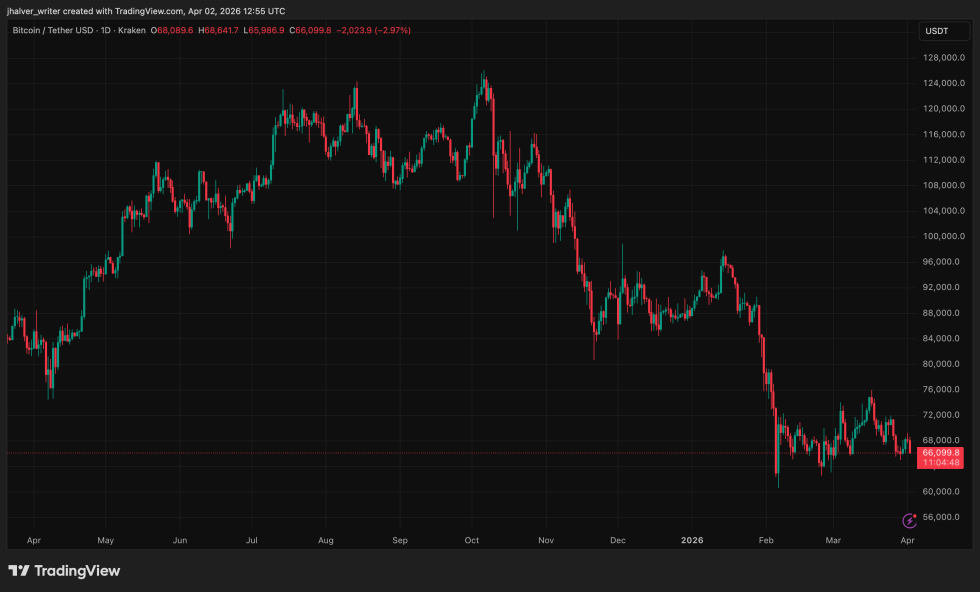
At the moment of writing, BTC trades for exactly $66k on the daily chart. Source: BTCUSDT on Tradingview.

Cover image from Perplexity. BTCUSDT chart from Tradingview.

Preguntas relacionadas

QWhy was the debate on the 'second-phase' crypto act in Korea postponed?

AThe National Policy Committee of Korea postponed the debate until after the June 3 local elections to avoid pushing through divisive provisions on banks and exchange tycoons during a sensitive election window.

QWhat are the two key disagreements causing a deadlock in the Korean crypto framework legislation?

AThe two key disagreements are over ownership caps for major shareholders of crypto exchanges and the regulatory approach for won-denominated stablecoin issuance, particularly between the Bank of Korea and the Financial Services Commission (FSC).

QHow does the Bank of Korea propose to regulate won-denominated stablecoin issuance?

AThe Bank of Korea is pushing for a bank-led consortium model where commercial banks must hold at least 51% of any issuer of won-denominated stablecoins.

QWhat ownership cap is being proposed for major shareholders of crypto exchanges in Korea?

ARegulators and the ruling party have coalesced around a 20% ceiling for major shareholders, with a narrow exception allowing stakes up to 34% for new entrants.

QWhat are the potential market implications of the delayed crypto legislation in Korea?

AThe delay could keep risk premia high for Korean venues, make local listing or market-making plans harder to model, and potentially reshape liquidity and altcoin listings depending on the final rules for stablecoins and exchange ownership.

Lecturas Relacionadas

Will the Next Crypto Bull Run Start with On-Chain Trading of SpaceX?

This article presents a scenario-based forecast for the crypto industry from 2026 to 2029, arguing that the next major cycle will be driven not by technological narratives but by legal access to real-world assets. The author predicts that by mid-2026, pre-IPO perpetual contracts for top private companies like SpaceX, OpenAI, and Anthropic on platforms like Hyperliquid will become the primary gateway for accessing quality assets, as most crypto-native tokens fail to capture real value. The much-hyped AI x Crypto intersection largely fails except for prediction markets, which thrive on betting on AI model supremacy. By 2027, public blockchain foundations are forced to choose between catering to retail speculation or building compliant infrastructure for institutions, with many opting for the latter. Growth in stablecoins and tokenized private credit/equity hits a "triple ceiling" due to regulatory and political uncertainty rather than market demand. The pivotal shift is forecast for 2028. A major liquidation event in pre-IPO perpetuals exposes the structural flaw of synthetic markets lacking a real underlying asset anchor. In response, regulatory changes finally allow the public solicitation of private securities resales to verified accredited investors. This creates a legitimate secondary market for real company equity, which then becomes the core asset class of the new bull market, relegating synthetic perps to a niche role. By 2029, the industry becomes "boring" but foundational. Tokens without claims on real cash flows or assets cease trading. Stablecoin growth is steady but politically capped. Crypto infrastructure fades from view as it gets absorbed into traditional finance backends. The article's central thesis is that the key bottleneck for crypto's next phase is legal and regulatory channels for real asset ownership, not technology.

marsbitHace 14 min(s)

Will the Next Crypto Bull Run Start with On-Chain Trading of SpaceX?

marsbitHace 14 min(s)

The Value Distribution of Stablecoins

**Summary: The Value Distribution of Stablecoins** The article argues that stablecoins are evolving from mere trading tools into broader channels for dollar access. It divides the stablecoin ecosystem into four layers to analyze how value is distributed: 1. **Issuance Layer:** Mints stablecoins, holds reserve assets, and captures the spread between reserve yield and user costs (e.g., Tether, Circle). This layer currently earns the largest profit margin. 2. **Infrastructure Layer:** Connects stablecoins to the traditional financial system, handling fiat on/off-ramps, banking integration, compliance (KYC/AML), and asset management (e.g., Bridge, BVNK). This is the "unglamorous" but critical work, building the essential bridges between crypto and real-world finance. 3. **Acquiring/Distribution Layer:** Integrates stablecoins into merchant systems, manages payment flows, and provides enterprise financial software (e.g., Stripe, Coinbase). They act as the access point for businesses. 4. **Application Layer:** The end-users and businesses that ultimately use stablecoins for payments, settlements, or as a store of value. They benefit from convenience but have little pricing power. The core thesis is that while the issuance layer currently dominates profits, the often-overlooked **infrastructure layer holds significant long-term potential**. The real challenge and barrier to mass adoption is not the on-chain transfer of stablecoins (which is simple), but the complex "last mile" integration into existing business workflows, banking systems, and regulatory frameworks across different countries. Companies in this layer are currently in a "land grab" phase, investing heavily to build networks, secure bank partnerships, and establish compliance pathways. While their position is currently pressured by the profitable issuers above and distribution platforms below, the article suggests that if stablecoins become a default financial rail for businesses, the infrastructure providers who have done the hard work of integration will ultimately gain strong pricing power and become entrenched, essential players.

marsbitHace 6 hora(s)

The Value Distribution of Stablecoins

marsbitHace 6 hora(s)

The Value Distribution of Stablecoins

The Value Distribution of Stablecoins The article argues that stablecoins are evolving from a mere trading tool into a broad "dollar channel." It analyzes the industry's value chain through four layers: 1. **Issuance Layer (e.g., Tether, Circle):** The top layer that mints stablecoins, holds reserve assets, and captures the thickest interest rate spread. 2. **Infrastructure Layer (e.g., Bridge, BVNK):** Connects stablecoins to the traditional financial system, handling critical but complex "dirty work" like fiat on/off-ramps, banking integration, compliance (KYC/AML), and cross-border settlement. 3. **Acquiring/Distribution Layer (e.g., Stripe, Coinbase):** Embeds stablecoins into merchant systems, manages payment flows, and integrates with enterprise software. 4. **Application Layer:** End-users and businesses that ultimately use stablecoins for payments, settlement, or storing value. The author posits that while the issuance layer currently captures the most profit, the most overlooked and potentially critical layer is infrastructure. The core challenge for stablecoin adoption isn't the on-chain transfer (which is simple), but bridging the gap between blockchain and the real-world financial system. This involves solving practical problems for businesses: fiat conversion, reconciliation, tax handling, and user onboarding. Infrastructure companies are currently in a difficult "land-grab" phase—building networks, securing banking relationships, and achieving compliance country-by-country. They face pressure from both the profitable issuance layer above and distribution platforms below. However, the author suggests this layer is building a crucial moat. Once stablecoins become a default business rail, the infrastructure players who have done the hard work of integration may gain significant, durable value and pricing power.

链捕手Hace 7 hora(s)

The Value Distribution of Stablecoins

链捕手Hace 7 hora(s)

Trading

Spot
Futuros

Artículos destacados

Cómo comprar EDGE

¡Bienvenido a HTX.com! Hemos hecho que comprar edgeX (EDGE) sea simple y conveniente. Sigue nuestra guía paso a paso para iniciar tu viaje de criptos.Paso 1: crea tu cuenta HTXUtiliza tu correo electrónico o número de teléfono para registrarte y obtener una cuenta gratuita en HTX. Experimenta un proceso de registro sin complicaciones y desbloquea todas las funciones.Obtener mi cuentaPaso 2: ve a Comprar cripto y elige tu método de pagoTarjeta de crédito/débito: usa tu Visa o Mastercard para comprar edgeX (EDGE) al instante.Saldo: utiliza fondos del saldo de tu cuenta HTX para tradear sin problemas.Terceros: hemos agregado métodos de pago populares como Google Pay y Apple Pay para mejorar la comodidad.P2P: tradear directamente con otros usuarios en HTX.Over-the-Counter (OTC): ofrecemos servicios personalizados y tipos de cambio competitivos para los traders.Paso 3: guarda tu edgeX (EDGE)Después de comprar tu edgeX (EDGE), guárdalo en tu cuenta HTX. Alternativamente, puedes enviarlo a otro lugar mediante transferencia blockchain o utilizarlo para tradear otras criptomonedas.Paso 4: tradear edgeX (EDGE)Tradear fácilmente con edgeX (EDGE) en HTX's mercado spot. Simplemente accede a tu cuenta, selecciona tu par de trading, ejecuta tus trades y monitorea en tiempo real. Ofrecemos una experiencia fácil de usar tanto para principiantes como para traders experimentados.

538 Vistas totalesPublicado en 2026.03.31Actualizado en 2026.06.02

Cómo comprar EDGE

Discusiones

Bienvenido a la comunidad de HTX. Aquí puedes mantenerte informado sobre los últimos desarrollos de la plataforma y acceder a análisis profesionales del mercado. A continuación se presentan las opiniones de los usuarios sobre el precio de EDGE (EDGE).

活动图片













