Crypto Traders On Alert: Is CLARITY The Last Chance To Protect Stablecoin Yield?

bitcoinistPublicado a 2026-04-14Actualizado a 2026-04-14

Resumen

A U.S. Senator is preparing to release a compromise draft of the CLARITY Act to resolve the ongoing dispute over stablecoin yields. The key issue is whether crypto firms can pay interest on idle stablecoin holdings, which banks oppose as it competes with traditional deposits. The draft aims to distinguish between prohibited passive yield and permitted activity-based rewards. This legislation will significantly impact stablecoin yields, liquidity, and where traders hold their capital, potentially affecting competition with foreign digital currencies and offshore platforms.

A U.S. Senator might unveil a “compromise draft” aimed at settling the crypto-stablecoin yield dispute in the forthcoming CLARITY Act.

Another Update On The Crypto Legislation

Republican U.S. Senator Thom Tillis (R-N.C.) claimed this Monday he aims to unveil a draft deal this week to break the stalemate over stablecoin yield between banks and crypto firms. According to Politico, he has been collaborating with Sen. Angela Alsobrooks (D‐Md.) on new CLARITY Act language designed to finally settle whether crypto companies can pay interest on idle stablecoin holdings.

According to the report, the text has already been shared with both banking groups and crypto firms. Banks still oppose key elements, the report says, and Tillis has left room for changes.

The already long-standing yield dispute is the main roadblock keeping the landmark CLARITY Act stuck in the Senate, even after the House passed its version last year. Although the GENIUS Act that was passed last year prohibits stablecoin issuers from paying interest directly to holders, it still allows third‐party platforms like exchanges to offer yield.

At the beginning of the month, Coinbase’s chief legal officer Paul Grenwal suggested that negotiators in the Senate were “very close” to a deal on the CLARITY Act’s most contentious crypto issue: the stablecoin yield.

The Stablecoin Yield Dispute

Let’s remember the dispute lays on the fact that yield-bearing stablecoins compete directly with traditional bank deposits because they offer dollar-denominated assets that can move instantly on-chain while still paying attractive returns, thus making them a compelling alternative to savings and money-market accounts.

Banks fear this could drain deposits that fund their lending and investment activities, especially from younger and more digitally native customers who are comfortable holding value in tokenized form. As a result, they push for strict limits or outright bans on interest-like payments to stablecoin holders, arguing that such products should be regulated like banking and that unchecked yield could undermine financial stability and their core funding base.

From the crypto side, however, yield on parked stablecoin balances is seen as a fundamental feature: it’s one of the main ways exchanges and DeFi platforms attract and retain users by turning idle cash into a revenue-generating product. These returns help differentiate on-chain dollars from traditional bank accounts, support token incentive programs, and deepen liquidity across lending markets, perpetuals, and automated market makers.

For many platforms, cutting off or sharply limiting stablecoin yield would hit their core business model, weaken DeFi integrations, and make it harder to compete for global capital that can move to more permissive jurisdictions with a few clicks.

What This Means For The Market

Lately, the emerging policy line seems to be in the direction of no “passive” yield for idle balances, but possible rewards tied to payments, transfers, and other “active use”. Tillis’ compromise draft is meant to codify around it, clarifying what counts as prohibited interest versus allowed activity-based rewards.

The way the U.S. defines stablecoin yield will shape dollar competition with foreign central bank digital currencies (CBDCs) and offshore stablecoin venues that still offer yield. U.S. exchanges may have to pivot to activity-based “rewards” and offshore platforms could attract yield-chasing capital.

Any final text will heavily influence stablecoin APY, liquidity, and where serious traders park their dry powder.
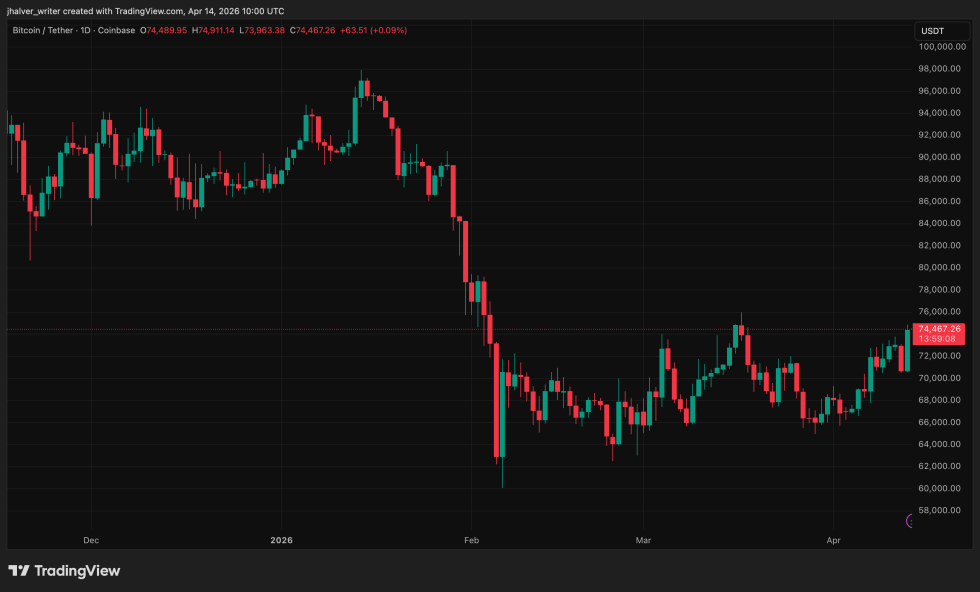
At the moment of writing, BTC trades for more than $74k on the daily chart. Source: BTCUSDT on Tradingview.

Cover image from Perplexity. BTCUSDT chart from Tradingview.

Preguntas relacionadas

QWhat is the main purpose of the upcoming 'compromise draft' in the CLARITY Act, according to Senator Thom Tillis?

AThe main purpose of the compromise draft is to break the stalemate over the stablecoin yield dispute between banks and crypto firms by clarifying whether crypto companies can pay interest on idle stablecoin holdings.

QWhy do traditional banks oppose yield-bearing stablecoins?

ABanks oppose them because they compete directly with traditional bank deposits by offering attractive returns on dollar-denominated assets that can move instantly on-chain. This could drain deposits that fund their lending and investment activities, especially from younger, digitally native customers.

QHow does the crypto industry view the ability to offer yield on stablecoins?

AThe crypto industry views yield on stablecoin balances as a fundamental feature. It is a primary way for exchanges and DeFi platforms to attract and retain users, turn idle cash into a revenue-generating product, differentiate from traditional banks, support token incentives, and deepen liquidity in various markets.

QWhat is the emerging policy direction for stablecoin yield as mentioned in the article?

AThe emerging policy direction seems to be against 'passive' yield for idle balances but allows for possible rewards that are tied to payments, transfers, and other forms of 'active use' of the stablecoins.

QWhat potential market impact could the CLARITY Act's final text have?

AThe final text will heavily influence stablecoin APY (Annual Percentage Yield), liquidity, and where serious traders park their capital. It could force U.S. exchanges to pivot to activity-based rewards and may lead yield-seeking capital to move to offshore platforms or impact competition with foreign CBDCs.

Lecturas Relacionadas

Can Generative Models Finally Be Trained End-to-End? The Core Is a For Loop

This article introduces a novel training paradigm for generative models called Explorative Modeling (XM), which enables true end-to-end training. Traditionally, powerful generative models like autoregressive and diffusion models are not trained end-to-end. They are trained to predict a single small step but require iterative multi-step sampling for inference. This "exposure bias" leads to error accumulation and limits performance. The core challenge XM addresses is "mode blurring." In generative tasks, a single input (e.g., "generate a dog") corresponds to many valid outputs (multiple modes). Standard training objectives like reconstruction loss force the model to average these modes, producing unrealistic, blurry outputs. To avoid this, existing models break generation into many small, almost deterministic steps, sacrificing end-to-end training. XM tackles this by restructuring the training loop itself. Its key insight is to amplify "generative expressivity." For each training input, instead of generating one sample, the model generates K candidate outputs. Only the candidate closest to the real data is used for computing the loss and updating the model via backpropagation. This simple "best-of-K" mechanism is implemented as a short for-loop. By exploring multiple possibilities, the model learns to distribute its guesses across different modes rather than collapsing to their uninformative average. The paper demonstrates that "exploration" acts as a new, powerful scaling axis. Gains from XM increase with model size, data scale, and compute. Experiments show improvements in FID scores for image generation and significant efficiency gains, sometimes outperforming larger models without exploration. When pushed to the limit, XM enables fully single-step, end-to-end generative models. In robotics tasks, an "Explorative Policy" matched the performance of a 100-step Diffusion Policy with a single forward pass, drastically improving inference speed. While the best-of-K concept is not entirely new, the authors' contribution lies in formally understanding it as a direct method to boost generative expressivity without fragmenting the generation process. This work suggests that as models scale, enhancing exploration during training may become crucial for overcoming fundamental performance bottlenecks.

marsbitHace 10 min(s)

Can Generative Models Finally Be Trained End-to-End? The Core Is a For Loop

marsbitHace 10 min(s)

Annual Salary of Millions Competing for Electricians, Meta Rushes to Open Its Own Technical School

The AI boom is facing an unexpected bottleneck: a severe shortage of skilled construction workers and electricians. As tech giants like Meta, OpenAI, and Alphabet race to build massive data centers—such as OpenAI's $16 billion "Stargate" project—they are hitting a critical labor wall. The U.S. needs an estimated 130,000 more electricians, 240,000 construction workers, and 150,000 supervisors by 2030 for AI infrastructure alone, but tens of thousands of electrician jobs go unfilled each year. While AI companies offer high premiums, with electricians earning up to $280,000 annually, worker scarcity still causes massive losses—delays on a single project can cost $14.2 million per month. The complexity of building AI data centers, which require immense power (equivalent to powering hundreds of thousands of homes), sophisticated electrical systems, and advanced liquid cooling solutions, demands highly skilled technicians who are in short supply. To combat this, companies are investing heavily in training. Meta has committed $115 million to a free training school offering tuition, housing, and stipends, targeting 5,000 new workers. OpenAI is partnering with unions to secure skilled labor. These efforts are paying off, with a significant rise in Gen Z interest in trade schools over college. However, the power demands are staggering. AI data centers are driving a rapid surge in electricity consumption, projected to account for up to 12% of U.S. power use by 2028 and raising costs for consumers. Furthermore, the construction boom is project-based, leading to a potential future glut of trained workers once building peaks, which could depress wages industry-wide. The race for AI supremacy now depends as much on skilled hands as on advanced chips.

marsbitHace 1 hora(s)

Annual Salary of Millions Competing for Electricians, Meta Rushes to Open Its Own Technical School

marsbitHace 1 hora(s)

Trading

Spot
活动图片





